Silicon Valley Technology Commentary & Archives · Est. 2006 3,045 Posts · 2006–2026
Showing posts with label Data (26 posts). Show all posts

October 13, 2014

October 13, 2014 · 3 MIN READ · BY LOUIS GRAY

Cloud Powered Near Instant PC, Mobile Upgrades Are the New Reality

Cloud Powered Near Instant PC, Mobile Upgrades Are the New Reality

Buying a new computer or getting a new phone used to be a huge pain. Even if everything was up and running right away, you had to plan for hours, or even days, of moving all your data from the old device to the new one. And if you didn’t successfully complete the data migration, or had sufficient paranoia, you could end up with old devices cluttering your home - just in case you might need to get that old content. But with so much of our data moving from local disks to the cloud, and new operating systems improving their sync and account setup, the day of hot swapping devices is here.

As you know, for the past few years, our home has been a ChromeOS and Android family. This started well before I joined Google, and as each OS gets smarter, that move looks to have been the right one - especially when it comes to this issue.

Samsung's 2012 Chromebook Got Bumped for the 2014 HP.


Last week, thanks to a sale on Woot.com, I purchased a new HP 14 inch Chromebook for my wife. One evening, as she was using the 2012-era 11 inch Samsung Chromebook, I told her to close her eyes. I took her old laptop and put the new one in her lap, and when she signed in, she didn’t miss a beat. All her bookmarks were there, even down to the tabs she had open in her browser. With one move, and for the same $200 or so I spent two years ago, she got a faster device, double the RAM, and a larger, more vibrant screen, with no headaches around data.

There was no question of whether she had to back up photos, or copy her songs. No dragging and dropping off folders and documents. It just worked, exactly as I had expected it to. And the next morning, when she had to print to our networked printer, she just told the browser to print, and the printer was listening. No printer drivers, and not even a memory of a CD-Rom or DVD. It just worked.


Meanwhile, on mobile, the story is much the same. Whether it’s due to an accidental drop (which has happened in our home more than once), or a required factory reset thanks to trying new software before it’s ready (that’s also happened), starting over with a new phone or starting the phone over from scratch is no big deal any more either. Signing into my account brings my account information, access to my data, my apps, and my preferences.

In the storage industry, we used to talk about hot swappable units - which would enable upgrades without reboots or interruption of access to data. The dream of upgrading servers, disks, arrays or network equipment without downtime was rarely achieved, but often talked about. On the consumer side, many of us have grown accustomed to the inevitable pains that come with getting new devices or even upgrading those devices from one system version to the next, and it doesn’t have to be this way any more.

Standard Disclosures: I work at Google, the company behind ChromeOS, Android, and great tools that help you sync your content between devices. You can assume I prefer cloud-based data.

April 14, 2014

April 14, 2014 · 4 MIN READ · BY LOUIS GRAY

Automatic Takes On My Driving Data, Says Slow Down

Automatic Takes On My Driving Data, Says Slow Down

Data makes you smarter, and can make you improve your behavior. The more we learn about how what we consume impacts our bodies, how exercise can help you lose weight, and how smart energy use can reduce costs and be helpful for the environment, improves all our life decisions.

I've been a staunch Fitbit fanatic for about two years now, quickly brought Nest and Sunrun into my home to reduce our energy demands, and am now sporting a new device in my car that tracks my speed and acceleration, to help me save money on gas and be more efficient overall. The app's name is Automatic - which I first talked about back in May, but only finally received a week or two ago, when they completed the first rollout of their app on the Android platform. And now, every single time I drive my car, no matter where I'm going, the app (and the dongle which attaches by Bluetooth to keep things updated) are watching and alerting me to when I make any moves that aren't perfect.

Trip reports from Automatic Show Costs, Quality of Driving

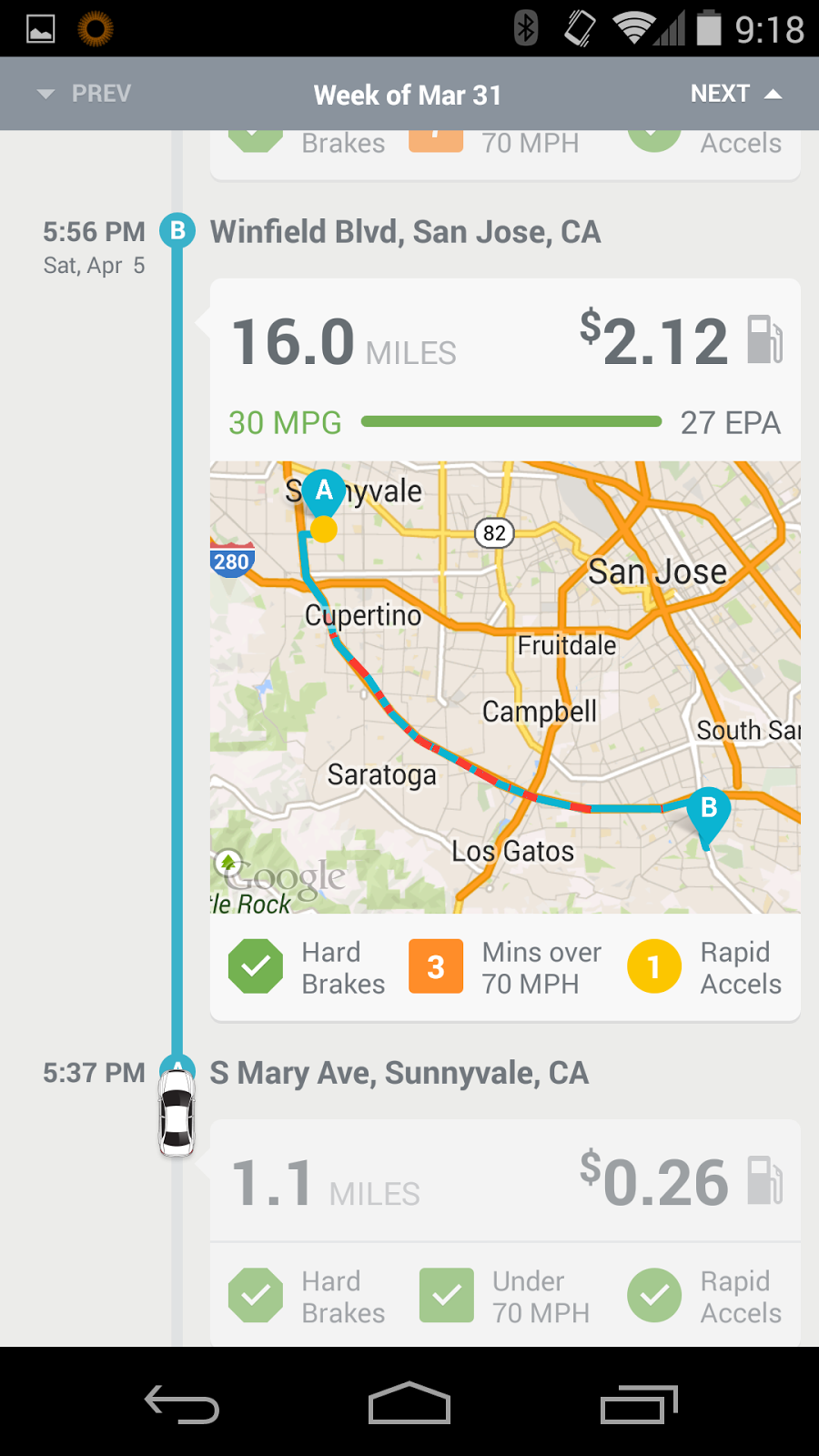
Setting up Automatic was, as you would expect, very easy. I unpacked the device, plugged it into my car's on-board computer, connected it to my phone through their dedicated app, and was good to go. The pairing tracks every trip, including distance, speed and estimated miles per gallon, and uses that data to provide an estimated cost of the trip and an overall score, starting with 100 for driving perfection, and deducting any time I step out of line.

You Can Scroll Through Previous Trips and Get a Score from Automatic

Automatic's assumptions for what makes for bad driving are simple as well. It's assumed that if you are driving over 70 miles an hour, that you're using more fuel than you should. So every time I get out on open highway in my BMW, capable of doing much more than 70, and I hit that mark, the Automatic device makes a chirping sound, telling me to slow down. If I stay above 70 for a sustained amount of time, the alerts continue and seemingly change tenor to be more dramatic.

I also get alerted if I accelerate too quickly from a stop, or if I brake too suddenly (though I haven't yet encountered that in my small sample size of use so far). So if I peel out of an intersection, Automatic bleep bloops at me and marks it on my permanent record (so to speak) through the app, so I can feel guilty later.

I Can Even Locate My Car and Diagnose With Automatic

And like any good app that monitors driving, Automatic is set up to be your wingman should any problems arise. The dongle monitors engine health, and promises to avoid your needing to go to the dealership for repairs if your check engine light goes on, taking away one of life's greatest mysteries. Same goes for the hopefully unlikely chance you're in a crash. Using its crash alert capabilities, Automatic swears it can report any accident to the proper authorities, even if you're unable to. I hope to never ever use this feature, but any added value in my book is a good thing.

So what of my trips? I haven't taken the car out for a long drive of any massive length since getting started. As I found when I started using Fitbit and later, the Nest thermostat and SunRun solar panels, simply having the data in front of me had me thinking about the sources of the data a little bit more. I walked more. I ate less. I turned down the heat and root for sunny days to save me money. To avoid getting yelled at by my Automatic, I find myself hovering around 68-69 miles an hour instead of above 70, so my overall score gets closer to 100.

The Automatic Link dongle for your car - not so big.

But I'd also like to give Automatic more data - like telling it to alert me if I'm going 10 MPH or more above the posted speed limits, or to set the speed warning at 75 instead of 70, little things that would make the device and accompanying app a little better and more personal, instead of acting like one size fits all. Also, by looking at the data, I found the one time I sustained my speed above 70, on highway 280 here in the Valley, I actually had higher miles per gallon than average. So it could be what's always considered bad, maybe isn't.

It's early days for Automatic for me, and I'm bullish on the trend of gadgets making us all smarter. So if I can withstand the occasional sharp chirp from my Automatic Link telling me I'm a non-ideal driver, over time I'll get even better. And I'm looking forward to even more data as the sample size increases. You can check out Automatic at https://www.automatic.com/.

May 23, 2013

May 23, 2013 · 3 MIN READ · BY LOUIS GRAY

Apps and Gadgets Optimizing More of Your Life Data

Apps and Gadgets Optimizing More of Your Life Data

It's been just over a year since I started my experiment with Fitbit, tracking not only my every step daily, but also my weight, learning how I measured up against my peers and against myself. The act of tracking my information, and keeping up with my peers, along with an irrational desire to stay atop virtual leaderboards, led me to lose thirty pounds at peak, and with little dramatic effort, I dropped 7 inches in my waist and have had to rebuy clothes more than once.

But Fitbit hasn't been the only data tracking app I've made part of my life, and I'm looking forward to more, for information truly is power, and as you start to quantify and measure that power, you get results.

If Fitbit is about tracking your activity, how much energy you burn, and how far you get with that effort, it's not too much of a stretch to see Nest's smart thermostat as Fitbit for your home. The attractive Nest dial not only is a small conversation piece in our home, but it has simplified our heating and cooling, letting us manage our home via smartphone and the web, all while getting regular reports on how much we've tasked our utilities.

Okay, thirty pounds is enough. I don't need more badges.

I purchased our Nest thermostat in March of last year, and that means we've gotten through a full twelve months, giving us enough data to check usage year over year. Even with the usual caveats of weather variations, kids needing more laundry done due to more activities, or anything else, it's clear we routinely have saved anywhere from $40 to $100 a month in electricity and gas with Nest, which means we broke even on our $299 purchase within six months.

PG&E Agrees We're Saving Energy and Money

That catapults Nest from the "fun gadget" category to the "real benefits" category. It doesn't take a brain surgeon to say that you use less heat when things warm up, like my monthly Nest Energy statement from April reported, but it does take smart science to learn when my family is in the house, and how to cool or heat our home at the right time, so nothing is wasted.

Monthly variations from Nest hit my email, showing use.

Fitbit and the Nest aren't the only devices that urge you to be better with the delivery of data and smart analysis. Today, I got more excited about a new gadget than I've been in some time, when I stumbled upon the promise of Automatic.com, and their early stage smart driving assistant. The assistant, which you can read more about on their site, sucks down information from your driving behavior, sends it to your phone, and helps you learn how you can change your behavior to save money on gas, and generally be a better driver. It even promises to help diagnose mysterious issues that flare up with everyone's car now and again.

Obviously, living and breathing a world like Google, as I do, we're thinking about data and separating good information from bad all the time. But this isn't a story about Google. It's a story about how smart thinking and critical application of the right information can make your life a better one. You don't need ten posts from me that crow about how Fitbit has made me thinner, but it did. You don't need me to tell you I'm one of the cool kids who has Nest, but I did get one, and I'm very glad I did. In months, after my preorder of the Automatic driving assistant comes through, I bet my driving may change in the same way my walking has - and the same way we don't have our air conditioning and heater constantly blaring.

We're in an interesting time in technology, where we're moving from a counting data for data's sake, and posting it without filters, like the first passes with Last.fm and Foursquare, to a utlity-based model, where the machines and software are getting smarter, teaching us and guiding us to be better. It's really exciting when you think about it - as we move not just from quantitative data, but qualitative data, and present it in such a way that it's not just for the geeks, but for everyone. Bring on more gadgets like this, please.

May 18, 2012

May 18, 2012 · 3 MIN READ · BY LOUIS GRAY

Web Data Caps Not Prepared for Pervasive Connectedness

Web Data Caps Not Prepared for Pervasive Connectedness

Comcast (Xfinity) made headlines yesterday with its discontinuation of a standard 250 gigabytes a month cap for its residential users, in favor of a new format, which starts at 300 gigabytes a month, with the option to buy more. As a residential customer, I had noticed they stopped tracking our net usage in April, as after continuous growth in our home's Web traffic, the number shockingly (and incorrectly) displayed it was stalled at 56 Gigabytes, following a 162 GB month in March, up about 20 percent from February, and in turn up nearly 40 percent from January.

The main rise in our home for data consumption is two-fold, with my kids' adoption of Netflix and YouTube on our various tablets, and our own use of Google+ hangouts for live video interactions with others on the social network, including extended family and remote friends. As I watched our monthly data consumption increase, it looked like we would be on track to hit Comcast's data cap of 250 Gigabytes somewhere in the second half of the year, barring changes in our behavior or an eventual topping out - and that doesn't include the various megabytes taken down over 3G and 4G from our Android phones and Chromebooks.


Typically, limits imposed on users are indicative of one of two matters - the first being a lack of robustness in the system, which has proven incapable of supporting a change in customer usage, and the second being bad actors within the system, who for whatever reason, consume a dramatically greater amount than the average customer. It's easy to point at illicit file sharing, pornography or piracy as the reason for these caps, but with increased use of cloud computing, high quality video consumption and web communication, including VoIP and video chat, what used to be the exception is threatening to become the new normal. The wonder is if the infrastructure can adapt to consumer needs, or if even more disruption is needed.

The face to face to face video chats of today and near instantaneous downloads of feature films that we take for granted, even in HD, seemed improbable five years ago and impossible 15 years ago. One has to wonder what could be made possible in the next five to 15 years going forward, with advancements in software codecs, fibre outlay and wireless standards. My kids are growing up in a world when they expect any TV show to be accessible on any device whenever they want it, and it's unlikely they'll ever understand the sounds of a dial-up modem, let alone references to floppy disks, analog address books and rotary phones.

Traditional infrastructure providers like Comcast and others who find themselves making incremental changes in a world that seems ripe for significant change and disruption make me feel like they are solving for today's problems without preparing for big changes that are on the way. Even their newest proposal, to start allocations only 20% ahead of previous limits, with warnings to those who hit these new limits, seem short-sighted. The answer, for me, is to prepare for a world with 10 times the bandwidth we have now, when not only every show ever is available to any device at any time, but possibly anything at any quality, anywhere.

If my kids and I, in our casual use, can start to bump up against caps designed to slow down illegal use, just imagine the damage we could do to these artificial caps with a more round the clock schedule and even more devices. Even my thermostat and my scale are connected to the web now. It's time we stopped playing with small percentages and started getting ready for a real Internet of things, or... scratch that... an Internet of every thing.

Disclosures: I work at Google, which is working on Google Fiber in Kansas City, and provides products like Google+ hangouts, YouTube, Android, and Chromebooks, and could be considered a competitor or partner to Comcast and Netlfix.

July 15, 2011

July 15, 2011 · 2 MIN READ · BY LOUIS GRAY

Google's Data Liberation Front Frees Your +1s

Google's Data Liberation Front Frees Your +1s

In a new and innovative way to leverage the company's new Hangout feature as part of Google+, Google's Data Liberation Front held a small press briefing with a handful of tech journalists today, walking them through why the company is focused on leveraging open standards and helping users get their data out. Alongside the discussion, engineering manager Brian Fitzpatrick said the company has extended its exports to include the +1s you've made for Web sites - a small bump obviously, but one that demonstrates their seriousness about making getting your data out of Google as easy (if not easier) than it is to get it in.

Without speculating on other company's practices (namely Facebook), Fitzpatrick asked those of us participating if we would recommend a restaurant which locked its doors to prevent us from leaving after we sat down for a meal, or if we would recommend people rent an apartment that demanded it keep your furniture and family photos once you moved. The obvious answer is of course not... and Fitzpatrick said the same should be true for your online content. He recounted how when the Data Liberation Front first started with Blogger, there were some internal concerns at Google that users would leave the platform en masse for WordPress or other solutions, but in fact, they instead regularly downloaded content but kept posting - using the exports as local backup. (This is what I do as well)

Google Takeout Liberates Your Content from Multiple Services

Fitzpatrick pointed to Google Search as an example of not locking in one's data, as users, with many choices, will use the engine and can go to any other when they like. But with many online services, content goes in and doesn't come out. As I've demonstrated with my own personal backup of my Facebook wall and photos, you can get your data out of the social network, but it's possibly not configured very simply to move to another platform altogether. This is a main focus for the Data Liberation Front team, said Fitzpatrick, who said the effort is made to point to XML, Activity Streams and Microformats wherever possible, letting your data be interchangeable within services.

Downloading My +1s is a Mere 25KB.

Now that My +1s are Downloaded, I Can Move them Elsewhere

Lost in much of the coverage of Google+ a few weeks ago, the Data Liberation Front introduced its Google Takeout policy on the same day, making it easy to download data from multiple services and take them elsewhere. This list includes your +1s now, as well as Google Buzz, your Circles and Streams from Google+, and Picasa Web albums. As they mentioned at the time of that launch, if they make it simple for you to get your data out of the company, they have to work harder to keep you in.

June 4, 2011

June 4, 2011 · 5 MIN READ · BY LOUIS GRAY

A Scorched Data Policy Is Bad for Web, Bad for History

A Scorched Data Policy Is Bad for Web, Bad for History

In a world where the cost of storage is practically zero, and the incentive to delete data declines, I'm befuddled by the lack of prioritization for some companies to focus on a complete search history, and in parallel, an intentional erasure of information by more prominent content producers, who seem to arbitrarily decide that the long tail of the Web, and the interest of future readers is less important than being seen as participating in the latest hip wave.

Even as I've changed technologies, blog providers and structures, I make extra effort to not lose historical archives and keep comment streams intact, not for ego purposes or for SEO, but because it's the right thing to do.

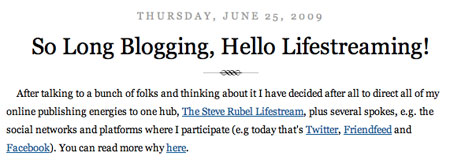
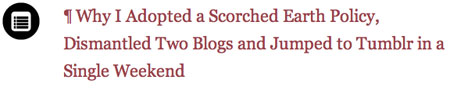
Steve Rubel, an executive vice president of global strategy for Edelman, a longtime blogger who was among the first to espouse the benefits of blogging, social media and was often at the leading edge of tech only a few years ago, has more recently swayed to and fro based on the hot startup of the day, leaving thousands of broken links in the process. After running out of time to update his blog regularly, back in 2009 he ditched the blog to run a lifestream, based on Posterous. (Google cache). Last month, he pivoted again (another hot thing to do in the Valley these days for those with unsuccessful ideas) and now is the proud owner of a Tumblr-powered blog.

Pivot Number One Saw Steve Go to Posterous

Pivot Number Two Saw Steve Go to Tumblr, and Delete Everything

But instead of leaving the older sites open, he deleted everything, proudly stating:
"With just two clicks of a mouse I rid the web of literally thousands of blog posts, some of which I am proud of - others less so - and redirected the URLs to the new site."
While no doubt many of his older posts (like mine) have limited or no value to today's readers or those in the future, they are an insightful historical record of one of the more visible bloggers of a specific period, one who is now in the process of erasing his tracks.

With more than five years of blogging myself here, the blog archives now take on their own role as a personal reference desk. When Kevin Rose left Digg, I was able to go back to my comments on Digg in 2006 to see my thoughts at the time. When TweetDeck was sold to Twitter, I could go back to 2008 and see my first thoughts on the service. With PostRank selling to Google yesterday, I found a post I made two years ago that had comments on it from people who now work at Google. If I didn't manage to keep the posts alive and the comment threads as well, this would not be possible.

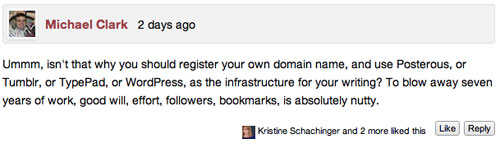
Steve's Community Is Very Unhappy With the Deletions, Calling it "Nutty"

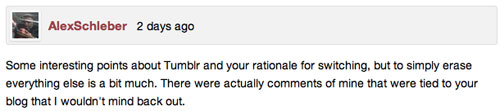
Others Say Erasing "A Bit Much", Want Their Comments Out

For those of you who don't consume my blog exclusively by RSS, you might have noticed some recent changes to the look and feel (Go ahead and look). It's not a major change, but an upgrade nonetheless. Part of the reason for my slow migration was the criticality for me to not lose the existing posts, structure, external links and attached discussions. I know some comments from a few years ago are still out of reach, but I'm hoping to bring them back.

Of all the Web content I have produced or managed in the last fifteen years, one of my biggest regrets is the complete void from my time in college, both from my own personal home page, and from the student newspaper where I was the online editor and also wrote hundreds of posts, most on the front page. Current Valleywag editor Ryan Tate, who picked up the online editor job at the paper after I had left, struggled with a series of malicious hacks, and all our collective work was gone, erased from the Web like a bad memory. Whenever we trade emails or talk in person, we both lament this loss.

Steve's Original Micro Persuasion Blog, Pre-Deletion

This data obliteration is something that really is avoidable now, and yet, we let it happen on a near-constant basis. Most newspaper stories from the terrorist attacks in 2001 come up as 404s, beyond the reaches of the Archive.org project, or Google's search engine cache.

What I would like to see is a proposal from Google, or some other well-intended Web entity, such as Amazon, to offer a solution, embedded in today's modern browsers, as an option, that solves for intentional or unintentional content deletion. All those links that I provided back to Steve Rubel's MicroPersuasion blog from 2006 to 2009 should automatically be detected as dead, and then presented, to the best of the tech's ability, as they originally were, using Google cache or S3, Archive.org or something. And yes, I'd love it if somebody like Google or Microsoft would also give Twitter or Facebook a helping hand to get their own search archives into something useful.

Steve Thinks The World Won't Care About His Old Posts.

The issues I have with Steve's approach to pouring gasoline on his past and then lighting it on fire is not one of a choice of platforms. While seeing him join Tumblr is about as hip as your dad trying to snowboard with the cool kids, the more important part is that it eliminates the choice for readers, present and future, to ever get that data, and fill in the blanks. It's not his call to decide what has value for others, even if he sent me a tweet saying "we're foolish if we think the world really cares."

The world should care about walking through the historical record - be it on Steve's blog, or Dave's blog, or Robert's blog, or Mike's blog, or Penelope's, or any of the people who have been chronicling the world they see around them. I wish we had full archives from newspapers for years and decades backward, or the personal journals of people famous and ordinary from centuries past. What they might have found mundane is intriguing to others of us - maybe not massive populations, but to one person, they could contain serious insight. The Web is supposed to cater to the long tail, and the history of what we've produced should be there when they come looking for it.

July 4, 2010

July 4, 2010 · 4 MIN READ · BY LOUIS GRAY

A Day to Call for Data Independence

A Day to Call for Data Independence

I Want My Data Independent of Companies and Services

We don't live in a data democracy. Every day, we give over more of our data to people we don't know, whose motives we may not fully understand, and the possibility of our getting it back is very slim. Unlike in a democracy, we don't get to vote in the leaders of companies who build the programs and sites that harness and manipulate our data. We don't get to set term limits on CEOs or throw the bums out of corporate offices if our data is used in ways that are unsavory. And just like our tax dollars, we keep creating more and don't always know where our data is going to end up.

In today's world, as much of the data we create transitions from offline to online, and from our personal computer hard drives to the cloud, we are being forced to make choices in terms of what companies we trust, what services we believe will have a future, and what applications or Web sites can do what with our data. If we choose wrongly, we stand in danger of losing data, losing access to that data, losing historical data or metadata. Our data could be compromised by ill-meaning people, or simply cannot be moved, written once and made to lack true portability.

As I said in January, I think the time has come to deliver personal clouds with OS and application-neutral data. I don't want to be forced to accurately guess the right programs and providers, and I want anytime instant access to my own personal data, including contacts, relationships, rich media, e-mail, documents and more from any device.

We have not yet scratched the surface of data interoperability and portability between services and devices. While work on standards continues, there remain significant challenges, and often, as they do in government today, politics play a big role, between and often inside companies. Is what is in your best interest also in the best interest of those storing your content? And should they be one and the same?

I am calling for:
  • The ability to export one's social profile from network to network.
  • The ability to export one's shares and postings from network to network.
  • The ability to change blog software back-ends quickly, without losing content.
  • The ability to change blog comment providers quickly, without losing data.
  • The ability to change e-mail providers without long and tricky transfers.
  • The ability to purchase applications once even if you change operating systems on mobile or desktop.
  • The ability to access one's purchased media from any device if you provide your identity.
  • The ability to access one's bookmarks and history from any browser if you provide your identity.
  • The ability to access one's contacts and messages from any browser or e-mail client.
  • The ability to export one's social graph and reconnect it in a new place.
  • The ability to purchase media once even if you change media sources.
  • The ability to switch carriers without penalty.
  • The ability to collaborate with people across geographies, OS and Web browsers.
  • The ability to add actions to entries (such as likes or comments) and have them flow to all entry points.
  • The ability to migrate from one RSS reader or shared link blog and not lose subscribers.
  • The ability to download all videos and images in one's network rapidly.
These are just a few ideas off the top of my head, and the list could no doubt grow dozens long with your input and more hours spent trying to learn just where our data goes when we hit publish or submit. I am trusting an increasing amount of my data to the cloud with every post I write, every status update, every photo I upload, or every video I add to YouTube. With more than a decade and a half of activity on the Web, the legacy of my choices often impacts what I can do in the future, or the speed at which I can make change. I have had to walk away from created data before, and I have had to make compromises on choice or accept things as less than ideal much more often.

There are people out there working on very real standards to let our data move from place to place without hiccups - such as those hammering away on the DataPortability Project. Some of these issues are being solved in front of our eyes, while others are getting much worse. On a day when one nation is celebrating with big words like Freedom and Independence, it's worth knowing just who owns our data now, and striving to one day see a time when it can truly be moveable and independent - not beholden to any company, service, software or environment.

That would be a day worth celebrating.

April 16, 2010

April 16, 2010 · 3 MIN READ · BY LOUIS GRAY

Ads? Check. @Anywhere? Check. Chirp? Check.

Ads? Check. @Anywhere? Check. Chirp? Check.

In November, when Twitter COO Dick Costolo (@dickc) promised ads that we would "love" were on their way to the popular status update service, I promised to embrace the move, assuming the content was relevant. Now that Twitter's "Sponsored Tweet" model has been revealed, and promotional updates can be seen in various search results, we're seeing the tip of what should become a consistent and growing revenue stream for the much discussed San Francisco start-up.

The news of the Sponsored Tweets platform came in a week of delivery for the company, who held its first developers conference on Wednesday and Thursday, talking to the somewhat shaken community, explaining their direction and plans to make more opportunities for them to tap into the company's massive real-time ecosystem. The week also saw them begin the roll-out of their @Anywhere platform, bringing elements of Twitter to the rest of the Web, this Web site included. (For example, mouseover @louisgray or @rsarver and see what happens.)

The most interesting news out of Chirp came from two things: the promise of a new API that delivered live content streaming (See @jesse: Twitter Announces Live Social Graph Streams) as well as the delivery of a new option for developers, dubbed annotations. (See @scobleizer: Developers: how will we all get along with Twitter’s annotation feature?) The combination of these two pieces means not that Twitter will be reducing the need for developers' products, but giving them more access to more data more quickly, with the option to extend information well beyond their famous 140 character limit.

For some, the metadata around Twitter's data will always be more interesting than the short updates themselves. We can know, for instance, when you said something, the location from which you said it, what client you were using, and whether it was in reply to someone else to continue a conversation. Those are things we have taken for granted - the basics. With annotations, we can now go well beyond. Additionally, the elimination of latency and polling should let aggressive clients like TweetDeck and Seesmic get even more robust, as they can focus on adding more features, not on band-aids to work around what have been slow elements in Twitter's infrastructure.

You Can Get to a Sponsored Tweet If You Look Hard Enough

Despite my not having attended Chirp, I saw the onslaught of updates from those participating and attending through their various streams. Their viewpoint of the service having just completed the event looks much stronger than it did going in, when the news of official mobile clients from Twitter threatened to drive down developer morale. Hopefully this means future releases that are even more innovative which I can get to review here.

As for those ads? Right now, they are incredibly hard to find. Twitter is starting slow, letting big brands be the testbed before opening up to the world, as AdWords has. You can find a Starbucks ad when you search for coffee, for example, but for the most part, you won't see a Sponsored Tweet unless you try hard. Over time, I expect this will change, even as Twitter moves to make them more pervasive in search results and in third party clients. So not only am I fine with how they're being run so far, but their impact is small - except to show that Twitter is serious about revenue, just like we always hoped they eventually would be.

After the announcement of the ad platform, I got an e-mail from one reader, who said, "Still waiting for your post on Twitters Biz Model." When I pointed to my November post, asking "... that was in November of 2009. Do I need a new one?", he responded: "Ha! Touche. I forgot that you're one of the few who actually write presciently."

I can't say it's a level of prescience. It's just common sense. And Twitter, despite its challenges, is progressing on the right path. In a few years, you just might look back and say, "Remember when?"

Disclosures: I am an unpaid advisor to MyLikes, a company which also allows Twitter users to post sponsored Tweets in their stream. I also advise SocialToo, which would benefit from the new API options, and is @Jesse's company.

March 23, 2010

March 23, 2010 · 3 MIN READ · BY LOUIS GRAY

FriendFeed Data Joins Its Coders At Facebook

FriendFeed Data Joins Its Coders At Facebook

Despite not achieving the lofty position in the social media stratosphere many of us had hoped it would as an independent company, FriendFeed played a significant piece for a mid-size community that has, for the most part, felt adrift and abandoned in the seven months since the once-perky startup was acquired and absorbed into Facebook. When parts of the site started to creak over the last few weeks, with features breaking or slowing, some thought it spelled yet more bad news. But after some considerable effort, the site and all its data has been migrated to the more robust Facebook data centers, which should hopefully keep the site going for those who have stuck around, even when others have said their last goodbye.

Moving all data on a live site as complex as FriendFeed's to another is no trivial feat, made even more challenging by differing hosting environments or code nuances.

On Thursday, after some of the site's more dedicated users complained the network's search engine was broken beyond repair, FriendFeed co-founder Jim Norris explained:
"We're working on moving the FriendFeed servers to the Facebook data center, which will have significantly more speed and capacity and (we hope) more reliable hardware. There are a bunch of difficulties we've run into though: FF has been running on Ubuntu Linux distributions whereas FB is based on various (old but stable) Fedora Core and Centos versions, so the package management is completely different."
Paul Buchheit, also a co-founder, best known for his work on creating GMail while at Google, and a successful angel investor besides, gained the unenviable task of compiling the code and building it on the new machines. As Jim added in a throw-away line, "I don't know the exact timeline but if when I see Paul I'll beat it out of him."

It turns out that timeline was for late Monday night and early Tuesday morning, as Bret Taylor, director of products at Facebook, announced the successful transfer of FriendFeed's data to the Facebook datacenter, adding, that it "fixed many of the ongoing performance problems we have had with the site and will provide us more room to grow."

Whether FriendFeed is growing, stagnant or decreasing depends on one's point of view. No longer a gem in Silicon Valley early adopter corners, the site did bounce off traffic lows last month (at least according to Compete.com) to rise more than 80 percent - even as new challengers including Google Buzz gained attention. FriendFeed has said the United States is no longer the most active country on the site, as that honor falls to Turkey. So somebody's using the site, and while figuring out the site's future and how it maps to Facebook requires either a divining rod or root access to Mark Zuckerberg's laptop, it doesn't look like the site is being allowed to gather dust and fade into the shadows.

As the move took place, users on the site are already thanking the team for improved speed, and lower errors. And as FriendFeed never quite let me export all my data I'd piled into the site since October of 2007, that's a good thing. If they had a way to export it all, that'd be a very interesting offer, but it's a battle for another day.

February 28, 2010

February 28, 2010 · 3 MIN READ · BY LOUIS GRAY

A Month In the Cloud Shows Potential

A Month In the Cloud Shows Potential


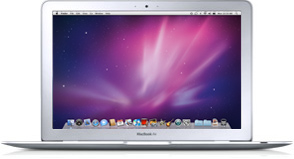
At the end of January, I told you how I had recently picked up a MacBook Air to replace my aging MacBook Pro, and as part of that process, I would try to do as much as I could online instead of through desktop applications, leaving much of my rich media on the old laptop, and choosing the Web over hard disk as often as possible. A month in, it seems there is still much room for the cloud to grow, but despite the general trend for massive data growth, I still haven't used more than 30 percent of my spartan 128 GB solid state hard drive - a back of the hand measurement of how little data I am keeping with me and not leaving in the air.

As I mentioned last month, one of the first decisions I made was to keep iTunes and iPhoto data on the old laptop. I recognized I needed to keep Microsoft Office, for pure sanity purposes, but left Adobe's CS suite on the other machine.

Those applications I have downloaded have been rare, letting me tap into the cloud itself - for example, Skype, for audio phone calls and podcast recording, the Sonos controller to power the home stereo system, and Spotify, to access the on demand music network.

The goals are multiple. First, can I do a test run at being operating system agnostic, maintaining the flexibility to move toward a promised Chrome OS when it ships? Second, can I make the actual hardware insignificant, treating the new Air as a "disposable" machine, making migration to a newer device in the future simple? Third, and most important, can I find major weaknesses that continue to exist with an all cloud strategy?

At the end of February, my 128 GB solid state disk hard drive, much smaller than the 200 GB SATA disk it replaced, has 91.36 GB available, or just more than 71% of total capacity. This includes all system files, the pre-installed iLife applications from Apple, and preferences for many of the pre-installed apps. In fact, the one place I expected to consume a lot of data, with client files and PowerPoints, has proven to not be much at all. The folder for Paladin, with all client folders, is actually less than a single gigabyte.

Are there any headaches to going cloud-only (or close to it)? Sure. For somebody who uses PhotoShop a lot, the lack of PhotoShop has me reaching for it often. In the interim, for images for the blog, I've relied on lots of screen captures, and small editing in Preview. Anything stronger pushes me to the media machine. But the problems have been extremely rare. If I had an Office competitor that made it easy enough to edit all my files and save them remotely, I would be happy to give Microsoft Office the boot. But it's not there yet. And in the meantime, I am using GMail more and my Mac e-mail account less. I have been taking Zoli Erdos' advice and moving my Mac e-mail to the cloud, but that process isn't yet completed. I'll keep you posted on that, promise.

My new-ish MacBook Air isn't just lighter in terms of weight. It's massively lighter in terms of data too. It makes sense that in the future, so long as we have one place to put all our rich media, the rest of us really only need thin clients. We're getting there.

January 9, 2010

January 9, 2010 · 5 MIN READ · BY LOUIS GRAY

The Future: Operating System And Application-Neutral Data

The Future: Operating System And Application-Neutral Data

We are now growing accustomed to the concept of the "cloud", where our data will be increasingly stored in Web services, not on local disk, accessible from any computer, operating system or browser. But, despite the adoption of standards from major players storing our personal data, the choice of services causes serious vendor lock-in, as the data suite, be it from Microsoft, Google, Apple or other providers, is not only interpreted by their offerings, but stored there as well. This storage and management of our data makes migration between services incredibly difficult, and still leaves us at the mercy of a large company, whose priorities may not be the same as our own.

The time has come to start on a path to true ownership of data by the individual, reducing applications and Web services to the role of filters and containers, rather than hosts, who can propagate lock-in as these services spread to mobile devices and tablets from their desktop roots.


What makes a digital device mine, be it a laptop or a cellphone or an music player, is the personal content that is stored, and how that data is translated, stored, presented and categorized. Similarly, when we make a choice as to our preferred Web services or technology providers, we are, for the most part, passing our content to them exclusively. While we may have made the data location independent, it is far from being service independent, and any potential future switching will have dramatic impacts on time and productivity, including:
  • Complicated export and import of personal data
  • Differences in the interpretation of data between similar applications
  • Potential loss of metadata between services
  • Reduced backup stability as differing instances of our data is housed at differing services
This headache is a major part of vendor lock-in. Today, when I make a choice as to what brand computer to buy, or what phone to purchase, while I may be committing to a brand or a suite of applications, all I am really doing is asking this product to provide its own interpretation of my data, including:
  • My Contacts and Relationships
  • My Music Files
  • My Videos
  • My Photos
  • My E-mails and Hierarchy
  • My Documents
  • My Bookmarks and Hierarchy
Increasingly more important than the actual data itself is its metadata, or data around data. How is the data structured, meaning... Do I have my e-mails in folders with subfolders and rules? Do I have photos in specific albums? Do I know how often I have played a specific song or genre? When were documents created or last edited?

Today, for the most part, we are choosing from three major service providers, although there are alternatives. We can select Google, who offers Google Contacts, Calendar, YouTube, Picasa, GMail, Google Apps and Google Chrome for the majority of our needs. We can, instead, select Apple and use Address Book, iTunes, iPhoto, Mail, and Safari. Or, we can stick with Microsoft, and leverage Outlook, Windows Media Player, and Internet Explorer. (Or their online equivalents)

Despite standards adoption, not all programs interoperate well. No doubt there remain issues with meetings from Microsoft Exchange being received by Apple Mail, and the integration of Web browser bookmarks and Web history is not shared between Google Chrome and Safari. These minor problems are greatly magnified when you consider the potential for future switching, as you migrate from one platform to another or one computer to another - largely because in every case, the applications themselves, even those that are Web services, are storing our data for us, and interpreting it in their own way.

I think it is time for a change, that lets us own our own data, turning the situation on its head.

Instead of hosting our own data with the service provider of the day, we should host our own data in a standard format, which will be adopted by the leading providers, whose applications will tap into us directly, and pull down our data and its metadata. If I chose to log in with GMail one day, I would authenticate who I was, and GMail would pull down my e-mail stream, complete with e-mail activity history (such as replies and forwards). The data would not be stored on Gmail, but instead be more like a read-only process, whereby changes to data, including sent items, would not be stored in GMail, but written back to my personal "cloud", if you will. Similarly, if I opted to log in to Microsoft Outlook, tapping in to my own, authenticated, account, I could browse my contacts in their application, through their filter, but the data would reside with me.

Hosting one's own personal cloud with our own data is not an end run around large corporations in fear of Big Brother, but instead, for real, true, portability. In this situation, a longtime iPhone user could pick up an Android phone, enter my own personal ID (be it through OpenID or some other standard), and pull down my details into all of Google's native applications. Similarly, I could log in to any Microsoft, Apple or Google powered device and become me, not with my data hosted on the new machine, but with my data being read, like a Web page, on that device, in their own lens.

Even as we on the Web are rallying around these concepts of standards, and the cloud, we are seeing the concept of vendor lock-in be as true as ever. The switching costs from hardware device to hardware device, OS to OS and Web service to Web service remain completely too high, and the way around this problem is to take back our data, make it personal, and enforce standards that get the major players to come aboard. While we may not all have all the broadband access necessary to make this a solution today, it's 2010, and we should be well beyond the same issues we have been facing in computing for the last 20 years.

So how do we make this happen?

October 29, 2009

October 29, 2009 · 5 MIN READ · BY LOUIS GRAY

The Blurry Picture of Open APIs, Standards, Data Ownership

The Blurry Picture of Open APIs, Standards, Data Ownership

Look beyond "real-time" and "social", and you'll easily find another pair of tech buzzwords that everybody wants attached to their product or service - "open" and "standards". Companies are practically falling over one another to show they have embraced developers or users, letting data stream in and out of their products, while avoiding words like "proprietary" and "closed", which are PR death. But as you might imagine, the very definition of "open" can vary depending on who you talk to, what the service's goals are, and how they may leverage existing standards on the Web. Following the much-discussed news of Facebook debuting its "Open Graph API" on Wednesday, I traded a few e-mails with a few respected tech-minded developers, and found, unsurprisingly, that not everyone believes Facebook is fully "open". In fact, it's believed some companies are playing fast and loose with terms that should be better understood.

To quickly summarize the discussion, there are essentially three major ways to bucket "open" APIs, agreed those I contacted.
  • The first, "open access", means that anybody can use the API, but all the data in or out of the services is owned or controlled by the company whose service you are using. The Facebook Open Graph API "is open insofar as you do not violate their ToS", one developer wrote. "Here, 'open' is superfluous -- no (question) you're giving people open access to it, how else would they use it?"
  • The second type is that of an API that leverages open standards, including those such as XML, HTTP, and others. But that doesn't mean APIs that leverage those standards are open by definition. For example, Twitter's API is proprietary, even though it is built on open standards. The developer adds, "Here 'open' is just saying they've tried to incorporate best practices from other engineers -- it would be stupid if they didn't."
  • The third type is the most "open", including open standard APIs like OpenSocial, OpenID, PubSubHubbub, AtomPub and others. These APIs have a clear definition that can be utilized by multiple providers in a way that is interoperable, decoupling providers and consumers.
In short, you have "open but we control the process", "standing on the backs of open" and "truly open", if this opinion is accepted. The developer adds, "In short, the first two mean nothing, the last one actually fits the dictionary definition. The Web is built on open standard APIs and protocols."

Chris Saad, VP of Product and Community Strategy at JS-Kit, well known for his efforts in the data portability space, concurred, writing over e-mail:
"Facebook in particular has made a concerted effort to dilute the word open and use it in reference to a human/cultural thing when talking about the platform and their products."

He added, "In reality there is a VERY big difference between having an 'Open API', an 'Open Standards API' and an 'API'. An API is just a thing you poke and you get data back. When you get FaceBookPropietaryXMLData using FacebookPropietaryAuthMethod and you can only cache the data for 24 hours - that is NOT an open API - it is an API."
So who cares? Historically, services like Facebook and AOL have been characterized as walled gardens, meaning their information is sealed within, beyond the reach of the standard Web. Other services are known as "data roach motels", where data gets in, but never gets out. As the first developer said, the Web is built on open standard APIs and protocols, so sites can work well with each other, and activities operate in a similar manner, regardless of service.

Jesse Stay, a friend of mine, fellow blogger, and well-versed developer for both the Facebook and Twitter platforms, agreed that there is a tremendous amount of confusion around the definition of "open". In fact, just last month he wrote a post on his site, "The Open Web – Is it Really What We Think it is?"

Today he said Facebook's move gave full access to "users' walls, comments, likes and social graph... accessible from any Web site, desktop application or mobile application, using open API access protocols." Meanwhile, Facebook users can now opt into letting their status updates indexed by search engines, and the company is open sourcing architecture like the Tornado Web server (acquired as part of the FriendFeed buy) so other developers can make new platforms.

Jesse is more optimistic about Facebook's goals than was Chris. He said that the site lets users decide how open they want to be with their data, and that they are "working to give users full power" in that regard. But he also states frustration with the company's restricted access to search, and a lack of access to the entire network in aggregate, with the exception of their fan page directory. And he didn't address the core issue with Facebook in terms of them owning your data bidirectionally, and yes, them having the option to block your access if they felt you had violated the terms of service. (Remember this one? Scobleizer: Facebook Disabled My Account)

Web standards are very well known and we usually recognize them by their acronyms. JSON. HTTP. XML. POP3. Atom. Open means that developers can tap into the standard and use it as they wish, both procuring data and pushing it elsewhere. When we start to blur the lines about open and associate them with specific companies, like Twitter, Facebook, Yahoo! or others, you can usually guess that the solution is slightly less open. Somebody has the option to change their proprietary code and block you from having full access.

As stated more than a few times here, I have chosen to trust companies with my data. I put a lot of data into the Web and move it around. I expect standards to work the same way across sites, and I hope that those services that I use treat developers as well as they do their users. I recognize I am not as technical as folks like the developers I pinged today, and thus I need to trust their comments at times once my expertise is surpassed. But we need to be more knowledgeable about what is "open" and what is "sorta', kinda' open". Maybe Facebook can help us all understand their level of openness as time progresses.