Silicon Valley Technology Commentary & Archives · Est. 2006 3,045 Posts · 2006–2026
Showing posts with label Storage (17 posts). Show all posts

October 13, 2014

October 13, 2014 · 3 MIN READ · BY LOUIS GRAY

Cloud Powered Near Instant PC, Mobile Upgrades Are the New Reality

Cloud Powered Near Instant PC, Mobile Upgrades Are the New Reality

Buying a new computer or getting a new phone used to be a huge pain. Even if everything was up and running right away, you had to plan for hours, or even days, of moving all your data from the old device to the new one. And if you didn’t successfully complete the data migration, or had sufficient paranoia, you could end up with old devices cluttering your home - just in case you might need to get that old content. But with so much of our data moving from local disks to the cloud, and new operating systems improving their sync and account setup, the day of hot swapping devices is here.

As you know, for the past few years, our home has been a ChromeOS and Android family. This started well before I joined Google, and as each OS gets smarter, that move looks to have been the right one - especially when it comes to this issue.

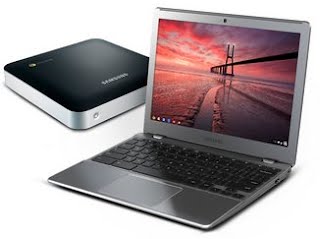
Samsung's 2012 Chromebook Got Bumped for the 2014 HP.


Last week, thanks to a sale on Woot.com, I purchased a new HP 14 inch Chromebook for my wife. One evening, as she was using the 2012-era 11 inch Samsung Chromebook, I told her to close her eyes. I took her old laptop and put the new one in her lap, and when she signed in, she didn’t miss a beat. All her bookmarks were there, even down to the tabs she had open in her browser. With one move, and for the same $200 or so I spent two years ago, she got a faster device, double the RAM, and a larger, more vibrant screen, with no headaches around data.

There was no question of whether she had to back up photos, or copy her songs. No dragging and dropping off folders and documents. It just worked, exactly as I had expected it to. And the next morning, when she had to print to our networked printer, she just told the browser to print, and the printer was listening. No printer drivers, and not even a memory of a CD-Rom or DVD. It just worked.


Meanwhile, on mobile, the story is much the same. Whether it’s due to an accidental drop (which has happened in our home more than once), or a required factory reset thanks to trying new software before it’s ready (that’s also happened), starting over with a new phone or starting the phone over from scratch is no big deal any more either. Signing into my account brings my account information, access to my data, my apps, and my preferences.

In the storage industry, we used to talk about hot swappable units - which would enable upgrades without reboots or interruption of access to data. The dream of upgrading servers, disks, arrays or network equipment without downtime was rarely achieved, but often talked about. On the consumer side, many of us have grown accustomed to the inevitable pains that come with getting new devices or even upgrading those devices from one system version to the next, and it doesn’t have to be this way any more.

Standard Disclosures: I work at Google, the company behind ChromeOS, Android, and great tools that help you sync your content between devices. You can assume I prefer cloud-based data.

October 22, 2013

October 22, 2013 · 6 MIN READ · BY LOUIS GRAY

Real Valley Stories: "The Missiles are in the Air... Please Stay"

Real Valley Stories: "The Missiles are in the Air... Please Stay"

Editor's Note: Part 10 in an irregular series of stories from my 15 years in Silicon Valley. Part 9 talked about the time I emailed the entire company about impending layoffs days before they took place. This time, a story about how, during a stressful time at the office, I got a job offer at a competitor, and over not much more than a weekend's time, rescinded and stayed instead - all while gaining new promises for career growth.

Ten years ago was a time of change, or so it seemed. I'd just gotten married, and Silicon Valley was in the throes of a deep recession. The once-packed highways became easy to drive again. Parking lots were empty and constructed buildings didn't have any tenants. Two-plus years into my job, we'd already seen our unfair share of peaks and valleys. The CEO had been replaced, as had our VP of Sales, and the Marketing team had almost completely turned over, making me one of the more senior folks, surprisingly. But while I believed in our technology, our future was not certain, so when a former colleague gave me a call, asking me to interview at his new startup, I figured I'd give it a try.

At the time, amid a national recession, and extreme risk aversion by our target customer base to test and deploy equipment from startups, meeting our numbers each quarter was challenging, to say the least. On the marketing side, we found our budgets compressed down to nearly zero, and our options were increasingly limited. Our trade show and travel budget was eliminated. Our online advertising budget was deleted. We even took our PR work completely in house, paying only for the typical wire service fees, followed by strategic emails or phone calls from me to press to push the success stories we did have, or try to take the reporters off the scent of how dire things seemed.

The Friend Throws Me a Job Opportunity

Then came the phone call. A former director of product marketing who'd found a new home asked me to come in and interview for the role of digital marketing manager. I polished up the resume and started the process - talking to the hiring manager by phone, and eventually coming in for an interview.

Stepping into the competitor's office was a dramatically different feeling than the quiet library-like ghost town of the startup where I worked. This one sported bright colors and the fresh smell of new venture funding, being bankrolled by one of the Valley's biggest names. The interviews went well, and I remember specifically driving them to be a pioneer in the space, using Google's AdWords, which at the time were untapped waters for the industry, and could be a fast way to get inexpensive leads.

A few days later, on a Friday, I got a phone call, and they wanted to move forward. I got the job. They wanted me to start as soon as possible, which put the ball in my court, to call HR and let my employer know I was leaving. So the next day, on Saturday, I called the VP of Human Resources, catching him at a kid's softball game. I told him I didn't want a lot of drama around my leaving, that I just wanted to be done by that Friday of that week. The sooner out, the better. I was excited about moving on.

The Best Phone Call from HR Ever - and a Note from the CEO

The next morning, Sunday, I checked my work email and saw a rare message from the CEO, with a simple subject line: "please stay". The body of the message too was short, but said he was traveling to Europe, didn't want to lose me, and to reach out any time. That was interesting.

Later that day, the VP of HR emailed to say he wanted to talk that night. So I awaited his call. Overnight, I'd gone from having two feet out the door and feeling like a low-level peon to someone who'd gotten the attention of senior management. My wife, appropriately, rolled her eyes, and told me to be wary.


Which Direction to Take?

That night, he called. It was after 10 in the evening, and I paced back and forth in my apartment kitchen, telling him how with our company's situation, and recent changes in the marketing team, I just didn't see a route for us to be successful. Citing Bush's comments at the time as we started battles in Iraq, I said, "Marketing needs a regime change." Seconds later, he answered with the coolest line I've ever heard from HR. "Louis, the missiles are in the air."

From that moment, the tone changed - not from one where I was on the way out, but to one where I said what I would need to stick around, including the obvious meeting or exceeding in compensation, but additional responsibilities, and transfering to a new boss, whom I'd already had a ton of respect for.

Never Take the Counter-Offer?

That made Monday awkward. In addition to putting through my usual tasks, I met quietly with the HR VP again and practically every roadblock I saw as preventing me from staying was knocked down. I was promised the salary match, a title change, and a changed reporting structure. The people who had limited my ability to succeed were going to be out of the way. And all it took was my sending a note back to the competitor that I had rescinded the offer. I obviously couldn't tell them why, but I had to let them know.

You read in career guidance books to never take the counter-offer. Despite any financial gains, the reason you were interested in leaving is usually still the same. The people are usually the same. But I drafted a "Sorry but..." letter and sent it off. This no doubt surprised them, and it really burned my friend, who'd brought me in, as he left me a livid voice mail which landed me on his bad list for years to come.

And yes, I was immediately worried I'd flubbed the decision - especially as I saw this company eventually launch, put out their share of positive releases, and have glitzy booths at our mutual events. But their star faded, even as I got more opportunities to own our strategic direction and help the company grow out of its darkest points through new product introductions, several cycles of upgrades, dramatic customer expansion and eventually, an IPO filing - although we never did quite make it.

The biggest surprise in all this, even during the darkest times for us as a company and as an industry wasn't that I could find a new role, or that things ended up right after all, but that I had allies higher in the food chain than I had ever anticipated - people who agreed with my views, and respected me to the point that they would give me an opportunity to succeed on a path I saw made sense.

And those missiles that were in the air? They landed, and eventually the people that were slowing us down and making roadblocks for me and the company found new roles somewhere else. As for the company that almost pulled me away? They never went public, instead selling back to their primary investor. They burned bright for a short minute and eventually faded away. It turned out I had made the right choice.

September 19, 2012

September 19, 2012 · 7 MIN READ · BY LOUIS GRAY

The Future of Local Storage Is Practically None At All

The Future of Local Storage Is Practically None At All


Stand Back or Your Hard Drive Is Going to Get It

First they came for our floppy drives. Then, they came for our CDs and our DVD drives. It won't be too long until the concept of a hard drive, or any local storage, beyond that needed for temporary offline use, is itself antiquated. After decades of dramatically increasing PC hard disks, from megabytes to terabytes, saving local data is more likely to put you at risk of loss, relative to remote backup, than it is to keep your data safe, helped along by many trends pushing toward cloud storage and applications.

In April of last year, I talked about how I planned to forego the purchase of physical media, disavowing books, CDs, DVDs and other printed materials, when digital would do, and I haven't looked back - getting to my media from any device that recognized my signed-in identity. Meanwhile, as chronicled, starting in early 2010, when I first got a MacBook Air, and accelerated as I've turned toward ChromeOS as my primary device, I have almost entirely stopped the use of desktop applications. If it can't be reached via web browser, it's probably not worth having.

Goodbye Desktop Applications. Your Time Is Past


May's introduction of the latest Samsung Chromebooks (see my review) left me using my Mac only once per day, for a specific task - synchronizing my FitBit. Until recently, FitBit didn't have a completely cloud-capable service, so each night around midnight, after a full day's neglect, I open the Mac, sync the FitBit in the cradle, confirm the data's gone through, and close the Mac again, until the next day. With the recently announced FitBit One series promising wireless syncing to iOS or Android, I'm just one device away from being done.

For the rest of the day, without exception, I am on my Chromebook, or my Android devices. All my music, emails, photos, documents and other web services can be accessed and managed on the cloud through the browser.

Knocking Down Lagging Apps One By One

The evolution of software and its intersection with platforms is an intriguing one. We Mac users in the 1990s and early 2000s occasionally had to make sacrifices, not having access to apps available only on Windows. Similarly, as iOS and Android increased in market presence, there was the occasional app missing from one platform or the other. But over time, practically all applications, or their equivalents, make their way to the top platforms, and while my move to Android more than two years ago came with some apps missing, all the ones I needed quickly followed me there.

No Seriously, Have You Seen Pixlr on the Web? It's Great.

Now the web itself has proven capable enough for almost any task, and reasons why not to go all Web are dramatically reduced, especially the improved capabilities of documents, spreadsheets and presentations in Google Drive, the release of high quality image editing software like Pixlr, and promises that popular desktop applications like Spotify are set to reach the cloud very soon now, to stream music in addition that which you can purchase from Google Play.

Time to Move on From the Desktop and File Mentality

With solid reasons to not go all Web rapidly eliminated, this evolution also brings up the opportunity to revisit old paradigms we've always taken for granted, as how we use our computers and mobile devices has changed.

Consider, for example, the desktop and files metaphor. Decades ago, we adapted our PCs to be similar to those environments we knew offline. The desktop, folders and files all hearken back to this original model. Even the hyperlinks of today's Web follow similar structures with directories and files owned by top level domains, and today's leading cloud storage vendors, including Dropbox and Google Drive, mimic a traditional desktop environment to bring ease of adoption to users migrating from local storage. But this shouldn't always be the case.

While clean directory structures once were enough for me to almost quit a job over a decade-plus ago, machine-generated links to content are good enough, and it's possible we just need to know how content relates to one another, or what you're searching - for example, email, and tags that generate metadata, providing you with what you need even if you don't know exactly where to look.

All Your Computers Are Mine. Seriously.

The notion of this being "my laptop" or "your PC" doesn't even make sense any more if you think about it. All I need is access to my "stuff", and that stuff is tagged to my identity, be it one that is affiliated with Apple, Google, Microsoft, Facebook or any other provider. While Chromebooks have made it most clear that you can sign out of one account and sign in as another and retain access to all your things, the truth is that so long as you are using a leading provider of identity, you should be able to get to all your files, bookmarks, and media from any device with a modern browser. Go ahead, steal my laptop. I'll just get another one that will do the same things and be up and running in minutes.

Kids These Days... They Don't Need Hard Drives

Consider also that my children should never need to use or know about local storage. At ages 4 and 2, my children will enter elementary school in 1 to 3 years. They have been raised with web-connected TVs, tablets and smartphones, have an expectation of anytime access to data, and shouldn't be trained to store data that is tied to any single device. To them, every device has Netflix. To them, every device can get to Google, and anything they want to see, hear or watch can be found by asking Google for the right image or video, instantly - no buffering allowed.

Just two to three years is enough for us to see how rapidly USB thumb drives went from being the hot tradeshow giveaway to now seeming almost completely useless, with online sharing being the norm. Just two to three years was all I needed as a student attending Berkeley in the late 1990s to move from carting a floppy disk across campus to the computer lab for printing my freshman year, to instead email the document to myself as an attachment my junior year.

Oh. So You Don't Have Pervasive High Speed Wireless?

It's easy to sit in Silicon Valley's ivory tower and say that with pervasive high speed Internet, eliminating any dependency on local storage is a brilliant idea. It's easy to overlook potential power outages, cloud disruptions, dependence on third party services, and spotty web. Nobody likes being out of range for phone calls, let alone all your data, and nobody truly wants to be helpless if their account is compromised. Those are not minor and trivial concerns. But neither is ensuring data compatibility as the data is stored on multiple local machines, and backed up to temporary local storage which may or may not be less reliable than a service provider that serves millions or more.

Years ago, it may have seemed silly to move to web-based email instead of desktop applications, and the same could be said for other apps that have now become default on the web - including calendaring, address books, event planning and more. Digital media for entertainment, once the province of physical media delivered to your home or picked up at a retailer, is now accessible anywhere on any device. So too will be your photos, music, documents, and more. I even moved all my family's photos off spinning disk on an array of Macs from the last 4 years and put them on Drive.

The key to staying prepared for the next evolution of computing is to be willing to take a leap of faith - knowledge that you don't need desktop devices when a laptop will do, knowledge that you don't need to have DVDs in your living room when Netflix or iTunes have all you need, and that what you've been used to and taught over decades just might not be entirely the same any more.

Disclosures: I work for Google and yes, Google makes many services that provide for cloud storage and computing, as well as those nice Chromebooks, one of which I gained for free earlier this year and am using right now to make this post (as well as all the screenshots and images in the post, edited in Pixlr).

September 7, 2011

September 7, 2011 · 3 MIN READ · BY LOUIS GRAY

HDS Acquires Network Storage Player BlueArc

HDS Acquires Network Storage Player BlueArc

This morning, Hitachi Data Systems, a subsidiary of Japan's Hitachi Global, announced the acquisition of network storage provider BlueArc, one of the last independent storage startups that survived the economic turndown of the previous decade. The deal, an all cash transaction, closes a chapter in my own work history, for as many of you know, I spent 8 1/2 years at the startup on the marketing side, from our initial first customer shipments back in early 2001, through being a key part of the team that readied the company for its first attempt to enter the public markets, back in 2007. We eventually withdrew in 2008, before the new team, after I had left in 2009, filed again earlier this summer.

For those who watch the storage networking market closely, with the most popular term being "Big Data" these days, BlueArc's relationship with HDS seemed like it had a high chance to become a marriage for a number of years. After signing a reseller contract that made BlueArc's high end network storage products available to HDS' sales people, rumors about a potential acquisition were printed as far back as 2006. So it took a little while, but appears the two companies were able to work something out - a year after some of the biggest deals in the space were consummated, as EMC purchased Isilon for $2.25 billion in November of 2010 and HP acquired 3Par for $2.35 billion in September of 2010. In December of 2010, Dell purchased Compellent for just under a billion dollars, three years after buying Equallogic for $1.4 billion. All solid proofpoints for why I wrote in August of last year that there are big dollars in big data.

That said, BlueArc's road to this exit has been a long one. The company launched with its differentiation being marked by speed and scale, the source being its hardware-centric model, when competitors focused on software-based solutions or turned to clustering to achieve scale and power. Hardware generations were launched every 18 months or so, with software updates in between.

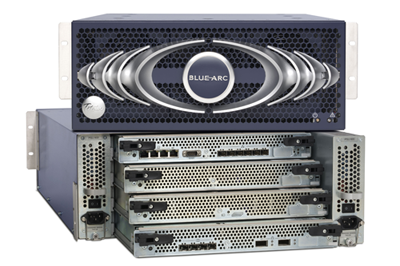
BlueArc's modular network storage system, Titan, announced in 2004.

I joined BlueArc in January of 2001 at an interesting point in the dot com boom and bust. Revenue-light dot coms and Web services were falling apart, and a flight to hardware seemed more stable. BlueArc had an incredible roster of respected industry players, and promised technology that was well above competition. Sitting as part of the marketing team as the initial waves of press lauded our innovation was exciting, and people were flocking to know more. It was the very definition of a hype cycle, as product maturation had yet to occur, and it took a few product generations and tweaks of customer messaging to really get the formula predictable. As you can imagine, through 8+ years at a single startup in the Valley, we had our fair share of bumps and turnover, mixed with good news. Crunchbase shows an accurate listing of our funding rounds and while the process was difficult at times, and other companies had seemingly simpler routes to success, many more failed during the time I was there. Simply holding firm, I saw former colleagues update their LinkedIn 2, 3, or 4 times.

The partnership with HDS, signed in late 2006, signaled a change in strategy for the company that made BlueArc's products available for resale, and gave the company multiple paths to revenue - including a much deeper sales force. In a world where IT managers were typically conservative, and often looked as much at a company's viability as to the products themselves, having HDS on board, or even leading the sales march, helped ease some of those fears, especially at the largest named customers. Meanwhile, I focused on improving our messaging for new markets and announcing our direct wins and customer highlights.

Having left the company two years ago myself, I've been removed to some of the most-recent progress, and saw many former colleagues follow suit while others stayed. The company didn't ever go public, though they filed twice, but they were a storage survivor.

Disclosures: I am a common stock shareholder at BlueArc, due to my years employment there.

June 27, 2011

June 27, 2011 · 4 MIN READ · BY LOUIS GRAY

Not All Roads to the Public Markets Are Smooth Ones

Not All Roads to the Public Markets Are Smooth Ones

In Silicon Valley, we fall in love with and memorialize success stories. Leaders of successful companies can be seen as pop culture heroes, and their decisions during times of challenge or opportunity can be told and retold as legend. The first years of companies like Apple, Microsoft, Sun, and Oracle in one era, Netscape and Yahoo! in another, Google and LinkedIn in a third, and in today's evolving present history, including Facebook, Foursquare, Groupon and more, are possibly going to be reviewed and dissected in the same way we look back on innovations from the turn of the 20th century with the assembly line, and the Industrial Revolution in centuries past.

The opportunity to grow fast, get big and get rich drives many people to flock here and try their own hand at catapulting an idea into a passion that could see millions or tens of millions of users. But, if nine of ten startups fail, for every big name I just mentioned, there are carcasses of many others that never make it. And for every rocketship IPO that has people clamoring for updates, there are others that take a longer path. (See all of the S-1 filings on the SEC)

Friday saw the second filing of an S-1 by BlueArc, my employer from early 2001 to Spring of 2009. The company is looking to raise $100 million by entering the public markets on the heels of rising revenue and reduced losses. I know the story well as I helped author the first version of this same document when we filed to go public in 2007 and was there when we withdrew the filing in 2008.

(You can safely assume I own shares, though not a significant number, and it's in my best interest if they do eventually go public. Given the company's sensitive position, I'm reticent to mention particulars, so this article is painted with a broad brush, and is as neutral as possible. Rather than ignore the news, I'm offering the filing as an example of a company that has not seen overnight success.)

The company was founded in the late 1990s, and raised more than $200 million, the most recent round completed last fall. In my time there, we signed some amazing customers, got some powerful OEM and reseller deals, and sold to new territories. We learned where our products were a great fit, and where we had challenges. We hired lots of great people, and saw others struggle. CEOs were changed a few times. We had layoffs a few times. The company and its customers made the front page of trade magazines and the business sections of the New York Times and Wall Street Journal. Other times, rumors flew about the company's viability. At one point, the noise got so bad, a leading industry analyst wrote an entire column about how he'd heard so many rumors on the company, fed by tough competitors, that he recommended anybody hearing such rumors to just ignore them.

The result of a company that has a few years under its belt, with many funding rounds, some happy investors and some unhappy, some happy employees, and some unhappy former employees, is a body of work that tells a story. For financial junkies and tech watchers, or just the curious, poring over the details of BlueArc's S-1 is interesting. There are no funny numbers like those from Groupon, who quite visibly took money off the table for its founders and key employees. There is no meteoric financial windfall like those seen at Google and assumed at Facebook. Just a growing, challenging, business in a tough market that has seen competitors purchased by industry heavyweights for billions of dollars and others, failing, just go out of business or sold for scrap.

While most of the tech press is enamored with consumer Internet plays and mobile apps, the enterprise market has its own unfair share of intrigue - often harder to grok, but just as aggressive. The South Bay especially, the world of Milpitas and San Jose, is dotted with networking firms, semiconductor firms, storage and switching companies in the shadows of NetApp and Cisco. Having lived that world for most of the last decade, coming from the position of a challenger with unique technology, I'm hoping that the colleagues of mine still at the company find a positive exit for the decade-plus some have put into the effort, or lesser tenures for the more recent arrivals. But for those of us who seem to have attention deficit disorder when it comes to watching companies start and flourish, or to our own job-hopping resumes, this is an interesting case study of one company that didn't take the easy route.

Disclosures: I was employed in the Marketing department at BlueArc from 2001 to 2009 and own a small amount of the company's common stock.

August 16, 2010

August 16, 2010 · 7 MIN READ · BY LOUIS GRAY

In Storage & Networking, Big Numbers In Dollars and Data

In Storage & Networking, Big Numbers In Dollars and Data

Today, at least for those of us who watch the enterprise space closely, the big news is that Dell Computer has offered to acquire Fremont-based 3Par for $1.15 billion, a premium of more than 80 percent over the company's stock price. In a world where much of the tech news is dominated by small companies taking money from angels, it's interesting to see the gulf between what it takes to grow a successful hardware company and the more ephemeral Web-based or application based companies that play significant roles on practically everyone's smartphone. And while I haven't talked about it too much on the blog, trying to keep a black and white separation between my day job for much of the last decade and my more hobby-oriented interests here, I've lived it, participating in one venture backed storage startup for more than 8 years, from 2001 to 2009, seeing companies raise, rise, fall and fail. In storage, the big winners, with few exceptions, can raise hundreds of millions of dollars before reaching break-even, and may be worth billions on the other side. Others may never find traction at all. 3Par, which took on tech titans like EMC and IBM, proved to have a winning formula.

There are three major truisms in technology. The first, and most well known, is that of Moore's Law, which while it has slowed in recent years, dictates that CPU processing speed increases at a regular clip while reducing in price. The second is that data storage capacities and densities are doubling at practically the same rate. Just look at the gigabytes or terabytes on your desktop or laptop hard drive and compare that with 5 or ten years ago. And the third is the speed of the network, both wired and wireless, increases - from the Kbps-rated modems of yesteryear to the fast-flowing networks of today, including 10 gigabit Ethernet on the client side and high speed Fibre Channel on the back end of many data centers.

These three advances mean simply this - more data can be created, shared, transmitted and stored more quickly than ever. Entire industries have been spawned around managing the data flow and storage, enabling branch office access to centralized data, deduplication and compression, load balancing and virtualizing the resulting complexity. If you watch consumer companies, such as Twitter, Facebook and Google, you probably see each of those companies creating new standards for global file systems and redundancy. You see them eschewing traditional storage companies and building their own devices in an effort to keep costs down as usage spirals upward. The trends are both amazing and incredible.

Back in January 2001, as Web 1.0 was crashing, I left a Web services company (eventually sold to Oracle) and joined a small company called Synaxia Networks, which later launched publicly to the world in March as BlueArc. At the time, comparable network attached storage devices from EMC and NetApp were capable of scaling to a then-massive 7 terabytes, and performance was not a metric either of them dominated. Our approach was simple - by converting aspects of the file system from software to hardware, we could dramatically accelerate storage. We scaled not to 7 terabytes, but to 225. We promised five nines (99.999% uptime) of reliability, and performance that was ten times the competition. And if we were less than that, everybody knows that two to five times the speed of the incumbent is still pretty darn good.

As we debuted, the press attention at the time was incredible - as our launch, backed by $30+ million in funding and our CEO being a former top guy at Compaq computer, gained massive attention. We had headlines in the Wall Street Journal and New York Times. George Gilder proclaimed that our product "imperiled" all software based storage devices, and after a successful debut at PC Forum, one reporter at TheStreet.com said it was like offering crack to CIOs. Pretty heady stuff, and not unlike other dramatic booms seen from companies that captured the tech press's attention, including the currently hot Twitter and Foursquare, to those less successful, like Handspring and Transmeta.

But building a storage company takes a lot of real money. BlueArc, which raised another $20 million just last month, has raised $200+ million over its lifespan. 3Par, purchased today by Dell, similarly raised $100 million in 2001 (as we were raising $72 million) and others raised similar amounts. Cereva Networks, whose assets were later purchased by EMC, had raised $137 million and laid off 140 employees back in 2002 after not getting off the ground. Zambeel closed in 2003, having raised $66 million, but selling only a single system. Panasas raised $25 million in 2008, one of multiple rounds for the firm. Maxiscale raised $12 million before coming out of stealth. Pillar Data, funded largely by Oracle's Larry Ellison, is expected to have raised between $300 and $400 million alone. So when I hear tech reporters hem and haw about Web startups raising $10 or $20 million, it doesn't make me blink, considering the world of big dollars I've operated in for a decade.

So why the big dollars? Why are venture capitalists so willing to put such big bets into spinning disk and faster networks? Because when things go well, the customer benefits are very real, and the returns could be even better. Customers will pay top dollar to reduce the amount of time it takes to build special effects or bring pharmaceuticals to market. Fast network storage devices are key in mapping out the earth's terrain from satellites, and combing its ocean floor for potential oil deposits. Fast network storage is being used to collect mountains of data by the government, to simulate nuclear weapons' testing, and build next generation vehicles. And those companies that won't compromise on the speed of execution will buy from new storage startups not named IBM, EMC and HP.

That's why Isilon, a competitor to BlueArc during my time there, is worth more than $1.1 billion today, even after its own public struggles. 3Par earned its way to the discussion and is now cresting above $1 billion. Ocarina Networks, a client of Paladin, was purchased by Dell last month, for an undisclosed sum. Ocarina's competitor, Data Domain, was caught in a bidding war between EMC and NetApp, eventually going to EMC for more than $2 billion last year - simply with the promise of reducing storage capacity!

Today, some of the biggest debates in the Silicon Valley are around angels versus venture capitalists, and whether a $500k round can tip you from one side to another. Some of the best known Web startups today are begging for a $25 million acquisition by Google, or so it seems. FriendFeed, one of the biggest acquisitions by Facebook, was rumored to be "only" $50 million. But on the other side of the datacenter, it is an entirely new ballgame, where hundreds of millions of dollars go in one side, and you could get billions out the other end, or you could get nothing. Companies like 3Par, BlueArc, Isilon, DataDirect Networks, Panasas and others have put pressure on EMC, NetApp and IBM to innovate, and expand their product portfolios. Companies like Data Domain, Ocarina Networks and Permabit are working to optimize storage throughout the datacenter. Emulex, Qlogic, Brocade and Cisco are working on faster networks, cards, adapters and protocols to make sure data can go between client and server and back again at rates previously impossible, and everybody is betting on standards they hope will put them in the best spot.

So congratulations to 3Par for their fantastic exit and sale to Dell. Congratulations to Isilon for fighting a tough battle and living the life of a public company, worth $1 billion and up. It's fun to see companies and people I once saw as competitors, partners and allies, who I rubbed shoulders with at trade shows, and with whom I traded taunts on Twitter, taking things to the next level. There is no doubt in my mind that others will be good stories, and some will go the other way with spectacular flameouts, equally incredible to watch, but for much different reasons. It's a very different ballgame over here.

Disclosures: As a former BlueArc employee and investor, I own private equity stock in the company. In addition, Emulex is a current client of Paladin Advisors Group. Prior to their sale to Dell, Ocarina Networks was also a client of Paladin Advisors Group. Maxiscale was also a Paladin Advisors Group client in 2010. At times, I may seek to do business with or engage with many companies in this list, or their competitors.

May 16, 2010

May 16, 2010 · 1 MIN READ · BY LOUIS GRAY

InfoSmack Podcast: Blogging On the Corporate Watch

InfoSmack Podcast: Blogging On the Corporate Watch

Rejoining the InfoSmack podcast on Friday after my January debut, I had the opportunity to talk about a serious issue that many independent bloggers are finding, as their content occasionally may run afoul of their corporate management. Alongside Greg Knieriemen of Chi Corporation, behind the popular StorageMonkeys blog, he and I spoke with Greg Ferro of Ethereal Mind and Stevie Chambers, a Cisco employee who had recently seen his blogging future threatened after one controversial post caught the eye of analyst firm Gartner.

The discussion, which is a lot better in terms of content than sound quality, reviewed whether disclaimers on a personal blog are enough to cover an employee's back in times of conflict, or whether they should assume they are always speaking on behalf of a company, even if they are not an approved spokesperson.

At the end of the podcast, Greg also challenges me in a new segment he called "10 Big Questions", where he asks, among other things, whether Apple will ever accept Flash, and to name something I don't like about Robert Scoble. You'll have to listen to the end to find out just what I said. The full content is below, and in its original form here: Infosmack Podcast Episode 50 - Cisco, Gartner and Bloggers.


January 10, 2010

January 10, 2010 · 1 MIN READ · BY LOUIS GRAY

Podcast: Infosmack Episode #33, Talking Storage and Social

Podcast: Infosmack Episode #33, Talking Storage and Social

Aiming to show I'm not just a one-trick pony, I gained the opportunity to participate in the Infosmack Podcast this last Friday, with EMC's Mark Twomey, 3Par's Marc Farley, and Greg Knieriemen of Chi Corporation, behind the popular StorageMonkeys blog, which targets enterprise IT folks and other data geeks.

The podcast managed to talk up recent recent acquisitions and rumors of acquisitions in the storage industry, wrapping up the recently-completed CES conference in Las Vegas, and also, how social media is growing in the enterprise, most specifically in network and storage. This isn't the typical startup fan affair, so if you want to hear some geeks talk storage and social, enjoy below. You can also find the podcast at its original URL or subscribe below.


Infosmack Podcast MP3

Subscribe with iTunes

November 23, 2009

November 23, 2009 · 3 MIN READ · BY LOUIS GRAY

By Thinking Small, Data Robotics' Success Looking Big

By Thinking Small, Data Robotics' Success Looking Big

2008 and 2009 haven't been particularly kind for many companies. Amidst a cacophony of bailouts, bankruptcies, lowered valuations and layoffs, Data Robotics, a direct attached storage manufacturer based in Santa Clara, has delivered growth exceeding 100 percent in each of the last two years - and hopes to be on track for going public via an IPO some time in the next two years. Combined with a popular product line, which was enhanced with a pair of new models today, you can see they have bucked the trend, surprising many people, including me, with their success.

Initially known as Trusted Data, before changing the company's name in 2007 to better reflect the company's automation capabilities without confusing customers into thinking they were a security company, I have known the company and its founder, CEO Geoff Barrall, for several years, having once worked with him as a colleague, and even working for him directly from 2004-05. (Consider that my disclosure)

When he started Data Robotics in 2005, I wasn't all that keen on yet another small storage array entering the market, even if it was aimed at consumers, and came with nifty features, like a meter that showed disk utilization on its facade.

My skepticism, and that of others, didn't deter Barrall, as he and the company found niches for its Drobo desktop storage arrays, including the creative professional community, and most recently, the federal market, which has become the company's primary vertical, I was told. The company has made a name for itself over the last few years with a distinctive product appearance, a proprietary non-RAID architecture that aims to protect data in the event of disk failures, and the potential ability to upgrade forever, simply through swapping out disks for those in a larger size, thanks to evolutions in disk density, that have seen capacities grow from the hundreds of gigabytes not too long ago to multiple terabytes today.

In the most recent year, Data Robotics accrued approximately $30 million in revenue, double that of the previous year, and quadruple the one prior. With the current quarter looking well, Barrall told a group of storage geeks, as part of Gestalt IT's Tech Field Day, a few weeks ago that doubling revenue again was not out of the question. Having seen profitable months already, the company intends to blast through break-even, and test the public markets when both they and Drobo are ready.


Drobo Teased Us With A Preview Earlier This Month

Today, the company added on to their product line with the new Drobo S and a new iSCSI SAN, the Drobo Elite. While some vendors, such as EMC or NetApp, started at the top of the market and are working their way down, Data Robotics started with the consumer and is working its way up into bigger devices, up to a significant 32 terabytes in its latest gear.

In contrast to my "set it and hope to forget it" Apple Time Capsule, which stays a single configuration for ever and ever, until I get rid of it, the Drobo can be upgraded over time, and doesn't blink at seeing disks of different sizes in the same array. Though it requires a second device, called DroboShare, to provide Network Attached Storage (NAS) functionality, it is quite compelling, especially as I start to increase my creation and archival of rich media storage, as most fathers of twins no doubt do.

The new entrants to the product family aren't necessarily for the low-end consumers like me, who might do just fine with a 4-bay desktop storage device, and don't need iSCSI functionality, but they show that the company is filling any gaps in the market that may prevent it from continuing its doubling of growth. At a time when many companies are shuffling the deck and trying to mute bad news, Data Robotics has been quietly growing.

See additional coverage from this morning around the Web:

September 21, 2009

September 21, 2009 · 3 MIN READ · BY LOUIS GRAY

MaxiScale Debuts Scalable Storage Platform for "Era of Billions"

MaxiScale Debuts Scalable Storage Platform for "Era of Billions"

There's no question that an ever-growing number of Internet users are spending more time creating and consuming data online. While a great deal of attention in recent years has been spent focused on the creation of and access to rich media files, including YouTube videos and photos, be they on Flickr, Smugmug or Facebook, the truth is that often much of the data consists of small files, which can number in the billions for the most popular of Web services. Add to the mix the potential for some files to go "hot" as they become popular, and a fickle audience that expects data to load instantly, and you can see why the issue of storage has been critical to every Web-based business.
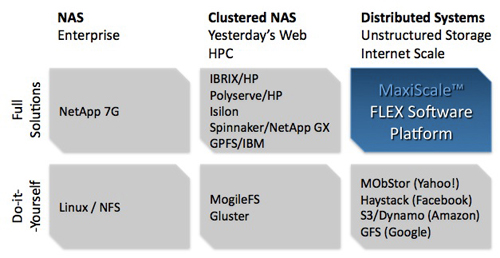
Traditionally, getting companies' storage issues "solved" through a rapid growth phase has been accomplished in one of three ways. The first is through the purchase and management of expensive or complicated storage networking hardware. The second is through using a storage service provider, like Amazon S3, and paying for data that is used. But the Internet's giants are taking a third route, creating customized file systems, and dedicating an incredible amount of engineers' efforts to test, create and validate. Through this, you have seen names like Haystack from Facebook, MobStor from Yahoo!, and yes, Google's GFS (Google File System), each built independently for the company's unique needs.

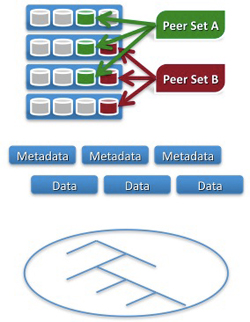
Into this world enters a new approach from MaxiScale, who claims its new software system can change the economics of Web-scale software with a promised 10x gain in performance, 100x the scalability and reduced costs. This new venture, unveiled today, was designed specifically with the Web's large data sets in mind, and is not based on any existing vendor's offering. The solution does not offer any customized hardware, and supports both Linux and Windows environments. The system also does not rely on RAID (Redundant Arrays of Independent Disks) to make sure that files are protected, instead replicating the files across storage nodes for backup.


Graphics Courtesy: MaxiScale

Last week, prior to my trip to London, I met with Gary Orenstein, the company's vice president of marketing, and Gianluca Rattazzi, the company's CEO and co-founder. I previously worked with Gianluca when he and I were at BlueArc, and he was the CEO and chairman of the board from 2002 to 2004. In fact, a good number of the team's engineers and leadership hail from BlueArc, so scrolling through the company's phone directory from their lobby was fun to see. As we talked about MaxiScale's approach, it was clear the team had considered the pitfalls that typically trip up companies' growth on the Web - namely price, scalability, latency, and availability.

Why have companies like Yahoo!, Facebook, Google and Amazon each created new approaches to the traditional world of file systems? Because their exceptional needs pushed requirements that standard offerings could not meet, growing too costly, or introducing issues of downtime or latency. MaxiScale calls this new world the "Era of Billions", be it tens of billions of photos at Facebook, streaming of a billion songs at MySpace, hundreds of billions of YouTube video views a month, or exceeding 100 billion ads served by AdMob - the company's first named customer. It's a new world of big numbers.

Of course, not every Web company growing virally can ask a core team of engineers to build a new file system, and deploy massive data centers. That's why you see so many turning to S3, which is a great solution for small to medium size businesses, but can see costs grow as demands increase. MaxiScale's platform claims to grow with these companies, on standard hardware, optimizing file serving for all types of files, with a single namespace with highest reliability and predictable performance, even with growth to hundreds of petabytes. The idea? Give companies that are focused on the Web an alternative to expanding either their budgets or their staff, taking their eyes off the ball from what should be their core product development.

You can find MaxiScale at http://www.maxiscale.com or their blog, "Serving Size" at http://blog.maxiscale.com/. See also coverage from earlier today by SearchStorage and StorageMojo.

Disclosure: From January 2001 to April 2009, I worked for BlueArc, where Gianluca Rattazzi, Francesco Lacapra and many other MaxiScale employees were colleagues. I have no current financial relationship with the company or any of its employees.

July 7, 2009

July 7, 2009 · 2 MIN READ · BY LOUIS GRAY

For My Latest USB Storage Solution, the Form Factor Is Key

For My Latest USB Storage Solution, the Form Factor Is Key

At the end of May, I was able to meet with Edelman's Steve Rubel during a quick visit of his to the Bay Area. And while I already told you about one of the conversations I had with him and Steve Gillmor, Rubel was more than happy to also show off a pair of his most recent gadget related acquisitions. The first was a small iPhone stand from Seskimo that fits in your wallet. The second was a USB key that literally looked like a key, and sat on his keychain, next to the house keys and the car keys. Its simplicity and utility, at least to me, made it a must-have.

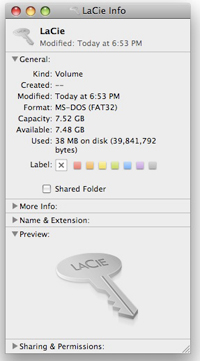
My USB key is seen here plugged into my laptop.

Needless to say, I followed up with Steve, and yes, bought both the iPhone stand and the USB key, from Lacie, called simply "iamaKey". In fact, I actually got two of these keys, and gave one to my wife, so we both can move files from laptop to laptop and location to location, no longer needing to dig through computer bags, or comb through our electronics basket to find out just where the flash drive disappeared to.

While the iamaKey from Lacie is not brand new, having been reviewed as far back as March by jkOnTheRun, it's new to me, and I haven't been eagerly awaiting any shipment from Amazon.com this eagerly since my parents sent me Mario Kart for the Wii this April. So when I got home from work this evening and learned the Lacie keys had arrived, I wasted little time in getting mine opened up, on the keychain, and pushed into service.

Weighing in at 8 gigabytes, the iamaKey isn't going to exactly replace my main hard drive, but its available size is significant enough for any project I plan moving around, from Office documents to photos, or video. For my first project, I plugged in the key to the Dell laptop from work, pushed over some PowerPoint presentations, and then plugged back into my Mac and copied the data over nice and quick. Amusingly, even the USB drive's icon looked exactly like a key - a nice touch.

With the iamaKey on my keychain now, I know I won't ever have to wonder how I can get my data to and fro, as it's always going to be there. Of course, if I lose my keys, that's a different issue altogether, so I'll try and avoid that. You can buy the drives from Lacie in both 4 gigabyte and 8 gigabyte versions here.

February 27, 2009

February 27, 2009 · 3 MIN READ · BY LOUIS GRAY

Web Two Dot Oh DotCom Dot Cloud Colon Slash Slash

Web Two Dot Oh DotCom Dot Cloud Colon Slash Slash


This afternoon I had the opportunity to attend a session presented by TechCrunch, hosted by Steve Gillmor, around cloud computing, featuring some of the Valley's thought leaders, from many of the biggest names in all of tech, ranging from Salesforce.com to Rackspace, Google, Yahoo!, Microsoft, Sun, Ning, FriendFeed, Facebook, Amazon.com and a small handful of startups. Each of the participants discussed how their product leveraged the cloud, what it was about this new approach to harvesting data storage and computing that made their products execute the way they do, and how they approached new problems of bandwidth, capacity, licensing, security and scale.

The event, essentially a two parter, with early-stage start-ups presenting for five minutes apiece in front of an expert panel for the first half, and a roundtable of technology elite for the second half, saw a healthy dosage of skepticism mixed in with what was largely a genuine desire for these companies to try and deliver higher-quality services for their users by taking advantage of new protocols.

With everybody saying the word "cloud" to represent customer data or computing being stored independently of local physical disk or blade servers, the word itself grew to be mocked. One 'expert' said cloud was the new "dotcom". Another compared the cloud to rabbits as they kept multiplying, and a third called the cloud "Kool-Aid". With the move of terminology over the last decade from "Dotcom" to "Web 2.0" to "Cloud", you can see why people would be necessarily wary of jumping on the newest movement with two feet.

All names aside, there is as much fact as there was fad in the cloud. The cloud's benefits are clear as data can be stored independent of physical disks, and doesn't require dedicated storage and server administration. Code developers want anytime access to infinite bandwidth and storage, and consumers want instant response times. As the panel debated the genesis of enterprise apps absorbing consumer application features, it was clear that each was facing challenges impossible just a decade ago, and the cloud's availability changed everything.

Paul Buchheit of FriendFeed referred to the Internet as just one big computer, and said that instead of shipping software in a big cardboard box with floppies to introduce version 3.0, you could just ship new code three times a day. Mike Schroepfer of Facebook talked about how his team could handle 1 billion status messages of 100 characters each on a different level of storage than the 1 billion images, each a few megabytes apiece. And Marc Benioff of Salesforce.com won the prize for the best quote of the day, saying, "As an industry, we are always overestimating what we can do in a year and underestimating what we can do in a decade."

Benioff's quote is no doubt true. The next engineering team I meet that hits the initial proposed date with all the requested features is the first one I will meet. But a decade ago, we wouldn't have expected to stream full-length feature films without buffering, or do many of the things we do online, always having been limited by location, bandwidth, memory, storage, or even operating systems. Now, the operating system is even less a part of the discussion. While the panel was held at Microsoft's Silicon Valley office, practically all presentations were done on Apple Macintosh, and featured FireFox, not Internet Explorer. Now, consumers and businesspeople expect to get all their applications and data from anywhere on any device. It was enough that Benioff even left his laptop behind on a trip to the World Economic Forum in Davos, Switzerland, in favor of his BlackBerry Bold.

It is happening. Not too long ago, yet another meme went around the Web on what the Internet looked like in 1996 - a blink of an eye when you think about it. In 1996, I was hosting a personal home page, using WebStar, on my Apple Macintosh Performa 631 CD, with all of 8 megabytes of RAM. Now, my blog is hosted on the cloud. The images themselves are on the cloud. My participation in social networks like Facebook and FriendFeed... is done on the cloud. And I'm taking my iPhone everywhere. I used to despise the term cloud, and used to rail against it with my colleagues at 3Cube back in 1998 to 2000, but it looks like I lost that battle. Good thing all of us as consumers are winning.