Silicon Valley Technology Commentary & Archives · Est. 2006 3,045 Posts · 2006–2026
Showing posts with label Twitter (442 posts). Show all posts

February 19, 2019

February 19, 2019 · 4 MIN READ · BY LOUIS GRAY

The Future of Web Q&A Panels Should be Cake

The Future of Web Q&A Panels Should be Cake

Last week, Recode's veteran tech reporter Kara Swisher visibly held an aggressive interview with Twitter and Square CEO Jack Dorsey, who has been on something of a meandering press tour over the last few months, which has led to more questions than it's seemingly answered, as he has avoided specifics, and not taken full responsibility for many of the negative impacts the platform he created has spawned.

Despite Kara's noble attempts, this round didn't fare much better, largely due to Twitter's failing as a medium for such a debate. The #KaraJack hashtag, expected to be the core space for her serves and his returns, with a fair share of unforced errors, was difficult to follow in real time, with Twitter's poor design getting as much visibility as the discussion itself. Taylor Lorenz of the Atlantic called it impossible.

Twitter was not designed for this, and barring dramatic redesign or new product spinoffs, it won't be.

The most impactful press interviews are typically done live, be it for radio or TV, while other forums, like Reddit, have made Ask Me Anything (AMA) events a free for all with viewers getting as much access to the subject as anyone else. But #KaraJack wasn't supposed to be a free for all, with every tweet seeing replies from the masses, or requiring dedicated TweetDeck columns and search queries. It was supposed to be on a stage of sorts, with bright lights seeing yet another tech CEO sweat and try to avoid withering under Kara's query onslaught - the type of event you would see at an All Things D or TechCrunch Disrupt, or if you insist... at SXSW.


That's not to say panels can't be done on the web - for they can be, and done well, with a moderator having the option to interview a subject (or multiple subjects), with progressive question and answers, and audience reactions, but not interruptions. I know this, because I've seen it done. A quietly intriguing web service called Cake, created by Chris MacAskill of Smugmug and General Magic fame, has been working on a topics-focused, troll-free, community that offers a unique approach to panels.

Cake, when not doing panels, focuses on topics of interest.

If you're unfamiliar with Cake, the site's content is much like if Medium met Flickr - not a surprise from a site with roots in photography, like Smugmug, which coincidentally bought Flickr from Yahoo! last year. You can use Cake for long form posts, as I did last year after seeing my dad purchase a gun, making me rethink the safety of family visits, or you can just share a photo. Each post allows for Slack-like reactions, but also, comments, from any user - with a focus on finding similar interests, be it on Photography, Tech, Travel or anything else - not uncommon on the social web.

Cake posts showcase total reactions, which reactions, and related topics.

A site for sharing on the web is not new, nor is the idea of one focused on topics. Their manual approach to curation and high quality discussion is noble, but becomes challenging at scale, should they get there. But what is working is their approach to panels, which would have been a great home for #KaraJack, instead of Twitter.

Cake panels work because they remove the noise from the discussion and keep it in one place. Like Reddit AMAs, they can be scheduled and announced in advance. But unlike AMAs, a moderator can invite an individual or group of people to a panel, and when the panel begins, they are the only ones who can make posts or replies. The audience, for once, is silent. No shouting @replies, like on Twitter. No hashtag spam. Just the questions and the answers. And if you want audience engagement, you can create a parallel post on Cake to solicit questions or have discussion as the panel is ongoing.

Imagine a #KaraJack where only Kara or Jack could post.

Trying to design a conversational medium that is all things to all people is a mess. Twitter has struggled with experiments with tweetstorms, moments, live video, doubling character counts, trending topics, short form video and more. Twitter is great at real time news and short updates. Their search, after years of struggles, is actually very good. But it's not a good place for a smart panel like #KaraJack.

A Cake panel showcases who is on stage, what it's about, and engagement.

In the last few months, there have been panels with venture capitalists, the founder of GrubTubs, the man behind 20 years of Steve Jobs keynotes, and former General Magic employees, as well as dozens of others. Each of these panels has a clear formula, with a topic, an introduction, and then the back and forth of discussion that brings a feeling of a shared space, even if geographically distributed.

Do I expect future conversations with Twitter's CEO to happen on Cake? No. Of course Dorsey would want to use his own product. But #KaraJack didn't do Twitter any benefits, showcasing one of the service's many holes. There is a better alternative to Q&A like this out there, and I hope we can see more innovative panels coming.

The social web is long overdue for some real innovation, beyond photo filters and disappearing content. We need smarter conversations and less noise. Panels are a solid start.

October 20, 2018

October 20, 2018 · 3 MIN READ · BY LOUIS GRAY

Comments as a Platform, Or Silencing the Trolls

Comments as a Platform, Or Silencing the Trolls


Web content has typically divided into three camps - those who create, those who react, and those who just watch. The lurkers, if you will. From the very earliest days of blogging, those first posts awaited the inevitable comments, and, given a clear revenue stream, you would see early participants like Fred Wilson say that "comments are how bloggers get paid."

[Source: https://vanelsas.wordpress.com/2008/06/02/the-real-value-of-social-media-interaction/#comment-2531]

The earliest engagements we had with people who read our site gave us incredible discussions, and spawned more posts and even, in rare cases, changed minds. Sites like Digg, Reddit, Slashdot and others became known for their diverse threads, and those in the comments are why you showed up.

But we've also seen the pendulum swing the other way. Everybody knows to "never read the comments" on popular news sites, as the most aggressive vitriol and ignorance floats to the top. YouTube comments have long been notorious for their lack of quality (though I feel this has improved of late). And Twitter, for many who should be able to use the platform, their every move can attract trolls who have a vendetta to take them down - but somehow don't get banned.

As social media sites eclipsed the momentum of blogs, conversations moved. We adapted by integrating social discussions from FriendFeed, Facebook and Twitter and appended them to our blogs. We would all share our posts on social, and then engage where the content landed. The best bloggers would find their readers wherever they were. But others simply turned comments off. Maybe it is because they were full of spam (they were) or the quality wasn't there (often true), but also, because the total quantity declined.

Let's go back to talking about Twitter. Twitter drives me nuts because it's fantastic and so poor at so many things. They seriously have real-time on lockdown. There is no better place to see what is happening right now. If there's a calamity, search Twitter. A breaking news event? Search Twitter. A sporting event? Twitter.

But Twitter has this awful habit of giving all users an equal voice. Now hear me out what I mean.

If you tweet publicly, anybody who you haven't blocked can reply, and their content is appended to your tweet. It follows you around. If a Republican politician posts, left-leaning posters race to take down their message, while the MAGA crowds prop it up and try to gain eyeballs. If the Kardashians say something, the crowds pounce on the valuable real estate quickly to show their adoration or pimp whatever link they've got going.

And down the publicity food chain, if you're a woman, especially a visible one, you get awful men saying foolish things. I guarantee it. They may call you names or question your ability. You block one and ten more pop up. If you're black, or Jewish, the racists will find you. They all know how to tweet.

So what I recommend above all other Twitter changes is the ability for people to reclaim their space. Hillary and Trump should both be able to post information without the crowd's replies being appended. Just like blogs and YouTube stars can turn comments off, Twitter users should be able to as well. The thing about social networks (and most products, to be honest) is that you should give the users control. But they haven't done it, and I think it delivers a great disservice to the platform, which has become a hotbed of harassment and hate - as Reddit and others have too.

If you can trust your commenters enough to give them a voice, by all means, amplify their voices. But when they have shown you time and again that they cannot be trusted, turn it off.

January 4, 2018

January 4, 2018 · 7 MIN READ · BY LOUIS GRAY

A Decade of Silos Has Throttled Open Content Distribution

A Decade of Silos Has Throttled Open Content Distribution

The 2018 Social Media Flow is Driven by Content Silos

In the ten-plus years since I started this blog, one of the clearest trends on the Web has been for destination sites to want to control the user session and experience. In parallel, sites focused on aggregating content from external sites or highlighting the best of the web - serving as a filtered pass through, have struggled. Many are gone.

While significant efforts were made during the forging of Web 2.0 to drive open standards and allow for data to flow from one site to another, through RSS, Pubsubhubbub, Atom, XMPP, or whatever your preference, 2018 on the social web is a much more challenging place to write once and publish everywhere.

As I view the publishing space, I often turn to four big challenges that have to be solved for a platform to be a success to both authors and readers:

1. Creation

A platform, be it for photos (Instagram, Flickr, Google Photos, etc.), short updates (Twitter), long form (Medium, Blogger, WordPress, etc.), video (YouTube) or a mishmash of all (Facebook, Google+, etc.), needs to make it easy for the content creator to share what they want, in the form they want, and have the output be what they intended. This is true whether we are talking about desktop or mobile creation.

2. Distribution

Once the content is created, it has to be sent somewhere. If you write a post and hit publish, how do people find it? Is it sent to a third party network where they are hanging out? Is it sent by email? Do they get a notification on their phone? Does it flow down their timeline, as they have new items to consume? Or is it just another flat file, waiting to be indexed by Google and other search engines?


3. Discovery

Readers want to find new content. They seek relevance, freshness, and community. This mirrors the three pillars of social sites I highlighted back in 2009, and echoes that readers want intriguing views that mirror their own preferences. Like I'd predicted in 2006, the Web has become a divided place, where we all flock to our groups of like minded people, and disavow opposing views, but we still are eager to find more who reinforce our position. We still crave new friends and stories and we want to find them quickly.

So how good a job do these apps and sites do of surfacing new people and ideas? Do they have an aggregated site with highlights and popular people or posts? Is there a place to find more obscure viewpoints and new voices?

4. Consumption

Since the smartphone revolution, kicked off by Blackberry and the iPhone and now led by Android, more people are constantly connected and reading news from their mobile devices. In many countries, the mobile device is the only window to the Web. Does the content flow well for mobile consumption and new ways to navigate from screen to screen, update to update? Or is it best suited for a leanback tablet experience or for the desktop?

What typically happens with content platforms is the content fills the available container. Twitter is a clear 140 or 280 characters. Social hubs like Facebook and Google+ favor large photos and a short introduction. Instagram is all about the photo with a small description. Blogger and WordPress and Medium are as long as you want to go. One has to consider if users and screens keep up.

2009's promise of sharing everywhere wasn't meant to be.

We've Come a Long Way from Aggregating Streams and Sharing the Web

As content started to be created in a wide array of social sites, aggregation services like FriendFeed helped bring people's streams together. Bookmark services like Delicious helped people save the highlights from the Web and amplify the world's favorites. Users voted up posts from Digg and passed them along with StumbleUpon. The most voracious consumers lived in Google Reader and didn't miss a single post from the RSS feeds they were subscribed to.

It was too good to last.

The largest social platforms were not content in simply being links to external sites. Facebook focused more on original content shared on the platform, with less priority given to send traffic off site. Google Reader shut down, and while Feedly and others stepped up, the world of RSS never recovered. Delicious died. Digg is a shadow of itself. FriendFeed was obliterated. LinkRiver closed. Socialmedian closed.

In the wake of all these gateways' demise, taking content from the open Web and getting it in front of new viewers is more challenging. While I've always said you need to be where the users are and can't force them to come to you, what could be automated is now requiring manual intervention at practically every step.

Just What Am I Talking About?

The alpha and omega, yin and yang of social outlets (for text, anyway) are Facebook and Twitter. Facebook is much bigger and much more profitable, but don't get distracted. People creating content for the Web also need to make sure that content fares well downstream on Facebook and Twitter. You can write it for the open Web, but you then have to take explicit action to share the content downstream - or set up automation to either site, usually backed by RSS. At that point, whether you get discovered or not is up to each site's algorithm, which has leaned more in favor of implied interest rather than chronology of late - meaning you can see viral content from hours or days ago before you get the newest stuff.

On a mobile phone, notifications are the holy grail of getting someone's attention. (See: Life by Numbers and Notifications from 2014) It's not uncommon to get notified when someone tweets, but it's very uncommon to ask for a notification when a site makes a post.

In parallel, the feedback loop from such networks, as well as Instagram or others, is near instant and acts as an incentive for the author to initiate their content on that silo natively. Post a 20-tweet storm to Twitter, and immediately start seeing those likes and retweets roll in. Post a story to Facebook and wait for the Likes and comments. Post a news story or a blog post, and ... wait. Wait for visitors in Google Analytics? Wait for the post to be shared downstream? Wait for the story to be indexed in Google News and search?

The elimination of Google Reader, FriendFeed, and Digg as amplifiers of Web content, alongside the attention absorption by Facebook and Twitter makes it harder for Web authors to get visibility - and they they aren't dropping their content into the real time stream.

So What Does the New Flow Look Like?


In 2009, it seemed pretty easy to me. Post on the blog. RSS would take it to FriendFeed and Google Reader. FriendFeed would post to Twitter. Twitter would post to Facebook. Then I'd run around and answer comments wherever they were distributed. (More on distributed conversations from 2009)

Now, I can still post on the blog. And the RSS link is the same. I even get the small bump of engagement on Google+ from the blog's page automatically adding my content there. But then, to make sure I cover all my bases, I then make another share of the same content to Medium, for those who love their site, and I've even found good engagement on LinkedIn, by making a third post of the same content on their channel. It's a different audience, but, if on topic, they share and engage.

So that's three posts. Meanwhile, I still have to share the story on Facebook and Twitter separately, hoping that someone will break their consumption flow and engage on my content downstream.

It feels like more work to get less return. And yes, I recognize that some may not miss FriendFeed because they never used it. Maybe others think Digg got replaced outright by Reddit, and gains similar traffic. Others prefer Hacker News. So aggregators do exist, obviously, but hubs aimed at surfacing new content, as opposed to highlight content on the site and keeping readers there, have declined.

To properly make the Web as desirable and viable a platform for publishing, we need to work together to fix the distribution and discovery gaps, make content fantastic on mobile for creation and consumption, and allow for engagement that is as simple as a Like. I applaud (there's the joke) Medium's approach to reward users with claps, for at least they're trying something. We should all be trying.

Disclosures: Yes, I work at Google. Sometimes, I help the Blogger team. I used to work on Google+ and have many friends on those teams still. I miss Google Reader every day. FriendFeed too.

February 11, 2016

February 11, 2016 · 5 MIN READ · BY LOUIS GRAY

We Need Smart and Personal Streams, Not Just The Latest Updates

We Need Smart and Personal Streams, Not Just The Latest Updates


Once again, the tech web is aflutter about a proposed change in Twitter’s timeline — as they have finally made a choice to offer more than a simply chronological feed of updates displayed in the order they were posted. While a chronological order of tweets can be considered a hallmark definition of what Twitter is today, and truthfully, one of its most addictive features as each new Tweet rolls in, it’s also a detriment to those who aren’t ready to be constantly hooked to the information IV drip.


My 2010 Summary of a Personalized Web future

Twitter is 10 years old now. That’s fairly mature from a Web services standpoint. Its peers, LinkedIn and Facebook, are 14 and 12 respectively. The next generation? Pinterest is just over six. Instagram nearly six. Snapchat is five. And yet it often seems as people are still waiting for Twitter to make that big leap forward to properly sit at the adults’ table.

Twitter as a Media Network, not a Social Network


Ex Twitter PR and comms guy Sean Garrett, now running his own firm, commented yesterday that Twitter’s been done a disservice by being labeled as a social company instead of as a media network. Taking that summary seriously, it clarifies one of the major needs for a personal and intelligent ranking of content, rather than a raw feed of the latest updates. Media companies don’t just give you the very latest updates in order, with no external curation. Instead, they sort it, rank it and deliver them from the most important to least important — whether their medium is television, radio, print or online.

For the most aggressive media consumers, like myself, the idea of seeing content out of order may seem like pure heresy. We read every email, read every blog post in Feedly, and generally catch up on Twitter to the point where we left off. Scrambling that up seems abhorrent. But we’re not normal. We’re seeing that from the tippy top 1% of the bell curve, and hoping the rest of the world will catch up to us. But not only won’t they, but they don’t need to, and we should stop expecting it.

A successful network has an obligation to give its users the best possible experience and do it instantly. But surfacing the right updates for the right person at the right time is a tricky Venn diagram to figure out, be it based on the users’ topics of interest, their affection for the person posting the content, the recency of that content, and obviously, a mix of all those signals and more. Just sitting back and showing the latest stuff only solves for one of those qualities: recency — completely ignoring what I like, who I trust and so on.

Personalized Content Leads to Happier Users, More Usage

From 2009 to 2011, I worked with my6sense, first as a third party consultant, and later as the company’s VP of Marketing, before I joined Google. Their app surfaced content from your social streams in a personalized way, just for you, based on your own implicit behaviors — what you clicked on, what you chose not to, how long you read something, etc. The more you used the application, the smarter it got, and eventually, we would know your interest patterns so well, that we could take our user model and apply it to any stream on the web.


my6sense for Twitter

In early 2011, we delivered a Chrome extension for Twitter, which took the smarts we’d developed and displayed the results of that effort on the Twitter website — giving you two options: your standard timeline, ordered chronologically, and a smart, personalized timeline, from my6sense.

By no means were we the first company to try and bring sense to a social stream. In fact, in 2008, FriendFeed (RIP) offered users personalized recommendations as a feature to their service, aimed for those who’d been away and wanted to quickly catch up. But one aspect important to both of these examples is that they gave the user a choice. You could quickly switch between a chronological feed, which was the default, and the smart feed, personalized to your interests. You could always go back.

But as we found out, the more the user visited the app, and the more accurately we could determine their preferences (which we called digital intuition), the less likely they were to ever visit the unfiltered, unsorted feed. If you became accustomed to a curated feed tailored just for you, going back to one that wasn’t seemed unacceptable in comparison.

Quantity Isn’t Quality. Popular Isn’t Personal.

So imagine you’re one of the millions of users of Twitter (or Facebook, etc.) who doesn’t check in every day. On the rare occasion you do visit, you’re not seeing a feed of updates from people who matter to you most. You’re instead seeing a feed of updates from people who post the most. And quantity rarely was quality. When your selling action to those most likely to leave your service is to give them something low quality and off topic, that’s a problem. And yet, for many services, that’s the default.

Going even further, what many services provide as an option is a leaderboard of popular or “Top” content. It’s assumed the most engaged content is the “best”, but this alone is far from the truth. If you seek out a stream for intellectual curiosity and news, you won’t get that from viral videos and memes, jokes and celebrity news. But many people go to these services to turn their minds off or to relax, and their goal may be in direct contradiction with yours.

Twitter’s Success Really Isn’t the Topic of Debate

Now that Twitter has gone public and its financial success is being graded quarter by quarter, and Wall Street’s public vote on their valuation is there for the world to see, its success could be easily measured solely by stock price. Amid the hubbub of whether Twitter could sustain a billion person audience, like Facebook, or if it’s exceptionally valuable due to the role it plays in the world’s news dissemination and communication, the reality is that it has to do better both for its current user base and those yet to embrace it. And that requires change and evolution.

Twitter should be personal just for me. So should Facebook. And LinkedIn. And the web at large. And my phone and car and so on. If a dichotomy is set up between something that’s smart and personal against one that isn’t, I know I’m going to give the service a chance to give me a better experience — and if not, I should always be able to go back.

Disclosures: I work at Google, a partner and occasional competitor to Twitter. I’ve been an active Twitter user for eight-plus years. I was previously VP of Marketing at my6sense, which built a personalization engine.

January 14, 2016

January 14, 2016 · 6 MIN READ · BY LOUIS GRAY

Listen Different And Learn

Listen Different And Learn

For most people, new ideas and perspectives make us uncomfortable. It’s easier and less taxing to surround ourselves with people who agree with our worldview, and reinforce our way of thinking, to make us believe we are correct. We self-select our communities, both in the physical world, and the online space, and these friends or peers become an extension of our own identity.

A byproduct of this selection process is that our communities end up looking a lot like us and behaving like us. Techies follow techies. White guys talk to white guys. Democrats engage with Democrats. While the Internet has a virtually infinite pool of people and ideas to choose from, we easily ignore, unfollow, mute or block those voices and appearances that we don’t identify with or make us question our position.

A Divided Web


Ten years ago, I saw this polarization coming, saying the web was dividing in what I called a “bifurcation”:
“It is human nature to seek out a community of peers and equals, of those who yearn for the same things or have parallel experience… (and thus) polarized and wholly separate communities will grow and thrive.” — Feb. 23, 2006
As a white male in Silicon Valley for the better part of two decades, my world view is a very specific one. I know that my experiences don’t always match people who don’t look like me, or whose LinkedIn profile looks vastly different. And over the last decade of participating in many different social channels, (Google+, Twitter, Facebook, etc.) my established audience I’ve curated has ended up looking a lot like me. It’s very white. It’s very male. It’s full of people from Silicon Valley, who love tech, and, in most cases, vote Democrat.

But I know that’s not good enough. To close ones eyes to the rest of the world means also closing my ears, and my mind. Last May, I was especially struck, and angered, honestly, by how the Silicon Valley community seemed especially blind and silent on the topics of racial bias in our country’s police forces, which sparked unrest in places like Ferguson and Baltimore. While protesters loudly called for improvements in their world that begged for equality, millionaire VCs speculated about unicorn valuations and other techies complained about high rents in San Francisco — which don’t seem all that important in comparison.

Amid this noise and seeming tone-deafness from the public profiles of many active Valley participants, we have an ongoing cry for help and recognition and value from women in tech, who correctly see an uneven playing field that throws roadblocks at their career progress, polluted by landmines of sexism, bias and the good old boy networks — as well as a call for an expanded level attention to increase diversity in all our ranks, with diversity meaning not just women, but people of color (POC).


 Exploring New Streams for New Voices


So over the last year-plus, I’ve actively tried to do a much better job of listening and engaging with people who aren’t like me. And this simple act of listening opens my eyes every day to things I may have missed — while making those topics that I might have previously ignored become critically important to me as an individual.

Twitter Analytics shows my audience is overwhelmingly male. Not a surprise.

As I still love tech, and still identify a geek, my bias and interests remains there, but I’ve aggressively opened my eyes and ears to more women voices and more black voices — especially on Twitter, where the following model is very lightweight, and the stream’s recommendation system smartly brings me new people who I may never have previously discovered.

On Twitter, as of today, I follow just under 600 accounts, including brands. But by no means is my stream a perfect picture of diversity and equality. So I created a list that explicitly expunged all the men and all the brands from my stream — carefully only showing tweets from the 170 or so women I choose to follow, as well as those retweets they found interesting (No Men. No Brands.). And by dipping my toe in this curated stream, the view is remarkably different.

While this may not be rocket science, women don’t always want to talk about what the loudmouthed ego-driven men want to talk about. They bring in topics and conversations that often get otherwise lost in the testosterone flood, and introduce me to even more interesting ideas and initiatives. So when the men annoy me too much, I turn them off by following that list instead.

But as I said above, it’s not enough to count my streams as diverse just because I made a list that follows a bunch of women — because diversity means diversity of thought and backgrounds.


 Diversity Doesn’t Just Mean Women


As the conflicts in Ferguson and Baltimore extended to cover alarming incidents in Cleveland, Texas, and so many other places across the country, those leading the social justice movement, like Deray McKesson, Shaun King, and Johnetta Elzie spoke loudly to me, as did others speaking up about inequality everywhere, like Bianca St. Louis, Jacky Alcine, Yukio Strachan and Trilly Stardust. I started adding them, and each new person brought me a new voice. And, unlike the old days, where the lack of a return follow may have felt like personal rejection, I’ve left the ego at the door, and not expected the same. I have to earn my way into the conversation, and can’t just expect a seat at the table.

In July, I saw many in my stream go in euphoria over Drake and Meek Mill.
But most of you missed it.

Now, it’s not uncommon for my Twitter stream to be overwhelmed by updates from women, and people of color. And it’s excellent. The increased diversity of voices and topics means it’s not a monotonous echo chamber, but one that’s vibrant and has me seeing things I would never likely otherwise see.

All of us who participate online, even if we’re not in tech, have a responsibility to keep our eyes, ears and minds open to people who don’t share the same backgrounds, and may not look like or sound like us. But so many times, that’s the trap we fall into. We may not like looking into a mirror, but we are surrounded by our clones.


 We Have a Responsibility and Challenge


My colleague and great friend, Rick Klau, also spoke on this issue last summer in his post “My unconsciously biased address book”, where he stated the downside of keeping our world homogeneous:
If the majority of leaders at most companies are men and if the majority of their networks are men (as mine are), then this is a self-perpetuating problem.
We have an opportunity to choose our networks. When we unconsciously choose for our network to shut out a segment of people, we are doing a disservice to them and to us — and we extend the issues, which are very real, one generation further, rather than confronting them head-on ourselves.

Without listening, we can’t be learning. If you think you’ve built your networks with blinders, take them down. Cast them aside and rebuild. It’s beautiful over here.

October 13, 2015

October 13, 2015 · 8 MIN READ · BY LOUIS GRAY

Layoffs and Loyalty in a Liquid Valley

Layoffs and Loyalty in a Liquid Valley


Layoffs Are Painful. Even if the X Doesn’t Land on You
(Image: Dreamstime)


In seventeen years of work in Silicon Valley, I’ve only left a job by choice once — in 2011, when I made the jump from being a partner at my own consulting group to join Google. The other three times, my employer informed me my time was up, and at that my services were no longer needed, loyalty be damned.

In two cases, the startup I worked for ran out of funding, and once, the new VP wanted to change things up, bringing in somebody they previously worked with instead of going with the team they inherited. When it comes to a debate between the company succeeding versus your being comfortable, the CEO will never pick you.


Layoffs Suck.

Layoffs initiate feelings of numbness and outrage, fear and self-doubt. People cry at almost every layoff, even if their jobs were spared. Others yell or curse under their breath as they are escorted out of the building, having already handed in their security badges and seeing their work files, along with hundreds or thousands of email threads, no longer relevant, slip from their view.

I’ve seen companies hire armed guards to patrol the building, in case of retaliation, and once arrived at work the morning after a reduction in force to find a brick had been hurled through the HR VP’s office window, making the premises a crime scene.

Layoffs suck. Getting laid off sucks. Seeing coworkers lose their jobs sucks. Laying people off.. sucks. When a company cuts staff, they are admitting something has failed and needs to change. They’re not growing fast enough. Too many people were hired to do not enough things. Something isn’t working. Today, Twitter laid off 336 people. That’s a lot. Not the 30,000 reported layoffs at HP, but a significant number, one that wasn’t supposed to happen at one of the tech industry’s most discussed companies.

In recent months, gallons of digital ink have been spilled on the frothy technology market we see today. Talk of unicorns and skyrocketing Bay Area housing prices focuses a microscope on the top one percent of success, while many on the outside look in wonder why they haven’t joined the vaunted three comma club. Effort and skill aren’t enough. You need luck too.

I’ve been lucky enough (so to speak) to be present at a number of layoff rounds in my near two decades in the Valley. Let’s talk about it. It’s human.


May 1999

After eight months as an E-commerce analyst at a low-revenue startup during the dotcom heyday, my boss rolled up to my desk in his chair, and in halting English, crowned by his Russian accent, told me the lead investor was done with his little experiment, and we, in two weeks, would no longer have jobs.

His crowning quote: “You and Ferris (my colleague) are laid off. I am fired.”
More: Real Valley Stories: You Stay, Your Boss Has to Go


January 2001

Somehow I escaped that layoff with my desk intact. I took a different role with the sister company in the same building. While that was unusual, and I put in nearly two solid years at the company, it too fell on hard times.

Our $1 million in seed funding (at a $10 million valuation) was running dry. By the end of 2000, we were asked to work without salary, waiting for a follow-on round that never came.

A few weeks into the new year, my boss, the VP of Marketing, called me into a meeting to say he was laid off. In fact, all of sales, business development, and marketing, myself included, were done. Only the engineers would stay behind to clean up the mess.

I lingered around the full workday, wasting time on the Internet, until a friend flew into the San Francisco Airport, as we were set to go to MacWorld Expo the next day. He helped me lug my PowerMac G4 and monitor to my car, and I was done. The next day we saw Steve Jobs introduce iTunes.


November 2001

After a brief three weeks out of work, which seemed like an eternity, I landed at a fast-talking hardware storage startup with $30+ million in the bank, en route to a 72 million Series C round that May, which valued us above $300 million. But our gaudy goals, combined with product slips, ruthless competition and a shocked economy after 9/11 meant we just weren’t meeting expectations.

With rumors buzzing in the hallways for weeks, we cut 15–20% of staff on a Friday after Halloween, said goodbye to our crying coworkers, and were battered by a huge reality check. Our charismatic CEO swore up and down in a mandatory all hands meeting that afternoon in the company breakroom that we would never have to experience this again. He was wrong.


April 2002

Five months later, we had another all hands meeting. But our CEO was missing. In his place, the chairman of the board, who informed us that he, not kidding, was the new CEO and that our previous CEO was visiting family, in Italy.

There was no mob hit, but the following week, we browsed the Active Directory from our Windows machines at the office, and quietly sat shocked as we saw red minus signs on dozens more of our coworkers, whose accounts were immediately made inactive.

I looked up to see two of my best friends in the hard working Inside Sales team grab boxes at their desk, and punched the cubicle wall.

That afternoon, our Marketing Communications Manager, on his honeymoon, called me at my desk to ask about the rumors. I couldn’t tell him that by the time he got back to the office, he’d be without a job. The next Monday, he packed up and joined the ranks of the unemployed.


June 2005

Having somehow lived through the post 9/11 recession, raising money when we needed it, and delivering a product that just enough customers liked for us to keep the VC checks flowing in, we were on our third CEO, fifth head of marketing, and fourth sales lead. Or something like that. Our stock options had been reverse split twice, first at a 550–1 exchange, and later, 40–1. They were worthless. So there was a lot of grumbling.

Amidst the grumbling, some things were working. The product was starting to find a niche. A few verticals swore by it. And we were able to raise a series AA - a recapitalization that essentially rebooted our financial valuation, and trashed the cap table, wiping out previous investors.

One of the requirements to the raise? Another reduction in force. But this time, instead of sacking the underperforming or most-recently hired, the company excised the bad apples who talked badly about leadership and expected failure.

When their pink slips came, they were happy to get them, and the company was happy to see them go. My old boss, and the IT manager, who closed his own account, literally had tee times set up at the golf course that afternoon, and groused about how long the layoff was taking, so they could make their appointment.


February 2009

As I pored over the tech newswires, I saw news that our chief competitor,NetApp, had missed earnings, and cut hundreds of jobs. Our newest marketing VP, the sixth to hold the role, had joined us from the NAS storage giant, so during our sales meeting, I tapped her on the shoulder and gave her the news. Her eyebrows shot up. She got up from her laptop, grabbed her phone and went to the hallway to start making calls.

One of those calls was to an ex-colleague of hers who had been impacted. The new marketing VP’s vision? Bring her old friend in as someone she knew, and give me the gift I’d watched play out in front of me many times — the layoff.

By April, I too got pink slipped and was on my own. My running clock of eight and a half years of loyalty got reset to zero.


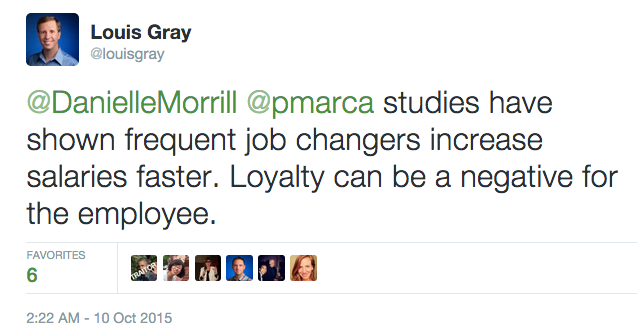
You can lament the frequent job changers,
but the company doesn’t have loyalty to you.


In business, and particularly in the insular, navel gazing, Silicon Valley, it’s easy go Pollyanna and only talk about good news. The billionaires. The parties. The VC funds and App Store rankings. On the flip side, it can be easy to demonize the bad actors or complain about traffic, and the ripples of corporate decisions. But the truth is always in the fuzzy middle.

Loyalty is wonderful when you find a passion and team you can believe in. But it can all be discarded in an instant, through a fight with a manager, or a merger or acquisition that sees you as redundant. A stock market crash. A change in heart. A bad quarter.

Layoffs happen. They can make you question everything you worked for. All the thousands of hours you put in caring about the little things that got you to where you are. All the conversations and debates that made the product you own.

You have to reexamine what’s important and decide on a new trajectory. And it’s okay to take time to both feel and to heal. Being emotional is part of what makes us human, even in a data-driven world being taken over by robots. So yes, it hurts, and you are going to be angry. Furious even. But being laid off in 2015, in an active tech job world is a much different event than in the tighter, pessimistic environments of 2001 and 2008.

Twitter’s job losses today won’t be the last we’ll hear from current and past unicorns. Those who ride the highest, like Icarus, can be burned by the sun.

Disclosures: I work at Google, which is an occasional partner to Twitter, and assumed competitor in some ways. I have friends at Twitter. And any examples I use here related to my previous work experience are intended to be accurate, even if I missed a date or anecdote.
May 14, 2015

May 14, 2015 · 4 MIN READ · BY LOUIS GRAY

Preaching to Our Choirs and Setting Up Blinders for All Else

Preaching to Our Choirs and Setting Up Blinders for All Else

Just about four years ago, Eli Pariser raised some very real flags about the "filter bubble", concerned that many of us on the Web were limiting our viewpoints by following those people and companies with whom we were most aligned. Our personal positions on politics, sports, and yes, even technology, have us in a constant state of affirmation seeking, and the desire to be part of a group of like-minded people, to reinforce our position and strengthen our decided upon beliefs, that we just might be right. And should somebody in our streams disagree with us, or launch into an off topic rant, we can easily unfollow them, and "clean up" the channel.

At the time, thanks to tools like my6sense, where I was an advisor, and later VP of marketing, I said the filter bubble was "not bad" as options were always there to see new voices. While my6sense may not have been a massive consumer success, it was amazingly smart tool that solved the problem for me. But in the ensuing time, it's become even more clear that people, through constant following and unfollowing on our many social networks, are growingly subscribed to homogenous streams, and the content creators, be they bloggers, Tweeters, photographers or anything else, are limiting the subjects they discuss, to continue feeding the faithful.

As someone who gained a following talking about tech, new tools and communities, I've staked my position on the Web as an early adopter, a cloud proponent, a measurement advocate, and engaged social media participant. I have a pretty good idea of what topics will resonate with my audiences on the various streams, and what won't. I know that my discussing items outside of my bubble are seen as noise to those who have chosen to follow me, and they vote with their engagement, or lack of it.

More than nine years ago, shockingly, I saw this coming, when I talked about a Web divided, where people who espoused a certain view would flock toward an extreme community and not be interested in the opposite view. But it goes beyond picking a side in a discussion. What's happened is that people set up blinders to avoid discussion of anything else - including the content creators themselves.

There's a lesser-used feature in TweetDeck, which enables you to view a Twitter stream through the eyes of another user, surfacing public tweets from accounts they follow. During the Baltimore riots, while a huge portion of Twitter's audience was living through the accounts through the news media, or sharing their experiences about race and police, the Silicon Valley tech bubble largely stayed silent, as if there were two different worlds that didn't connect. I could log in to TweetDeck and pick any prominent voice in tech and see that, in their streams, there was no talk of Baltimore. Or race. Or Ferguson. While people marched in the streets, and dodged rocks or tear gas, the digerati continued to talk about who was raising money, the quality of pitch decks, or complaints about housing prices in San Francisco.

My tweets about Baltimore arresting police offers or links to why the situation exploded in the first place went unnoticed - while the streams continued to debate the future of wearables or the latest entrant into Unicorn status as a billion dollar startup. It was more than an echo chamber. It was a wind tunnel. And my daily journey into Feedly seemed to be no different than any other time. The same articles were written by the same people, about the same things. The same headlines begging you to click were thrown out there, only to be reshared and retweeted in a rush for page views.

Oh. I see you're tweeting about something that's not tech.

Maybe we've grown fatigued of outrage. Maybe there have been enough dramas and disasters and disappointments that we just don't react publicly. But I think there's more to it. We have been taught, thanks to our constant focus on engagement and numbers, that we have to speak to a niche. VCs talk to VCs. Engineers talk to Engineers. Startups talk about being a startup. We're becoming afraid of expressing a position that may cause a debate. We're refusing to talk about things that are uncomfortable, and we're closing our eyes to people who don't always care about the things we do. And I think that's dangerous. It sets us up to further carve out our cliques and become closed minded.

I mildly apologize for the irregular posts here of late. But part of the reason, beyond being busy, or focused on other things, is I don't want to be more of the same. The world is a vibrant tapestry, not monochrome, and I don't want to be the thirty-second person to talk about the same things everyone else is. We should embrace a world focused on curiosity, not compliance.

October 14, 2014

October 14, 2014 · 5 MIN READ · BY LOUIS GRAY

What If We Redid the 2000 .Com Monopoly Edition for Today's Web?

What If We Redid the 2000 .Com Monopoly Edition for Today's Web?


In the year 2000, as the .com bubble was at its peak, it seemed new tech names were going to rapidly eclipse the old guard. Emails and downloads were new conversation topics, and if you weren’t still on AOL, debates would ensue over which ISP you should choose, or which search engine or portal was the best. Sun was the dot in .com and Linux seemed poised to take over the desktop. Obviously, not everything turned out that way, even if some of the names are still around, and even strong.


The 2000 .Com Monopoly Board

One of the fun collectibles that came out of this time was a .com edition of Parker Brothers’ Monopoly. Instead of properties around Atlantic City streets, you had websites. Community Chest and Chance were replaced with Email and Download cards. And you couldn’t buy property for a few hundred bucks, as everything was in the millions of dollars. Not too soon after the game came out (and of course, I still have it), the .com market was decimated, as the companies of the future weren’t built for the present. Now the game board itself looks like a relic of a short-lived era gone by.

The 2000 List of Companies and Categories


As something of a lark, and thought exercise, let’s consider who would take these 2000 era companies’ spots on the board. I’ll go first with my take on today’s cast of characters.


Dark Purple
2000 .com Monopoly edition: Sportsline.com and FoxSports
2014 .com Monopoly edition: Deadspin and ESPN.com


Commentary: Back in 2000, ESPN, as part of Disney, didn’t have a great approach at owning its web presence. It was part of the Go.com family, one reason it missed the original .com board. Now, ESPN represents sports on all media. Deadspin is an exceptional alternative with sharp commentary that is a must read for serious sports fans. (Apologies to SB Nation)


Light Blue
2000 .com Monopoly edition: GeoCities, Oxygen and iVillage
2014 .com Monopoly edition: Pinterest, SnapChat, and WhatsApp


Commentary: The 2000 edition definitely had a bent toward community. With iVillage and Oxygen, two of the three properties were focused on women. GeoCities didn’t age well and was retired. Pinterest, SnapChat and WhatsApp have become some of the fastest growing communities for pretty much all ages and both genders.


Light Purple
2000 .com Monopoly edition: Shockwave.com, Games.com and E! Online
2014 .com Monopoly edition: TMZ, Buzzfeed and Reddit


Commentary: Shockwave? Really. Let’s move on. For fun entertainment and burning hours of Web surfing, TMZ, Buzzfeed and Reddit can’t be beat. Reddit is a tough one to categorize, as it calls itself the Web’s front page, but it’s knocked off Digg, Slashdot and others for that title.


Orange
2000 .com Monopoly edition: Priceline, Expedia and eBay
2014 .com Monopoly edition: Square, PayPal and Yelp


Commentary: eBay could easily be a repeat in 2000 and 2014. Priceline and Expedia are still doing fine. But Square and PayPal are how the Web does business these days, while Yelp is often the place to go for recommendations on what to buy or where to go.


Red
2000 .com Monopoly edition: The Weather Channel, About.com and CNET
2014 .com Monopoly edition: Dropbox, Instagram and Tumblr


Commentary: About.com looks like a content farm, and while CNET’s still alive and kicking, there’s been nothing to talk about since its CBS acquisition. The Weather Channel? Please. There’s an app for that. And more than just finding content sites, anybody can create and share content globally with apps like Instagram, sites like Tumblr and share it on Dropbox. (Apologies to WordPress, Box and others)


Yellow
2000 .com Monopoly edition: eTrade, Monster.com and Marketwatch
2014 .com Monopoly edition: Wikipedia, LinkedIn and Twitter


Commentary: Monster.com and eTrade were monsters in 2000. I still use eTrade regularly, but they’re not known for their monkey-centric Super Bowl ads any more. Marketwatch is a snooze. Now, people get their financial and business data from each other via LinkedIn, in real time on Twitter, and check its veracity on Wikipedia. (Apologies to Seeking Alpha and StockTwits).


Green
2000 .com Monopoly edition: Ask Jeeves, Alta Vista and Lycos
2014 .com Monopoly edition: Microsoft, Amazon and Apple


Commentary: In 2000, Search engines took the entire final row of the Monopoly board. But the positions of Alta Vista, Lycos and Ask Jeeves weren’t strong against innovators that got stronger in the next decade. Now, diverse infrastructure plays like Microsoft, Amazon and Apple (for many reasons each) occupy this highly valuable section of the board.


Dark Blue
2000 .com Monopoly edition: Excite@Home and Yahoo!
2014 .com Monopoly edition: Google and Facebook


Commentary: That Yahoo! was the Boardwalk of 2000 is telling. Excite@Home was a $6.7 billion megamerger in 1999, but by 2001 was pretty much in steep decline. Without intending too much bias toward my current employer, Google and Facebook are the 1-2 when it comes to the Web today, from the top destinations to hours spent, tools deployed, etc - and both play a role in discovery for everyone.


Railroads/Stations
2000 .com Monopoly edition: Nokia, MCI Worldcom, Sprint and AT&T
2014 .com Monopoly edition: Verizon, Comcast, Netflix and YouTube


Commentary: Worldcom? Whoops. Nokia? Whoops. Things change, and companies don’t always adapt quickly. The megalopoly of AT&T is now most like Comcast’s ISP/cable monolith, and Verizon (including their FIOS offering) is the big carrier to be dealt with. Fighting the good fight, and using a ton of bandwidth in the process are Netflix and YouTube, which are essential media mediums on every device.


Utilities
2000 .com Monopoly edition: Linux and Sun Microsystems
2014 .com Monopoly edition: WiFi and Cloud


Commentary: We’re still waiting for the year of the Linux desktop, and Sun is now somewhere in Oracle’s beautiful campus. But while you could take a stab at a language or a platform, like Python, Ruby on Rails, or even PHP, generically its best said that the storing of data and access to that data are the true utilities of 2014. Pervasive WiFi (or 3G/4G) and Cloud power every app and every site.


Summary: The Web is dramatically larger, and more global, now than it was less than two decades ago. This admittedly English-first version of the .com Monopoly for 2014 misses out on the international communities like Baidu, AliBaba and others. There’s no place for the Uber and Lyft rivalry, and while Tumblr was included, it’s hard to put Yahoo! on the board, which probably isn’t 100% fair. I wanted to find a spot for Spotify and Hulu, but failed. I’d be ecstatic to see if Parker Brothers was up for another run at the web centric board, and you know I’d buy it.


Disclosures: I work at Google, which is a customer, partner and competitor with many of the names on this board. Putting them on a Monopoly board is not an opening for the company (or any other on the board) being a monopoly joke.

September 22, 2014

September 22, 2014 · 3 MIN READ · BY LOUIS GRAY

I Heartily Endorse This Event Or Product

I Heartily Endorse This Event Or Product

Everyone's a cynic. Or at least it can often seem that way, when the concept of 'balanced' reporting means to find the gray cloud for every silver lining, giving equal weight to unequal issues or looking for ulterior motives from well intended people who genuinely find value from products, groups or communities.

Many years ago, I made a decision to use my blog for good and not evil, per se. I recognized there was little value in tearing things down, and that my readers and I would benefit more from a series of highlights than a trolling muckery through half-finished products and half baked business models. (See: Does Negativity Deliver Credibility? If So, That's Nuts.) There are enough good companies and good products that you can showcase the very best - something I've gotten even tighter at since reducing my regular posts here to something less frequent.


But when I do find something I really enjoy, and use regularly, I want to tell you about it, and that position is a genuine one. I want you to see the same benefits I do, and give the company or service more users, improving their chance at success, and extending the network effect, which often brings me value. As +Mark Hopkins said back in 2008, regarding my consistency: "Forget product evangelist. When he likes something, he's a one man crusade."

This weekend's Twitter discussion about sponsored posts.

In a world where many people are using their streams to promote self interests, be it their companies, their stock investments, or pimping their latest book, I'm hyper aware of being trusted. My posts aren't sponsored. So this weekend, after highlighting MightyText, a personal favorite app I helped unveil and have since covered regularly, one Twitter user snarkily suggested the update was an ad, or sponsored. And that's annoying. With Twitter being at times overrun by self-promoters and shillers, it's no good to be lumped in with the dreck.

I use MightyText daily because it's an exceptionally fast way to text from my computer or tablet. I switched to Android more than four years ago because I was very happy with the product's direction and the wealth of choices available compared to iOS, let alone Blackberry or Palm. My preferring one over the other doesn't mean that your choices are bad or that I wish ill on anyone who has selected an alternative. It's just what I prefer, and I'm more than eager to tell you why.

If you're pushing products you don't actually care for, you're in danger of losing the trust earned with those in your community. Sonos and Spotify made sense to me right away. ChromeOS was alluring and is now my go to OS all the time. I've been a happy eTrade user for 15 years. Sunrun and Rachio are saving me money and helping the environment at the same time. The list of brands I've interacted with that I can point you to are many. But it's not because I have hollow self interest. If I did, you could wait to see my disclosures. That's what they're for.

Disclosures: I work at Google, which in some ways competes with Sonos in hardware, Spotify in software and MightyText for messaging. But I still love those products. And Sunrun has a great referral program. But that's not the point.

September 4, 2014

September 4, 2014 · 5 MIN READ · BY LOUIS GRAY

Striving for Streams of Serendipity or Inbox Zero?

Striving for Streams of Serendipity or Inbox Zero?

Nobody really likes spam - those unrequested commercial emails that join your email box. They interrupt you, distract you, mislead you, or maybe worse - trick you into giving up your money or personal information. And over time, most email services have been pretty good at determining just what is spam, and what's not, while we, as consumers, are getting better at refining just what content we want on all our screens, be it our email box, or our social streams.

With this experience, what we've labeled as spam now not only encompasses the obvious scam message, but practically anything that enters our view that we didn't explicitly ask for, or surprises us. Most of us living in a social media powered world have taken a lot of effort to refine our content sources, to the right sets of blogs, and the right friend groups on social networks. When we log in to Twitter, Facebook, Google+ or anywhere else, we pretty much know what we're going to get.

Many of these social networks, dating back to the first blogs, are sorted chronologically, with the newest content at the top. With some effort, you can quickly scan to where you last left off, and feel complete. There's no more to read, and you can move on to the next thing. It's a permuation of the famed "In Box Zero", which says your task is complete.

But increasingly, thanks to pressure to fill streams of less active users, or to increase engagement from regular users, it's become more commonplace to push content that's not explicitly requested into user streams. This can be "Friend of a Friend" content, like we saw back in early 2008 when FriendFeed first introduced the feature, or more recently, items that your friends on Twitter have retweeted or favorited, that Google+ friends have +1'd or Facebook friends have Liked.


It's assumed the more signals given to the network about what your friends like, the more likely it is that this piece of content is also relevant to you. It's not necessarily wrong, but it's a change, unwelcome to people who like to perfectly curate their streams - while possibly exciting to those who do want to take signals from the network - believing they aren't the one perfect arbiter on whether an item is interesting or not.

In 2008, FriendFeed spoke to this change, saying, "Our goal is to make the most interesting shared items more prominent so your FriendFeed has a higher percentage of interesting stuff and active discussions." And it worked. If I believed +Paul Buchheit had high quality interactions, I could be alerted to items on the stream that he had liked. But FriendFeed also gave me the option to turn it off, and many people did.

In 2014, Twitter is a lot bigger than FriendFeed was six years ago. It's a world-recognized stream for real time communication, so their moves get a lot of attention. Every minor change in the stream is especially scrutinized. After already taking for granted the fact that retweets from friends would be sent to my stream, the occasional tweet now appears, simply because someone I follow added it to their favorites. Unsurprisingly, this experiment, which is easy to spot on their mobile app, set the tech blog debates abuzz again - trying to figure out how it worked, and whether it was good or bad.


It's widely assumed putting content in user streams benefits the service provider. Twitter should see higher engagement, higher relevance and more clicks. For the OCD "In box zero" types, these serendipitous pieces disrupt their worldview, and, unsurprisingly, those who write about tech and social media all day are more likely to be of this type than the general population.

When +Barak Hachamov and I were working on my6sense, we were more than happy to rank social streams based on your activity and implicit interests. The solution, in my view, hasn't seen an equal, even in the three plus years it's been gone from consumer's hands. We offered a stream based on relevance, with your interests playing a huge role, a toggle to view the stream chronologically, and yes, we promised occasional serendipity to deliver surprise - to get you out of a knowledge rut, which can come from seeing the same topics debated and shared by like minded thinkers.

Relevance vs Time in my6sense

What we've learned from the Web is that we tend to gravitate to people who reinforce our own views and agree with us. Debate happens, but we don't actively seek out opinions from those with opposing takes on political, religious or even sports. (I wrote about this in 2006: Blogging Bifurcation - A Web Divided) The Web, despite being especially diverse, leads to us forming cliques, with friends, with what we read, and where we choose to congregate. Our three social pillars are what I called out back in 2009: Technology, Community, Relevancy. Most of us active in social streams have bought into the technology, and crafted our community, assuming the community's thoughts are themselves relevant. And by seeing new content, we immediately question its relevance.

For the 95%+ of people who haven't put hundreds of hours into scanning their streams to never miss a post, and who haven't taken time to set up lists, form circles, or fully understand Facebook sharing settings, the serendipity of surprise is as important as what they've explicitly asked for. While those of us on the tech edges react to the surprise with shock, we should know this is something we give in exchange for participation in somebody else's stream. The only thing I'd ask is that, like FriendFeed, we always have the option to please, kindly, be able to turn something off. Then we'll all be happy.

Standard Disclosures: I work on the Google Analytics team at Google, which provides Google+. Various services from Google partner with or can be assumed to compete with products from Twitter and Facebook. Also, from 2009 to 2011, I had a consulting relationship with my6sense as part of my work with Paladin Advisors Group. Disclosures are fun.

January 7, 2014

January 7, 2014 · 5 MIN READ · BY LOUIS GRAY

Books Step Behind the Curtain of Tech's Leading Companies

Books Step Behind the Curtain of Tech's Leading Companies


Nearly three years ago, I made myself a public promise to stop buying books, CDs, DVDs, or basically any form of media that took up any space. (See: Physical Media Has To Go. I'm Digital Only From Here.) With media stores on practically every platform, whether you prefer Apple's, Google's or Amazon's, and streaming entertainment available from Spotify, Netflix and the aforementioned three, you can get just about anything you want straight to your computer, phone or tablet. So my all digital diet hasn't slowed me down a bit.

The end of 2013 brought us an unusual array of tales on technology going behind the public faces of some of technology's biggest names, including Apple, Google, Amazon and the newest $30 billion kid on the block, Twitter. So I spent a good amount of the holiday break taking in stories, with their own various embellishments, covering the challenges of building a mobile operating system at Google and Apple, the executive tug of war and pivot of Twitter, the focus on design in Jony Ive's laboratory, and how Amazon has craftily executed on its plan to become the single store for everything under the sun.

Taking in the tales of Silicon Valley companies is something I'll likely never get bored of, even if I'm covering the news as a blogger, living the news as an employee, or enjoying the benefits as an end user. So to get all four of these books at about the same time is an embarrassment of riches.

As I've read each of the books on Google Play, I've tried to be a good Web citizen and provide a rating and a short review. If we're connected on Google+ and you look at the book on Play, you'll probably see my take. If you aren't, or we haven't synched yet, here's a quick run through of what I thought on each title. Each title links to Google Play, where you can pick it up too.

Hatching Twitter (Author: Nick Bilton)

Review: "Many characters needed to make a mere 140. Politics over tech, and very public... similar to many startups that aren't quite under the microscope."

Expanding: As someone who's covered Twitter as a blogger for some time and used the service extensively for five years, I had hoped for more insight into how the Twitter team took on technology scaling challenges, worked through product decisions and managed the fast-growing community. Bilton focused primarily on the office drama at the highest levels, and the day to day challenges seem to happen practically invisibly. Also, as noted in my review, as a veteran of some challenging political environments in startups, the executive turnover is not unique to Twitter, but it's unusual for it to become so public, or for the company to survive even with the infighting.

Jony Ive: The Genius Behind Apple's Greatest Products (Author: Leander Kahney)

Review: "Good story. Very one sided. Jony is an exceptional mind working on high quality and highly desired products. The author recaps the highlights and approaches the subject as if Apple is infallible and perfect, which get tiresome. Jony is made out to be a deity. The truth is already incredible. The fable is not needed."

Expanding: Jony Ive and Apple make incredible products. The iPod and iPhone and iMac are great examples of that. I liked Jony's origin story and how he was forged in the UK before making his way to Cupertino. What I liked less was the over the top, breathless deification of Jony that went well beyond what I felt ws necessary. It was so sugary, one had to put the book down every few minutes until you could get enough strength to start again. That's no slight to Jony or Apple, of course.

The Everything Store: Jeff Bezos and the Age of Amazon (Author: Brad Stone)

Review: "The best book on tech in 2013 An intriguing dissection and chronicling of a truly modern company's rise to market dominance."

Expanding: The story of Amazon was by far my favorite of this group. What's striking is the drive behind Jeff Bezos and team to take on incredible challenges, and just get it done. Amazon, through perseverance and ingenuity, skated through the hardest times in the Web 1.0 crash, and came out a world leader, starting new businesses and categories at a pace and scale hard to fathom. If you had to read just one of these four, I'd pick this one.

Dogfight: How Apple and Google Went to War and Started a Revolution (Author: Fred Vogelstein)

Review: "Good stories and current! Only a few obvious inaccuracies, but well intended."

Expanding: This was a fun one, as someone who prefers Android to iOS, but has been a heavy user of both. As someone who knows some more color to much of the stories, I found some of the author's summaries and shortcuts to simply be wrong. I was mostly willing to forgive that, considering the book was entertaining and insightful. I only hope the parts that I liked were true. As a Googler, it actually gave me more knowledge about individuals on the team and their own efforts that I didn't have before, so I appreciated that.

If you're like me, and you live and breathe technology and the Silicon Valley, these four books are a great way to go beyond the day to day headlines and clickbait you see on the "news of the minute" sites. If you are an entrepreneur or even just an office drone like the rest of us, you could learn something, be it the why, or the how, but you can't say any of these books left you more lacking for knowledge at the end than when you started. So check 'em out - digitally.

Disclosures: Yes, I work at Google. Google makes Android and Google Play, and could be a partner or competitor to Amazon, Apple, Twitter, Spotify or Netflix, depending on which product or feature you're thinking about.

October 15, 2013

October 15, 2013 · 5 MIN READ · BY LOUIS GRAY

You Don't Get Any Participation Medals for Just Showing Up

You Don't Get Any Participation Medals for Just Showing Up

"I need some record of you being in this class," hissed my 8th grade math teacher, looking at me and pointing to my lowly 5% grade to date in his course after ten assignments, by far the lowest mark in the class. My not so glowing 50 points out of a possible 1,000 was the product of many days' not turning in homework, as my continued refrain of "I'll get to it tomorrow" started to become an impossibility to tackle.

Each day I told myself I'd eventually get to the previous day's assignments, taking a penalty for my lateness, but part of me knew I'd just float through the day to day and try to make it up on the tests. For me, it was proving I knew the answers - conveying mastery of the subject. Yet for my grade, it was proving that not only did I know the answers, but I was willing to do the work. Just showing up wasn't enough.

For the past 15 years, I've been working in Silicon Valley, and I've encountered an incredible mix of people who perform as if they are on different gears. Some work incredibly hard, and are driven to succeed at practically any cost, refusing to let traditional limits get in their way. Others seem almost crestfallen if they can't keep up with those gracing magazine covers simply by being in the right place at the right time. And the truth is that life's not perfect. There is an intersection of skill and luck that very often sees great employees at bad businesses punished for their career choices, while less impactful employees at incredible companies gain the benefit of their colleagues' work.

From the outside looking in, Silicon Valley might look like a technology-centric Disneyland, where the future can be experienced today, where dreams can get funded, and you can't walk down the sidewalk without knocking shoulders with millionaires. But every success story you read, and those people who become household names, be they Steve Jobs, Meg Whitman, Larry Ellison or Marissa Mayer, came not as a product of pure luck, but the application of effort against risk.

Risk Is Often Required If Something Is Worth Doing

I remember sitting around our corporate boardroom one afternoon ten or so years ago, as an account manager on our team explained why we had been unable to close a once-promising deal. He said, paraphrasing with some angst, "In his business, the IT manager's job is to reduce risk. At our stage, we're all about risk." And it was true. While our more established competitors didn't have all the whiz-bang capabilities our devices did, what they did offer was a track record of success, integration with top partners, security, and all those things that moved risk out of the data center. We had to look elsewhere to find customers more willing to take a bit and absorb some risk, in exchange for our differentiation.

Which brings us back to "just showing up".

I spent my first three years in the Valley working at two very small startups. The first didn't have any revenue, and some odd ideas. When the founder was let go, the sister company asked me to stay on, and we worked hard at bringing traditional office tasks to the Web. The work was good, and our customers liked our products, but we weren't growing fast enough. When we went out to raise a $10 million B round, we came up light, and that was the end of my tenure. But as we were plodding along with our incremental growth, it seemed like everyone around us was going public, making money and buying homes - which to us was pure fantasy. Some of our best engineers took other jobs, and spoke openly about the frustrations they felt when all their friends were getting rich, while we were still bringing our food in a bag lunch and eating at our desks.

Even in a bubble, showing up wasn't enough. At my next company, where I spent 8+ years, we had enough spikes and troughs to fill a novel. Maybe some day I'll write it. We scored several rounds of venture funding, several rounds of layoffs, and filed to go public, not once, but twice. The company eventually sold for a good amount after I had left, but not before a number of upstarts had soared past us, having much more profitable exits, at valuations anywhere from 4 to 5 what our exit had been. And while we could feel bad about not having hit a home run, I was all too aware of the many other players in our industry who had already gone bankrupt, or returned money to the original VCs, lacking a business model, and other former colleagues who had bounced from company to company in search of something that stuck.

I've always been raised with the mantra that nine out of ten startups fail. I've seen other ratios with different numbers, but the truth is that the overwhelming majority of small business concepts, even those with venture funding, don't have a positive exit, and it's a much rarer one that sees the founders and employees strike it big. For every market sensation like Facebook, Twitter, Instagram, Tesla or Spotify, you have scads of others with software products few wanted, or website plays that have seen their URLs turn into dead links.

In the big race of keeping up with the Joneses, especially in an area ripe with exceptional people who have impacted history, seeing others' success can make it seem easy. Easy to start a company. Easy to start a venture fund. Easy to find customers. Easy to do practically anything. But it's not. I remember the wave of aspiring dotcom millionaires who came from around the country sporting MBAs, only to return when things got tough. And I remember the stories of former Business Development managers loading luggage at the airport when jobs were scarce. Success is not doled out equally and fairly, and the best products and best people don't always get rewarded. But the equation improves with incredible market study, exceptional effort, and the self-awareness to make change where it's required at the right time.

Do read up on the world's successful people, as I remember doing in college, checking out "The Difference Between God and Larry Ellison" from the Berkeley city library. Do make yourself aware of their smart strategies and innovative products. But don't forget the hard work and effort required that set them up with a greater likelihood to succeed. Or you'll be like I was in 8th grade -- getting dressed down publicly by my teacher who questioned why I was even there at all if I wasn't going to do the bare minimum.

Disclosures for fun: I worked at BlueArc from 2001-09 and owned options, as well as stock acquired in the company's 2005 AA round. These converted to shares when HDS purchased the company in 2011. I currently work at Google, and any references to their competitors or partners are just part of the story and presented without intended bias.