Showing posts from May 2011 (34 posts). Show all posts

May 31, 2011

The San Francisco Chronicle Launches An iPad App

The San Francisco Chronicle Launches An iPad App

While some magazine and newspaper publishers are seeing spotty results with digital editions of their content specifically tailored for the iPad, the millions of Apple tablet owners remain an attractive target for print media brands looking to make additional cash, stemming the bleeding from years of declining subscribers and advertising dollars.

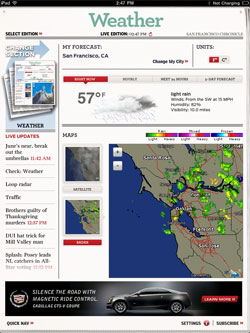
The latest entrant is the Bay Area's own San Francisco Chronicle, who introduced its iPad app today, free to subscribers, but premium for all others, bringing the full content of the day's paper (and editions from the week prior) into your hands without the complementary ink and subsequent visit to the recycle bin.


The Chronicle Front Page on iPad, and Browsing Previous Editions


The Chronicle's iPad app delivers edition integrity for the day's paper, containing all stories from all editions, but also features a "Live Edition", marrying the existing content with real-time traffic, weather and news updates. This essentially provides the best of both worlds, letting you meander the paper as you would traditionally, while also getting the benefit of being Web connected.


The Chronicle's Sporting Green Section and a News Story


The application looks and behaves like a standard newspaper, with lead stories, backstories on subsequent pages (a swipe away, of course), and more details from each story continuing on the jump (newspaper parlance for continuing on a later page). But visual perks to the app leverage the fact it's a digital edition, including a sectional carousel that you can navigate left to right (or the reverse) to browse from Business to Sports, Obits and the front page, for example.


Browsing Sections on the Carousel and Seeing Live Traffic


For existing paper subscribers, the new app is free. For those who don't get the paper, after a free 30 day period, access is priced at $5.99 a month or $59.99 a year. This compares to $99 a year for full access to the paper's online edition, or $9.75 a week to get the paper home delivered, Monday through Sunday.


Checking the Current Weather Radar and Sharing a Story to Twitter


With the exception of the controversial The Daily and national news media apps, like those from the New York Times and Wall Street Journal, the most lauded media apps have been almost entirely social, with Flipboard being the most widely known, followed by Zite and others. The San Francisco Chronicle's app is not designed to bring in social content, but sharing outward to Twitter and Facebook is integrated easily. Once your credentials are included, you can share out using the Chronicle's custom URL shortener. Meanwhile, if you are going to be offline, you can download up to ten stories for local reading.

The app itself is free for download, outside of the aforementioned charges. Each page of the app contains a standard horizontal Web banner ad, which no doubt brings in a few dollars to the paper as well. If you're in the race to kill of physical media like I am, moving the Chronicle to your tablet certainly helps in this quest. There's not yet an Android option and the company hasn't announced plans to develop one yet.

Minno Rebrands as BuySimple, Raises $700k Seed Round

Minno Rebrands as BuySimple, Raises $700k Seed Round

Two weeks ago, I highlighted Minno's integration with SoundCloud for micropayments. The new service, founded by a pair of ex-Googlers, is hoping to tap into the growing market for in-app payments and premium social games and solve the complexity presented by today's solutions.

This morning, the company is announcing a not so micro boost to their chances with the closure of a $700,000 seed round, including contribution from Farhad Mohit, the founder of Shopzilla, Jack Abraham, founder of Milo, and GRP partners. In parallel, the company is also changing its name to BuySimple and setting up shop at http://www.buysimple.com.

The name change is more than cosmetic, helping the company evade a cybersquatter who thought Minno.com was worth exchanging high five figures for, which would certainly have put a dent into the seed round. It also captures the hope that Noah Ready-Campbell and Calvin Young have in making the long-discussed but rarely done well action of micropayments a simple one.

BuySimple Integrated on Hacker Monthly

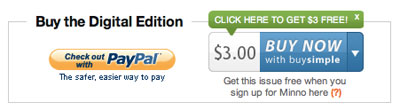
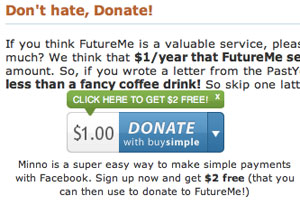
Why will BuySimple be easy where other offerings have failed? In part, users don't need to create new accounts to use the service. They can tap into their existing Facebook accounts today, and imminent support for OpenID providers is promised. Merchants like SoundCloud and others are seeing the opportunity and already signing up. Early partners also include Hacker Monthly and FutureMe, who have posted buttons on their sites to enable users to donate using BuySimple or purchase digital editions of their magazine, right alongside the ubiquitous PayPal buttons.

BuySimple on FutureMe

Unlike PayPal, who is tightly integrated with parent company eBay for auctions and all other sorts of online purchasing, BuySimple is focused on micropayments and making the process easy. During a beta period, the company promises that qualifying partners can tap into the product free. New users get two dollars credit on initial use.

BuySimple is not affiliated with BankSimple, the new banking startup founded by former Twitter engineer Alex Payne.

May 30, 2011

Quora Makes It Harder to Hurt People's Feelings

Quora Makes It Harder to Hurt People's Feelings

While Wikipedia is well-known for its edict against self-aggrandizement and editing one's own biography, question and answer collective Quora looks to be going quite a bit in the other direction, not just permitting people to manage their own reputation on the site, but to outright push for deletion of topics or questions they don't like. In a new policy issued late last week, the service says not only do they want people under discussion to automatically gain moderation of such topics, but any question that is "hurtful or mean-spirited" simply isn't allowed. So no more questions about why specific people are such jerks, you mean Quora-ites.

The policy outlines that it is intended to protect individuals fairly and equally, regardless of their public stature, so Mark Zuckerberg and Ron Conway have equal access as John Smith. Don't know John Smith? Well, he has as much a chance to defend himself on rude comments on the site directed his way as the next guy.

So why is Quora making this move? Is it to whitewash the site of any negativity? They don't seem to believe so, but they do recognize that some high profile users will use the increased ability to moderate, to "remove questions that other users would be interested in learning about," as Marc Bodnick adds, "We believe that this risk is worth taking in return for the benefits we achieve..." in line with the company's mission to create the "best database of human knowledge on the Internet."

While running from the world of libel and slander is laudable, one has to assume that negativity exists in both the real and virtual world, and it's possible that negative feedback related to individuals could be valuable, especially as the word "best" is so subjective. But their goal is to keep the content on the site relevant and valuable.

Oddly, despite focusing on equal protection under the rules, the change is clearly targeting the famous and semi-famous alike, closing with a hope that "Quora will remain a site where there is not much gossip about the personal lives of well-known individuals," as Bodnick adds, "Internet users have many other alternatives for this kind of content."

The move follows another controversial move earlier this month, when the site disavowed its initial position against self-promotion.

May 28, 2011

Youtify Turns YouTube Into Your Music Video Jukebox

Youtify Turns YouTube Into Your Music Video Jukebox

YouTube is much more than a repository for amateur videos and bloopers. The video giant is the second largest search engine for the Web, a practically endless treasure trove for TV clips of all types, and unsurprisingly, heaven for music video promoters and fans. A cool site called Youtify (YouTube + Spotify, get it?) launched this month to tap this resource, letting you build your own playlists, search for your own music, and pretty much make the Web your jukebox. Even if you don't want to watch the videos, the music alone is great.

Available both as a stand-alone Web app (at www.youtify.com) as well as a Chrome browser app, Youtify transforms your Web browser into something looking much like the iTunes music player, prepopulated with two playlists: "Top 100", showing the usual popular fare from artists like Beyoncé, Katy Perry and Lady Gaga, and "Best of YouTube", which highlights fan-submitted music (like Super Mario beatbox and ukulele the beatles - obladi oblada).

Searching Youtify for Underworld Turns Up Scads of Videos

Every link plays the music video in the bottom left corner of your browser (like iTunes does in its music player) and has the option to expand to your full screen. You can also right-click and go to the YouTube video directly.

The Top 100 Youtify Videos Are Names You Would Recognize

While that's fun, what's even better is when you search for your favorite music. Even a techno geek like me could pick up hundreds of tracks (well, music videos) from bands like Chemical Brothers, Underworld and Daft Punk. If a band has ever made a music video worth playing, it's on YouTube. You can create and save playlists, and search playlists across the network. The great part of that is instead of recreating the playlists for each artist, it's possible they already exist somewhere. Searching an artist name can turn up dozens of playlists, each with dozens of videos already there.

Building and Playing a Youtify Playlist

With MTV getting way the heck away from its initial mission, YouTube has taken over as the premiere venue for music videos on the Web, and possibly, all media. Youtify makes finding those videos and the music behind them fun. While it's not going to replace your music library app (be it Spotify, iTunes, Google Music or something else), you'll definitely want to check this out. Just don't plan on being extremely efficient at the office while doing so. Find it at http://www.youtify.com.

May 27, 2011

How to Scrobble Your Google Music Plays to Last.fm

How to Scrobble Your Google Music Plays to Last.fm

Google Music is very much a beta product, but one that is going to get a lot of attention as it becomes more widely available, competing in the online music world with Apple's forthcoming cloud music player, Amazon's cloud player, and Spotify, which thus far has focused on desktop or mobile applications to play on-demand tunes.

After taking a few days to upload my music to the cloud, I'm enjoying getting access to my tunes on any computer I want, from practically anywhere. But the service doesn't do a few things that are practically a must for me - first, update Last.fm with my listening history, and second, play to my Sonos S5 setup at home, leaving me to listen through my laptop or phone's speakers.

Last.fm integrated into my Google Music Player

After politely venting about these product holes on Twitter this morning, the first of these two holes was solved. Daniel Slaughter, a Web Developer at Grand Valley State University in Michigan alerted me to a project of his that brings Last.fm scrobbling to Google Music, letting the OCD side of me enjoy the music again, while keeping my statistics up to date.

Google Music Player updating Last.fm

His project, simply titled Google Music With Last.fm, is a script that runs on FireFox 3 or 4 with Greasemonkey installed, or of course, Google Chrome. To get it running, I downloaded and ran the script, and a new Last.fm section showed up in my Google Music. Once I had authenticated the application to update my personal Last.fm account, the song plays and history started to rack up.

If you're one of the early folks to gain access to Google Music Beta, and you miss the Last.fm integration that practically every other music player (including Spotify and iTunes) offers, you'll want to get this script going. Very easy to add and very clear to see the benefit. Nice work, Daniel.

Bre.ad Rises in June, Adding Billboards to Social Sharing

Bre.ad Rises in June, Adding Billboards to Social Sharing

Everybody and their mom has a URL shortener these days. With 140 characters being the new 1,000 words, shrinkage is no longer a bad thing. But not all URL shorteners are the same. Bre.ad, which promises it will be opening to the public in June of this year, gives its users an option to deliver a customized digital billboard attached to every share, be it for a favorite brand, cause, charity or anything else. Have something to promote as well as something to share? Bre.ad hopes you'll join their bakery.

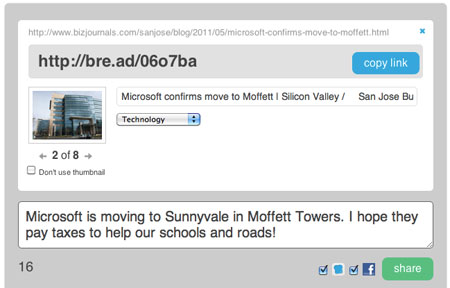
Bre.ad enables you to share to three places - their own site, aggregating all shares within the network, ordered by chronology, as well as the standbys, Facebook and Twitter.

I Make a Toast to Charity Water

Before you share on Bre.ad, you first select an interest, brand or charity that you want to promote to your friends and make "a toast" explaining why you selected that cause. Having selected this promo, then you're ready to bake some bre.ad links.

Sharing My Link to Bre.ad

From that point, sharing links is pretty similar to other shorteners, like bit.ly, goo.gl and the rest. Copy the original link, enter accompanying text, and you're on your way. But Bre.ad also lets you pick a thumbnail for the share and a category, helping the bre.ad network know how your link should be categorized.

The resulting Tweet and Link. 

When friends bump into your bre.ad links on Twitter or other services, before they reach your link, they see your promo, which can last five seconds. For me, I picked Charity: Water, the fast-growing and incredibly interesting charity that's bringing clean drinking water to places that need it. For you, you might pick Apple, Nike, Lady Gaga or whatever you find interesting.

Think your connections won't mind a small ad before your content? That's what Bre.ad is betting on. You can sign up for their beta now. Doors are opening soon.

Zerply an Interesting Alternative to About.me, LinkedIn

Zerply an Interesting Alternative to About.me, LinkedIn

The market for centralized indentity-driven personal profile pages is getting increasingly interesting, with players like About.me (see writeup) and Google (see writeup) in the mix alongside established social networks such as LinkedIn, Facebook and Twitter. One of the newer entrants, nearing exit from private beta, having recently joined the well-regarded 500 Startups accelerator, is a service called Zerply, who aims to connect a hybrid of your professional background with your social profiles.

Like About.me, Zerply profiles are tightly designed. Unlike About.me, which relies heavily on creative background art from the profile owners themselves, Zerply presents multiple themes to select, and once you've provided your social profile accounts and vacuumed up your professional history from either LinkedIn or Facebook, lays out the content in a pleasant way.


Zerply profiles lead with a short one-line description, as you see in most places, including Twitter, and a short bio, which can be anything you like of course. Visitors can download your vCard, email you, or check out your activity from around the Web. Dozens of social sites are supported, including all the regulars.

One's profile is divided into three portions:
  • The Basics
  • Experience
  • Education
The basics is your bio and social networks. Experience includes your employment history. Education includes your degrees. If your LinkedIn already has all this, importing is a breeze, or you just add it yourself. Just takes a few minutes.

Setting Up Zerply With Services and Interests


Zerply bills itself as "The easiest way to present yourself professionally". It is pretty easy, to be honest. And it is fairly professional. Better looking than LinkedIn, more professional than About.me, reaching a safe middle ground. Of course, it helps Zerply that most folks have already added information about themselves in third party services, so importing is simple. Otherwise, data collection still takes time.

Pulling In My LinkedIn Profile to Zerply

But where they have a distinct disadvantage versus About.me is in the naming. About.me has a smart way to tell people about you. Zerply is a lot less catchy, and it will take some effort for people to do the crazy thing I did, like changing my Twitter "about me" link to Zerply over one of the other sites. Google, Facebook and LinkedIn are no slouches either when it comes to centralized profiles.

Want in to Zerply? I do have a few invites, and you'll get some too, once you sign up. Start with this URL: http://zerply.com/invite/6ANB7VPDCWTz1ng.

May 25, 2011

Social.com Domain Is Up for Auction: Who Will Bid?

Social.com Domain Is Up for Auction: Who Will Bid?

After owning what would seem to be an attractive and much sought-after domain name, social.com, for more than 15 years, the current owner, Scott Carter, is passing the torch to the highest bidder, after a few halted attempts to drive value from the premium URL didn't take off. Scott, who was the creator behind BigTweet, who I covered back in 2008, is now putting the site up for auction, which might be of interest to any number of startups, established social media players, daily deal flingers or free e-mail accounts.

In 2010, BigTweet converted to Social.com, acting as a bookmarklet that could post to downstream sites (such as Twitter and Delicious), without being considered a competitor to Ping.fm (owned by Seesmic). But that didn't prove lucrative.

Another pivot later, earlier this year, Scott and I traded emails, where he told me he had moved Social.com to act as a multi-user Wordpress site, with users gaining their own social.com as a subdomain for their blog. As he said in March, "Still getting started, so I haven't spent much time promoting it."

So today, it was finally announced the domain itself was up for auction. As Scott wrote, "I've tried a few ideas with it, but never quite found the right way to develop it ..." and on June 8th, Social.com, along with other premium domains, from Data.com, Skills.com, and HorseRacing.com, is going up for bid in an extended auction at the DOMAINfest Barcelona Auction Series.

While I doubt social companies with major brand names (Twitter, Facebook, LinkedIn, Google, etc.) would be interested, maybe others would? Maybe LivingSocial wants Social.com? Maybe SocialText wants Social.com? Maybe there's a new aggregation site that would love to be Social.com? Maybe MySpace will rebrand again? Who knows. Maybe Klout gets Social.com and Data.com and has a field day? We'll find out when the auction completes on June 22nd.

Teens In Tech Announces 2011 Conference, Incubator

Teens In Tech Announces 2011 Conference, Incubator


As you know, one of the companies where I sit on the board of advisors is Teens In Tech, the youth geek oriented startup founded by Daniel Brusilovsky. The company has seen some changes in the two years since I partnered up with Daniel and the rest of the team, but the mission remains the same, to bring value to teens looking to get support through community, peer networking and industry advisory. Today, Teens In Tech is announcing their 2011 conference, scheduled for August 5th in Palo Alto. This comes on the heels of the launch of the company's Incubator program, which will help cultivate some exciting startups born from the minds of the next generation.

In the mold of Y! Combinator, TechStars and 500 Startups, the eight-week Incubator program kicks off on June 20th at Appcelerator in Mountain View. Five teams have been selected to participate, who you will no doubt hear about next month and beyond.

On August 5th, participants in the incubator will present as part of a Demo Day at the historically renowned Xerox PARC campus in Palo Alto, alongside this year's conference - which should be a highlight of the event. In addition, the event will feature speakers from Mozilla, Eventbrite, Audrey Capital, Flexibits, Cortex and others. Should be a great day to invigorate teens who are pushing to enter the fast-moving world of startups.

If you want to attend or know somebody who should, we'd love to have you there. Early bird tickets are available for $30 with tickets closer to the time of the event going at $40.

Quora Extends Mobile Reach With SMS Question Posting

Quora Extends Mobile Reach With SMS Question Posting

Quora, the nascent question and answer site founded by a small team of former Facebookers, has expanded its mobile capabilities in the last week with the addition of posting questions by SMS, letting you interact with the service via text message, starting initially with US support. While remaining primarily desktop Web centric, this addition opens the door for mobile question posting for impulse queries, and mirrors the heavy reliance on SMS from another Valley high-flier, Twitter, who continues to count its texting users among the most active and most loyal.

Quora, true to form, has made the process of posting questions relatively simple, with single keystroke responses interacting with the system.

   
Once Confirmed, I Posted a Question to Quora on SMS


As with the standard product, Quora abhors duplicate questions. Ask a question via SMS, by texting your question to the Quora service (having first added your mobile phone via the site and confirming it on the handset), and Quora will ask you whether you want to follow a similar, existing question, or post the question net new. Not sure if your question has already been submitted? Just enter "M" for More, or click any of the numbers to toggle through (and follow) similar queries.

   
Quora Prompted Me to Follow Other Questions or Add It


I tested the service tonight, opting to start with a simple question.

I texted "What is the average lifespan of a beagle"?

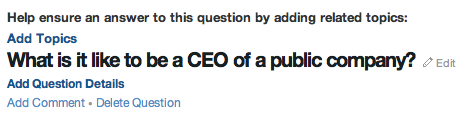
Quora whirred into action, suggesting instead "What is the average lifespan of a blog?" and "What is the average lifespan of a race horse"? Opting for more got me "What is the average lifespan of a cell phone?" So there's some work to do. I changed the topic to be more tech-centric, where Quora has thrived, asking instead, "What is it like to be the CEO of a public company?". Unsatisfied with some of the preexisting questions, I just entered "A" to add my question, and it was posted.

   
Posting a Question about Being CEO of a Public Company Via SMS


Assuming you do post your question on Quora via SMS, they promise to extend the conversation in the same way. In a post introducing the feature, Shreyes Seshasai wrote, "When you select a question, we'll send you a summary of the top answer on the page, along with a link to the full question page so you can view it in your mobile browser. It's a quick and lightweight way to check answers on the site."

The Question Gets Posted to Quora As Any Other One Would


Quora has lofty aspirations. Making the product more mobile and pervasive, including this introduction of SMS support, will absolutely help. While I didn't find beagle to be the equal to blog or race horse, that's something the service will likely improve on with growth and more data being added to the system.

To find out more on Quora and SMS, check the initial post from last Thursday.

May 23, 2011

Honeycomb Plays Well on Samsung's 10 Inch Galaxy Tablet

Honeycomb Plays Well on Samsung's 10 Inch Galaxy Tablet

My Honeycomb Home Screen Littered With Icons, Widgets

A 2010 convert to Samsung's 7" Galaxy Tab, I've long grown accustomed to Android on my tablets, and slowly watched my kids take over the use of our first generation WiFi iPads. While Google pushed manufacturers (and consumers) late last year to wait for the release of Android 3.0 (Honeycomb) for tablets, I got used to the build more appropriate for phones, in Froyo 2.2 on my Tab, and haven't had complaints, taking the 3G-enabled device with me practically everywhere, even in my suit pocket at church on Sundays. But when Honeycomb hit stores on the Motorola Xoom, I had to check it out, and I didn't fall in love, although I certainly tried. Despite three separate trips, to a Verizon store, to Best Buy and Staples, I had a hard time with the clunky hardware and what at the time was a nonintuitive interface.

My Apps on Honeycomb

In the ensuing months, Apple introduced the iPad 2, improving the product's hardware, and more manufacturers (including Samsung, LG, Acer and more) have delivered on their promise to build Android tablets on Honeycomb. Google I/O attendees were treated to free 10 inch Galaxy Tabs from Samsung, and this device is the one it seems Honeycomb was waiting for - even if it still doesn't fit in my jacket pocket. The device is extremely light, and Honeycomb has grown on me - with new features that make it fit even better between the world of mobile phones and the world of laptops.

The Gallery App on Honeycomb With a 10 Inch Screen

As with the standard Android interface I've been using for about a year, Honeycomb features not just the option to litter your screen with application shortcut icons but also, widgets, customizable by the app developer, with varying levels of interactivity, be it to change tracks on Google Music or Spotify, view new messages in your Gmail or other POP3 email accounts, or to track social media updates with your favorite client. Honeycomb assumes more real estate, and hopes you'll use it. The Galaxy Tab 10.1 features up to five home screens and widgets for practically every core app - from bookmarks to your calendar, the Android Market, and YouTube. YouTube and Market use a new three by two widget that rotates content to bring interesting items to the front. Beyond widgets and shortcuts, you can also post shortcuts to bookmarks, contacts, directions, email accounts, Gmail labels and other items on your home screen, keeping the display flexible.

Android Market for the Honeycomb Tablet and Featured Apps

The Honeycomb hardware to date has done away with hardware shortcut keys, putting software keys on the device for the home screen, back button and a new button that shows your last five active apps. This wouldn't make too much sense on a phone, but on the tablet, it leverages Android's fast switching and multitasking capabilities to bring you in and out of applications rapidly. Much like Command-Tab or Alt-Tab on Mac or Windows, this minor piece becomes used a lot.

Google Music Beta on Honeycomb on the Tablet

Android also continues to excel on bringing important notifications to the front without interrupting users. New email messages, Foursquare checkins and Twitter replies all cycle their way to the top, in the lower right hand corner of the device, instead of a top-down menu as Froyo and other 2.x based phones have offered. If one catches my eye, I just tap the alert and find myself in the appropriate app, with the option to return to my previous task quickly.

9 Innings from Com2US on the 10 Inch Honeycomb Tablet

To date, most of the criticism for Honeycomb has focused on the number of applications for the device. The good news is that practically all applications built for Froyo and the entire 2.x line work on Honeycomb, even if their rendering is not ideal. But this is like saying the iPhone apps all scale well to look good on the iPad, when of course, they don't. Most applications scale up and stretch out, but others that hardcode their apps for a 4 inch screen look pretty bad, filling the rest of the space with black pixels. This is true with the Mint.com app and a Texas Hold 'Em Poker game that worked great on the 7 inch Galaxy Tab, but are less great on the 10 inch tablet.

Reading a Book from NOOK on the 10 inch Galaxy Tab

Meanwhile, as I'm waiting for developers to build for Honeycomb and bring their apps, I was surprised that not all of my apps made the upgrade. For example, MLB At Bat is on my phone and my Galaxy Tab 7, but is marked as incompatible on the Galaxy Tab 10.1, so I can't get the app from here to there. Even if the experience is not perfect, it's not clear why it's blocked from installation. 

Duck Hunt is back and on the Honeycomb Tablet

That said, all the standard Google-centric apps look great on Honeycomb, from a tablet design for Gmail to Google Calendar, the included browser app and Maps. I've read entire books using the NOOK app from Barnes and Noble on the 10 inch tablet, and already wasted too many hours swinging at bad pitches with the 9 Innings baseball app from Com2Us. If sports isn't your thing, there's always the 8-bit NES throwback, Duck Hunt, which only asks you to shoot with your finger, leaving your trusted Nintendo Zapper behind.

My Gmail on the Honeycomb-based 10 inch Galaxy Tab

Clearly, I am living in an embarrassment of riches with my 10 inch iPads and Galaxy Tab strewn about next to the 7 inch Galaxy Tab and 7 inch NOOKColor in our home alongside our unfair share of laptops and phones, but despite this luxury, there is a growing use case for each device - as I take one for one use and put it down for another.

The 10 inch Galaxy Tab, running Honeycomb is, like the iPad before it, a great media device, for books, photos, video and music, with instant connectivity to cloud apps. It doesn't fit in my pocket, so I won't be taking it everywhere I go, and it didn't come with 3G attached, making me somewhat tethered to WiFi. But the stutters and frustrations I felt with the Xoom in my testing, plus its bulky form factor, are solved with Samsung's device. Honeycomb has some continued opportunities for improvement in simplicity, and developers are going to need to get their act together for the new form factor, but the device is quite nice - raising the bar for what tablets that don't bear the Apple brand are expected to deliver.

Disclosure: As previously noted, the Galaxy Tab 10 inch was distributed freely to Google I/O attendees, myself included. All other devices mentioned, including my Android phone, the NOOKColors, iPads and Galaxy Tab 7, were purchased on my dime. 

While Amazon Chokes on Lady Gaga, Spotify Flows

While Amazon Chokes on Lady Gaga, Spotify Flows

While Amazon is struggling to keep up with demand for their near-free $.99 sale of Lady Gaga's "Born This Way" album, frustrating many people, it's interesting to note that Spotify, the on-demand streaming music service based in Sweden, has had the full album, plus an additional set of tracks, available for free to Premium users for some time, and there are no issues in getting to the music, just another great example of why US customers who don't yet have access to the site, are missing out, and why heavy-handed tug of wars with the music labels involving Google, Apple and Amazon are keeping the best tech away from users, thanks to record executives hoping to keep their inflexible business models from being eaten alive.

With today's headlines focused on Amazon's 'exclusive' offer, and the resulting server meltdown, it's worth noting that Spotify users actually gained access to the same set of music back on Wednesday, May 18th. In fact, the album is aged enough in Spotify's eyes to no longer be included in their "Brand New Albums" section, replaced by even fresher tracks.

While access to the service here in the U.S. is still limited to those with explicit access, it continues to the best streaming library in the world, this just being the latest example. Don't love Lady Gaga? You don't have to listen, but at least on Spotify you can.


The Amazon offering provides 14 tracks plus a digital booklet for $.99. Peter Kafka notes Apple's iTunes offers the 22 song special edition for $15.99 and the standard album for $11.99. Spotify subscribers paying $9.99 a month (as I am) get it for an additional $0.

May 20, 2011

Samsung 2012 "Cloud Phone" to Tap Chromium or WebOS

Samsung 2012 "Cloud Phone" to Tap Chromium or WebOS

At a Samsung Mobile Town Hall held in Sunnyvale yesterday evening, one of the company's executive vice presidents, Ho Soo Lee, EVP of the media solution center for Samsung, held court with developers and aspiring partners or future employees to highlight Samsung's position as the fastest-growing smartphone vendor, which has helped play a role in the company's growth to more than $130 billion in revenue for 2010, up 20 percent from the previous year, along with $15 billion in profit. To keep the company's position accelerating, Samsung is continuing its multiple mobile OS strategy, with Android and Bada being its one-two punch in 2011 with Windows Phone 7 also supported. But come 2012, the company has its sights set on a phone that is completely cloud-centric, much like Google's Chrome OS. To get there, Samsung is looking to tap Chromium, and has even considered approaching HP to see if they are willing to license WebOS.

Samsung, along with Apple and HTC, is one of the few handset manufacturers showing considerable market share growth in this competitive landscape. They achieved this with rapid release of handsets for a wide range of countries globally, support for multiple carriers in each, and platform leadership on both quality and quantity. The company's Galaxy S II model and the Galaxy Tab series (7 inch, 8.9 inch and 10.1 inch) are the leading options on the Android platform, going head to head with Apple's iOS. While the company has come under some criticism for slow release of Android milestone upgrades, and its proprietary approach to Bada, the company has achieved a 12.2 percent market share in smart phones, putting it in the 4th position worldwide.

As Lee explained to the packed room in Sunnyvale last night, the company's roadmap hopes to bring cutting edge features like WiFi display from the phone to the TV set, WQXGA support for high resolution tablet displays featuring resolution of 2560 x 1600 pixels, 3D accessories and smart phones. One new wrinkle is their stated plan to bring a "cloud phone". Lee said that at this time, Chromium, the open source Web browser project from Google Chrome, would be considered, adding "we are thinking about how to get WebOS right now", an interesting wrinkle, considering HP hasn't yet announced plans for licensing the mobile OS, born out the Palm acquisition, to date.

On the question of slowed updates to Android, and why the company isn't offering a "stock Android" model, Samsung said their strategy is to have their own user experience (UX), believing that their proprietary UI (called TouchWiz) "is a benefit to Samsung's customers". They stated that there is a lot of commitment internally to the company to improve on their pace of upgrades, but also that there is a lot of work to test the upgrades against devices and carriers globally, in addition to the physical act of pushing out the upgrade.

The company called the mobile phone "the center of your social life", referring to it as the most important communication medium, with mobile devices getting stronger as cloud capabilities advance. But they also understand that it takes more than feature one-upmanship to gain customer loyalty - something Apple has proven for decades.

"People don't care about the technology." Greg Dudey, Vice President of the Visual Displays UX Lab at Samsung said. "They care about what it can do. The next two years, we see we are going to be combating the technology experience, but after that, the ecosystem experience."

May 19, 2011

Google Music Move: Days of File Transfers Ahead

Google Music Move: Days of File Transfers Ahead

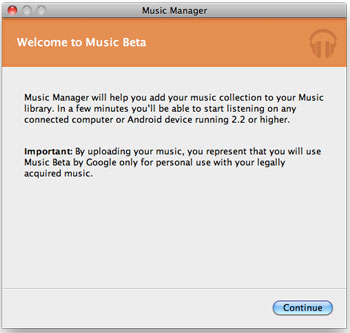
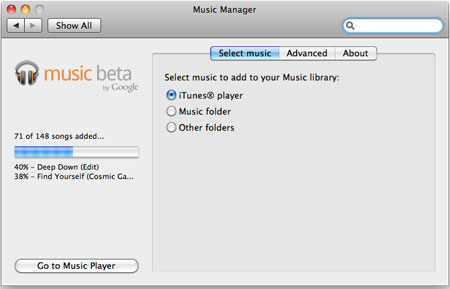
Around noon on Wednesday, I fired up my old laptop, downloaded Google's Music Manager, and started the process of uploading my vast, but long-neglected, music collection to the cloud. Assuming the migration is complete, I'll have a Web-based repository for all the music I've purchased, as a companion to all the on-demand music I can find using Spotify - a match I like a lot. More than 30 hours later, thousands and thousands of my songs are on Google Music in beta. Yet, there are thousands more to go - highlighting a process that may be a challenge for users who may consider making a similar transition. And once they are uploaded, it's not clear if there's a way to get them down from the system if I want to move again.

My blogging colleague MG Siegler, he of ParisLemon and TechCrunch, argued yesterday that Google's move to open up a music locker (as Amazon did) without first gaining expensive deals with the music labels, has essentially locked up the market for Apple, who is quite unwilling to lose their leadership position in the market. He argued that the complexity of moving one's library to the cloud, instead of a simpler, faster way of matching your library to a known database and providing you access (as LaLa once did) would be a major stumbling block for the curious consumer. Putting MG's pro-Apple bias aside, there is some truth to that, if a known brand has a simpler solution and an official relationship with approved music downloads, the value to the cloud locker from a competitor is not obvious.

Downloading 1,945 high quality iTunes Plus tracks

As you know, migrating one's library out of iTunes and to a secondary location, be it Google Music or anywhere else, cannot happen for DRM-locked content. To strip one's iTunes library of the DRM, one must first pay Apple upwards of $.30 per track to upgrade to iTunes Plus. For a library like mine with thousands of tracks, this upgrade can (and did) cost hundreds of dollars - a steep pair of handcuffs, considering one doesn't get any new music in the deal. Converting to iTunes Plus doesn't actually upgrade the songs directly, but downloads brand new tracks in their place, and you have the option to delete the old files.

With a goal of completing this process, come Hell or high water, I gave Apple more than $340 yesterday to upgrade 1,945 tracks - at the same time as I had already told Google's Music Manager to upload my non-DRM tracks to the cloud. After about an hour, Apple sent me an email to say my tracks were ready, and I could begin the downloading process. So I set my old Mac aside, and put it to work, downloading the nearly 2,000 tracks at the same time as Google was uploading thousands more. Good thing I have unlimited bandwidth...

Google's Music Manager Has Uploaded 3,000+ Songs So Far

With my iTunes library now fully Plusified, Google Music has full go-ahead to get my music and that's happening. At this pace, it's likely the first pass of my full library will complete mid-day or late tomorrow, about 48 hours after I started. This process would take longer if it were on my primary machine, doing other tasks, or constantly interrupting the move by putting the machine through normal on/off paces.

Assuming the process completes, I am excited to have all my music in the cloud, searchable and playable from any computer where I am logged in. But as one person asked me, what if Google Music goes the way of Google Wave? I don't think it will, of course, but what if I want to take my more than 50 gigabytes of music down from the cloud, back to a desktop, or move from this service to another?

My Top Songs from iTunes Are Making it to Google Music

One admirable passion Google promises is the support of Data Portability. Its Data Portability Project is focused on letting users move data in services and out of services. You can see the conflicts over data ownership flare up especially in the battle with Facebook, who let users pull in Gmail contacts, but didn't let Google do the reverse. So I am a little surprised to see there isn't yet a way to bring data out of Google Music. Yes, it's brand new and early, but there's no talk, unless I missed it, about getting your music downloaded - be it one track or many. You can delete songs from the service. You can edit them and all their metadata, but you can't move them once they're uploaded. This means if you don't fully believe that Google Music will be around forever, you might still want to keep a second copy somewhere.

There is no doubt a considerable back story to the labels' fights with Google, Apple, Amazon and Spotify. I've heard people say there are hundreds of millions of dollars being promised up front and the biggest payer wins. Google said at Google IO that the expectations were prohibitive and they couldn't agree to such arduous terms. If Apple offers a comparable service on the cloud that knows one's iTunes purchasing history, and can eliminate the need to upload and store songs, but get the benefits of cloud, it will have a leg up in usability. I expect in coming months we will hear more from the Google Music team about improving migration and just how we can be sure we can always own our music.

Linktamer: Coming Soon to Find Your Best News Links

Linktamer: Coming Soon to Find Your Best News Links

While we're on the topic of personalization and filters... there's a new project called Linktamer currently under construction that looks like it could be a Web-based tool to find the most interesting stories from your feeds based on your interests, relying heavily on your direct feedback to stories, and the tags describing them. While there's been no mention thus far of the service's plans for a public debut, a Twitter account (@linktamer) exists, possibly waiting for the day it's officially unveiled.

Like many other services, including my6sense and others described in last night's post, Linktamer breaks the latest news into two separate streams - that of the most recent content, and that ordered by your own assumed preferences, garnered based on inputs to the system. Every item contains the option to give future similar stories more value, or less, and with more development, it looks like there is future opportunity to sort stories by specific topic and drill down to find the best by subject, although that's not yet enabled.

Recent Items Pouring into Linktamer Without Assigned Scores (Not Logged In)

Much like the prototypical RSS reader, Linktamer streams in items, each providing a publish date, a headline, and a source. Linktamer extracts a lead graphic for those stories that have one, extracts about a dozen tags that describe the article, and delivers a score called "Signal", an analysis of how interesting that story is to the logged in user. Stories with no relevance have a rating of 00, with most relevance increasing presumably to 100.

Top Stories On Linktamer With Signal Scores
(Options to Provide Feedback Illustrated On Right)

To provide feedback for items in the system, there are four actions for each post on Linktamer. One can like an item by clicking the heart symbol, click the X to say you are "not interested" in the post (or others of its type, click the checkmark to indicate it has been read, or the arrow to share it - most likely to external social networks (though this is not yet implemented).

Items Sorted by Time Get Scores, If Logged In As a User

What Linktamer provides now is a raw hint at what could be another interesting alternative to personalized RSS streams - one that doesn't look to rely heavily (if at all) on collaborative filtering or simple popularity as many other services do, and starts with the Web while many others have kept their focus on mobile devices. The project appears to be thee brainchild of Alan Grow, who may emerge to claim it as time to launch approaches. Looking forward to seeing this one develop.

Disclosures: As noted often, I am vice president of marketing at my6sense, focused on personalization of news and social streams, much like Linktamer's future mission could be.

May 18, 2011

Why The Filter Bubble Is No Bubble and It's Not Bad Either

Why The Filter Bubble Is No Bubble and It's Not Bad Either

Multiple Factors Go Into A Solid Personalization Service
(from my6sense's internal slide decks)

Eli Pariser, former Executive Director of MoveOn.org, is a smart guy who knows the Web very well. His most recent work takes on the movement toward services that adopt algorithm-driven personalization to provide you individualized content - which he calls "The Filter Bubble", matching a book he recently wrote by the same name. His summary, as eloquently stated during a TED talk in March, is that we as Web consumers are going to miss being exposed to information that challenges our views, that we will self-select our sources and content we wish to consume, and the services will comply. The result? A dangerous world, he argues, that is bad for democracy, and no doubt bad for knowledge as well.

Spending considerable amount of time thinking about the impact of machine-driven personalization as VP of Marketing at my6sense, as well as being an early adopter of many other tools that adopt various factors of personalization, from The Cadmus to Zite, Flipboard, Hunch, Cascaad and others, it is important to think about the impact of our efforts to bring personal relevance to the fast-moving Web and if we are indeed pushing people instead to a house of mirrors where most things look the same and the comfortable world agrees with our world view.

First, the argument that people prefer to associate with like-minded individuals and listen, read and watch news and commentary that agrees with their worldview is pretty well accepted. In politics, conservatives may prefer Fox News for their media, while liberals prefer CNN and MSNBC. This is exacerbated dramatically further on the Web with niche discussions becoming even easier to find. Way back in February 2006, when this blog was pretty new, I talked about how people don't usually want to mingle with people of opposing views, but instead that views become polarized as communities flock to the edge, where they are comfortable.

Quoting my 28 year-old self:
"To measure credibility on the Web, visitors are looking for people who already agree with their opinions. They're not so much looking to be changed or to gain information from other viewpoints, but to instead become more hardened in their positions."
(See: Blogging Bifurcation - A Web Divided from February 23, 2006)
No matter the media, be it online or offline, we self-select what we consume based on a vast number of criteria.

We first self-select the source of our content - for example (in a world of dead tree papers) the New York Times, instead of the Washington Post or USA Today. Then, we choose how we are going to consume the content, be it to skim the front page first, or to dive into the business section. Perhaps we always read Sports first and then go back to the front page, and finally settle on the Features section. What we don't do is read every single story from beginning to end starting at the top left and moving to the back. Similarly, on television, we have our favorite shows, and again, we have preferences. We don't tun the TV on to channel one and hit the "up" button on our remote control until we find something we like. Instead, we choose our watching behavior based on our interests, and in a world of DVRs, we watch our favorite shows and limit our options to even be exposed to commercials highlighting other fare on the same network.

Personalization Puts You At the Center of Content

What new tools like my6sense and others are doing is recognizing that this capability of accurately divining the order of your preferences is largely missing in a new world of real-time streams. No man, not even the cyborg tech bloggers among us, can read every single tweet, Facebook update, Techmeme headline or news story that crests The Drudge Report. What my6sense and others like it are trying to do is eliminate the noise which you will never be interested in, while at the same time, surfacing the content which is deemed important to you based on your interests. No two people consume content in the same way, so presenting the content in the same way to each person (as has been done for centuries) doesn't make too much sense any more. It makes more sense, both for the user and for the content producer, to bring the best and most relevant content to the right people who want to see it and engage with it.

The concerns raised by Pariser are absolutely valid if the services being personalized don't offer any way for content that has not previously shown interest to come into your sphere. If the only signals that you've given to a service are that you like Apple computers and NBA playoff scores, and that's all you'll get, you'll have a poor understanding of the 2012 presidential election race and probably might not have noticed the fluctuations in the price of gas.

In my6sense, there are two critical ways that make sure you don't stay in your bubble forever:

1) There is always the option to view your streams sorted "by Time". Always.

Every single application that we have provided, from our iPhone and Android applications, to the NOOKColor application with Barnes and Noble, and even the Twitter extension on Chrome, offers a "relevance" tab based on your interests right next to the traditional chronologically-ordered view. There's no winner take all algorithm that erases the time view, because we know you should always have the option to see what your connections and feeds are saying "right now".

What's being discussed in the "Time" column could be anything. It could directly fall into your interests, or it could be something completely random, and that never will go away.

2) Collaborative filtering, while not the dominant signal, is still a signal.

If I have trained my application to know that I have a strong liking for technology news and consume this most of the day, it's unlikely that I will have previously given information that signals any interest in Osama Bin Laden's death or the earthquake in Japan. That said, if an event occurs that gets the attention of many of my social connections who begin to discuss it or share items on that topic, the system should interpret that as a strong social signal and surface this content in the application, so that alongside my regular Android ecosystem updates, I retain the option for breaking news.

In November, I wrote that "The Third Wave of the Web Will Be Uniquely Personal", as services adapt to my preferences and history to bring me a unique experience. We see this happening with Gmail's Priority Inbox, Google News personalization, the Facebook news feed and many other tweaks to our Web consumption experience. This doesn't mean that we are going to opt ourselves into a bubble by which we are never exposed to opposing viewpoints. Instead, it dramatically hones our signal to find us the best of what we want to see and leaves the door open for the real world to impact us.

As a member of the management team on a service that offers aggregation and multiple sources of a content, we often talk about how it's not a great user experience to deliver many articles in a row from a single source, or many articles in a row talking about the same event, even if it happens to be the event that is most critical for you to know. It is also not a great user experience if you feel that you are isolated, in a place where no other ideas enter and no other viewpoints get a chance to cross your screen.

The trend of personalization is a great thing - not bad at all. Every day you are self-selecting your news based on who you follow on Twitter and Facebook. Every day you are self-selecting your news based on the RSS feeds you read and the social networks you visit. This is something you are already doing. What apps like my6sense and others help to do is get you the best of what you want and free up the time you'd usually spend looking for that great stuff to go off and do something else - maybe start your own product... or even read other viewpoints where arguments are welcome.

For more on Eli's thoughts, see his interview with Time.com here: 5 Questions with Eli Pariser, Author of 'The Filter Bubble'. He is on Twitter at @elipariser, where he has personalized his news feed with 460 hand-picked people to follow.

Disclosures: I am vice president of marketing at my6sense, who delivers personalization of streams. my6sense can be assumed to be competing with multiple services in this piece, including Cadmus, Flipboard, Zite, etc.

May 17, 2011

Twitter Tweaks Emails Again, Highlights Connections

Twitter Tweaks Emails Again, Highlights Connections

If you still receive e-mail notifications every time a new Twitter user follows you, you might have seen a change in the messages, starting between 10 and 11 am Pacific time today. The new messages do a better job matching Twitter's new corporate color scheme and global approach, while eliminating some joint follower information common in the previous round of notices. This puts more emphasis on the individual and how they describe themselves, and reverses the social endorsement to those you already follow, more than their paying attention to you.

Until this morning, new notifications highlighted the user's avatar, biography and simple service usage stats, like total tweets, as well as the following and follower metrics. Below this, updates displayed up to three users who they follow who follow you, as well as up to three users who you both follow. The top bar was the original Twitter blue, featuring only the corporate logo and mascot.

The Older Notification Emails (from earlier this morning)

Now, the same HTML e-mails are aligned to display in the center of the message, and the blue bar has been updated to have image from the world map behind the logo with a more muted tone in line with the new welcome page. Instead of the two practically similar folllower/following details, you get one line, showing how may users you follow who also follow your new follower. This connection actually turns the relationship on its head, as instead of caring if others follow you too, you find if your existing connections find this new person valuable - probably more useful.

The new Twitter notification emails.

In the first array of new notifications I've seen, only once has the follower shared more than 3 connections with me, but Twitter did display the number of connections (8) with three select avatars.

As before, the first action in the fine print is to report the user for abusive behavior or spam, and the second is to stop getting such notifications. If you have thus far avoided unsubscribing, the new updates are not just more pleasing to the eye, they might actually provide more signals to indicate to you if the stranger has value.

Minno and SoundCloud Debut SoundRain for Music Payments

Minno and SoundCloud Debut SoundRain for Music Payments


With Apple and Google doing battle for developers' hearts on in-app payments, the world of micropayments on the Web remains open for conquest, with startups vying for an opportunity to take on PayPal and Google Checkout and enable content owners to sell anything they like - from articles to documents, videos, music and photos. Last month, I highlighted Gumroad. Meanwhile, in January, an entrant called Minno, founded by a pair of former Googlers, emerged to become "spare change for the Web". Today, they announce a partnership with SoundCloud, the popular sound creatiion and sharing service, to deliver what htey call SoundRain.

SoundRain (at http://soundra.in/) empowers musicians who are already making their tracks listenable via the Web on SoundCloud to monetize, with Minno on the back-end, simply by adding embed code to their site, which adds a purchasing option to the standard SoundCloud player. In the introductory video explaining SoundRain, Minno cofounder Noah Ready-Campbell called his service "a new way to buy little stuff on the Web".

Users who want to purchase the song don't need to create a separate account with Minno. They just have to click the "buy" button next to the SoundCloud song, log in to Facebook, and the account is created. As the service is new, and looking for more users, Minno starter accounts come with $2 of credit. good for two songs on SoundRain.

Minno itself launched on TechCrunch and other blogs at the end of March as a small and simple electronic wallet. The company came up with SoundRain just over a week ago at a Music Hack Day in San Francisco, when the team integrated with SoundCloud's API.

For those artists too small or too independent for major labels, or others tired of aggressive revenue sharing from large music services, selling directly to the consumer makes a lot of sense. With SoundCloud gaining momentum and Minno looking incredibly easy to use, there's no reason you wouldn't see buy buttons popping everywhere you see SoundCloud today. And with the Web still struggling to find simple ways for premium content to live, maybe Minno is that answer. Even we dumb bloggers who give content away for free all day have got to find a good way to make a few cents on the side.


Review: Google Music Beta On Android and the Web

Review: Google Music Beta On Android and the Web

While Apple's iTunes player and associated family of digital devices (namely iPods) is the ten ton gorilla in the digital music space today, competitors are setting up to poke holes in Cupertino's current position, with the on demand socially-oriented music streamers like Spotify and Rdio on one side, and the music lockers like Amazon and Google Music on the other, while Apple is largely expected to counter with its own cloud-based offering in the not too distant future. The music industry being what it is, a near monopoly run by people a little tired of having their businesses eviscerated by smart geeks with software for the last decade plus, no one service has been able to get everything it wants all at once. Spotify's US entrance has been slowed repeatedly, while Google and Amazon stopped short of signing all the labels, launching their service as solo silos, with later deals expected to fill holes. It's a crowded field with much riding on who gets access to what music and in what form.

On that backdrop, Google Music opened up in beta as part of Google I/O last week, not delivering the seemingly infinite music library I've enjoyed from Spotify over the last 18 months or so, but instead, giving a music player in the cloud on any modern browser - pushing me to find my non-DRM music files and transfer them into the cloud for later playing. Not limited just to Chrome, the service plays well with Safari and Firefox on the Mac, and an accompanying Android app accesses the same library - providing you access to your tunes from just about anywhere - convenient once you've achieved the task, but still feeling like homework when you first get started.

Music Manager Gets Me Started with Google Music

As noted Sunday, my main media Mac (an older generation MacBook Pro) has the lion's share of my music, with the MacBook Air having a few hundred songs only - all my activity having leaned to Spotify for the last two years. Nonetheless, I downloaded the Music Manager from Google, told it where to find my music, and for several hours this evening, the application uploaded my MP3 files to my Google Music locker, leveraging my iTunes metadata to correctly assign song details, including artist, genre, and even how many times the songs were played.

The Music Manager Uploads My Tracks to the Cloud

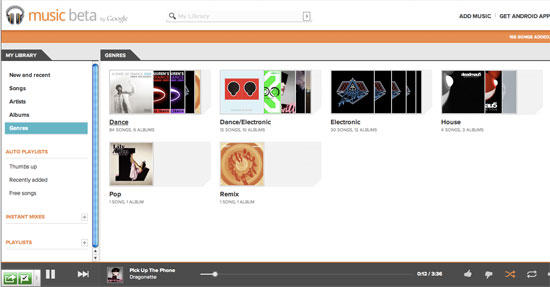
The Result Is All My Artists and Albums On the Web

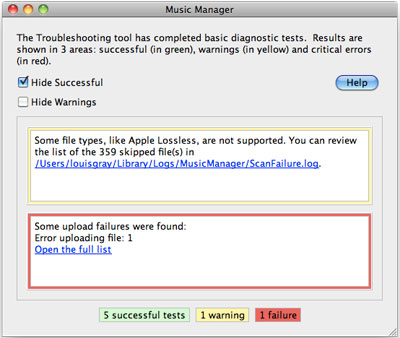
As Google Music can only post non-DRM tunes, of the 500 or so songs I have, just under 150 were found to be available without Apple's lossless formatting. Music Manager installed itself as a control panel on my Mac and uploaded tracks two at a time to the cloud in the background. I have to imagine that with larger libraries numbering thousands or tens of thousands of songs, this process will no doubt take days or weeks, so if you can use a non-production computer, or can set the job to take place overnight, you're probably better off.

If the Songs Have DRM, They're Not Going Anywhere

You Can Sort Songs By Genre, Artist, Name or Album

In this regards, for traditional iTunes users, Apple may have a leg up in its proposed cloud strategy, pointing to your previous iTunes purchases as being "owned" by you, while you're responsible for uploading or flagging the others from your own collection. The process of uploading seems cumbersome, but should only have to be done a single time. Alternatively, it'd have been great to check my own database of music against a central database owned by Google, who could simply "unlock" tracks or albums for me, skipping the actual data transfer process. But with no deals done, the music locker is simply an empty bin for me to fill, even if the metadata assigned to some of my songs is incorrect.

My Albums On the Galaxy Tab 10 Android App

As my songs started to populate Google Music online, the same familiar user interface most of us know from programs like iTunes, WinAmp and others is displayed, listing the song names, times, artist, albums and play count. Instead of a five star Apple-like rating, you can thumbs up or down individual tracks, but other attributes are the same - including the ubiquitous shuffle feature, and "Instant Mixes" which parallel Apple's "Smart Playlists" feature.

Seeing My Deadmau5 Songs On the Android Google Music App

Playing songs is straight forward in the browser or on the Android app. Click the track you like, and as with iTunes, you can use your keyboard to control most playback - using arrow keys to go forward or back, and hitting the spacebar to pause the song. Other aspects of the service are also similar, including editing track data, although you can't batch edit songs, and as the service is from Google, an Instant Search-like field is available at all times, so if you want to find an artist, song or album, start typing and that from your library will surface.

Searching on the Google Music App In Android

On the Android side, I tested the Google Music app on the new Honeycomb-enabled Samsung Galaxy Tab 10.1 that all Google IO attendees (press included) received last week. As the system recognized my account was tied to my own library, all songs posted to Google Music in the cloud were available on the device - with no downloads needed. On both Web and tablet, the music quality is very good, and i wouldn't expect otherwise.

Playing a Track On Android On the Galaxy Tab in Google Music

After nearly two years' experience on Spotify, the sheer nature of the cloud music is not dramatic, but getting the opportunity to convert my iTunes library from something that is currently locked down to spinning disk on a single computer and a few iPods to something I can access anywhere is no doubt going to be liberating - just like it will be when Apple finally brings their own cloud option, or when I tag my own library within Spotify to auto-add the songs I've purchased elsewhere.

From my talks with people close to the cloud music wars, the dollars and aggression being tossed about between players is intense, in a powerful cascade of one-upmanship from one player to another. Right now, it doesn't appear that Google has paid the top dollar needed to put all the labels in their court and out of Apple's hand, and Spotify is the little guy compared to a major league tug of war between Google, Apple and Amazon. Until this all gets sorted, Spotify remains the best option for me to get music I don't already own, and Google Music is an increasingly convenient option for the music I already do. For my Android-centric world that hasn't messed with iTunes much lately, it's good to know I can welcome back my old albums in my life again.

Google Music can be found in beta at http://music.google.com and the accompanying app can be found on the Android Market here.

May 15, 2011

AOL In the Attention Business, Mobile Getting More Of It

AOL In the Attention Business, Mobile Getting More Of It

Following HP's acquisition of Palm last year, David Temkin, the VP for the Developer Platform at the company, exited stage left to AOL, joining forces with Brad Garlinghouse, Tim Armstrong and the new management at the firm which is working to redevelop and revamp one of the best known Web brands which comes with the baggage of significant history, with more than its fair share of ups and downs. With the move, Temkin gained an incredible role, running all of mobile for the Internet giant, at a time when mobile content is growing faster than any other segment and users are more likely to add new behavior to their repertoire, unlike on desktops, where users are less likely to change their habits. On Thursday, Temkin updated members of the media on recent product launches and how the company approaches the important world of smartphones.

AOL is no slouch when it comes to the world of content and demanding users' attention - so much so that Temkin said "AOL is in the attention business," adding, "You gain attention by going to the users where they are."

AOL's Engadget App Drives More Page Views than the Web Itself

Users are increasingly going to their mobile devices to consume content, which has led the company to create 30 or more applications for iPhone and Android, with simple presentations of content, focused on delivering a "delighting user experience". With just under a year's tenure at the company, Temkin started with reaching out to all the disparate brands at the company and working with them to take the content they were already producing and making a strong mobile experience. While the most popular app, by a long shot, is Engadget, others include Moviefone, which hit iPad less than a month ago, and Popeater. In fact, the Engadget app drives more page views than the Web site itself - excellent numbers.

With dozens of popular iPhone apps on the roster, AOL recently shipped an Android-only music application, called Play, which was quickly featured on the Android Market, scoring more than 300,000 downloads in just two weeks. As users are still finding which applications deserve their time, Temkin sees the mobile market as having serious greenfield opportunity, gaining new customers and pushing others to switch their preferences.

The New Moviefone for iPad from AOL

"On mobile, people are still establishing their habits," he said. "User behavior on the desktop is fixed and difficult to change. It's an uphill battle."

That AOL is dropping dozens of new applications and new brands on multiple platforms is a far cry from the environment Temkin joined in mid-2010, when even the main company site was optimized not for smart phones but for feature phones, without rich media capability.

"AOL.com on mobile, when I joined, was a slightly upgraded WAP site," he said. "Now it's buzzword compliant and we have more than doubled in the year the number of users we have coming in. It's a nice thing to improve the product and see the kind of results we have."

Coming Soon: Editions from AOL

Still on the docket for release is the much-anticipated Editions magazine, coming for iPad in the vein of Flipboard and Zite, but driven by algorithms based on the users' interests and preferences - yes, much like my6sense and others have made their focus. As Temkin described, the application will not be an editorial publication, but driven by artificial intelligence, pulling in content as if there were an editor driving the magazine.

"Your cover will be unique to you, with the topic you are most interested in and what the publication thinks is most important," he said. "We are scanning thousands of sites. We track what you like to read based on what you click on and explicitly what you say you like by subject. Algorithms drive the layout."

If AOL is in the attention business, tracking your own attention to its properties seems like an obvious next step. As smart phones get more capable, and AOL pushes to have its content in front of as many eyes as possible, you should expect to hear the name David Temkin a lot, for he is running the strategy of the fastest growing piece of one of the biggest Web brands in the business.

As AIM head Jason Shellen quipped Thursday, AOL "has become a powerhouse for smart people, and it should become a not so quiet revolution soon. It's about bringing the brand up a level."

Disclosures: my6sense has similar functionality to that promised in Editions and other news readers with advanced personalization capability. I am VP of Marketing at my6sense. Additionally, HP is a client of Paladin Advisors Group, where I am managing director of new media.

Tackling My Biggest Impediments to Cloud-centricity

Tackling My Biggest Impediments to Cloud-centricity


More and more of my activity, both in desktop and mobile computing, is cloud-based. More Web services are replacing desktop applications, while activities that used to be the focus of local storage (including photos, music, video and email) are being delivered from the Web instead. But I'm not totally converted yet, and I can see how even the most forward looking of early adopters could still have some hangups in being fully cloud-enabled. To get to a cloud utopia, work has to be done not just on the operating system side, but on native apps, and peace of mind has to be delivered for users that they will lose no data or functionality in that transition.

In January of last year, anticipating a more cloud-centric future, I moved to a MacBook Air, one that had about half the storage space as my previous laptop, reversing the trend of larger and larger trays of spinning disk. Using the same device 16 months later, I haven't gotten close to using up the 128 gigabytes, although I have to admit I ended up installing a lot more programs on it than I had originally hoped.


Even with this admission, I kept the older MacBook Pro around under the guise of it acting as my "media machine", the master data set of all my music, photos and video. While I walked away from iTunes for music, every few months I'd transfer the latest home photos and videos via USB from the AIr to the Pro. Some got posted online and others not. With Google Music and Picasa offering options to upload all this content to the cloud, I know I'm just a few painful uploads away from finally migrating (once I get a new battery and charge the sucker).

Google's pitch for everything being on the Web is smart and future-looking, but it neglects, for consumers anyway, the story of migration, from one OS to another and also from one frame of mind to another. As Gmail once did with its offering a gigabyte of storage space at a time when competitors offered tens of megabytes, I have to think that letting people copy their important files to the cloud in a personal storage locker would be quite compelling. Steven Levy's "In the Plex" recounts the demise of a Google project "GDrive" thanks to its file centricity, but real consumers have real files and want to know they will never lose them in the future.

For me to truly get to the cloud one hundred percent of the time, I still need to:
  1. Convert my DRM-laden Apple iTunes songs to DRM-free MP3 files
  2. Synchronize those songs with Google Music and Spotify
  3. Upload all my photos from iPhoto to Picasa and/or SmugMug
  4. Migrate all my .Mac email archives to GMail
  5. Migrate old Word documents and PowerPoints to Google equivalents
#4 and #5 are supposedly easy. Find the right file types and point them to the right place, while making them private. But in practice, these migrations take time. I've had my unfair share of IMAP migrations to and from Mac to Gmail and probably have multiple email copies all over the place at this point, but the deepest archive is in local storage.

#3 touches on emotion as much as data. There's comfort for some in burning old photos to DVD, even if DVD (and CD-Roms and floppies before that) are holdovers to a doomed era in physical media. And songs are songs. I love my Spotify, but I bumped into an old Underworld album I own on iTunes that I hadn't seen in years and was reinvigorated to reclaim all that stuff I've purchased, so I wasn't walking away from thousands of dollars in investment, but also favorite tunes I might not remember later.

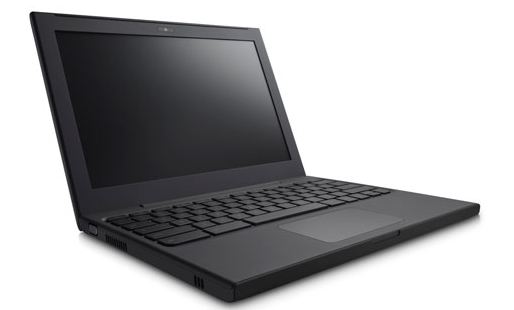
I have been using the CR-48 Chromebook more and more lately, using it exclusively at the Google I/O, SXSW and CES events, thanks to its great battery life and ease of access to 3G and WiFi connectivity. I am using the Chromebook more and more at home too, when I don't need to use Photoshop or take partial screenshots - something the Mac still does better than anything else I've seen.

I see the current state of Chrome OS as that of Mac OS X 10.0 upon Apple's launch of that operating system back in 2001. It didn't initially support DVD playing, and scads of programs were missing, forced to boot in Classic mode, including the aforementioned Adobe Photoshop and notably, Quark Express, key for the Mac's design culture. But eventually those holes were filled, and Mac OS X hasn't looked back in a decade.

Can Web apps replace Photoshop and other intense programs outright? Probably not on day one and maybe not even before the end of 2012. Google promised close tie-in with Citrix and VMware, telling the story of virtually connecting to apps outside of the cloud, and using them there. That's a really geeky solution to what would be a standard use case on a more traditional platform. I have to imagine that if Chrome and other cloud-centric options grow, traditional software makers (as Microsoft did with its Web office in response to Google Docs) have to start thinking about getting their apps into users hands on these new platforms, while the earliest users are going to have blood on their hands thanks to being on the cutting edge.

We're in the early days of a true cloud OS, and I've got a lot more room myself to go before I close the lid on my last MacBook. Agreeing in principle that I need to get my important data of rusty spinning disk, I have some work to do, and will keep up this effort. But more messaging has to address the issues of migration, storage space, compatibility and success in places where connectivity isn't pervasive.

May 13, 2011

MLKSHK: High Calorie Junk Food Photo Fun You'll Pig On

MLKSHK: High Calorie Junk Food Photo Fun You'll Pig On

You know what goes well with I Can Has Cheezburgers? MLKSHKs. In the vein of simple and addictive sites revolving around fun photos, images and community, MLKSHK, the brainchild of Andre Torrez of Simpleform, and formerly of Federated Media, MLKSHK opened its doors tonight (yes, on Friday the 13th) to push you to share your online findings with friends. As I found with late night discussions on Convore prior to that site's unveiling, the combination of creative friends and fun images strewn about the Web can often be side-splittingly funny, and MLKSHK hopes to capture all that in one place - organized by categories, and each share gaining the option to get user interaction in the forms of comments, saves and likes.

MLKSHK (obviously pronounced "Milkshake") separates grouped discussions and shares in what they call "Shakes". You can view shakes from all your friends, find featured shakes chosen by the community, or browse by collections, from animated GIFS, to comics, typography, all manner of TV shows, and of course, off the wall stuff one would expect from a @torrez or @mat project, like "Booze makes it all better" and "Roboshake 2084".


Do I expect to be a lot more productive with my life now that MLKSHK is open to the public after having early access for two months? No. Do I expect to jump in and find yet another site full of silliness and images that everybody wants to see but pretends they don't? Absolutely.


As the service's front page says, "Easily save images from everywhere on the web. The silly ones, the sweet ones, the cool ones, and the gross ones—then share them with your friends and family. Join groups of other people who like the same silly and cool stuff you do and contribute your own."


I've been in tons of silly communities, and most of them end up having a tremendous number of frothy conversations around silly images, be they started on FriendFeed or Facebook, the old Brizzly, Convore and now MLKSHK. Wrinkle your eyebrows at this entry to the world or not, but you know this is the site everybody wanted. Go forth and share.

About.me User Count Spikes Beyond Host Montenegro

About.me User Count Spikes Beyond Host Montenegro

Montenegro, a small country tucked into Southeast Europe, bordered by Bosnia and Hezergovina, Serbia, Croatia and Abania, has just over 600,000 residents. Among its most valuable exports of late has been its attractive .me domain, the country code TLD behind fast-growing personal page service About.me, who was snapped up by AOL almost immediately after public unveiling, and now says they are nearing 1 million unique accounts - well beyond the population of Montenegro itself, after being open for about 4 1/2 months. Company founder Tony Conrad, also known for selling Sphere into AOL back in 2008, recounted the story behind getting the brand name at a Media Roundtable day at AOL West Coast headquarters yesterday in Palo Alto, and says adoption has been phenomenal.

About.me was initially referred to as "Pumpkinhead", but was never intended to go by that name even from the service's inception. Conrad said the plan all along was to acquire the about.me domain, and it took considerable cajoling and back and forth calls with Montenegro government representatives between 11 at night Pacific time and 4 am to push for the service's getting the attractive name. All told, he said there were thirteen phone calls, each one going higher up the food chain and having a larger audience. Eventually, he gained the domain name, telling the Montenegro officials that the exposure of the new TLD would be more enough payback for giving up the lucrative URL.

"If you call them, they will say it was the best thing they have ever done," Conrad gushed yesterday. "About.me was the perfect marriage with the product we were about to offer, and it was going to get them incredible exposure."


The idea behind About.me came from the far-flung URLs many of us are using to define ourselves, be it our blogs, our Twitter accounts, Facebook profiles, LinkedIn resumes, and more. Conrad wanted to offer something controlled by the individual that could aggregate content from disparate sites, present a clean visual appeal, and avoid the step of going to Google to "dumpster dive" and find the right person in a sea of names.

"The opportunity was to create a page that was truly about myself," he said, "something simple that you could put in your email signature that makes sense."

The appeal of a simple "About Me" page has struck a chord with initial users, who are reportedly adopting the service faster even than well-known sites like Twitter, Facebook, LinkedIn and Foursquare, something Conrad gave credit to Twitter for, as the service has been leveraged to increase virality and visibility of the service. Now, he sees many people using the platform in creative ways beyond a simple dynamic business card, including "tons of baby announcements", and job searches.

Wanting to avoid the common aggregator problem of enabling scads of far-flung third party services (see FriendFeed or others), About.me will be introducing an API in Q3 that lets external sites integrate with the platform directly - beyond those that were "obvious and strategic for us to do", Conrad said.


For those of us initially skeptical on About.me's mission in a world crammed full of start pages and abandoned aggregators, the approach seems to be working - letting people creatively describe themselves with simple onboarding. This has been a key focus for the company even after becoming part of AOL - Tony's second stint there, and one he swore up and down is more fun than the last.

"That regime (following the sale of Sphere) was a bummer," Conrad said. "Under the old regime, I would not have come today (to the media briefing.) I would have been sick. But when I left, Tim Armstrong asked me to be a special advisor and I stayed around the table in a very abstract way. "

Continuing his proximity to AOL, upon About.me's founding, the company was funded by AOL Ventures to the tune of $25,000. During a regular check-in call, Conrad says Armstrong said, 'I want to own more', which came as a surprise as the product was barely off the ground and was considered a project.

"To his credit, he understood the vision we were working towards," Conrad said. "He made a very generous offer that impacted my team in a positive way."

About.me is rapidly approaching a million unique accounts. You can find my About me page here: http://www.about.me/louisgray. Tony Conrad's is here: http://about.me/tonyconrad. The company is hoping to further kickstart registrations and use with a partnership with MOO cards, so if About.me represents you, the URL should look great on your business card.

May 11, 2011

Samsung, Acer to Debut Chrome OS Notebooks In June

Samsung, Acer to Debut Chrome OS Notebooks In June

After one million people, myself included, begged to get access to Google's CR-48 Chrome OS notebook pilot program and thousands of devices were shipped, Google is taking what it's learned from the months of feedback and bringing a full-on assault to the established OS players (Apple and Microsoft) with delivery at scale of Chrome OS powered notebooks, starting with Samsung and Acer, scheduled to debut in the United States and six other countries on June 15th. Keeping with the company's Web-centric, speed addicted browser focus, Google promised at Google I/O today what they see as the first computers which speed up and improve the longer you use them, rather than the well-known reverse.

The devices, starting at just under $350 for the 11 inch Acer model and rising to nearly $500 for the 3G-capable Samsung offering, are to be sold on BestBuy.com and Amazon.com initially, while also being sold directly to businesses, educational systems and government for $28 a month for the former and $20 a month for the latter.

Google's promise, delivered convincingly by Chrome's Senior Vice President, Sundar Pichai, is that by making the notebooks as "nothing but the Web", this will dramatically reduce complexity, management, and keep apps up to date. Combined with integrated 3G connectivity, initially with Verizon in the US, and battery life between 6.5 hours on the Acer and 8 hours on the Samsung, the devices, like the CR-48 I've been using at the conference and elsewhere, look to deliver inexpensive anytime connectivity and the elimination of constantly searching for power plugs.

Google arrived at these announcements after rethinking the Web browser and the operating system itself, doing away with legacies of the past, Pichai explained.

"To deal with the Web on a browser, you have to deal with the legacy decisions of the last 30 years. Once you're inside, you have to make sure you manage your apps. Every single app has to be up to date," he said. "The experience is really complicated. We wanted to rethink the entire experience down to nothing but the Web. That's what Chrome OS is - an end to end experience."


Pichai's comments were echoed by Google cofounder Sergey Brin in a follow-on press briefing, where when asked if this was a direct attack on Windows, that there was nothing inherently wrong with Microsoft's offering but that "The complexity of managing your computers is torturing users, and it's a flawed model." This flawed model still is running XP at more than 50 percent of businesses today, it was reported, so this means there's not only a lot of opportunity for growth, but also significant challenge to make inroads at places that have often been reticent to change and conservative.

Consumers, besides the initial few of us who got our hands on the CR-48, will get their hands on Chromebooks (as they're now called) in just over a month. For the Web addicted, it could be a very compelling offering, one that both Apple and Microsoft have to watch closely and take very seriously.

Google Displays Big Numbers at GoogleIO. Is It Better?

Google Displays Big Numbers at GoogleIO. Is It Better?

The first day of Google I/O 2011 was focused on Android. For Google, focusing on Android and the mobile OS' growth is a real point of strength, with incredible numbers and increased velocity. But there are still open questions as to demonstrable quality leadership that would have people on the other side of the aisle drooling with jealousy.

Hugo Barra, director of product management for Android at Google, highlighted growth of Android from the first T-Mobile G-1, shipped 2 1/2 years ago to 100 million Android activations through 2011. Other statistics similarly portray a story of wide reach and penetration in practically every regard: 36 OEMs, 215 carriers, more than 450 thousand Android Developers, feeding 310 Android devices in 112 different countries. The 100 thousand activations per day highlighted in last year's session was doubled three months later, and doubled a second time, to more than 400 thousand daily now. Total software application installations have accelerated with the first billion installs taking two years, and most recently, only 60 days, with 4.5 billion installs to date.

With Google being a data driven company, there's no question they love their numbers, and these are good ones. But there's no doubt a sizable market who perceives the OS and the companion apps and hardware as being of lower quality versus competitors like Apple, or even HP and Microsoft. Barra stated, "The quality of apps is amazing," adding "The world's most engaging, useful and entertaining applications are running on Android."

Accompanying his comments was a laundry list of brand name apps that have come to be featured in Android Market, many of whom who started on iOS first, and have moved to Android, from Major League Baseball to Pulse and many top game titles. With that kind of intro, no doubt many of us were excited to hear what was to come next in Android, especially as we were caught up on improvements to Honeycomb 3.1 and the new Ice Cream Sandwich. But for the most part, the updates seemed very simple, leading off with enhanced widgets, and enabling devices to act as USB hosts. Ice Cream Sandwich was promised as bringing the best of Honeycomb to phones and tablets, but the response to Honeycomb so far, especially in its limited release so far on the Motorola Xoom has been lukewarm.

As was mentioned to me in a discussion with a small group of Google geeks, in a conference focused on developers, one shouldn't always anticipate the delivery of retail-capable products for end users. So while all the 5,500+ attendees (myself included) were no doubt excited to test and receive the new 10 inch Samsung Galaxy Tab ahead of its availability on the open market, much of the highlights were focused on technologies that looked futuristic in nature, with midlevel applicability to today's array of products.

The much-anticipated arrival of Google Music and movie rentals on the Android Market are definitely improvements for all Google-centric users looking to wean themselves off iTunes, but they do seem like they are playing the role of catch-up to both Apple and Netflix, who have significant headstarts and market visibility. It's obvious the music labels are so full of themselves as to be causing headaches for Google, Apple, Amazon and Spotify, but it'd be great to see Google leading the way on some of these spaces instead of filling holes in their lineup against Apple.

Don't get me too wrong. Google's software sounds very good, with fun demos of smart machine-learning driven mixes (comparable to that of iTunes), and wireless synching, where Apple lags behind. But if you're going to take on the established player in the market in the place where they are strong, it isn't just enough to play feature matching, you must catapult way beyond their offering, as Spotify did for me to iTunes, getting me out of that model entirely.

What I've seen happen in the last two years or so is that lines are being drawn between those who prefer one platform and those another. It's a rare person who gets the chance to try both platforms and come away with a full understanding of one's weakness and another's strengths. Instead, most are digging in with both feet and becoming defensive if their point of view is questioned. If Android wants to truly be perceived as the market leader, not just in quantity, but quality, it's got some more room to grow, to demonstrate highest quality tablet experience, app experience, universal application across devices, and feature leadership - because the other team has the branding and personal experience nailed, great numbers or not.

May 10, 2011

Reaching 1 Billion Monthly Users, Clearspring Adds On $20M

Reaching 1 Billion Monthly Users, Clearspring Adds On $20M

Alongside the boom in social media consumption, the world of social sharing, delivering content from a siloed source to a social destination has exploded in the last few years, as casual and professional media alike are scrapping for ways to bring their content to the fast-flowing streams of Twitter, Facebook, LinkedIn and more. A chief benefactor of this trend has been Clearspring, the company behind the practically ubiquitous AddThis buttons, which you see adorning Web sites of all types. The company, recognizing more than a billion unique users across the nine million sites where its buttons are installed, announced this morning the raise of $20 million to help harness the data being gathered and providing the next generation of analytics.

A few months ago, during the company's semi-regular swings to Silicon Valley, I met with Hooman Radfar, co-founder and CEO of Clearspring for dinner here in Sunnyvale, and was struck by the reach of Clearspring's properties, which has to be one of the few Internet names to touch ten digits worth of people. With Facebook counting user numbers well into the 600 million and beyond, for Clearspring to talk up a _billion_ users is quite an accomplishment. Of course, a widget on a Web site is not the same as a fully immersive experience, but in a world focused on data, and the extraction of meaning from that data, he with the biggest numbers wins.

Unsurprisingly, this morning's announcement focuses on how the gathered data will "accelerate Clearspring’s next-generation publisher products and continued growth of its advertising offerings, as well as to help fuel strategic acquisitions." There's no telling if $20 million will be enough to drive a big acquisition of any kind, but in a phone conversation yesterday, Radfar told me the company already had a good amount of money in the bank prior to the raise, while the new round brought "additional powder" for engaging in M&A, giving the company more flexibility for future expansion.

The AddThis platform, thanks to its universal visibility, has already become an interesting stopping point for statistics on which of the many social networks out there are gaining traction month by month, as I had highlighted back in late 2009 with the launch of their service directory. Interestingly, as captured in that post from 18 months or so ago, Facebook at the time accounted for 28 percent of all social sharing. Today, that number has increased 50 percent to 43 percent of all sharing throughout the AddThis network. In the same period, Twitter expanded from 8 percent to nearly 10 percent, and Myspace fell from having just over 8 percent to just over 2 percent, a 75 percent decrease.

AddThis' big numbers make it one of the top ten largest audiences online today, according to their press release, claiming also that revenue is on pace to triple from the previous year, and staffing is expanding at the rate of one new hire per week, on pace to double staff. Math suggests the doubling brings the team from just over 50 to more than 100 to exit 2011, and for AddThis, the future looks to be all about numbers.

“We’ve always held the view that big data would be one of the most valuable assets to come out of the social web,” said Ted Leonsis, Clearspring’s Chairman in today's release. “It is no surprise to anyone close to the company that we have parlayed our expertise in social sharing to achieve a reach surpassing Yahoo!."

AddThis supports more than 300 disparate social networks, so if you're like me and want to bring attention to the edge cases, you can find their orange squared buttons with the white plus symbol and share anywhere you like. Having $20 million more available makes it more likely you'll find these buttons in more places.

May 9, 2011

Revisiting Android A Year Into My Smartphone OS Migration

Revisiting Android A Year Into My Smartphone OS Migration

Tomorrow's Google IO approximately marks the one year anniversary of a shift in my digital lifestyle, when I began to use Android instead of my trustworthy iPhone, which had been my go-to device for a number of years. While any post I make regarding Android runs the risk of being assigned the 'fanboy' label, it's worth reviewing what has changed in the market over the year since I left the Moscone Center with a new HTC Evo - an intriguing year that's seen major announcements by players in and out of the ecosystem, with consumers reaping the benefits of an innovation race, assuming the courtroom battles between Apple and many other players don't throw a monkey wrench into the whole thing.

Mobile OS Software

When I left the Moscone Center with my new Evo (provided courtesy of Google and since replaced by a device I paid for out of my own pocket), the device came with stock Android 2.1, code named Eclair - with 2.2 Froyo having been demonstrated at the event and expected to arrive soon. At the time, my iPhone was on version 3.1.3 and the iPads were on iOS 3.2.

Not too long afterward, the Evo was gifted with 2.2 Froyo in an over the air (OTA) update, keeping it relatively on track with Google's calendar.

In late June of 2010, the iPhone was upgraded to iOS 4.0, bringing with it multitasking, folders and universal in boxes, to name a few things. The iPads reached 4.2 in late November, adding AirPlay and other items.

By the end of 2010, Google had moved beyond Froyo and was talking up Gingerbread, the 2.3 release. This release hasn't yet made it to the HTC Evo, which my wife now uses, nor to my Samsung Epic 4G, which I switched to in November of 2010. In fact, the Epic's meandering move from 2.1 to 2.2 was a big pain, but it was very much a laggard relative to its compatriots, and once it arrived, I had no complaints.

On the Android Tablet side, while Honeycomb (3.0) was said to be the go-to OS for Google-approved tablets, I've been quite happy with the Samsung Galaxy Tab, which came with 2.2 when I bought near the end of 2010. There hasn't been a clear roadmap from Samsung as to the Galaxy Tab getting to 2.3, let alone 3.0, but newer models of the Tab are centered around Honeycomb. So far, from my experience testing the Motorola Xoom, I haven't yet been tempted. The iPad 2's introduction in early 2011 was primarily a hardware bump for Apple, without new software features.

Mobile OS Hardware

As my conversion process to Android was ongoing, Apple started selling the iPhone 4 in June of 2010. Despite multiple visits to Apple Stores to try the device myself and reconsider if I had made the right choice, the hardware and software combo didn't persuade me to reverse course. Despite multiple rumors one way or another, Apple has not yet made any updates to the iPhone 4 in the past year, with the exception being adding a second carrier in the US (Verizon).

While Apple's been holding steady with iPhone 4, scads of Android phones from different carriers with different features have been released - some fantastic, some good and some not great at all. The Evo, despite many things I liked about it, was heavy and a power hog, and I felt odd writing a disclaimer each time I mentioned Android on the blog, so those things, combined with a simple upgrade to the Epic 4G, which gained me a hardware keyboard to boot, got me to switch. Besides phones with real keyboards (which Apple's not interested in), there are also dual screen Android phones, Android phones that offer laptop cradles and low-end Android phones that get below $99 at retail.

Where people have gained annoyance with Android is the tight leash carriers have over the software on the devices. It's perceived, even if not backed by great evidence, that the carriers are not incentivized to keep users on older hardware current, preferring instead to push them to new models. After starting and stopping its Nexus One program, Google introduced its Nexus S offering which, in addition to being a cool-looking phone, promises none of the carrier nonsense on the phone, as well as fastest access to Google code releases. While it's not a major win to say the attributes of the phone are simply avoiding negatives from carriers, it's valuable to have an unblemished alternative.

I Could Switch to Nexus S on Sprint If I Wanted

As a user, assuming money is available, the option is there to upgrade to an even newer and better phone on the Android platform, keeping the carrier you like (in my case, Sprint), every few months. If I found it made sense, or if they somehow give away Nexus S phones at Google I/O this year, I can switch phones again with almost no headache. Meanwhile, if I were still on Apple's side with the iPhone 4, I could stick with the iPhone 4 or stick with the iPhone 4. What most folks get confused about is the word "open", while I prefer to see it as "options". I can change if I want to something that works for me.

The 7-inch Galaxy Tab: Still the Gold Standard on Tablets

Speaking of "options", both the Samsung Galaxy Tab and the Android-powered Barnes and Noble NOOKColor come in 7 inch handheld sizes, which Apple thus far has avoided, sticking with their 10 inch model. While preferences are preferences, I do have the option on Android to go small, medium (8.9 inch) or large (10.1) if I want, while Apple is sticking with the one size fits all approach - one I expect they will change as the product matures. After all, they do have small/medium/large in laptops, iMacs and monitors, so it befits their history. I strongly prefer the 7 inch size over the 10 inch, and once you've used one for a good amount of time, a larger tablet just seems too big.

Applications

For those who prefer Apple and the iOS, aside from a unified experience, the second most attributed reason for keeping the iPhone candle lit is typically applications - either in number or quality. I hypothesized a year ago that Android's market share numbers and array of carriers, phones and users would lead to more developers, more applications and eventually better applications. I believe for the most part, this has come true. There are a select number of developers who continue to be iOS-only, but they are rapidly joined by those developing for both platforms, and increasingly, by those who are developing for Android first, iPhone and iPad second, like I said they would. Robert Scoble, well known tech blogger and Apple fan, cited this trend in his recent post this morning, when he said "the most interesting set of companies is being built around smartphones and here, for the first time, Apple’s iOS doesn’t have the coolest apps."

As a long-time Mac user (typing this on my MacBook Air now), I understand the defensiveness of quality over quantity and believing that you've got the best stuff. But I do believe that developers are bringing the best stuff over to Android as well and users are not going without apps they would have available on the other side.

There's no question there is tremendous work to be done to clarify payments to and rewards for developers on the Android platform, relative to the iOS platform, and there is work to be done on the Android Market to add discoverability versus iTunes, but again, having tried both, to say one is great and the other is lame is a dramatic oversimplification. There's something very cool about managing one's phones via the Web and installing applications to different devices from the browser with a few clicks - something I still can't do on iTunes.

What Does This All Mean?

It makes sense to try and keep an open mind when it comes to technology progress in a world that's changing fast. I've enjoyed iOS in the past, and am glad it's so simple that my kids don't waste much time on the iPads fighting technology. I've had my occasional bumps with Android, outweighed greatly by the benefits of multitasking, built in hotspotting, voice search, and flexibility of the platform. I actually tried and enjoyed the Windows Phone 7 experience, and hope to some day get a chance to try out HP's Web OS and Kinoma on any phone once that ships. To pick a side and stick to it while being blind to the many options out there in the market is silly, but in looking back on my switch, I am glad I didn't get stubborn and ignore the market trends. While Android has provided more options from different carriers with an array of devices and improvements in the user experience and applications, iOS has not done much in the same time, aside from make a ton of new customers and a ton of money. That's fantastic for Apple and for the tech world in general, but not much money has gone toward Apple from our home in the last year.

Google and the carriers have a lot of work to do to solve fragmentation and the perception of fragmentation. They have to do a much better job of explaining why their experience is better than that of the competition (if that's the case). They need to make Honeycomb dramatically more simple, and more attractive to developers. They need to make troubleshooting the devices, when things go wonky, solvable by humans without Linux backgrounds.

That said, I like that Android has given us choice in tablets, in smartphones and carriers. I like that I can use a platform that doesn't fill me with fear when I upgrade from one phone or another, or know that because my wife broke her Evo, that a new one which arrives tomorrow will take only minutes to configure, synched with her Google account. There's no telling what the next year brings in terms of new devices and new places we'll see Android, but I'm betting it will be another year filled with new functionality, new apps and new experiences I would have missed if I didn't jump from one side of the aisle to the other. No doubt tomorrow at Google I/O we'll start to get a few hints.

Google I/O 2011: Android and Chrome OS All the Time

Google I/O 2011: Android and Chrome OS All the Time


This week, Google is holding their annual developers conference on Tuesday and Wednesday in San Francisco. The event has grown in stature over the last few years, rivaling only MacWorld (back when Steve Jobs would keynote) in anticipation as press, users and evangelists banter back and forth about will or won't be announced at the event. For the second year in a row, I'll be there, after what was no doubt one of the more enjoyable technology events for me last year. But instead of going in expecting whiz-bang products and breath-taking surprises, I am expecting to hear strong updates on the company's continued march in hardware operating systems, both mobile and desktop, taking the company even further away from their initial core focus on search and accompanying ads, but not so extreme as to having us scratching our heads and demanding to find a use case.

Like the aforementioned Apple, Google already does a solid enough job year-round, between its biggest events, of keeping people updated. The Nexus One was announced at a special media event, as was the Honeycomb tablet OS. Google Buzz got its own event, all at the company's Mountain View headquarters where the venue was more comfortable, the expectations were maybe more muted, and the numbers were certainly smaller. But I/O is the crown jewel of conferences for the search and ads giant - a place to update its extended community of geeks on progress to date, while simultaneously encouraging them to help push their next initiatives forward, keeping their attention close while so many temptations lurk elsewhere.


The Sessions and Pods Heavy on Android & Chrome, Light on Social


If the Google I/O application for Android is any indication of the week's focus, there are dedicated tracks for the company's two-pronged approach to take share in mobile and desktop OS's - Android and Chrome, flanked by items deeper in the weeds, like App Engine, Commerce, Geo, Developer Tools, APIs, Tech Talk and Google Apps.


Tuesday's Schedule and My Tentative Attendance


The 2010 tracks make one either cringe or wax nostalgic with scads of updates on Google Wave, dedicated meetings to discuss Google Buzz APIs, and an entire track on the Social Web, from PubSubHubbub, Open and Social Web, OpenSocial, and the integration of Google Buzz with location and social gaming. Not in 2011. There's no Social Web track at all. Other sites have predicted what that means for the future of Google Social, but what it does mean is that one should plan on talking about something else outside of the two-part keynotes Tuesday and Wednesday.


Google I/O 2010 was the flashpoint in my transition from iPhone to Android, after the latter OS had just been a curiosity to me. I've extended this Mountain View infiltration into my life with the addition of the Chrome OS powered CR-48, and spend a ton of time with my Samsung Galaxy Tab and Barnes and Noble NOOKColor, both of which run Android. In the fall of 2010, as I joined my6sense, we launched on Android, and have leveraged the Android ecosystem to find partners. 2011 looks like it should provide updates on Android helpful to both developers and users, and it may possibly be the starting point for getting Chrome OS equipment to the masses, beyond the initial beta units that I and others like me have been lugging around.

The combination of Android and Chrome OS should be enough for the event. No doubt we'll hear more about numbers, partnerships, coding, development, standards, openness and what have you. We may get more demos of music, but no announcements. We may see updates on the Android Market and Chrome Web Store, but they're ancillary to the main attractions one and two. No swing for the fences surprises, but straight up execution where the company knows its strengths and won't likely be second guessed. That can be saved for a special event when the time is right.

May 7, 2011

Quora Opens Doors to Self Promoters, Bias and Marketeers

Quora Opens Doors to Self Promoters, Bias and Marketeers

Quora's differentiation from more established but less respected question and answer forums has typically centered around the quality of the discussions and those participating. It's not too infrequent that one finds the perfect person situated to answer a question pops up in Quora to take on challenging queries, from how companies started, to strategy and history. But as the site's grown in visibility, attracting more a wider swatch of early adopters, including social media marketers, there has been something of a tug of war between those looking to keep the site pristine, lacking self-promotion, and those who are hoping to leverage the site as yet another outlet for branding and positioning.

On Thursday, Quora's Marc Bodnick, famous for leaving Elevation Partners, where he is a cofounder, to focus on the site after gaining addiction as a user, posted that users are "encouraged to contribute helpful content about topics where they have relevant personal experience", which deviated from one original mission of the site to prohibit content that was considered "primarily self-promotional." As he put it, the old rules were too restrictive, that the quality of the answer trumps the objective the answerer may have had for posting, and that users with direct knowledge are invited to contribute. The ban on self-promotion could have potentially led those with direct knowledge, but continued vested interest, to avoid participating.

Marc Bodnick's Announcement of the Policy Change

While the floodgates are now open for any brand to insert a representative to start answering questions directly or tangentially related to their products, Bodnick reiterated that disclosure of affiliations (and therefore potential bias) was still required, such as whether you work for the company, are an investor, an school alumnus, etc.

While there is some debate about Quora's ability to cross the chasm to more mainstream users, it's clear there is significant potential in a high quality alternative to today's collaborative knowledge bases, without the relative anonymity and dryness of Wikipedia. Meanwhile, many people are extremely bullish on the company, given its objectives and its founding from well-respected early Facebookers, Charlie Cheever and Adam D'Angelo. See Wired: Does Quora Really Have All the Answers? for one particularly recent effusive take.

As Twitter, Facebook and LinkedIn all crossed the chasm from early adopter plaything to mainstream acceptance, brand advocates and marketers followed. Similarly, Foursquare has gained tie-ins with marketers and advertisers, while other recent tech hits like Groupon and Zynga have always been all about the money. With Quora becoming a magnet for high quality discussions, and the shackles being taken off self-promoters and marketers, there's a chance that one person's insight could be seen as another person's spam. The good news is that with Quora, the community's upvote and downvote capabilities might be able to keep the sleaziest of the gladhanders away and let the quality float to the top.

If you've represented a brand and to date, Quora's ban on self-promotion had you slinging your wares elsewhere, the game is now afoot.

May 4, 2011

Twitter Launches @twittersuggests for Follow Recs

Twitter Launches @twittersuggests for Follow Recs

Twitter really wants you following more people. The company launched a full-on assault to users' mentions tonight with the unannounced introduction of a new account called @twittersuggests, which recommends people to follow by way of a dedicated tweet, just for you. This extends the service's preexisting features that have brought recommended connections, including "who to follow" and joint following and followed by lists when you browse new accounts.

As Twitter describes it, "@twittersuggests is an experimental feature that helps you find interesting new accounts to follow by tweeting Who To Follow suggestions, personalized just for you! This feature was created by Twitter, and it looks like a normal Twitter account – it will Tweet recommendations which you can reply to, retweet or mark as favorites."

One Example Of @TwitterSuggests At Work

It might look a bit like the famed Follow Friday phenomenon, but instead of being broadcast from one individual to their stream in hopes that others will follow your friends, this is targeted at a single user with names that may top the recommended list.

Twitter Suggests Has Posted Almost 100,000 Times Today

Given the vast amount of Twitter users on the network today, numbered in the millions, there's no way that @twittersuggests is guaranteed to give your account some love right away. As they mention, there's no way for you to opt into the experiment, but you can block @twittersuggests if the mention spam bugs you. They write the recommendations are being sent to "a small percentage of users, as an experiment."

Pankaj Describing the New Feature

The service was first described by Twitter's tech lead, Pankaj Gupta, who said, "It's a dead simple experiment with success uncertain, but I'm proud of it." Pankaj's bio says he is focused on user relevance, personalized recommendations and ranking. It's a hot topic these days.

Interestingly, the service name listed for the @twittersuggests account is called "Real Time Who To Follow". Clicking that link takes you to the description of the @twittersuggests help page. That's it. The incredible part? Twitter Suggests has already posted almost 100,000 tweets and new ones are going out every few seconds. Membership drive indeed. It's like the reply spam firehose has been unleashed. Watch and see if you get recommended to anyone. You're likely to hear people talking about this account quite a bit.

May 3, 2011

Read Every Bleeping Tweet Without The Naughty Language

Read Every Bleeping Tweet Without The Naughty Language


Do you want to safely browse your Twitter stream and follow a good mix of people without running into the occasional swear word that would make razor-tongued Dave McClure blush? A microapplication built on the Kynetx platform removes all foul language viewed on Twitter.com and replaces it with something much more wholesome. The result is a cleaner stream that drops from a potential R-rating to a more serene PG environment.

Alex and Akiva Got Bleeped Out for Their Profanity

The app, simply titled "Bleep Tweets" is authored by Michael Grace (@MikeGrace), who is behind many small Kynetx apps that add value to the sites you already visit, including the very similar app "Foul Facebook Filter" which removes swear words from that network as well. Other cool Kynetx apps include Hoverme, which provides details on Twitter connections from around the Web and TomatoFlix, which adds Rotten Tomatoes ratings to Netflix, IMDB, Redbox, Fandango and more. All of these apps leverage the Kynetx platform, which they call the live Web, with the Web browser as the playground.

The Foul Filter Sits In Your Twitter.com, Censoring the Stream

With Bleep Tweets running. the app can replace naughty language with asterisks, the word "beep", can hide the status update outright or substitute pirate speak. It's quite silly, but with it always running, you're unlikely to hurt your sensitive eyes. For my running counter, since installation, it lets me know the app has checked more than 381,000 tweets and eliminated 7,150+ curses. That's just under 2 incidents for every 100 tweets. Follow somebody like Dave McClure (@davemcclure) or Alex Wilhelm (@alex) and you're sure to get your numbers a tad higher.

Oh beep! You just got censored.

Bleep Tweets now makes it safe to watch your friends' streams during major sporting events again, or in the often inebriated weekend evenings. And it's totally simple to run. Make sure your browser is Kynetx enabled and then add the app. You'll bleeping love it.

Xydo Opens Personal News Network to the Public

Xydo Opens Personal News Network to the Public

After a semi-private 10 week incubation period kicked off in mid-February, XYDO is ready to bring its social network to the public. Focused on news to bring socially-endorsed content from your streams to you, finding the best content powered by your connections, XYDO wades into a crowded field of news consumption apps - many of whom have opted to focus on mobile or iPad instead of the Web, where they argue the majority of people still go for news.

In a detailed brief released alongside their unveiling at midnight Eastern time tonight, XYDO says, "iPad reader apps, while theyʼve gotten a lot of attention, represent a tiny fraction of how online news is consumed," taking aim at products including Flipboard, News.me, Pulse and Zite, most of whom have made the iPad their launchpad. XYDO also highlights the availability of their content by dedicated social streams, such as those on Twitter which lead with an "x_", such as "@x_startups".

In February, when first encountering XYDO, I highlighted its similarities to the much discussed Quora. It seems this has resonated, as the company's founders see it as Quora mixed with Digg. You get the ability to engage with shared content on the site, but the numbers continue to drive the highlighted content, with shares on social sites pushing numbers ever higher, which they call "social endorsement", as opposed to "non-prioritized, purely reverse chronological order", common from streams like Twitter and Flipboard.

Like the vast majority of sites that talk the personalization game, XYDO appears to be leaning heavily on social collaborative filtering to divine the top news for you, tapping your social connections to surface interesting content, and organize it by topic. You can then filter the content based on your interests.

Its debatable whether this social news network can surface interesting conversations on the shared content, as Quora has, but it does serve as a curated alternative to the single sourced Paper.li and other personalized newspapers that grew like mushrooms last year. If you didn't get into Xydo a few months ago, you no longer need an invitation, so go to it. You can find me at http://www.xydo.com/users/978/submissions.

Disclosures: my6sense, where I am vice president of marketing, presents personalized streams on mobile devices and offers an API for users. Theoretically, this means we compete or could partner with some elements of Xydo, Flipboard, Pulse and News.me.

May 2, 2011

OneTrueFan Shifts Horizontal Network to Horizontal Bar

OneTrueFan Shifts Horizontal Network to Horizontal Bar

I've long extolled the virtues of OneTrueFan, the logical successor to the soon-to-be deceased MyBlogLog, spawned by the latter's founders, racking up one's visits around the Web, duking out top positions like Foursquare mayorships. I eagerly added code to my blog as one of the few active widgets I run to get a better sense of the frequent visitors and encourage community. Meanwhile, as I experiment, the network is growing up a bit and making changes. You can see one of those changes with the house ads running on my site, which you can trust I get no pennies for, and a refocus that takes the activity within the OneTrueFan network and makes it live completely within the bottom bar - an extension to most popular browsers, instead of on the company's Web site.

Unsurprisingly, initial feedback on OneTrueFan made the casual comparisons to Foursquare, along with some questions around security - where one had to trade off a third party watching what sites you visit and how frequently for a few badges and informal competitions with friends and strangers. I enjoy seeing people post they've taken the OneTrueFan badge of one Web site or another to Twitter, and the occasional emails I receive saying someone or another has kicked me off the top spot of one of my former top hangouts. But OneTrueFan isn't toying with being a silly gimmick for a sliver of early adopter Web centrists. It's very possibly creating a horizontal social network across the Web for disparate sites to understand their loyal visitors, and for those visitors to learn what stories people like them find intriguing through share history.

OTF Leaderboards from Across the Web

As you can see from the browser bar below, or if you have the extension installed yourself (and I wish you would), OneTrueFan has provided more transparency in how the service assigns points. The site speaks to wanting to encourage sharing of good content to other social networks, and that absolutely comes into play - meaning a popular Twitter or Facebook user who gets a lot of clicks can pass by a regular, but more reserved, visitor who regularly stops by each day.

The OTF Bar Encourages Sharing and Shows Community

OneTrueFan spells out the point system as follows:
  • Daily Site Visits are 10 points apiece, per domain or subdomain
  • Each page view adds 1 point.
  • Each page share adds 5 points per network.
  • Each clickthrough on a share gets 1 more point.
Simply stated, if I visit a Web site today, share a story and get 10 click throughs, I could get a possible 25 points, good enough to start creeping up the leaderboard. For small sites that don't get much traffic from early adopters, this could be a top position, but for more addicting and popular networks, it could take hundreds to appear in the top visitors chart. For example, one needs 221 points to be atop ESPN.com, and 260 to lead CNN, but the top LinkedIn score has tallied more than 1,100. Good luck being top dog there.

The OTF Bar on Hacker News and Checking Chris Yeh's Share History

I spoke with company cofounder Eric Marcoullier last week about the move to push more content into the bar and away from the destination site, and he said it was a move to encourage publishers to implement the bar themselves, as I have. Rather than push users to their site, the activity remains on the active domain. As the world knows, we have more than enough destination sites masquerading as niche social networks, and OneTrueFan (or OTF as we often call it), is trying to do something different, which brings value to bloggers, publishers and the occasional visitors alike.

The OneTrueFan site Still Shows Player History

Winning the OTF badge from a site doesn't yet create the prestige that racking up badges and mayorships does on everyone's favorite location based services, but it could, especially as more people get comfortable with sharing their browsing behavior. After all, you can easily tell the bar to stop tracking your visits to specific domains, and all known adult sites are automatically hidden. I've taken to putting the OTF bar on all browsers I use on all machines, and it's one of the few extensions I've embraced. In a world where a lot of activity can be siloed, or where we rely on teh sharing buttons that come from the publisher to get the best content downstream, it's nice to take the OTF with me and get credit for sharing the best stuff to my networks. You can get your bar at http://www.onetruefan.com.

May 1, 2011

News, Tech Revolutionized In Decade Chasing Bin Laden

News, Tech Revolutionized In Decade Chasing Bin Laden

On September 11, 2001, I learned of the terrorist attacks on the World Trade Center in New York by browsing an online finance bulletin board, and turned on CNBC to catch the news as it developed. I spent the day hearing updates on the radio and refreshing the Internet sites that were keeping us updated under heavy load. Tonight's news of Osama Bin Laden's killing came in a new environment, one that works not just faster in its ability to broadcast, but in its reliance on individuals and social connections to break the news.
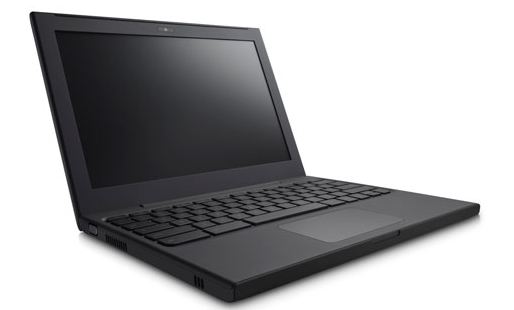
Tonight, I learned of the news via a Google Talk notification from a friend who served in Special Forces in Afghanistan. I then turned to Twitter to catch the world's instant reaction as they took in the quick updates. Babysitting the kids, I couldn't catch Obama live, but saw his address to the nation via YouTube as it was shared on one of the many social networks I visit regularly. My Facebook news feed was filled with excited updates from friends of all backgrounds, cheering what was very bad news for a small handful of people but great symbolic news for millions.

As with many other acts of history of late, from the Iranian protests in 2009 to more recent uprisings in Egypt, Tunisia, Libya, Syria and elsewhere, it's become cliche to highlight social media's involvement in the event or its spread. Make no mistake that social media had zero involvement in the killing of Bin Laden. Secret operations stay secret for a reason and are carried out by true professionals willing to risk everything. So you're not going to get yet another story like that from me. But the time lapsed between the event that put Bin Laden on the front page and tonight's announcement which concluded in his obituary saw dramatic changes in the way we discover and share data.

Keep in mind that in the fall of 2001:
  • Google was a private company with Eric Schmidt 6 months into his position of CEO
  • Internet Explorer 5.5 was the dominant Web browser.
  • The iPod was launched in October, to mixed reviews.
  • Blogger was two years old, and 18 months from its sale to Google.
  • Friendster hadn't launched yet.
  • LinkedIn didn't exist.
  • Mark Zuckerberg was in high school.
  • The combined AOL Time Warner was 8 months old.
  • Twitter was two companies away for Ev Williams.
Ten years of progress has delivered us a new world of realtime, a new world of smartphones, a world of mobile applications, a world centered around texting and instant notifications, one where friends can share news from any source to practically any destination, a world where anybody has the chance to have a voice, which can be shared to millions in moments if the content hits the right spot.

As the rare Silicon Valley geek who sports less-techy liberal arts degrees, with mass communications and political science from Cal Berkeley, the intersection of media and politics is always interesting to see unfold, tonight and on any other big night. I loathe those who are going to turn this into their own theater and trade barbs over party affiliations or try to make this about something it's not. I loathe the silly jokes I am already seeing about GPS and location tracking. I hope we can recognize the night in its context and know there will be even more big nights in the many years to come and each of us will find out the news in our own ways - faster and more direct from the trusted sources we choose on platforms we have not yet even dreamed.