Silicon Valley Technology Commentary & Archives · Est. 2006 3,045 Posts · 2006–2026
Showing posts with label mobile (52 posts). Show all posts

November 7, 2014

November 7, 2014 · 4 MIN READ · BY LOUIS GRAY

Our Smartphones Have Surpassed Their Role as Computers In Our Pockets

Our Smartphones Have Surpassed Their Role as Computers In Our Pockets

The prevailing mantra holds that as our phones become increasingly smart and constantly connected, that we're walking around with the equivalent of computers in our pocket.

These intelligent devices can do practically everything their PC predecessors could, from email and web browsing to document sharing and creation, music and photos, and any application you can think of. In fact, I'd argue that we're not only seeing people spend more hours with their mobile devices than traditional PCs, they're more functional as well - as the smartphone has surpassed the PC. Ever try taking photos with your iMac? It's tough.

Now, instead of considering these phones and tablets as miniature computers, which are used to access our desktop content on the go, we're seeing the reverse take place. The smartphones are initiating the activity, and the desktop connects us to the results. Instead of many small computers in our pocket, our PCs are essentially larger versions of our phones - and we come to our Web browsers and desktop apps to pick up where our phones left off.

Rachio's Web site is as Functional as the App

Not too long ago, it was common to expect apps to be made for our smartphone platforms that were extensions of our Web experiences. These simple mobile apps were wrappers for our cloud-based data, or simply sucked down web pages and media, but didn't offer experiences that were enhanced by being mobile. It was just a mirror of what you could get on the desktop. However, as the app ecosystem exploded for iOS, Android and other platforms, coding for the smartphone became the primary destination and effort for new companies and ideas.

Automatic's Web dashboard leverages data from the mobile device.

You could see this evolution go in a a three step process, from "Mobile too" to "Mobile first" and in many cases now, "Mobile only." Mobile experiences can't just be a shadow of the desktop version, but instead are now carefully crafted to meet rigid design expectations, with a user experience that adapts for smaller screens, and gets better with understanding of the user's location data or other apps installed on the phone. We're spending more and more time inside of our mobile apps, which can be our primary messaging and sharing vehicle, our second screens while watching TV or using the desktop, or a constant companion - to the point we hold them in our hands as we walk everywhere, or put them out on the table in front of us wherever we may go, waiting for the next chirp to grab our attention.

Fitbit takes its data and makes smart charts and graphs on their site.

The natural evolution of this mobile first, mobile centric reality is that we're now no longer going to our phones to pick up where our desktops left off, but the reverse. And when I do end up in front of a full-sized keyboard and monitor, I'm clamoring for smart Web experiences in my browser that reflect activities that have happened on the phone. If it's a miss, I may end up closing my laptop and picking up my Nexus 5 instead.

For applications that are primarily experienced on mobile, seeing a strong Web interface that contains the same data as on mobile is a pleasant surprise. You can see this difference in the way Fitbit has worked hard to have a great Web experience to mirror mobile, while the Moves app does not. Automatic and Rachio have a workable Web experience to match their mobile version.

Managing the Nest thermostat via the Web - same as the app.

Not too long ago, trying to use the Web and get data on our phones was exasperating. We had subpar experiences, had to make excuses for short email replies, or say we'd get to something when back at the desktop. But now, often, when at the PC, you're pining for what's on the phone - even if you can send texts or make voice and video calls from the browser. It's delightful to see when the two are working in sync, and the desktop experience makes the phone experience better. As a user, I'd be delighted to see the front-end experience for the same shared back-end data become more in sync and know the devices are working well together for every service.

Disclosures: I work at Google, who is behind Android, owns Nest, and makes browsers and apps for desktop and mobile. I work on the Google Analytics team, which has a great web experience and mobile apps for Android and iOS. (The first version of this post incorrectly said Nest didn't have a strong Web interface. I was wrong.)

January 14, 2014

January 14, 2014 · 3 MIN READ · BY LOUIS GRAY

Cover Makes My Android Phone Smart and Personal

Cover Makes My Android Phone Smart and Personal

I take my Nexus 5 everywhere I go. It's with me at work, at home, in the car, and practically anywhere. Considering I'm giving this device so much of my time, it makes sense that the device learns from my behavior, as I use different apps and do different tasks in different places and at different times. Instead of being an unchanging brick that waits for my next instruction, smart services like Google Now are bringing me updates relevant to my interests at the right time, and the relatively new Cover app is showing me what applications I might want to use next.

Developed by my good friends +Todd Jackson and +Edward Ho, along with +Gordon Luk, and designed only for +Android, Cover learns when I use different apps, and where, and brings those applications to a key piece of real estate on our phones that doesn't get much love - the lock screen. While other teams have designed widgets and launchers, the lock screen is an interesting battleground and one the typical smartphone user typically sees dozens of times a day. Now, instead of just being a place to wake your phone up, it is personalized and functional. It's as if somebody brought you breakfast in bed instead of forcing you to go to the kitchen and get all the ingredients yourself out of your many cupboards and fridge. And, like the best personalization systems, it starts out with great guesses, but gets smarter the more you use it.

Cover's starting point is fairly well defined. There are three main scenarios - you at home, at work, and in the car. When you're in the car, either driving or as a passenger, you're less likely to use some apps you use at the office, but others more.

Cover Highlights Some of My Top Apps at Home and Work

For me, I've always got +Spotify or Google Music playing on the ride to and from the office. It's in the car when I usually make phone calls to my wife to tell her I'm coming home, and make one last offer to get something on the way home. When I do get home, +Cover recommends I put the music on my +Sonos, or settle down and watch a film on +Netflix. And yes, practically everywhere I go, Gmail and Hangouts (for chat and SMS) play a big role.

Add Your Address to Cover to Make It Smarter

I've been a longtime believer in the world of personalization. I think your streams should be smart. Your apps and sites should be smart, and the information that you put into the system should benefit you as much as it does the company whose service you use. I took a field trip up to the Cover offices on Friday and talked with the team about my early feedback on the app, and some ideas on where they could go next - a real Silicon Valley perk.

In addition to tackling the lock screen in a smart way, the Cover team has also made an impression on people through its Android only strategy. While many developers build in parallel for iOS and Android, or may go iOS first and Android second, the open nature of Android made developing for it the obvious choice. You simply can't do what Cover has achieved on iOS, and they've made exceptional effort to make the application beautiful and inviting.

I test a lot of services and apps, and tell you guys about a few. But Cover has made an instant impression on me, and it's one I'm keeping on my phone. If you're on Android, and you should be, add it to your phone or tablet here. I've known Todd and Ed from their time at Google, when they worked on Gmail, Google Buzz and other products. I know their attention to detail and desire to make incredible user experiences, and see their first efforts with Cover have met the high expectations I have for them. They're funded to the tune of $1.7 million from First Round Capital, and are just getting started.

Disclosures for Fun and Profit: Google is the provider of Android mobile OS and Google Now. Todd and Ed were both briefly colleagues of mine here at Google, and I worked with both during product integrations with my6sense during my time at Paladin Advisors Group.

November 12, 2013

November 12, 2013 · 4 MIN READ · BY LOUIS GRAY

Are the Big Phone Carriers 'Good Enough' These Days?

Are the Big Phone Carriers 'Good Enough' These Days?

Last week, I got my hands on the brand new Nexus 5, and, as you might expect, I've been quite happy with it. The screen is fantastic. The size and weight are perfect, and the battery life is beyond anything I've had so far. But this isn't a post about the Nexus 5. It's about what I also switched when I changed phones - my carrier.

In the process of moving from my aging 2011 Galaxy Nexus on Verizon, I'm now on T-Mobile. This means in the space of five or so years, I've gone from an iPhone on AT&T, to an HTC Evo and Samsung Epic 4G on Sprint, to the Galaxy Nexus on Verizon and now the Nexus 5 on T-Mobile. You could say I've tried all the big carriers here in the US, and experienced their positives and negatives. And in my experience, what they deliver, for the most part, is good enough.

Those of us who were early adopters on the first iPhone here in the US remember that AT&T was the only option - and the service's flakiness was well-chronicled. Many thousands of words were spent in blog posts here and elsewhere decrying AT&T's seeming inability to scale up to the unprecedented data demands brought on by the iPhone. (See: Thoughts on AT&T: What Steve Jobs Should Have Written) Calls that would complete without dropping, even with both parties staying completely still, seemed impossible, and it wasn't unusual for the first words after calling back were something to the effect of "Stupid AT&T".

Moving to Sprint for me was as much a function of switching to Android from iOS as it was leaving AT&T. In 2010 I was making a bet on momentum, app choice and quality, and that choice looks to have played out correctly. But when my family moved across town, we unhelpfully ended up in a place where Sprint coverage was not great - meaning most of my successful calls would have to be made in the backyard. For a year, that was just fine, and we made do - especially as most of the time, we use our phones for data, including email or texts, than we do with phone calls.

In 2011, I switched to Verizon when the Galaxy Nexus came up, and data/voice have been very good. No complaints. But they weren't a partner on the Nexus 5 launch, and while I had considered either going Moto X on Verizon, or keeping my creaky Galaxy Nexus around just a bit longer, I wanted to take another experiment and move to T-Mobile. As Pokemon was best known for saying: "Gotta Catch 'em All!"


Prior to making the switch, I polled people in person and many whom I didn't (via Twitter), to see how they rated their own carrier, on a 1-10 scale, and what mobile OS they were using. Surprisingly, the overwhelming majority of people rated their carrier with a score of 8 out of 10 or above. I had expected to see a lot of lower scores, and to see some trends play out, be it low scores for AT&T on iOS, or lower scores for the smaller carriers, specifically T-Mobile and Sprint. But by and large, people seemed pretty happy - leading me to wonder openly if the only safe business to be universally disliked is that of airlines - who never get any credit.


At the time, my curiosity was as much tied to MotoMaker for the Moto X launching first with AT&T. Was AT&T good enough again to be forgiven for their 2008-10 era quality gap? Could I possibly think of getting back with AT&T after all the frustration I'd seen? I saw people on iOS, Windows Phone and Android all giving AT&T scores above 7, and those from other carriers also being quite favorable. There were no clear laggards.

So when the Nexus 5 came available on Google Play, my internal debate over how to move forward was a pretty simple one. I saw that T-Mobile's LTE coverage includes my work and home. I saw the pricing for T-Mobile was in line (and actually a bit cheaper) than Verizon, and practically the only risk I'd be taking is if it was weak when I traveled outside of my usual stomping grounds. And so far... no complaints.

There's no question that as more and more of us as consumers and businesspeople are expecting more from our smartphones and tablets, that the demands we're putting on our telecommunications infrastructure is dramatically increasing. We've gone from a society that exchanged voice calls and simple texts to one where we expect full HD video and streaming live audio. We expect high speed access on all our devices, practically everywhere.

To build and support that demand, all the carriers are racing to be sure they're not the one who ends up left behind, as all the smart consumers end up attached to the market leaders. It's been a long time since I've read a great rant on AT&T, or seen a wave of people reporting dropped calls. Verizon's commercials promise the widest LTE available, and they do have "the map for that", but the alternatives seem to keep up in users' eyes. So maybe, just maybe, we've hit a turning point when the carriers are pretty good, and the user experience is going to get even better as our hardware improves and the mobile software gets even more excellent. I'm glad we've gotten this far.

Usual Disclosures: I work for Google. Google builds Android, and shaped the Nexus 5. I initially received my first HTC Evo free from Google I/O 2010 before I joined the company. This post isn't aimed to indicate any bias or favor to any Google partners. That'd be silly.

May 2, 2013

May 2, 2013 · 3 MIN READ · BY LOUIS GRAY

Mobile Data Goes Up, Phone Calls Go Down, Can't Explain That

Mobile Data Goes Up, Phone Calls Go Down, Can't Explain That

By the end of last month, Verizon was regularly sending me updates on how close I was to reaching the top of my 4 gigabyte data cap available in the plan I share with my wife. A little over two weeks in, I had used more than two gigabytes, after three weeks a third, and by the end of the billing cycle, I could have hit maximum capacity, had I just left my favorite Spotify playlist on play and asked all my apps from Google Play to update simultaneously.

But I was nowhere near capacity for our shared voice plan. Not by a long shot. In fact, the month saw a record low in our actual voice usage, racking up less than an hour's time over 30 days, which averages down to less than 2 minutes per day, more than enough time to call home, say, "Are the kids fine? Do I need to get anything?" and hang up.

It's unlikely the activity seen in our own home is unusual. Where just a few years ago, one could see passersby talking on their phones as they jostled down the sidewalk, or ringing phones would be commonplace in cafes and restaurants, it seems more people are looking down at their phones to trade updates than picking one up for a quick call. At this point, it's likely most of us don't even know our best friend's phone numbers, but could rattle off a few hundred Twitter handles of mere acquaintances if it came down to it.

The story of how static land lines with inflexible phone numbers were rapidly diminished with mobile phone numbers that stuck with a person from plan to plan, phone to phone and more recently, carrier to carrier, is a well known one. Hotels can no longer expect you to rack up ridiculous phone bills for local calls and family updates, and hope they can instead get you to foot the bill for 24 hours of questionably high speed Internet instead. And the telecoms are no doubt praying that all of the youth addicted to texting stick with SMS and far away from the many different free services that connect people in real time.

When I was on a trip last month to Paris and London, I didn't even make an effort to ensure my phone worked in Europe after I had crossed the Atlantic. Where in years past, walking around with a less than functional phone would be crippling, and worth the extra quid to get a few megabytes and minutes, I replaced all that potential cost with daily Google+ hangouts to see the family face to face, and stuck near WiFi for everything else.


That's not intended to be a plug for Google+ hangouts (although you all know I work at Google and think hangouts are great), but a real clear example where traditional voice seems rather quaint. Instead of a voice relationship and fighting over the phone between my 3 youngsters, I could see them and their expressions, even to the point of making funny faces, from thousands of miles away.

Our phone voice use has never approached our max, and is at a new low.

What I did see, however, especially in London, was the availability of SIM cards with pre-paid contracts that were data only, with no voice attached. It's clear that in a world of apps, our mobile devices aren't expected to be held up against our ears, but in front of our eyes, ready for our hands' next command.

Voice calls now are the refuge of two major parties - the salesmen and the grandmothers, essentially. Receiving a phone call from a number you don't know, or a geography you don't visit is practically guaranteed to be a robocall or somebody wanting your money or your opinion. And grandmas get a pass because they've usually passed the point where they can learn new tricks.

Just like we passed a time where physical media made sense, becoming a clutter in our home, and practically all of us said goodbye to our landlines, I wonder how long it will be until we say goodbye to voice functionality on our phones, except in the event of an emergency. These devices won't cease to be communicators, as our primary point for email, social networking and photography, but voice is practically an also ran on the very devices initially created for that very purpose. It's very interesting to watch.

June 15, 2012

June 15, 2012 · 4 MIN READ · BY LOUIS GRAY

Pictures, Or It Didn't Happen on Mobile

Pictures, Or It Didn't Happen on Mobile

Foursquare made waves two weeks ago with the launch of their newest application, which more broadly emphasized recommendations, discovery and tips from friends than the original use of the app - a simple checkin, alongside the race for badges and mayorship as you traveled from place to place. Some sites called it the death of the checkin altogether, not wanting to miss an opportunity to be sensational.

But the application's refresh did more than take the focus of all my minor comings and goings. It made photos an even greater part of the experience, putting pressure on me, more than ever before, to include something visibly pleasing as part of the checkin. With the upgrade, Foursquare joins many other leading social apps that have rallied around photos as a major part of their approach to mobile.

Images from my Path and those from a friend.

Instagram's recent sale to Facebook for a gaudy $1 billion thrust them into the spotlight, as the photo sharing app had users preferring its emotion-grabbing images and filters to the standard fare seen on the largest social networks. Given Instagram's iOS-only approach during its early period, I'd never gravitated toward using it, but many embraced its simplicity - the presentation of photos, and encouragement of light social signals for friends to react.

In some ways, this is similar to the Path app, which initially made waves for going mobile only, and focusing on a 50-friend limit, when other networks let you friend freely into the thousands and tens of thousands. Their push for an intimate network, making every share a selective one, where you can see who has liked a moment, or even just seen it, puts more focus on the user to share something meaningful and personal, instead of the mundane.

Now that Path's on Android, and with people I respect, like Shak Khan (formerly of Spotify) and Dylan Casey (formerly a colleague at Google) on board, I've been using the app a lot more, even if it's just as a simple way to send high quality photos to Foursquare. It's been fun to tap into the casual photos and moments from those friends on Path and see things from their view, in color.

Now I Feel Guilty If I Check In Without a Photo, Even At Home

Of course, like Path, selective sharing has been a hallmark of Google+ since the network's launch a year ago. The idea of getting the opportunity to share the right content to the right people at the right time, parallel to that of how you share offline, has struck a chord for privacy-seeking individuals, families and groups. But it's also been a good showcase for photographers who want to bring the images to the world. Prominent camera slingers like Thomas Hawk and Trey Ratcliff had gained followings in the millions, and there was even a  conference in San Francisco for the Google+ Photographers community at the end of May.

On mobile, as many noted, the refresh of the Google+ app, first on iOS and quickly following on Android, made photos take center stage. Like Instagram, Path and Foursquare, the mobile app displays photos to the full width of one's screen, letting the images do the talking. While Google+ also is home for lengthy comment threads, and longer text-centric posts, if there is an image available to display in the post, it gets the headline, and everything else is below the fold.

Google+'s Mobile App Delivers Full Bleed Photos and Full Color

The move toward photo-centric experiences in social mobile apps is one that reflects a few things - that smartphones are increasingly capable of taking high quality images, but also having improved displays to bring pictures to life, that wireless download speeds can handle the increased demands of a photo-centric experience, unlike the days of WAP and text-only mobile sites, and that users love it when updates from friends come to life.

Facebook Also Pushes Large Images In Its Mobile App

Google's Chrome browser was famously named as a reverse expression of its qualities. Chrome referred to all the borders and features that surrounded the app's content. Chrome took them away, for the most part, going to the edges and trying to put the emphasis on the pixels inside the browser window. These apps, including Facebook, on the news feed and individual timelines, are doing the same - putting photos in the center of the experience, and encouraging lightweight social actions.

As many people are turning to social interactions with micro-updates and away from lengthy text-centric blogs, something beyond incredible prose has to catch one's attention, and it's becoming photos - from memes to LOLCats, Instagram, Path, Foursquare or others, you can see how the photos on mobile really have become as powerful as a thousand words.

Disclosures: I am a Google employee, and have worked closely with the team focused on Google+ Mobile. One can assume that in some way Facebook, Path, Foursquare, Instagram and others could compete with various aspects of Google's different products.

September 12, 2011

September 12, 2011 · 3 MIN READ · BY LOUIS GRAY

In-App Purchases: By Account or Device?

In-App Purchases: By Account or Device?

In a world where the Web is increasingly consumed on mobile devices, and applications on iOS, Android or other platforms continue to proliferate, developers are turning to in-app purchases to drive revenue, not just for premium applications, but for free applications that often get you in the door, but entice you to pay up for additional features. But what many developers aren't preparing for is a world where consumers have multiple devices, but carry the same apps - putting the customer's data at risk, tied to a single device, even when a centralized cloud solution seems like a reasonable and much more modern, alternative.

Traditionally, premium software vendors have asked customers to pay on a per-install basis. Want to run Adobe Photoshop on multiple computers? You have to pay a multi-user license. Want to run Microsoft Office for the whole family? Get a family pack. But on the mobile side, thanks in large part to Apple's leadership on the iTunes store, and other app stores, including the Android Market (tied to one's Google account), premium and free applications are synched on a per-user basis. Want to upgrade your iPod or iPhone? A sync with iTunes should get your apps back. Purchase the latest Android tablet or phone? Log into Google with your account, and the Android Market will start feeding you your apps.

That said, synchronization of content between devices is comparatively poor. For every cloud-based app like Gmail or Spotify that recognizes your ID and displays your information on every device, one finds applications that live on your phone or tablet, and don't communicate to any parallel installs you have. (See iTunes' guidance on this issue) This leads to the very common issue known by any Angry Birds addict, who finds themselves conquering the same levels from phone to phone to computer or even on Chrome, instead of starting where they left off. If you love killing pigs and burning time, that's wonderful, but I'd bet many people would find it valuable to log in with their account on any device, and continue where they left off. Some apps, like Barnes and Noble's NOOK app, do this very well, but many miss the target.

The situation becomes even more complicated with the advent of in-app purchases. Forget about the Mighty Eagle (just one dollar per level!) in Angry Birds. You can purchase weapons and tools galore for sports games and strategy games on your smartphone, but many application developers are making the purchase much like they did in the traditional sense - assigned by device, not tied to your Apple account or your Google account. That means that not only do your premium purchases not follow you from device to device, but even worse, if you have to reinstall your mobile OS for whatever reason, you've lost the in-app purchase data, and probably a bunch of the app's history as well.

Living on the bleeding edge of early adopterdom as I do, I've learned to be flexible with the occasional bumps. I got hit with this in-app issue this summer when I had the chance to reinstall Honeycomb on my Android tablet from Samsung, only to lose the in-app purchases I'd made on the 9 Innings baseball game, along with dozens and dozens of games played and players acquired. While I didn't have to rebuy the app itself, which is great, I was starting on Opening Day all over again. That's nuts.

I can understand application developers wanting to ensure they receive appropriate payment for their apps being downloaded and enjoyed. I think the functionality of in-app purchases is a great expansion of mobile commerce. But in a Web-centric mobile world with centralized accounts, storing one's application data on the device, without backup in the cloud, seems short sighted. Many of us carry multiple devices, and may some day upgrade our phones and tablets. It'd make more sense for me that we can do so without fear of losing our progress and our premium buys.

July 11, 2011

July 11, 2011 · 3 MIN READ · BY LOUIS GRAY

Still Looking to Sync the World of Desktop, Mobile Devices

Still Looking to Sync the World of Desktop, Mobile Devices


As an over-extended digital device collector, I have my unfair share of tablets, phones and laptops strewn about my office. My kids are practically tripping over them, each one having its own use or unique operating system. As I use each of these devices, I find myself seeing gaps in the way different applications share data - keeping user information local to the device and locking it away so I lose information when I switch. While the Web and the buzzword-heavy "cloud" are helping matters, we've still got a lot of room to grow.

As I move from device to device, I'm doing so making decisions based on what applications and data I will find when I get there. By using my laptop, I lose access to games and apps that run on my Android phone and tablets. By using my phones, I lose the desktop apps. While some are looking to Apple to lead the way by merging the OS X concept with iOS, less talk has been made of bringing these iOS apps to a touch-screen enabled desktop. Maybe the idea is not happening because it's a bad one, but some smart app developers have thrown caution to the wind and brought their content to practically every screen.

Take the ubiquitous Angry Birds franchise for starters. I can play Angry Birds on my Mac from the app on the Mac App Store. I can play it on Google Chrome on the Chromebook. I can play it on my Android phone and tablets. I can play it on the iPad and iPod Touch. It's everywhere. The downside, of course, is that I have to conquer all the same levels again on every device, with no central record.

A little better is how Barnes and Noble approaches its NOOK eBooks. Purchases I make on my NOOKColor may initiate there, but I can also read the same books from my NOOK app on the Galaxy Tab (7 inch or 10 inch) and there's even a Mac client. I just have to sign in to my account and my library is right there. Very cool. If I'm connected to the Web, it will even know which book I am reading and open to the right page. That's the kind of integration I am really looking for.

You can also see smart integration of user preferences in the way Safari on iOS has the same bookmarks as on your computer, or how Chrome bookmarks follow you from Google Account-enabled machine to machine.

But most of the time apps are not behaving this way. Android's default browser is still not Chrome (and this baffles many), so the integration isn't there. Meanwhile, if I play 9 Innings baseball on my Galaxy Tab 10 and get through 81 games, starting the same app on my Galaxy Tab 7 starts at game 1. Even if I buy in-app enhancements to the game (and others like Home Run Battle 3D), those enhancements are device-specific.

Now that we can have Web-centric user profiles and can back up our user content, history and preferences, the very least we can do is be sure that our activity is matched across similar mobile devices. I recognize that often coding for desktop and mobile can be very different, but as the devices blur between smartphones, tablets, laptops and desktops, a screen is a screen is a screen, and I want to get the same stuff everywhere.

Defaulting to a Web-centric operating system like ChromeOS is a start, of course, but it's early days for that, and not everything has yet made the trip. I'd love Spotify on my CR-48 the same way it's on my phones and tablets and Mac, but it's a major hole until it hits the Web.

One practically has to make a mental matrix to remember what content and services are available on which devices, and what one loses when they choose one screen over another. I'd like to see more developers thinking about eliminating these gaps and giving users what they want no matter what screen they choose.

May 15, 2011

May 15, 2011 · 4 MIN READ · BY LOUIS GRAY

AOL In the Attention Business, Mobile Getting More Of It

AOL In the Attention Business, Mobile Getting More Of It

Following HP's acquisition of Palm last year, David Temkin, the VP for the Developer Platform at the company, exited stage left to AOL, joining forces with Brad Garlinghouse, Tim Armstrong and the new management at the firm which is working to redevelop and revamp one of the best known Web brands which comes with the baggage of significant history, with more than its fair share of ups and downs. With the move, Temkin gained an incredible role, running all of mobile for the Internet giant, at a time when mobile content is growing faster than any other segment and users are more likely to add new behavior to their repertoire, unlike on desktops, where users are less likely to change their habits. On Thursday, Temkin updated members of the media on recent product launches and how the company approaches the important world of smartphones.

AOL is no slouch when it comes to the world of content and demanding users' attention - so much so that Temkin said "AOL is in the attention business," adding, "You gain attention by going to the users where they are."

AOL's Engadget App Drives More Page Views than the Web Itself

Users are increasingly going to their mobile devices to consume content, which has led the company to create 30 or more applications for iPhone and Android, with simple presentations of content, focused on delivering a "delighting user experience". With just under a year's tenure at the company, Temkin started with reaching out to all the disparate brands at the company and working with them to take the content they were already producing and making a strong mobile experience. While the most popular app, by a long shot, is Engadget, others include Moviefone, which hit iPad less than a month ago, and Popeater. In fact, the Engadget app drives more page views than the Web site itself - excellent numbers.

With dozens of popular iPhone apps on the roster, AOL recently shipped an Android-only music application, called Play, which was quickly featured on the Android Market, scoring more than 300,000 downloads in just two weeks. As users are still finding which applications deserve their time, Temkin sees the mobile market as having serious greenfield opportunity, gaining new customers and pushing others to switch their preferences.

The New Moviefone for iPad from AOL

"On mobile, people are still establishing their habits," he said. "User behavior on the desktop is fixed and difficult to change. It's an uphill battle."

That AOL is dropping dozens of new applications and new brands on multiple platforms is a far cry from the environment Temkin joined in mid-2010, when even the main company site was optimized not for smart phones but for feature phones, without rich media capability.

"AOL.com on mobile, when I joined, was a slightly upgraded WAP site," he said. "Now it's buzzword compliant and we have more than doubled in the year the number of users we have coming in. It's a nice thing to improve the product and see the kind of results we have."

Coming Soon: Editions from AOL

Still on the docket for release is the much-anticipated Editions magazine, coming for iPad in the vein of Flipboard and Zite, but driven by algorithms based on the users' interests and preferences - yes, much like my6sense and others have made their focus. As Temkin described, the application will not be an editorial publication, but driven by artificial intelligence, pulling in content as if there were an editor driving the magazine.

"Your cover will be unique to you, with the topic you are most interested in and what the publication thinks is most important," he said. "We are scanning thousands of sites. We track what you like to read based on what you click on and explicitly what you say you like by subject. Algorithms drive the layout."

If AOL is in the attention business, tracking your own attention to its properties seems like an obvious next step. As smart phones get more capable, and AOL pushes to have its content in front of as many eyes as possible, you should expect to hear the name David Temkin a lot, for he is running the strategy of the fastest growing piece of one of the biggest Web brands in the business.

As AIM head Jason Shellen quipped Thursday, AOL "has become a powerhouse for smart people, and it should become a not so quiet revolution soon. It's about bringing the brand up a level."

Disclosures: my6sense has similar functionality to that promised in Editions and other news readers with advanced personalization capability. I am VP of Marketing at my6sense. Additionally, HP is a client of Paladin Advisors Group, where I am managing director of new media.

May 11, 2011

May 11, 2011 · 4 MIN READ · BY LOUIS GRAY

Google Displays Big Numbers at GoogleIO. Is It Better?

Google Displays Big Numbers at GoogleIO. Is It Better?

The first day of Google I/O 2011 was focused on Android. For Google, focusing on Android and the mobile OS' growth is a real point of strength, with incredible numbers and increased velocity. But there are still open questions as to demonstrable quality leadership that would have people on the other side of the aisle drooling with jealousy.

Hugo Barra, director of product management for Android at Google, highlighted growth of Android from the first T-Mobile G-1, shipped 2 1/2 years ago to 100 million Android activations through 2011. Other statistics similarly portray a story of wide reach and penetration in practically every regard: 36 OEMs, 215 carriers, more than 450 thousand Android Developers, feeding 310 Android devices in 112 different countries. The 100 thousand activations per day highlighted in last year's session was doubled three months later, and doubled a second time, to more than 400 thousand daily now. Total software application installations have accelerated with the first billion installs taking two years, and most recently, only 60 days, with 4.5 billion installs to date.

With Google being a data driven company, there's no question they love their numbers, and these are good ones. But there's no doubt a sizable market who perceives the OS and the companion apps and hardware as being of lower quality versus competitors like Apple, or even HP and Microsoft. Barra stated, "The quality of apps is amazing," adding "The world's most engaging, useful and entertaining applications are running on Android."

Accompanying his comments was a laundry list of brand name apps that have come to be featured in Android Market, many of whom who started on iOS first, and have moved to Android, from Major League Baseball to Pulse and many top game titles. With that kind of intro, no doubt many of us were excited to hear what was to come next in Android, especially as we were caught up on improvements to Honeycomb 3.1 and the new Ice Cream Sandwich. But for the most part, the updates seemed very simple, leading off with enhanced widgets, and enabling devices to act as USB hosts. Ice Cream Sandwich was promised as bringing the best of Honeycomb to phones and tablets, but the response to Honeycomb so far, especially in its limited release so far on the Motorola Xoom has been lukewarm.

As was mentioned to me in a discussion with a small group of Google geeks, in a conference focused on developers, one shouldn't always anticipate the delivery of retail-capable products for end users. So while all the 5,500+ attendees (myself included) were no doubt excited to test and receive the new 10 inch Samsung Galaxy Tab ahead of its availability on the open market, much of the highlights were focused on technologies that looked futuristic in nature, with midlevel applicability to today's array of products.

The much-anticipated arrival of Google Music and movie rentals on the Android Market are definitely improvements for all Google-centric users looking to wean themselves off iTunes, but they do seem like they are playing the role of catch-up to both Apple and Netflix, who have significant headstarts and market visibility. It's obvious the music labels are so full of themselves as to be causing headaches for Google, Apple, Amazon and Spotify, but it'd be great to see Google leading the way on some of these spaces instead of filling holes in their lineup against Apple.

Don't get me too wrong. Google's software sounds very good, with fun demos of smart machine-learning driven mixes (comparable to that of iTunes), and wireless synching, where Apple lags behind. But if you're going to take on the established player in the market in the place where they are strong, it isn't just enough to play feature matching, you must catapult way beyond their offering, as Spotify did for me to iTunes, getting me out of that model entirely.

What I've seen happen in the last two years or so is that lines are being drawn between those who prefer one platform and those another. It's a rare person who gets the chance to try both platforms and come away with a full understanding of one's weakness and another's strengths. Instead, most are digging in with both feet and becoming defensive if their point of view is questioned. If Android wants to truly be perceived as the market leader, not just in quantity, but quality, it's got some more room to grow, to demonstrate highest quality tablet experience, app experience, universal application across devices, and feature leadership - because the other team has the branding and personal experience nailed, great numbers or not.

May 9, 2011

May 9, 2011 · 8 MIN READ · BY LOUIS GRAY

Revisiting Android A Year Into My Smartphone OS Migration

Revisiting Android A Year Into My Smartphone OS Migration

Tomorrow's Google IO approximately marks the one year anniversary of a shift in my digital lifestyle, when I began to use Android instead of my trustworthy iPhone, which had been my go-to device for a number of years. While any post I make regarding Android runs the risk of being assigned the 'fanboy' label, it's worth reviewing what has changed in the market over the year since I left the Moscone Center with a new HTC Evo - an intriguing year that's seen major announcements by players in and out of the ecosystem, with consumers reaping the benefits of an innovation race, assuming the courtroom battles between Apple and many other players don't throw a monkey wrench into the whole thing.

Mobile OS Software

When I left the Moscone Center with my new Evo (provided courtesy of Google and since replaced by a device I paid for out of my own pocket), the device came with stock Android 2.1, code named Eclair - with 2.2 Froyo having been demonstrated at the event and expected to arrive soon. At the time, my iPhone was on version 3.1.3 and the iPads were on iOS 3.2.

Not too long afterward, the Evo was gifted with 2.2 Froyo in an over the air (OTA) update, keeping it relatively on track with Google's calendar.

In late June of 2010, the iPhone was upgraded to iOS 4.0, bringing with it multitasking, folders and universal in boxes, to name a few things. The iPads reached 4.2 in late November, adding AirPlay and other items.

By the end of 2010, Google had moved beyond Froyo and was talking up Gingerbread, the 2.3 release. This release hasn't yet made it to the HTC Evo, which my wife now uses, nor to my Samsung Epic 4G, which I switched to in November of 2010. In fact, the Epic's meandering move from 2.1 to 2.2 was a big pain, but it was very much a laggard relative to its compatriots, and once it arrived, I had no complaints.

On the Android Tablet side, while Honeycomb (3.0) was said to be the go-to OS for Google-approved tablets, I've been quite happy with the Samsung Galaxy Tab, which came with 2.2 when I bought near the end of 2010. There hasn't been a clear roadmap from Samsung as to the Galaxy Tab getting to 2.3, let alone 3.0, but newer models of the Tab are centered around Honeycomb. So far, from my experience testing the Motorola Xoom, I haven't yet been tempted. The iPad 2's introduction in early 2011 was primarily a hardware bump for Apple, without new software features.

Mobile OS Hardware

As my conversion process to Android was ongoing, Apple started selling the iPhone 4 in June of 2010. Despite multiple visits to Apple Stores to try the device myself and reconsider if I had made the right choice, the hardware and software combo didn't persuade me to reverse course. Despite multiple rumors one way or another, Apple has not yet made any updates to the iPhone 4 in the past year, with the exception being adding a second carrier in the US (Verizon).

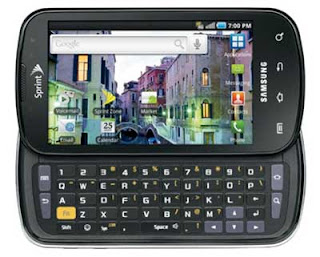
While Apple's been holding steady with iPhone 4, scads of Android phones from different carriers with different features have been released - some fantastic, some good and some not great at all. The Evo, despite many things I liked about it, was heavy and a power hog, and I felt odd writing a disclaimer each time I mentioned Android on the blog, so those things, combined with a simple upgrade to the Epic 4G, which gained me a hardware keyboard to boot, got me to switch. Besides phones with real keyboards (which Apple's not interested in), there are also dual screen Android phones, Android phones that offer laptop cradles and low-end Android phones that get below $99 at retail.

Where people have gained annoyance with Android is the tight leash carriers have over the software on the devices. It's perceived, even if not backed by great evidence, that the carriers are not incentivized to keep users on older hardware current, preferring instead to push them to new models. After starting and stopping its Nexus One program, Google introduced its Nexus S offering which, in addition to being a cool-looking phone, promises none of the carrier nonsense on the phone, as well as fastest access to Google code releases. While it's not a major win to say the attributes of the phone are simply avoiding negatives from carriers, it's valuable to have an unblemished alternative.

I Could Switch to Nexus S on Sprint If I Wanted

As a user, assuming money is available, the option is there to upgrade to an even newer and better phone on the Android platform, keeping the carrier you like (in my case, Sprint), every few months. If I found it made sense, or if they somehow give away Nexus S phones at Google I/O this year, I can switch phones again with almost no headache. Meanwhile, if I were still on Apple's side with the iPhone 4, I could stick with the iPhone 4 or stick with the iPhone 4. What most folks get confused about is the word "open", while I prefer to see it as "options". I can change if I want to something that works for me.

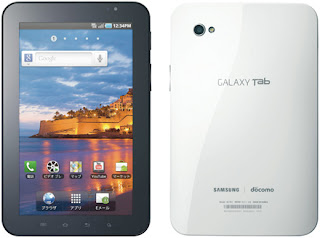
The 7-inch Galaxy Tab: Still the Gold Standard on Tablets

Speaking of "options", both the Samsung Galaxy Tab and the Android-powered Barnes and Noble NOOKColor come in 7 inch handheld sizes, which Apple thus far has avoided, sticking with their 10 inch model. While preferences are preferences, I do have the option on Android to go small, medium (8.9 inch) or large (10.1) if I want, while Apple is sticking with the one size fits all approach - one I expect they will change as the product matures. After all, they do have small/medium/large in laptops, iMacs and monitors, so it befits their history. I strongly prefer the 7 inch size over the 10 inch, and once you've used one for a good amount of time, a larger tablet just seems too big.

Applications

For those who prefer Apple and the iOS, aside from a unified experience, the second most attributed reason for keeping the iPhone candle lit is typically applications - either in number or quality. I hypothesized a year ago that Android's market share numbers and array of carriers, phones and users would lead to more developers, more applications and eventually better applications. I believe for the most part, this has come true. There are a select number of developers who continue to be iOS-only, but they are rapidly joined by those developing for both platforms, and increasingly, by those who are developing for Android first, iPhone and iPad second, like I said they would. Robert Scoble, well known tech blogger and Apple fan, cited this trend in his recent post this morning, when he said "the most interesting set of companies is being built around smartphones and here, for the first time, Apple’s iOS doesn’t have the coolest apps."

As a long-time Mac user (typing this on my MacBook Air now), I understand the defensiveness of quality over quantity and believing that you've got the best stuff. But I do believe that developers are bringing the best stuff over to Android as well and users are not going without apps they would have available on the other side.

There's no question there is tremendous work to be done to clarify payments to and rewards for developers on the Android platform, relative to the iOS platform, and there is work to be done on the Android Market to add discoverability versus iTunes, but again, having tried both, to say one is great and the other is lame is a dramatic oversimplification. There's something very cool about managing one's phones via the Web and installing applications to different devices from the browser with a few clicks - something I still can't do on iTunes.

What Does This All Mean?

It makes sense to try and keep an open mind when it comes to technology progress in a world that's changing fast. I've enjoyed iOS in the past, and am glad it's so simple that my kids don't waste much time on the iPads fighting technology. I've had my occasional bumps with Android, outweighed greatly by the benefits of multitasking, built in hotspotting, voice search, and flexibility of the platform. I actually tried and enjoyed the Windows Phone 7 experience, and hope to some day get a chance to try out HP's Web OS and Kinoma on any phone once that ships. To pick a side and stick to it while being blind to the many options out there in the market is silly, but in looking back on my switch, I am glad I didn't get stubborn and ignore the market trends. While Android has provided more options from different carriers with an array of devices and improvements in the user experience and applications, iOS has not done much in the same time, aside from make a ton of new customers and a ton of money. That's fantastic for Apple and for the tech world in general, but not much money has gone toward Apple from our home in the last year.

Google and the carriers have a lot of work to do to solve fragmentation and the perception of fragmentation. They have to do a much better job of explaining why their experience is better than that of the competition (if that's the case). They need to make Honeycomb dramatically more simple, and more attractive to developers. They need to make troubleshooting the devices, when things go wonky, solvable by humans without Linux backgrounds.

That said, I like that Android has given us choice in tablets, in smartphones and carriers. I like that I can use a platform that doesn't fill me with fear when I upgrade from one phone or another, or know that because my wife broke her Evo, that a new one which arrives tomorrow will take only minutes to configure, synched with her Google account. There's no telling what the next year brings in terms of new devices and new places we'll see Android, but I'm betting it will be another year filled with new functionality, new apps and new experiences I would have missed if I didn't jump from one side of the aisle to the other. No doubt tomorrow at Google I/O we'll start to get a few hints.

February 13, 2011

February 13, 2011 · 4 MIN READ · BY LOUIS GRAY

Kinoma to Bring Sleek App UI to Smartphones and Beyond

Kinoma to Bring Sleek App UI to Smartphones and Beyond

Near the end of 2010, Marvell Electronics, the San Jose-based silicon manufacturing firm, quietly made an acquisition of a software company called Kinoma, making mobile media browsers and other software for smartphones on Windows Mobile and Palm. This odd couple of sorts has pulled away the curtain today at the Mobile World Congress in Barcelona, Spain, promising to bring a new, elegant software platform for practically any digital device, designed for the new world of touch interfaces, bringing simplicity out of the domain of geeks, but all the way down to embedded devices. The idea? That Marvell ships a ton of silicon - billions of dollars a year worth, leveraging ARM processors that promise high performance and thrifty power consumption... but that don't have a strong UI to match. Kinoma now has a practically infinite playground, to take one of the slickest touch-based interfaces I've ever seen, pointing it first at smartphone and tablets, and later, taking it downmarket to practically every screen you've seen that begs for an overhaul.

The pedigree of the Kinoma team is a lofty one, filled with names you probably don't recognize, but whose products you use often. Peter Hoddie, who cofounded Kinoma in 2002, and is now VP of the Kinoma Platform at Marvell, spent nearly a decade at Apple working on the Quicktime platform. Brian Friedkin and Michael Kellner, also cofounders, similarly hailed from Apple, working with QuickTime and the development authoring platform Carbon.

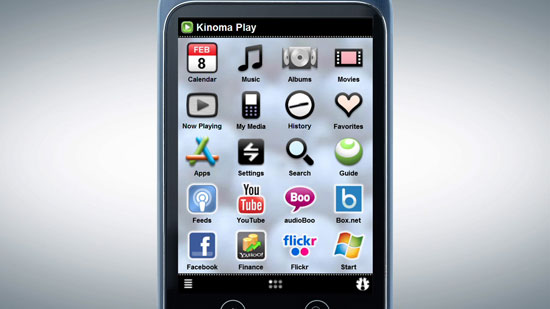
Kinoma Play - the First Kinoma App

The trio's time at Apple delivered two primary focuses evident in today's unveiled product - a focus on multimedia, and a top quality user experience. That they spent years coding for underpowered computers also prepares them well for a world of feature phones and embedded devices in line for a UX fix. Last week, I sat down with Peter for a demo of the new Kinoma interface, and to talk about his vision for a world of proliferating devices. His story was one of applications that could speak to one another, actions that took a single click instead of multiple commands, and delivering resources to developers who want to leverage a consistent user experience.

The initial offering, called Kinoma Play, is essentially a new smartphone launcher that starts with 40 native applications, from social media to location and search. Kinoma's underlying foundation will be open sourced, and Marvell can then focus on optimizing the software layer for the company's chipsets.
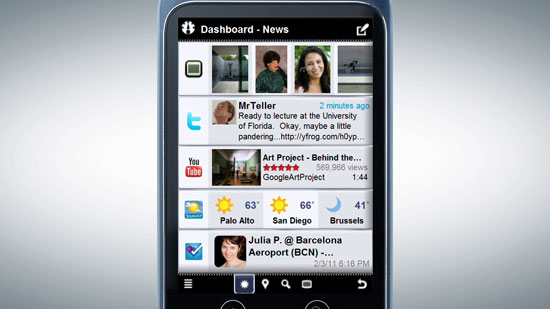
The Kinoma Dashboard in Action

"What we can do as part of Marvell is bring sophistication from the smartphone market down to embedded devices," Hoddie told me. "Think of it as an evolution. There were computers which became phones, and we adapted. Some of these lower end devices are stretching it another direction. Bringing a great user experience to these devices is a big deal."

Unlike many software manufacturers, whose hardware demands continue to increase with seeming incremental solutions, Kinoma's expectation is to run with small amount of code for even the simplest of devices - and the the product's SDK is intended to make new platforms accessible to a broader audience than has typically been available from offerings such as Android and iOS, which require languages like Java and Objective C.

The Kinoma interface is incredibly sleek, centered around a new experience called a Dashboard, which brings features and events from an application to a single place, described as being both "infinite" and "self-organizing". There is even an application called History which shows all activity across all applications in a single place.

"The whole experience becomes the baseline for people to build on top of," said Hoddie. "Apple brings design to the party, but makes it challenging for people to achieve to their level. Google brings an open platform, but not the thoughtfulness to user experience. We are the right solution at the right point in time that the market needs right now. Smartphones and tablets aren't the only game in town."

One of the more intriguing aspects of Kinoma is the capability for applications to interact and link to one another, rather than their trying to do all tasks or being solely limited. While they can speak to one another, Kinoma acts as the glue to bring a consistency in the operating system and applications. One can see the Kinoma launcher sitting atop Android phones and Windows 7 phones or other smartphones in the future, even as the smart UI travels downstream to devices most of us might not use every day.
So why Marvell? Kinoma's no babe in the woods, with 8 years of history, and they recognized they needed a big partner to provide the business muscle, developer resources and OEM relationships to gain serious traction.

"As a small company, we could be innovative and controlled our own destiny, but it wasn't enough to be small and clever," Hoddie said. "We were going to need more resources. In parallel, Marvell was seeing how important software was to what they were doing. Being close to the hardware is important, but also getting closer to the ecosystem, which will be a huge deal for Marvell and lift the entire industry."

Kinoma goes live at the Mobile World Congress in Barcelona today, and it won't be long until you can try out their unique interface on smartphones near you.

January 27, 2011

January 27, 2011 · 2 MIN READ · BY LOUIS GRAY

Samsung Launches Developer Portal for Android, Bada Apps

Samsung Launches Developer Portal for Android, Bada Apps

With the blistering rise in customer and partner interest and development of new applications for the Android operating system, companies like HTC, Motorola and Samsung have emerged as the go-to device manufacturers for a wide array of compatible handsets and tablets. Without a single provider offering both the hardware and software, like with Apple and the iOS, the companies have gained greater visibility with consumers, and some have even branched out to offer branded application stores to improve their standing in the expanding ecosystem. Today, Samsung launched a new online hub for 'Samsung Developers' at http://developer.samsung.com, aimed to spur tighter integration with their products and make their devices smarter.

Looking around my home, Samsung is rapidly vying with Apple for top brand representation. In addition to my Samsung Epic 4G phone (on Sprint), I have the Samsung Galaxy Tab, and even the TV in my office bears the Samsung logo. Samsung had a huge presence at CES earlier this month, and is expected to make a solid impact at the upcoming Mobile World Congress (MWC). Samsung's Galaxy S line of smartphones is tangling with iPhone for the top position in Japan and in other countries worldwide, and the Galaxy Tab has set the standard for Android Tablets taking on the iPad.

Samsung Apps Featured on the Developer Portal

But Samsung does more than Android, also promoting Windows Mobile devices and its Bada platform for lower-end devices, selling millions of handsets outside the US. The combination of its Bada offerings with Android and Windows Phone esentially means Samsung's brand is found from the most feature-rich smartphones to basic mobile devices. Added to the tablets and Web-connected TVs, and you can see how Samsung has lumped its offerings into a bigger pool called "connected devices". The new developer portal courts application authors to target these connected devices to reach "an audience of millions".

The new Samsung Developers portal takes much of the guesswork out of creating an app for the Samsung platform, with included "how to" and "getting started" guides to build applications that can run on multiple platforms and devices, and specific primers for such varied topics as bluetooth, theme design, security, widgets and how to leverage the Galaxy Tab's screen real estate. It also introduces the concept of Samsung Apps (http://www.samsungapps.com), optimized for the platform, including featured apps, both free and paid.

If you are an app developer looking to break out of the crowded Android market, teaming up with Samsung could be a great way to get visible on some of the best and most popular hardware in the smartphone and tablet market. The developer portal should help give a solid boost. Find it at http://developer.samsung.com.