Silicon Valley Technology Commentary & Archives · Est. 2006 3,045 Posts · 2006–2026
Showing posts with label Music (74 posts). Show all posts

January 18, 2012

January 18, 2012 · 1 MIN READ · BY LOUIS GRAY

Daria Musk Visits Google+ for Live Performance

Daria Musk Visits Google+ for Live Performance

Last Monday, I had the great pleasure of meeting +Daria Musk and interviewing her on stage, to learn more about her story and rise from relative obscurity to becoming a Google+ sensation. As I told the Google+ team, assembled in the private concert, in my introduction, Daria epitomizes the community here as well as anyone I know.

She is fully invested in this platform, is tireless, upbeat, and to boot, is incredibly talented. I'd heard her sing in many a hangout, but to hear her sing live at Google was transformative. Nothing beats a live performance by an artist with passion, energy and skill. With pleasure, I share with you our conversation with +Daria Musk.


/via My Google+ Profile.

August 17, 2011

August 17, 2011 · 2 MIN READ · BY LOUIS GRAY

Spotify Playlist Sharing Can Make You DJ for the World

Spotify Playlist Sharing Can Make You DJ for the World

On Friday, I mentioned Spotify's recent update that brought artist radio to the on demand music service, aiding for music discovery through similar bands and genres. But one of the main ways to discover music on Spotify is through your friends, thanks to the ability to design dynamic playlists and subscribe to any you find interesting. The social element, should you choose to leverage it, means you aren't just making playlists for yourself, but for anyone who wants to listen, making finding a new song even more exciting, as you can pass it on to your listening circle.

Having built my Spotify playlists largely for myself over the last two years, I haven't done an amazing job of curating them, and honestly, it's probable that the first one (Louis' Spotify) has gotten a bit stale. Even I don't listen to it as much as I used to. But I was jolted into paying attention when Facebooker Tudor Bosman, formerly of FriendFeed and Google, pushed me to keep updating the playlist. Apparently it is good background music to code to, and I wasn't doing my job well.

Tudor Asks Me to Keep My Spotify Playlist Flowing

With him now firmly in mind as my target audience, I know am even more interested in finding new music worthy of being added to the playlists. I even went back and cut many of my early adds, knowing I wanted to get the set right. Even if Tudor is my only listener, a good DJ just wants to be happy by making people dance. (Little known fact - I was the station manager of our campus cable radio station in high school and logged hundreds of on air hours) So now when I bump into a great song on Spotify, I add it to the playlist and imagine Tudor seeing the new song fall into his queue.

My Spotify Playlist Needs Some Updating for Listeners

Of course, Spotify's not the only service that has allowed for shared mixes. Apple's iTunes launched iMixes years ago, and I even wrote about my first one more than five years ago. But since the launch of iMix, Facebook blew up and Twitter debuted. This, in addition to other networks, has set the foundation for increased sharing one to one and one to many. Spotify posts have made up a good amount of my Twitter stream, and I've found new bands in my in box on the service, some good and some less so. 

Unlike Apple's iMixes, which if I remember correctly were to be published once and never edited, Spotify's playlists are dynamic. As I add or drop songs, the subscribers get new content and new arrangements. No good DJ plays the same set twice, and the same is true here, even if the subscribers are virtual.

August 12, 2011

August 12, 2011 · 2 MIN READ · BY LOUIS GRAY

Spotify's Artist Radio is Music Discovery, Pandora Style

Spotify's Artist Radio is Music Discovery, Pandora Style

While I've been head over heels for Spotify going back two years now thanks to its increasingly deep music library on demand to my laptop and mobile devices, integrated social sharing with friends and high quality sound with practically no buffering, I have seen some pushback from people who, seeing it for the first time, found it great for playing music you found, but not great for finding new music, in the same way that Pandora and Last.fm are known.

But there is a solution. It's called Artist Radio, and the company quietly pushed it out at the end of July without much fanfare. The combination means you can get the musical serendipity you like about Pandora and Last.fm, the social recommendations from friends, and yes, all the music you can eat on your own.

Here's how it works:

1. Search for any artist in Spotify (Examples: Underworld, The Cars, Blink 182)

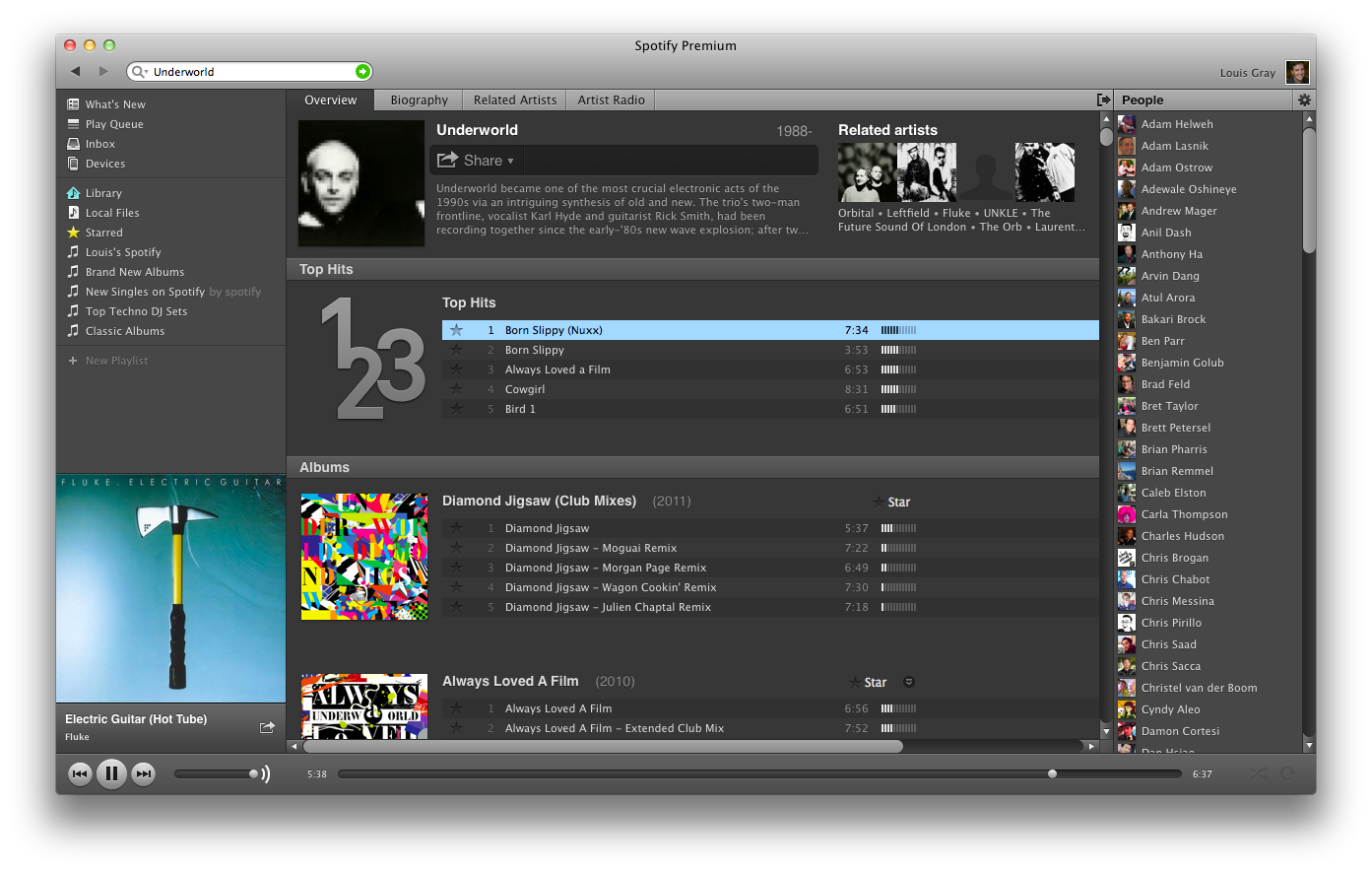
Searching for Underworld Gives me a Track List

2. Click the artist name in search results.

The Underworld Artist page shows hits, albums... and see that at the top?

This brings you to the dedicated artist page, complete with their Top Hits, Albums, and even lower, compilations where their music appeared. Almost all artists have a short bio, as well as a list of "Related Artists", one fast way to find similar music. But there's more.

Underworld Artist Radio Plays More than Just Underworld...

3. At the top is a tab called "Artist Radio". Artist Radio performs the same way as an artist's channel plays out in Last.fm or Pandora. If you select Underworld as your artist, Spotify will play songs not just by Underworld, but by bands including Orbital, Fluke, DJ Shadow and more. Dr. Dre sets up Snoop Dog, Eminem and N.W.A. Tori Amos plays music from Kate Bush, Bjork, Suzanne Vega and others. You get the idea. Without having to go find more music yourself, Artist Radio streams a set of new tracks to you until you hit the stop button.

As longtime Pandora and Last.fm fans will attest, finding new music from artists that are similar to music you already like is a great way to find new bands, new albums, and keep your music library fresh. Spotify hasn't talked a lot about this for its new US audience, but the combination of related artists, artist radio, and social recommendations probably puts the service ahead of all the others in terms of total offerings. So for me, someone who hasn't paid any money to iTunes music for years (aside from upgrading to iTunes Plus for Google Music) and who just disconnected Sirius XM Radio to save a few bucks, I enjoy letting Spotify play DJ. So if you tried Spotify at first and missed this feature, come back and check it out.

July 22, 2011

July 22, 2011 · 2 MIN READ · BY LOUIS GRAY

Sonos Shrinks Wireless Sound Systems With Play:3

Sonos Shrinks Wireless Sound Systems With Play:3


Sonos' mission is to deliver the highest quality music from any source to any part of your home, wirelessly. The company's beautiful Apple-like speakers have played a major role in my home's decor for the better part of 18 months, ever since I got my first S5, later added on two more units, and even a wireless dock to play songs from the iPod Touch. As new services like Rdio and Spotify have debuted, Sonos has been lightning-fast to support them, to get users fast access to their music. If there have been any complaints I've ever heard about the company's products, they've been price related. Something about premium quality and premium prices going hand in hand... but this week the company took a step down in the market with the introduction of the Play:3 line, which has a smaller form factor, fewer speakers, and a new profile which looks great if posed either vertically or horizontally. The new pricepoint is only $299, which should make the units even more attractive to consumers and audiophiles.

As someone who has long ranted in favor of Spotify for the better part of two years, I'm equally as effusive about my Sonos equipment - which plays a visible part in social gatherings, and entertains the kids who need to get their wiggles out by dancing to techno from all sorts of sources, including not just the aforementioned Spotify and Rdio, but also Sirius XM, local radio and topical content from the Web's deep library. Managing the now four devices (3 of the 5's and one of the 3) is simple with the intuitive software for both desktop and mobile, and it still amazes me to have the near instant response from an action I take on the app impacting the wireless speakers anywhere in the house.

How small is the Play:3? My 10-month old can straddle it.

With the introduction of the Play:3, Sonos is rebranding its equipment in a much simpler way than in the past. Gone is the letter and number pairing of the S5, replaced by the Play line of players and the Connect line, including the ZoneBridge and ZonePlayers that turn existing speakers into wireless systems, or connect your routers to your Sonos equipment.

When the Play:3 arrived at our door this afternoon, the twins opened it up and said "Dancing!" when they first saw the unit. So yes, they know what it's for. In about 3 minutes, the device was connected to power, added to my desktop software and streaming music. It's simply not fair how easy it is and how good it is to get such high quality sound from such a small device. It's a smart extension of the product line I've invested in after first getting introduced to Sonos early last year. Huge win.

Disclosure: The Play:3 was provided free of charge via Sonos. I've previously purchased multiple Play:5 machines.

July 14, 2011

July 14, 2011 · 4 MIN READ · BY LOUIS GRAY

Spotify's US Launch Goes Well as Listeners Flock for Invites

Spotify's US Launch Goes Well as Listeners Flock for Invites

My experience with early access to Spotify in the US has been nothing short of game-changing in terms of what I expect from my music, and after my having said so for about two years, I know a good number of folks got fatigued of the promise, and just wanted the company to ship already. Today, as was much-anticipated and well reported, Spotify did open its doors in the US, bringing the massive on-demand music library for desktop and mobile devices to the world's biggest music market. The service was open via invitation only, as many found themselves refreshing their email boxes, waiting for the invites to arrive. Luckily, thanks to my ongoing relationship with the company, especially their Head of Special Projects Shak Khan, I snagged a dedicated URL with invites and passed them around on Google+, Twitter and Facebook before I had to zip off to something resembling a real job this morning. The link is here: http://www.spotify.com/us/louisgray/

In case it wasn't obvious, go get it ... now. I'll wait.

After much waiting and an equal amount of hyperbole, the arrival of the music app took on a life of its own, overshadowing the actual delivery of a new challenger that could change the way many of us consume and share music - as much as Napster and iTunes did in their own times.

Quickly stated, Spotify is a streaming music application that offers the deepest legal library of music available for multiple platforms. Unlike the lock-in faced from the iTunes/iOS side of the world, I can get to my Spotify library from any Mac, Windows or Linux computer, and any Android or iOS device. In addition to having incredible instant access to music with almost zero buffering, even if I have never listened to a track before, I can link Spotify to my Facebook social graph, share tracks and playlists with friends, and browse their own listening preferences to discover new music.

Spotify Highlights My Artists, Tracks, Friends, Starred Songs and Much More

In the last two years, when I heard of a new band or a new album, invariably I checked Spotify to see if the music was available there first, and in almost every case it has been - often weeks or months ahead of iTunes, Amazon and others. I often put Spotify to the "name an artist or song" challenge to friends who tried to find some lesser-known band to stump the service unsuccessfully, and then would skip to a later part in the song without any hiccups.

The Crystal Method playing on Spotify. Note the Scrollbar's Size for So Many Tracks!

Through the wait for Spotify's arrival, much attention was placed on the service's plan to continue with a free option for listeners, which scared the heck out of music labels. After much finagling, they landed a way to offer a free, entry price and premium price for the service. Considering premium is only $9.99 a month, it's a steal, period, and I'd expect serious conversions to the higher models. Spotify has also reportedly provided upwards of $60 million in music royalties to artists just in Europe alone in the previous year, putting them second highest behind iTunes. Add the USA to the mix and obvious virality thanks to social networking, and that number is bound to jump.

Pro Tip: Subscribe to the New Singles Playlist to Get New Stuff Immediately

As many skeptics have stated, Spotify does not enter greenfield territory, being flanked by Rdio, MOG and other streaming services, including the grandfather of the bunch, Rhapsody. The company's app is serviceable, but not beautiful, and music discovery could see some improvement. But that hasn't stopped practically everybody I know (myself included) from getting addicted to the service and using it with practical exception of all else. The flexible combination of downloads, streaming, playlists, sharing, and pure high quality sound sets Spotify apart from the rest, and you could see A-list artists as excited about the debut as we have been.

My Friend Charles Hudson's Profile on Spotify

As my invite URL link bounced around the social networks, emails started getting delivered late in the evening, and everybody who has been graced with a Spotify invite almost immediately sees the value and knows this changes their game. I am glad I haven't lost my purchased music converted from iTunes to Google Music, and love that GMusic is in the cloud, for Chromebooks' sake, but Spotify's got me in every other place. Sometimes, even after all the hype, things are better than expected or stated. With Spotify, this is one of those times. You owe it to yourself to try, if you've been locked out before. I am so glad I no longer look elitist with my early access. Go get it.

http://www.spotify.com/us/louisgray/

July 9, 2011

July 9, 2011 · 1 MIN READ · BY LOUIS GRAY

Digitally Imported Releases Android App

Digitally Imported Releases Android App

Digitally Imported Radio (www.di.fm) has been around for a decade. I've enjoyed their music from the days of SoundJam and early iTunes and Web streaming. Now their channels are built-in to Sonos and other places, but no matter the place you get your music, their channels are excellent.

My preferences include their Trance, Classic Trance, Goa-Psy Trance, Hard Trance and Vocal Trance channels. Now they've got an Android app. I just sent the app to all my devices. Go get it. :)

/via my Google+ Profile.

July 7, 2011

July 7, 2011 · 2 MIN READ · BY LOUIS GRAY

Spotify In the US: Of Course It'll be Great and Affordable

Spotify In the US: Of Course It'll be Great and Affordable

Spotify's long drawn-out arrival in the United States has been rumored and rerumored over the last two years, drawing fatigue from those both eager to get their hands on the service and those covering the space, some of whom have compared the nascent cloud-based music service to the much-delayed Duke Nukem Forever. In the meantime, US-based services like Rdio have emerged as real competition, alongside music lockers from Amazon and Google, and Apple's iCloud, which dropped last month with a feature set that was somewhat underwhelming to those who had epxected Spotify-like features from Cupertino.

In recent months, more news has trickled out from Spotify in terms of their expanding their US office in New York, and capturing deals with the dinosaur US labels, who haven't shown their innovation or eagerness to adopt their sales strategies in recent years, both cozying up to Apple and then cowering in response to their every move. Yesterday, Spotify in a fairly understated way said yes, their launch in the US was imminent, though no date was given, and now you see people speculating on pricing.

After initially having free access to Spotify starting in late 2009, I converted to a true paid for premium plan early this year, at $9.99 a month, bringing Spotify's huge music library to my desktop and all my mobile devices - made even better with solid integration to my Sonos S5 wireless speakers throughout the house. I do not expect that when Spotify officially launches that I'm going to see any kind of price hike, and I am adamant that this is the best deal going. Theoretically speaking, although I prefer lower prices of course, I would probably pay upwards of $30 a month to get Spotify access, just for the feature set they have today.

Due to the delays around Spotify and much ongoing hype, some from here, those who have been on the outside looking in might be tired of the promise and continue their skepticism until they can download the app and gain access to the service - but what was once a pipe dream looks like its coming very soon and at a great price. So if you're tired of hearing about it, you don't look like you have to wait much longer. It's the #1 reason I almost completely stopped using iTunes.

June 7, 2011

June 7, 2011 · 4 MIN READ · BY LOUIS GRAY

The Split Definition of Cloud Suits Those Speaking

The Split Definition of Cloud Suits Those Speaking

Like any good Mac user and tech fan, I absorbed yesterday's announcements with Apple with great interest - knowing the OS updates will be hitting my laptop in a few months' time, and the iOS feature bumps will reach our array of iPod Touch and iPads at home - eventually seeing the best of these new features trickle out to non-Apple systems (including our Androids) thanks to the continued leapfrogging we see in this closely followed industry. But where Apple struck was where one would expect them to - in a manner that suited their interests. It's not necessarily always best for the future, but what's best for them. All money-driven companies would love to shape the future to meet their needs.

The most heavily anticipated updates from Steve Jobs and crew yesterday pertained to their introduction of iCloud, the next generation of MobileMe and iTunes. With Google and Amazon having announced music lockers, and streaming services like Spotify, MOG and Rdio in the mix, Apple's big move into the cloud was much-discussed, as news items followed each label, signature by signature, and watched the tea leaves to try and anticipate what Apple would deliver.

Apple used the term iCloud to represent the near-synchronization of digital media between a host of devices, from music to movies, books and photos. Buy once and play anywhere was the idea. No more moving of data back and forth. That's good stuff - and much was made of the $25 a year iTunes Match, which would push all your music, purchased on iTunes or not, to your other devices. Very clean, but oddly misrepresented, I believe. Apple says that iCloud stores your music, and its description page strictly states "your music is stored in iCloud", while the music automatically appears on your registered devices. But it's not streaming, and it's not as if when you are playing your music that you are doing so from their cloud. You're still doing it from your local device.

In contrast, we have seen two major business models from more acceptably-labeled cloud music services. The first, like Google Music, has you upload all your tracks (which can take a while) and then you can play them in a Web browser, any Web browser with your Google credentials, and play any time you like. The music is hosted in the cloud and streamed to you. The second, like Spotify and others, lets you tap into their available tracks, including playlists you've made from that library, and stream it to you.

Apple did not announce either of those approaches yesterday. They kept with their device-centric model which is making them billions of dollars and quite honestly, simplifying the Web and applications for millions of people. As I joked with one ardent Apple fan yesterday, Apple makes other people's inventions beautiful. They do quite a bit of innovation on their own, of course, but they sure do know how to take other people's ideas and make them look fantastic. But they didn't turn their back on their devices, despite talk of making them second-class citizens.

Google's approach on being truly Web-centric, and not tied down to specific devices, supports their business model, of course. They are making money from Web services (and associated advertising) while commoditizing hardware, which we will see with a big kickoff in a few weeks with the launch of the first ChromeBooks. The ChromeBooks, including the CR-48 which I've been using since December, bring you the Web and nothing but the Web. Sign in with your ID and get your content. Sign in with somebody else's ID and get their content. It's a fantastic idea and one that clearly supports their own business strategy. Their cloud interpretation supports what makes sense for them.

The divergence between these two players' strategies was in clear display yesterday. As a Mac user who has multiple Apple devices and a host of iTunes files, having them everywhere is cool. But I did also make the move to put them in the cloud (Google's version) and love the fact I can get to them from anywhere. Having used the CR-48 a ton lately, it's eye-opening to think of how the hardware is practically disposable. Assume you're logged out and it gets stolen. So what? Go buy a new one. For the price of a high-end iPod, you get everything back. No lost data or preferences. Google's interpretation of the cloud, which matches their interests, has some kind of real value to the user, and so does that with Apple.

If I was looking for a big announcement from Apple yesterday to keep me on iTunes instead of Spotify, it didn't come yesterday. I didn't see a major reason to stick with MobileMe/iCloud instead of Gmail and Google Docs either. But I absolutely see real value in their introductions, and anytime you see major companies slugging it out on quality for their users, everybody wins. But don't expect them to tell you what the future holds, unless you know that their projections are directly in line with what they can sell you today.

June 2, 2011

June 2, 2011 · 2 MIN READ · BY LOUIS GRAY

Record Labels Yank Videos from Youtify Over Syndication

Record Labels Yank Videos from Youtify Over Syndication

Saturday night, I introduced the service Youtify, a neat service which helps find top music videos and playlists from YouTube, and organizes them in a browser app that looks much like iTunes. Though I published late on a weekend, the story was quickly distributed, especially on Twitter, with nearly 150 shares of the story. But the fast rise to visibility has hit a wall for the service, thanks to problems that started late Tuesday night, when almost all the top videos from YouTube simply stopped playing.

It turns out the rights owners for the music videos themselves, primarily record labels, put a stop to their content being played on the site, with Youtify specifically being blocked.

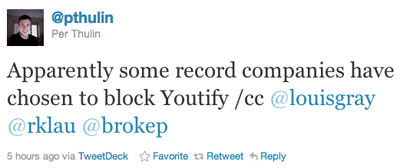
Per Thulin, one of the cofounders of the project, along with Karl Tannergard, initially thought he had somehow run afoul of YouTube's API rules, as users found the video player was rendered almost completely useless. But after reaching YouTube, they confirmed it was the record labels, and not they, who had stopped access.
Youtify Ground to a Halt Thanks to Record Labels' Intervention

That the record labels aren't immediately excited about yet another cool and innovative way to showcase their artists' content is no surprise. They've been late to the game and backward in practically every opportunity over the last 20 years. As Thulin wrote me in an email, the action caught them by surprise, especially as nobody made any attempt to contact Youtify directly.

Youtify's Playlists Show Holes Thanks to Rights Management

"Our new plan is to embrace and reward the artists and labels still allowing us to play their videos," he wrote. "We will let those artists and labels put ads in our application for free, and also let our community help spread these videos, generate good ratings, viewcounts, shout-outs on Twitter, etc. We hope that our growing community will generate enough noise for them to reconsider!"

Other Songs Not Impacted Play As They Always Have

Unless the record labels change their mind, the most likely culprit being VEVO, who owns a large portion of the videos that aren't working, Youtify, for the time being, is somewhat hobbled. A small fraction of the Top 100 songs play, while amateur content from "Best of YouTube" still runs as will many searched for playlists that don't intersect by the resistant labels.

The concept for Youtify is great. Even the user interface got a revamp in the last few days following the initial post. But the content is what it's all about, and if they are starved for content, users will probably not be made loyal. The question is will the labels let this one go, or will they remain obtuse?

May 28, 2011

May 28, 2011 · 2 MIN READ · BY LOUIS GRAY

Youtify Turns YouTube Into Your Music Video Jukebox

Youtify Turns YouTube Into Your Music Video Jukebox

YouTube is much more than a repository for amateur videos and bloopers. The video giant is the second largest search engine for the Web, a practically endless treasure trove for TV clips of all types, and unsurprisingly, heaven for music video promoters and fans. A cool site called Youtify (YouTube + Spotify, get it?) launched this month to tap this resource, letting you build your own playlists, search for your own music, and pretty much make the Web your jukebox. Even if you don't want to watch the videos, the music alone is great.

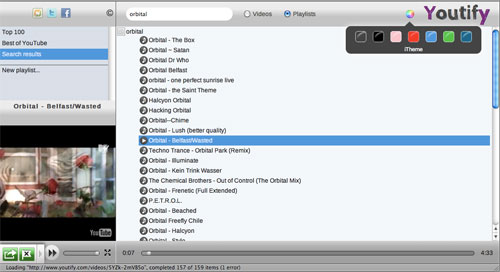
Available both as a stand-alone Web app (at www.youtify.com) as well as a Chrome browser app, Youtify transforms your Web browser into something looking much like the iTunes music player, prepopulated with two playlists: "Top 100", showing the usual popular fare from artists like Beyoncé, Katy Perry and Lady Gaga, and "Best of YouTube", which highlights fan-submitted music (like Super Mario beatbox and ukulele the beatles - obladi oblada).

Searching Youtify for Underworld Turns Up Scads of Videos

Every link plays the music video in the bottom left corner of your browser (like iTunes does in its music player) and has the option to expand to your full screen. You can also right-click and go to the YouTube video directly.

The Top 100 Youtify Videos Are Names You Would Recognize

While that's fun, what's even better is when you search for your favorite music. Even a techno geek like me could pick up hundreds of tracks (well, music videos) from bands like Chemical Brothers, Underworld and Daft Punk. If a band has ever made a music video worth playing, it's on YouTube. You can create and save playlists, and search playlists across the network. The great part of that is instead of recreating the playlists for each artist, it's possible they already exist somewhere. Searching an artist name can turn up dozens of playlists, each with dozens of videos already there.

Building and Playing a Youtify Playlist

With MTV getting way the heck away from its initial mission, YouTube has taken over as the premiere venue for music videos on the Web, and possibly, all media. Youtify makes finding those videos and the music behind them fun. While it's not going to replace your music library app (be it Spotify, iTunes, Google Music or something else), you'll definitely want to check this out. Just don't plan on being extremely efficient at the office while doing so. Find it at http://www.youtify.com.

May 27, 2011

May 27, 2011 · 1 MIN READ · BY LOUIS GRAY

How to Scrobble Your Google Music Plays to Last.fm

How to Scrobble Your Google Music Plays to Last.fm

Google Music is very much a beta product, but one that is going to get a lot of attention as it becomes more widely available, competing in the online music world with Apple's forthcoming cloud music player, Amazon's cloud player, and Spotify, which thus far has focused on desktop or mobile applications to play on-demand tunes.

After taking a few days to upload my music to the cloud, I'm enjoying getting access to my tunes on any computer I want, from practically anywhere. But the service doesn't do a few things that are practically a must for me - first, update Last.fm with my listening history, and second, play to my Sonos S5 setup at home, leaving me to listen through my laptop or phone's speakers.

Last.fm integrated into my Google Music Player

After politely venting about these product holes on Twitter this morning, the first of these two holes was solved. Daniel Slaughter, a Web Developer at Grand Valley State University in Michigan alerted me to a project of his that brings Last.fm scrobbling to Google Music, letting the OCD side of me enjoy the music again, while keeping my statistics up to date.

Google Music Player updating Last.fm

His project, simply titled Google Music With Last.fm, is a script that runs on FireFox 3 or 4 with Greasemonkey installed, or of course, Google Chrome. To get it running, I downloaded and ran the script, and a new Last.fm section showed up in my Google Music. Once I had authenticated the application to update my personal Last.fm account, the song plays and history started to rack up.

If you're one of the early folks to gain access to Google Music Beta, and you miss the Last.fm integration that practically every other music player (including Spotify and iTunes) offers, you'll want to get this script going. Very easy to add and very clear to see the benefit. Nice work, Daniel.

May 19, 2011

May 19, 2011 · 4 MIN READ · BY LOUIS GRAY

Google Music Move: Days of File Transfers Ahead

Google Music Move: Days of File Transfers Ahead

Around noon on Wednesday, I fired up my old laptop, downloaded Google's Music Manager, and started the process of uploading my vast, but long-neglected, music collection to the cloud. Assuming the migration is complete, I'll have a Web-based repository for all the music I've purchased, as a companion to all the on-demand music I can find using Spotify - a match I like a lot. More than 30 hours later, thousands and thousands of my songs are on Google Music in beta. Yet, there are thousands more to go - highlighting a process that may be a challenge for users who may consider making a similar transition. And once they are uploaded, it's not clear if there's a way to get them down from the system if I want to move again.

My blogging colleague MG Siegler, he of ParisLemon and TechCrunch, argued yesterday that Google's move to open up a music locker (as Amazon did) without first gaining expensive deals with the music labels, has essentially locked up the market for Apple, who is quite unwilling to lose their leadership position in the market. He argued that the complexity of moving one's library to the cloud, instead of a simpler, faster way of matching your library to a known database and providing you access (as LaLa once did) would be a major stumbling block for the curious consumer. Putting MG's pro-Apple bias aside, there is some truth to that, if a known brand has a simpler solution and an official relationship with approved music downloads, the value to the cloud locker from a competitor is not obvious.

Downloading 1,945 high quality iTunes Plus tracks

As you know, migrating one's library out of iTunes and to a secondary location, be it Google Music or anywhere else, cannot happen for DRM-locked content. To strip one's iTunes library of the DRM, one must first pay Apple upwards of $.30 per track to upgrade to iTunes Plus. For a library like mine with thousands of tracks, this upgrade can (and did) cost hundreds of dollars - a steep pair of handcuffs, considering one doesn't get any new music in the deal. Converting to iTunes Plus doesn't actually upgrade the songs directly, but downloads brand new tracks in their place, and you have the option to delete the old files.

With a goal of completing this process, come Hell or high water, I gave Apple more than $340 yesterday to upgrade 1,945 tracks - at the same time as I had already told Google's Music Manager to upload my non-DRM tracks to the cloud. After about an hour, Apple sent me an email to say my tracks were ready, and I could begin the downloading process. So I set my old Mac aside, and put it to work, downloading the nearly 2,000 tracks at the same time as Google was uploading thousands more. Good thing I have unlimited bandwidth...

Google's Music Manager Has Uploaded 3,000+ Songs So Far

With my iTunes library now fully Plusified, Google Music has full go-ahead to get my music and that's happening. At this pace, it's likely the first pass of my full library will complete mid-day or late tomorrow, about 48 hours after I started. This process would take longer if it were on my primary machine, doing other tasks, or constantly interrupting the move by putting the machine through normal on/off paces.

Assuming the process completes, I am excited to have all my music in the cloud, searchable and playable from any computer where I am logged in. But as one person asked me, what if Google Music goes the way of Google Wave? I don't think it will, of course, but what if I want to take my more than 50 gigabytes of music down from the cloud, back to a desktop, or move from this service to another?

My Top Songs from iTunes Are Making it to Google Music

One admirable passion Google promises is the support of Data Portability. Its Data Portability Project is focused on letting users move data in services and out of services. You can see the conflicts over data ownership flare up especially in the battle with Facebook, who let users pull in Gmail contacts, but didn't let Google do the reverse. So I am a little surprised to see there isn't yet a way to bring data out of Google Music. Yes, it's brand new and early, but there's no talk, unless I missed it, about getting your music downloaded - be it one track or many. You can delete songs from the service. You can edit them and all their metadata, but you can't move them once they're uploaded. This means if you don't fully believe that Google Music will be around forever, you might still want to keep a second copy somewhere.

There is no doubt a considerable back story to the labels' fights with Google, Apple, Amazon and Spotify. I've heard people say there are hundreds of millions of dollars being promised up front and the biggest payer wins. Google said at Google IO that the expectations were prohibitive and they couldn't agree to such arduous terms. If Apple offers a comparable service on the cloud that knows one's iTunes purchasing history, and can eliminate the need to upload and store songs, but get the benefits of cloud, it will have a leg up in usability. I expect in coming months we will hear more from the Google Music team about improving migration and just how we can be sure we can always own our music.