Silicon Valley Technology Commentary & Archives · Est. 2006 3,045 Posts · 2006–2026
Showing posts with label Internet (36 posts). Show all posts

January 30, 2018

January 30, 2018 · 5 MIN READ · BY LOUIS GRAY

Real Valley Stories: Search Marketing With the Open Directory Project

Real Valley Stories: Search Marketing With the Open Directory Project

Editor’s Note: Part 12 in an irregular series of stories from my many years in Silicon Valley. Part 11 talked about the time I got called into HR's office to meet with lawyers over industrial espionage. This time, a story involving gray hat search engine marketing in the early days of the Web.

DMOZ is now closed. 

Believe it or not, before the world of automated spiders that crawled the entire Web and ranked the results for your searches, much of the way we found content on the Internet was thanks to manual updates from an invisible army of directory editors. Yahoo! defined the initial dot-com era, with its hierarchical oracle making or breaking traffic downstream, as sites were organized and shuffled into categories by unseen text tweakers, much like the editors of Wikipedia try and keep its tens of millions of article pages up to date, with a seemingly fluid mass of edits to keep the live encyclopedia current.

But Yahoo! wasn't the only Web directory. Rich Skrenta and others, also behind Web 2.0 efforts Topix and Blekko, introduced the Open Directory Project, referred to as DMOZ, for it was hosted on the directory subdomain of the Mozilla.org site, with an objective of harnessing contributions from around the world (like Wikipedia), to build a directory, similar to Yahoo!, that could plug into any site that wanted to host one. In a time when many sites were seeking Internet traffic and riches by acting as the front page for the Web, attaching the open directory project to your portal could give you an edge and not require you to bring on a ton of staff.

As with Yahoo!'s directory, a company's inclusion in the DMOZ directory could act as a binary gate as to whether or not potential users would find you. In 1999, working as a Web marketing manager for a Web startup that offered internet faxing and conference calls, I found myself irked to see that our services were not included in DMOZ. Making things worse, the categories I would expect to see us listed in seemed slapped together and without an official owner. Given my understanding of the space and knowing our many competitors, I registered an account and requested to moderate the relevant category.

The DMOZ Internet Fax Listings from 1999 (via Archive.org)

Not too long afterward, I was given the option to update the category, including those of our competitors. As it was nearly two decades ago, I honestly don't remember if I used my company email or a Yahoo! email or equivalent, but I didn't try and disguise where I worked. My application had gotten through.

FaxCube from the year 2000.
When I did log in, I found the content in a state of abandonment. There wasn't much you could do with a site's listing. Give it a title, a link, and a short description, literally about a dozen words. It was fairly impossible to differentiate services from one another, especially in a commoditized space where the core function was pretty straight forward. But I cleaned up the descriptions for all the entries, including our competitors, to accurately display their offerings. Some offered email to fax services, while others offered the reverse. Some offered broadcast faxing. Some required a proprietary fax viewer, and others were completely Web based. That kind of thing.

When content was edited in DMOZ, edits would later propagate downstream. Sure enough, my colleagues noticed a spike in Web traffic to our main sites, with referrers coming from all the places DMOZ was set up. For no cost, I had a clear impact in our customer acquisition funnel, and maintaining the DMOZ became part of my ongoing work.

Later, DMOZ added the option to highlight two entries in the group, which were solely up to the moderator. This, of course, gave me the option to expand from a gray area, to clearly going over the line into promotion. It went without saying I thought our service was the best, and highlighted it at the top. I also chose to highlight a partner site (the Netscape Fax Center) that was white labeling our service, essentially the 1 and 1A positions.

This got even better when we soon realized DMOZ was fueling search results for AOL. The more people who searched for Internet Faxing on AOL, the better we were to see results.

DMOZ listings for Internet Telephony in early 2000. (Via Archive.org)
In early 2000, we introduced a new Web based conference call and meeting product. Addicted to the free traffic from DMOZ, my team asked me to see if I could get our content similarly included on whatever the equivalent was for Internet conferencing. I poked around, and, again, applied to be an editor for the Internet Telephony page. It wasn't a perfect fit, but it was pretty good.

Again, I got approved, and again, I added our sites, and again, I promoted our main site and a partner site to be included as the pair at the top of results. Again, we started to get plenty of Web traffic from DMOZ and its downstream partners, accounting for more than double digit percentage of our traffic to both properties. But this time, it wouldn't last long. Maybe it was the clear marketing copy promoting both services, but one day, I logged in and saw our service demoted to the standard results, with another in its place. I reversed the change, and it wasn't too long until there was a debate upstream as to whether these listings were in good faith.

PhoneCube, in all its glory, from 2000.
Not too long afterward, my moderation rights had been removed from both sections. I'd essentially been fired from my side job of gray hat SEO, long before most of us knew what that meant. And yes, my engineering peers lamented the loss of traffic, as our more organic listings, on AOL search and elsewhere, didn't carry as much weight, once we became one of the fold.

Had I just stayed content to include our services in the listings, or even just to stay a moderator of the less exciting Internet faxing space, it's possible I could have been editing text descriptions for our sites and our competitors indefinitely. But pushing our own products and our partner sites turned out too good to be true. The "Wild West" Internet traffic rush didn't last forever, and, as it turns out, neither did our products. I was laid off after we couldn't get a funding round closed at the beginning of 2001, and a few months later, the company was parceled off to become part of Oracle (see 2006 post). Some of my colleagues still work there nearly two decades later. As for DMOZ, it too shut down a few years ago, a relic in the world of Google and Facebook.

Disclosures: This whole post is a disclosure! I worked at 3Cube during this time. I work at Google now, a perceived competitor to whatever Yahoo! and AOL call themselves now. And as I work on Google Analytics, this is not a post about SEO to all you SEO/SEM folks.

May 10, 2009

May 10, 2009 · 6 MIN READ · BY LOUIS GRAY

10 Rules for Today's Consumers In the New World of Real-Time

10 Rules for Today's Consumers In the New World of Real-Time

The world of communication and product delivery is changing as the Web evolves and new services are introduced, enabling us to gain faster access to information, download richer media more quickly, and rapidly voice our opinions and feedback near and far in a wide variety of methods, including text, voice, video and imagery. As customers become more savvy and in tune with these new tools, we are also expecting those offering products and services to adapt, and as such, I thought it made sense to put forth what I believe are key tenets of a new consumer manifesto for today's real-time world.

1. We Want Access to Your Product As Quickly As Possible

We have become an "instant gratification" society. Our short attention spans are being rewarded with ubiquitous access to fast food, the rollout of ever-faster download speeds, near elimination of commercials, thanks to DVRs, and the ability to replace activities that were once limited to venues outside the home with in-home equivalents, including on-demand programming and simulated bowling on our Wiis.

When we order your products, or sign up for your service, we want access to them immediately. We don't want to wait for an approval period, and if the product is physical, we want it shipped quickly at the first possible convenience.

2. We Expect the Product to Work On Any Platform In Any Location

Many of us spend more time in the Web browser and our e-mail than we do in our Operating System software these days. We rapidly grow frustrated with any Web sites or applications that operate differently if you utilize different operating systems or Web browsers, and we expect to have access to your product, or a mobile equivalent, when we are away from our desktops.

3. We Want to See That You Allow for Feedback, Positive and Negative

The time of a siloed product experience is gone. We want to see that you provide a forum or link to a third party site that discusses your business and your products, and connects us with peers, where we can learn from one another in a venue that reaches you as well. And if you do provide a forum or bulletin for us to provide feedback, we will not look kindly on your deleting threads or comments of substance.

4. We Expect That You Respond to Your Customers, Quickly

Customers are talking about your products on their blogs, on Twitter, on Facebook and other aggregation sites. They may send you e-mail or post in public forums. While we can't expect CEOs of the largest companies to respond to every mention, we do expect company representatives to be listening, and for the smallest companies, we do expect founders and entrepreneurs to be accessible.

5. We Expect That You Join and Lead the Conversation

In the absence of communication from you, rumors and negative feedback can snowball. And while you might be coached in handling crisis PR in case something gets out of hand on blogs or Twitter, the best way to get ahead of potential issues is to have a presence in these social areas before problems occur, so that your customers have a place to engage you, and you them, helping to redirect the conversation and react. Additionally, you can use your communication outlets to show thought leadership and teach us better ways to use your product in ways we may not have considered.

6. We Want to See That You Continually Improve Your Product

Thanks to the now assumed two-way conversation with your customers, we expect you will be making incremental updates and improvements that both meet your corporate objectives and satisfy user expectations - beyond fixing bugs. Not only do we now expect instant access and near real-time responses, but we hope for rapid iterations that add to our satisfaction. A stale product will lead to cranky users, and breed disloyalty, as we may migrate to alternatives that appear to be updating more frequently with more agility.

7. We Expect You to Use Your Product and Be Visible

One of the greatest endorsements of your own product is that you use it and make it a part of your own visible activity - making you appear as a peer with a shared experience in parallel to that of your customers. For the smallest companies, including startups with 1-10 employees, we expect to likely see your CEO and founders visibly consuming their own dog food, both exulting in its benefits and suffering through its disappointments. And if you do put up a central example of your employees or founder using your products, don't do it once and never update again, because we'll know about it, and it will a stark reminder of your pandering.

8. We Expect That You Will Embrace or Lead Standards

As we are helping you create a business by selecting your product instead of that of the competition, we expect you will help us, and the ecosystem as a whole, by either embracing existing standards that are agreed upon, or by forging new standards and releasing them to the community for the benefit of all. We reject proprietary methods that don't deliver significant differentiation, or aren't forced by antiquated legalities.

9. We Expect You Are Driven By More than Money Alone

As consumers, we are eager to be seen as your partner, and to contribute to improving the next iteration of your product, or in helping to grow the information base around it, through consistent feedback, formation of user groups, or in creating content related to your product. As such, we do not expect to be seen as blank checks, there to support your bottom line when quarters draw thin. Instead, we want to see that you share a passion for your products and your market, and know that you, as we are, are driven by the potential of what your product can enable us to accomplish. We want to know the story of what you are trying to solve, and how it can help the community, more than we want to hear about your margins and your EPS.

10. We Want You To Treat Us As Informed Consumers and Partners

We have real-time access to news and many of us are rabid information sponges who are experts about you and your product. We don't want to be talked down to, and often have significant history with your organization. We despise the tendency to architect service, support and marketing to the lowest common denominator, and greatly appreciate your expecting that we have a baseline of understanding that includes recent headlines on you and the industry.


While books including the Cluetrain Manifesto and Naked Conversations have chronicled the move by consumers and businesses to e-commerce and a new world of online communications, continued advancements toward real-time news and exchanges of ideas lay the platform for a revamped approach to consumer relations with business. We are finding out more about you than you ever believed possible, and we are more than willing to share it just as quickly - both the good and the bad. Embrace the change and embrace us as partners and we can be your greatest ally. Be truthful, transparent and trusted, and you can help us cross the chasm from customers to fans.

January 15, 2009

January 15, 2009 · 3 MIN READ · BY LOUIS GRAY

The Global Recession Is Crushing Web Ads. Expect it to Get Worse.

The Global Recession Is Crushing Web Ads. Expect it to Get Worse.

That I am not a fan of Web advertising on Web services and blogs is not a big secret. I was roundly pummeled for my over the top comments in April that tried to divorce authors from the idea that they could publish a blog, add AdSense and then wait for the money to roll in. But recent developments make it look like the Web advertising crunch is becoming critical. Inventories are not being sold, prices are dropping dramatically, and it's very likely more and more services reliant on ads are going to feel the pinch, forcing them to rapidly change their business models or close altogether. And they won't be alone. I'd look for many multi-author blogs you've grown to rely on to start thinning the ranks of reporters as ad returns weaken, and some have already started to make such cuts.

Back in December of 2007, I expressed my concerns in a piece called "The Web Advertising Bubble Has Got to Pop", where I said:
"The more I think about it, the more obvious it becomes to me that the ad-driven economy, both offline and on, could soon be in dire straights, and companies hoping to cash in need to think of new revenue targets - quick."
The reasons I gave for decreasing ad revenues, at the time, stemmed largely from audiences learning to avoid ads, or to use software to block them. I mentioned that even the mighty Google would be susceptible to a crunch, if was to happen, in the online ad market. Like others, I didn't forecast a massive global recession, but as the financial markets have spiked lower, and public markets have been closed to innovative companies, the drive to reach a profit, and do so without relying solely on ads, is stronger than ever.

Last night, Duncan Riley of the Inquisitr summed it up in what had to be a tough piece for him to write, "The Web Ad Apocalypse". He, being one of those bloggers who is heavily reliant on ad revenue, said advertising inventory at his providers has dramatically dropped. He adds, as I did more than a year ago:
"Advertising in blogging and 2.0 services/ apps is on the downward march, and companies that rely on advertising that were marginally profitable, or running at a loss are about to find life that much harder."
Duncan's comments are not in isolation. TechCrunch reported today that video ad rates dropped 25% in the last quarter. Be it in video, in banners, or in text ads, the trend is downward.

It is my belief that this problem, while exacerbated by the financial downturn, has been a long time coming. While Google made money hand over fist by pushing sponsored ads alongside native search results, their AdSense product, beloved by many bloggers, is often way off the mark when it comes to contextual advertising - and practically the only memorable online ads are those polluted by nonsensical dancing and misleading graphics that make you think you have a computer virus, or lie to you and say you've won an iPhone by being the 1 millionth visitor. I'd say we've come a long way from the late 90s when we were asked to "Punch the Monkey", but we haven't.

Online ad successes in Web services and blogging are not non-existent, but they are incredibly rare, and they are going to get rarer still. If you're trying to make money on the Web, it's time to think of a different way. If you have a service, get users to pay for it. Find a way to deliver value through premium offerings. Charge monthly fees. But the whole "free plus ads" mantra is going to get worse - and not worth the effort in many cases. That's a major reason I've never run ads here. I knew the trade-off for mucking up the site wasn't going to be worth the pennies. Now it's clear that's likely all I'd ever get.

December 24, 2008

December 24, 2008 · 1 MIN READ · BY LOUIS GRAY

This Christmas Eve, Go Internet Easter Egg Hunting

This Christmas Eve, Go Internet Easter Egg Hunting

By Mona Nomura of Pixel Bits (FriendFeed/Twitter)

In lieu of repeatedly wishing everyone on the Internet a Merry Christmas/Happy Holidays/Merry Kwanzaa, I have a special gift: Internet Easter Eggs. So Merry-Happy whatever you celebrate and enjoy!

makeuseof.com's Google's Top 10 Hidden Treasures


My favorite: Search Google for Once in Blue Moon

hehe2.net's 10 Cool Open Source Easter Eggs


My favorite: Ubuntu's ASCII cow

home.comecast's XP Secrets


My favorite: MS Paint's Image trails.

CNET News: "10 awesome Internet Easter eggs"


My favorite: Yahoo's Singing Yokel

TechRadar also has a massive post on Easter Eggs covering software, hardware, applications, and games here.

On a related note, FriendFeed is another great resource. Not Easter Eggs, but there are two very active rooms with heaps of useful information. The App Room is one of my favorites, where users share news, reviews, questions, and of course apps here. The Goodie Room has tips, tricks, shortcuts, hacks, and How-Tos. My favorites are Google / Gmail tricks here.

So whether you're single and have no family (like me), snowed in, avoiding the holiday crowds, agoraphobic, a Grinch, or you're just addicted to the Internet, these links should keep you preoccupied for the next few days.

Happy Holidays, everyone. :)

Read more by Mona Nomura at Pixel Bits

October 13, 2008

October 13, 2008 · 3 MIN READ · BY LOUIS GRAY

Silicon Valleywood?

Silicon Valleywood?

By Mona Nomura of Pixel Bits (FriendFeed/Twitter)

Cyndy Aleo-Carreira just posted a great piece about women in tech and how we shouldn't sell ourselves short. I would expand on that, but haven't been around tech bloggers and journalists long enough to give an informed two cents.

But...

I have been in IT for a while. Quickly approaching 10(!) years, to be exact. Wow. Heck back when I started, it was so uncool to be in tech -- even employed by a well known software corporation. My friends made fun of me, my work place was male dominated with the geekiest / nerdiest but brightest engineers. (Think worn out, raggedy dingy white t-shirts and too tight stone washed jeans.)

Fast forward to today, IT is definitely not what it used to be.

Geeks are no longer just white T-shirts with jeans, there's now a "scene", and even a gossip rag! Since becoming fairly active in Social Networks and especially being based in SF, I've been invited to countless Tweet-ups, and parties. Cyndy pinpoints the exact reason I choose not to go. I may be unfamiliar with the blogger / social network / entreprenuer circle, but definitely not new to partying. I've been there, done that, and very aware of what people assume upon first meeting me. I refuse to fall in the: "gaining notoriety by what I'm wearing or who I'm dating rather than gaining respect for my knowledge and insight" category. I am also 100% with Cyndy on how "we (women) don't need to sell out to make it in tech".

That said, I don't see tech turning into a mini-Hollywood a problem.

Within every subculture, there is always sub-categorizing -- just like school. I really thought once I finished schooling, the in-crowd vs nerds / geeks vs weirdos, etc., would be done with it. I don't know about you, but I still deal with all the things I hated about school on a daily basis. Think about it: from our workplaces, social circles, online communities, to even within our own families, it surrounds us everywhere! At least now as adults, it's easier to not get involved or care (at least for me), but that doesn't mean it's nonexistent.

So for the tech scene to have its own mini-Hollywood means the tech circle is growing larger. With that, comes the array of labels, sub categories, and classifications and I couldn't be happier. I love tech and everything tech related, so the expansion and growth is welcomed!

Now, it's up to us.

Us being anyone who blogs, reads blogs, or active members in Social Networks, to change with the way the industry is changing. Especially, since data is democratizing. Whether you're a blogger, a reader, a commenter, content provider -- however which way you want to participate, we have more and more choices to read who we want to read, listen to who we want to listen to, and "follow" who we want to follow. Data is no longer consolidated and centralized like it once was, and moving forward we're only going to get even more choices. Hence, it's up to us.

After all, just like Hollywood, the tech starlets, groupies, and wannabe starlets wouldn't be a part of the mini-Hollywood if it weren't for an audience, right?

Read more by Mona Nomura at Pixel Bits.

October 6, 2008

October 6, 2008 · 2 MIN READ · BY LOUIS GRAY

Hackr WatrCoolr: Tech News Aggregation With No Mouse Required

Hackr WatrCoolr: Tech News Aggregation With No Mouse Required


A couple weeks ago, in an article about Microspaces, I said that Web entrepreneurs are finding new ways for you to navigate their sites, and many are now incorporating keyboard input, to jump to new comments or pages. Though I mentioned it in a quick tweet on September 25th, I thought it was worth highlighting the Hacker WatrCoolr, a site that displays headlines from many popular tech news sites, and lets you quickly flick through them using only your keyboard - no mouse required.


A Headline from ReadBurner on WatrCoolr Tonight

WatrCoolr shows the latest headlines from Digg, Hacker News, Del.icio.us, Techmeme, Reddit, RSSmeme, Slashdot, Yahoo! News and ReadBurner. Each headline shows its recency, and the destination URL (e.g. nytimes.com or makeuseof.com).


Scoble's Post Hits Techmeme and Makes it to WatrCoolr

But unlike many other news aggregation sites, the Hacker WatrCoolr doesn't shoe-horn them into one busy page, like AllTop. Instead, it displays one headline at a time. To scroll through older items from the same source, you just need to hit the down arrow key. To see a new source, hit the right or left arrow. And to read the article, you just have to press the "r" key, or press "n" to have it open in a new window or tab.

While Hackr WatrCoolr is not looking to replace your RSS reader, some of the functionality is very similar to that of applications like Google Reader, and it's a very easy way to get all the top stories from each of these sites in one place. It may be a little experiment, but it hints at one way the Web could go to make the process of our news gathering even that much more easy. I hope to find more Web developers who are thinking different about how we navigate today's often-formulaic and static Web sites.
DISCLOSURE: I am an advisor to ReadBurner, and hold a small equity position.

September 20, 2008

September 20, 2008 · 2 MIN READ · BY LOUIS GRAY

Strands Targets the Mainstream by Going One On One

Strands Targets the Mainstream by Going One On One

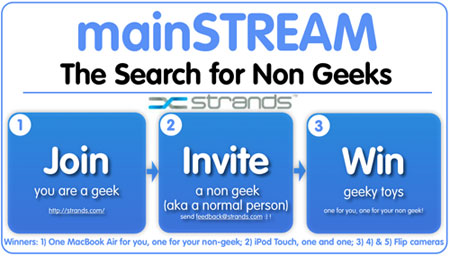
One of the most common themes in the blogosphere, and here at the Blog World Expo in Las Vegas, is questioning how Web applications many of us are using will ever reach the mainstream. Will people's parents, relatives and co-workers ever get Twitter the way they finally get e-mail? Will FriendFeed ever get the kind of name recognition that Facebook and MySpace have? Strands, a nascent lifestreaming and content discovery service, is launching a new initiative, starting today, to take the service mainstream, to the masses themselves in a project they call oOo: One on One, or Operation mainSTREAM.
(See their blog for more).

Drew Olanoff, community manager for Strands, says "A lot of what we create is meant to make our lives easier and more entertaining," and that "companies like Pandora deserve to be known outside of our circles," so what the team at Strands is looking to do is to give its users many invites, and will incentive them to invite non-geeks to the service. Those who recruit "nongeek friends" can win geeky prizes, including an Apple MacBook Air for you and your friend, an iPod Touch for you and your friend, or miniature Flip video cameras.


Strands: Operation mainSTREAM

But Strands isn't going to be sitting around, waiting for you to do all the hard work of recruiting by yourself. The team is going one one one (oOo), traveling state to state, to take the story of all these cool Web applications to the masses. As Drew writes, "I'm going to be visiting old folks homes, hanging out with some soccer moms, and hey...maybe some lawyers, to let them know why technology and your personal presence online is important."

Will this work? Will taking something that's considered an edge technology even for those of us in the Silicon Valley, and introducing it to technophobes in North Dakota and South Carolina give services like Pandora, Last.fm, and Twitter that push they need to get into the mainstream? Probably not all by itself. But as part of the micromedia panel I participated in yesterday, we discussed a new rule of marketing. You tell 10, who tell 100, who tell 1,000. If Drew and the Strands team can find the right 10 people in each of these locations around the country, they may be on to something. And just maybe, Web 2.0 applications have found their new evangelist.
DISCLOSURE: Drew Olanoff, the Community Manager at Strands, is also the CTO of ReadBurner, where I am an advisor, and hold a small equity position.

August 17, 2008

August 17, 2008 · 5 MIN READ · BY LOUIS GRAY

Google Has Leveled the Internet Playing Field

Google Has Leveled the Internet Playing Field

By Robert Seidman of TVbytheNumbers (Twitter / FriendFeed)

There are many motivations to write something and publish it on the Internet. Some write in hopes of making money, others like Louis, write because they want to be a part of something they enjoy, others like Hutch Carpenter find their next job. But I believe whether it's Duncan Riley, Louis or Hutch the common denominator is this: they want their voices to be heard.

It's a Very Different Landscape Than 1994…
A very low barrier to entry brings with it some blessings and some curses. The more people who participate, the better things are for everyone in the aggregate. But the more people participating, the harder it is to compete and have your voice rise up above the cacophony of all the other voices.

During my first foray into Internet publishing in the fall of 1994, the landscape was dramatically different. I launched a newsletter essentially summarizing the big events of the week in the online/Internet space. At the time of launch, my only competition was for-fee subscription content. There was no freely-available competition and as a result, I gained access to readers and industry insiders very quickly. Fortunately, Robert Scoble was writing about visual basic or something at the time, so I didn't have to compete with his bullhorn either.

I first met Bill Gorman, who I now run TVbytheNumbers with, within two months of launching my 1990s Internet publication. Bill was an executive at AOL, who helped launch America Online's international division. Around the same time, Bill started reading what I was writing, so did the person who was running AOL – Steve Case. Basically within two months of launching I was reaching high-ranking industry insiders.

…But It's Still Possible to Get Your Voice Out There
Today, if you were to launch a blog on social network services and hoping to get Mark Zuckerberg of Facebook to read it, I believe that task would be about 10,000 times more difficult. The likes of Louis, however, are proving that it's not impossible to write about companies you're interested in and gain 'inside' access. It may not be on the scale of Facebook executives for Louis (yet), but gaining insider access is certainly something he's accomplished to the point where he's now taken an advisory role with ReadBurner.

Louis might seem like an 'overnight success' story to many in the blogging circles, but not to me. What I see is a kid who has been plugging away since January 2006 and really started to get some traction by late 2007, which has accelerated greatly during 2008. Thirty-two months of plugging away to get where he is today isn't an overnight success story. It is a success story, but it is a success story that involved a lot of hard work, persistence and determination.

All Good Things…
The other day I brought up my FriendFeed and saw the link "Robert Seidman Quoted in NY Post On Phelps/Olympics" posted by none other than Louis. It was the first I'd heard of it. Although we have talked to reporters from the NY Post (and other publications) I hadn't talked to them about this. They'd just lifted the quote right out of a blog post and I wouldn't have it any other way.

Although getting quoted is nice, especially when quotes are just lifted off blog posts, the thing I was most proud of for the week was seeing this story comparing the minutes of online streaming to the minutes of viewing via traditional television pop-up in my Google Reader. An analyst working at Fox television crunched some numbers on top of some numbers I'd crunched in a blog post and Fox's PR team circulated it, citing our blog as the original source.

It's not lost on me that mostly happened because the song I was singing, "TV is still king", was a tune the people at the television networks really love to hear. But in a world where we're in some ways competing with Variety, Advertising Age, The Hollywood Reporter, Media Week, TV Week, The New York Times and the USA Today, to wind up having my thoughts on the subject heard was extremely gratifying. In some ways I'm in awe that the playing field is still level enough for that to happen.

Thanks Google!


I know a lot in the tech blogging circles will opine on whether Google is good or evil. For now in my mind, Google is still good. It leveled the playing field for us. We have little in the way of expense overhead (almost $0, really) and sure, it may work out that I've made about eight cents per hour, but that's the subject for another blog post. From my perspective, we are allowed to compete, and compete fairly without spending anything on marketing. It's hard for me to find fault with a system that provides that sort of level playing field.

Organic Google search (including Google News) is our number one traffic source. This leads to a lot of referral traffic from other sites and a good bit of the direct traffic.

A level playing field does not mean it's easy to get your voice heard, in fact, one of the best ways to compete in a very level playing field is with a lot of hard work. This may not equate directly to riches or fame, but if those were your goals the odds were already stacked against you before you started and you knew it.

Ultimately though, having your voice heard can lead to other very cool opportunities. Ask Louis, or Hutch, or even me. The best job I ever had, as a Senior Vice President at Charles Schwab running various portions of its online brokerage (from 1998-2003) came at least indirectly, and mostly directly, in my opinion, as a result of having my voice heard on the Internet. That was a lot easier to achieve in those heady pre-Google days, but even in this vastly more competitive era, Google does a great job leveling the playing field.

P.S. because I didn't think many FriendFeeders are interested in TV Metrics, I stopped feeding our blog into my FriendFeed stream and created a separate one here.

July 9, 2008

July 9, 2008 · 2 MIN READ · BY LOUIS GRAY

Seeing The Web's Racist Underbelly Is Saddening and Shocking

Seeing The Web's Racist Underbelly Is Saddening and Shocking

This afternoon, I caught a video broadcast with Wayne Sutton and Corvida Raven of SheGeeks.net, where Corvida had the opportunity to share her story of asking Verizon to drop their relationship with Loren Feldman of 1938 Media, in light of his controversial video parodying African American bloggers. While both carried on a strong conversation around the issues of race, bigotry and getting ahead through hard work, their efforts were dwarfed by some of the most hateful, shameful, racist speech I've been exposed to in a very long time.
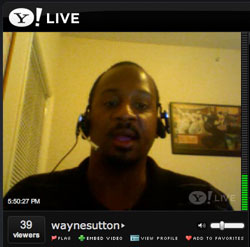
It's common knowledge that anonymous commenters often fall to the lowest common denominator. The wider the audience, the less respectable the discussion, with YouTube being a perfect example.

Most of the time, the places I engage in social media (and real life) are civil. But as Corvida and Wayne talked about her family's efforts with Verizon, and how black tech bloggers are often stereotyped, with Feldman's video as an example, the Yahoo! Live chat screen filled with filth, with racist words, references to Kentucky Fried Chicken and watermelon, comments on Obama, and discussion of penis sizes.

Essentially, you name the negative stereotypes and hatred that could be spewed against the African American bloggers, and they were there.
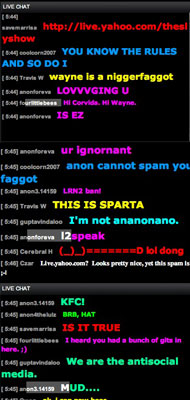
I don't want to spread the filth that was said during the chat, but it's worth exposing these purveyors of hatred, to illustrate the nonsense. If only there were a way to break through their anonymity...

There's no question the work was done by a few anonymous malcontents, but it was eye opening to unfortunately be reminded those people are out there, and are willing to share their nonsense in an attempt to intimidate both Wayne and Corvida, in hopes of persuading them to stop. But it didn't work. As Wayne said the issue of Loren Feldman was "a wake-up call for African Americans", today's nonsense was an unfortunate wake-up call for me.

I'm glad both Wayne and Corvida maintained their professional integrity in the face of ridiculous nonsense that could have brought weaker people to tears, but there was absolutely no reason they should have had to put up with that horrible behavior, which, as it was undoubtedly intended to do, made me quite angry.

Forty years after the assassination of Martin Luther King, and with all the advancements we think we've made in Civil Rights, we still have to see this horrible, ridiculous, ignorant junk. I was appalled at what Corvida and Wayne had to suffer through, and I wish I never had to see it again. These people do exist, but they don't deserve a platform, and in this case, there should have been ways to either increase filters, block by IP address or reveal the real names of the trolls.

I am very sorry Corvida and Wayne had to suffer through that in what was otherwise a very engaging disucssion, and I hope this filth doesn't slow any person of any background down for a second.

June 22, 2008

June 22, 2008 · 7 MIN READ · BY LOUIS GRAY

What I Believe: My 10 Web and Blogging Expectations

What I Believe: My 10 Web and Blogging Expectations

Sometimes, when I talk to people about why I blog, and what I set out to accomplish through covering what I do, and engaging where I do, I say that I am trying to help shape the Web, and blogging as a whole, to be what I want it to be - a better community with some strong standards for engagement, ownership, news gathering and innovation. Over time, as the number of posts here has racked up, you can see some of these core elements throughout the site. As an exercise, I thought I'd outline my beliefs, and I'm eager to hear your comments, whether these are shared or we disagree.

1. I Believe You Should Enjoy What You Do

Whether you are are the co-founder of a hot startup, an entry-level programmer at a technology monolith, a blogger, or simply a fan of social networking tools, you should be sure you're doing what you're doing because you enjoy it, and at its core, it brings you happiness. At times, I've seen people succumb to the stress of posting every day, of racing up or down the comparative measures out there, or slog day in and day out at companies because they're too unmotivated to seek an alternative. Even on those days when the work required seems overwhelming, it's worth stepping back and saying, "Are you having fun still?" As Steve Jobs told a graduating class at Stanford University a few years ago, if the answer is no too many times in a row, it's time to think about doing something else.

When you're not having fun, it shows. Your work gets sloppier. Your posts get crankier. You start talking more about how much time it's taking, how much pressure you're feeling. And when that happens... take a deep breath, or take a break. Reevaluate why it is you're doing what you do.

2. I Believe In Supporting and Promoting Innovation

Without an entrepreneurial spirit, change in our technology landscape would be muted. Innovation can be sparked from a single idea, whether creating a new market, or simply improving a new one. When I see potential, I want to highlight it, and work as a partner with the team aiming to deliver a new experience, and fulfilling their dreams.

Often, a rush to call "foul" on a product, to give it a negative label, or call failure, is done more to grab attention than through benevolence. You're not doing the innovator a favor, or their potential users a favor, but seeing the glass half full.

3. I Believe In Trusting First, Looking for Holes Later

For the most part, people don't start businesses or create products with ill intent. New services crop up every day, and the overwhelming number are there to help you learn something new, find something more quickly, or reach peers in a new way. As it can be relatively inexpensive to launch new Web services, or to start blogs, there are, simply put, tons of them out there. Many do very similar things. But at their core, most are well-intended.

For every spammer or troll, content scraper or hacker, there are thousands of others working on the right side of the law. And sometimes, when it looks like a service might be on the border of what's "right" and what's "wrong", I tend to give the benefit of the doubt, so the entrepreneur can explain themselves. I also believe that every service out there, from those a day old, to the market monoliths of Google and Microsoft, has issues. It can be fun to focus on those issues, but unless they completely disrupt the user experience to the point the product is unusable, I feel the product owner is both aware of them, and is working behind the scenes to make the product more robust, faster, and more fully featured.

4. I Believe In Equal Access to Tools and Opportunity

I believe in the availability of free or inexpensive services that enable people to broadcast, share and collaborate. I believe that for-profit institutions should make efforts to spread the availability of the Internet, broadband and wireless access to bring this information spigot to people everywhere, regardless of their financial or geographical status.

5. I Believe In Portability Of Content and Clear Ownership

I believe that products should enable support for open standards, such that data can be simply exported and imported from one service to another. I believe that these open standards should be deployed such that content, be it blog posts, news, comments or other actionable items (be it up/down votes, likes, avatars, etc.) be easily transferred, while retaining clear ownership by the original individual performing the activity. This portability should be developed in such a way that the third-party service, the content creator, and the person reaction to said content, all have the option to approve or disapprove portability or modification.

In those cases where full portability is not yet available, I believe services have an obligation to state their intentions to move toward an API, an open standard, display best intentions, or publicly declare their position to keep data siloed, buyer beware.

6. I Believe In Giving Credit Where It Is Due

I believe in bloggers giving best effort to determining the original source of news, and providing linkage, especially when the alternative is to link internally. I believe in making it clear who the entrepreneurs are behind services, and displaying a human face to what could otherwise be a personless brand.

I believe in displaying clear attribution for the source of quotes, paraphrasing or other use of third-party content, even if it is from what's considered a competitor.

7. I Believe In Supporting The Little Guy, While Not Hating the Leader

I believe in giving a new service or a small company its unfair share of support and coverage, as they make a valid attempt to enter a market. I believe in helping the service clarify their message, their features and benefits to the point they achieve critical mass on par with other market leaders. I believe that this presumed bias can be shown without disparaging leading services, or holding ill will against those already having achieved success.

8. I Believe In Transparency and the Removal of Barriers

I believe that those services who make their intentions, their product plans, and their updates clear to users and partners will achieve a higher level of success and trust than those that do not. I believe that company representatives should be easily accessible through clear methods, and should give best efforts to rapidly respond to feature requests, downtime or other concerns.

I believe that activities or barriers which reduce transparency, reduce access to company representatives and create confusion will be extremely damaging, reducing trust and good will.

Similarly, bloggers should be extremely reachable and should display and pre-existing biases, monetary engagements or sponsorships, be there any.

9. I Believe In The Ability to Disagree Without Ill Will

I believe that it is absolutely possible for multiple people to look at the same data set or service and achieve completely-differing conclusions and perspectives, without meaning either person to be lacking in intellect or experience. In the event that disagreements do occur, I recommend open communication and statement of beliefs will be much more successful at proving a point than labels, one liners or personal attacks.

In parallel, services can expect that not every review will be one they want to print out and send home to mom. If the author's found to not have a conflict of interest, efforts should be made to expose that, but otherwise, it can be assumed there might be some valid points, even in the most vile of screeds.

10. I Believe In Finding New Ways To Find, Share, Manipulate Data

I believe that the creation of data and content is nearing commodity status. New blogs and services debut every minute and die almost as quickly. But each month brings new and exciting ways to manipulate, share or otherwise locate the best data, through the launch of new social networks, aggregators, search engines, or semantic tools. The services we all use today will almost with certainty be different than those we use next year at this time.

It is with these 10 tenets, and likely more, that I look to engage. Through my small voice here, I believe I have been lucky enough to play a role in discussing how blogs give attribution, how they prioritize external links vs. internal links, the growing issue of RSS repurposing and comment fragmentation. I've tried to support the little guys and highlight individuals doing innovation. I've made a small number of negative posts, in contrast to my more supportive posts, and avoided throwing the second stone at times when my views weren't universal. The Web, and our ability in the blogosphere to impact it and play a role, is ever changing and exciting to me.

March 2, 2008

March 2, 2008 · 2 MIN READ · BY LOUIS GRAY

Guest Post: What Digital Media Can Learn From Books

Guest Post: What Digital Media Can Learn From Books

Guest post written by Arvin Dang, currently writing for The Apple Blog.

We are the generation that lives through media. We don’t watch to pass time, we watch to learn and grow. I’m not sure what this reflects on our education system, but just as literature inspires, media can spark the same creativity and instill similar values.

What can media learn from books?

The inherent value we gain from a book's physicality is amazing. I can buy a book, write in it, store it, trade it, share it, sell it, copy it and burn it. I may not be able to physically hold a movie or a song, but I hope to be able to create the same utility surrounding it.

When comparing digital media and books, I’m not comparing E-books or E-Readers because they face the same DRM issues as most music and videos do. I understand the rules and regulations of copyright placed on books, and I understand the necessity of including plagiarism in context of this.

Now let’s have a look

With a book, I understand the author’s words and right of ownership, but I’m free to quote them and to share their words. I can literally copy every page of a borrowed book without ever paying for it. Will I have RIAA or the Government following my every move? Borrowing a book, if anything, builds reputation. Just as word of mouth is the best form of advertising, sharing someone’s content enables the ability for word to spread. Not only will the author or creator gain readership, they gain reputation. Ultimately, that seems to be far grander than any monetary benefit. Why can’t the same happen with digital media?

Libraries, where books can be borrowed completely free seems completely unconventional right? If video content were offered on a public level similar to libraries, who’s losing out?

Why hasn’t independent content caught on as successfully as the Industry?

I don’t know. You tell me. Is it quality of production? Is it the acting? Or the writing? All I know is media should be based on reputation, not profit. If it helps make you more known, provides meaning, and basic ownership is understood, then why can’t TV follow the same path as books?

I understand the role of money in media. Without monetization, the Entertainment Industry may not be able create the beautiful epics we see. I see the success of independent creators like The Next New Networks proving that the industry doesn’t need to equate profit with content. It makes me very curious to see the actual breakdown; to take a season of The Office and see how much total production costs verse how much is monetized and gained from commercials and sales (DVDs, etc).

It’s a greedy market and a demanding world, but if books can find a balance, can’t media?

February 29, 2008

February 29, 2008 · 2 MIN READ · BY LOUIS GRAY

Dealing With Offline Companies Can be Such a Pain

Dealing With Offline Companies Can be Such a Pain

Unless you're a brand-new visitor to louisgray.com, you might remember a post from a few weeks ago where I revealed my wife and I are expecting twins, our first children. While that announcement was sure exciting, there are a number of very real offline preparations which are going to take real physical labor and change - not the least of which being getting our home ready for two permanent visitors. But as easy as it is to plan things online, it's those offline who can throw snags into the whole operation.

With my wife having more than a decade's experience in teaching school, and the two of us having accumulated our fair share of material goods, we're going to need a place to put some of our own things and get a room in our condo ready for the kids. So, on Monday night, before my trip to Boston, I reserved a 10' by 15' unit at a local Public Storage, letting us start moving our items. I was able to register online, and gained a confirmation e-mail, saying, "This price and unit will be held for 7 days."

But during my time in Boston, Public Storage called my home phone number, which I had left on the site, on Tuesday and Wednesday to confirm we would be ready to move in by Saturday. By Thursday, the afternoon I came home, a final message was left by a woman who gruffly said as we hadn't returned her call, that we had lost our spot. Held for 7 days indeed. A short 7 days from the night of the 25th to the afternoon of the 28th!

Did I get a single e-mail asking me to confirm I would be ready to move in on Saturday? No. If I had gotten one, I definitely would have responded. And what am I supposed to do now? Sue them for breach of contract? It's not even worth it. So of course, I logged back on today and reserved a new unit at a different Public Storage somewhere else in town for about the same amount, and yes, its automated e-mail has the same "7 days" guarantee.

I recognize that I can't exactly compress my offline materials, attach them to an e-mail and send them to a new location, while that would be nice. But it's gotten to the point I expect customer service to be much better and for true online companies to be much more responsive and interactive than these offline clowns. That they wouldn't even think of sending an e-mail, after the initial confirmation made no sense. Why ask for it then?