Showing posts with label Comments (20 posts). Show all posts

October 20, 2018

Comments as a Platform, Or Silencing the Trolls

Comments as a Platform, Or Silencing the Trolls


Web content has typically divided into three camps - those who create, those who react, and those who just watch. The lurkers, if you will. From the very earliest days of blogging, those first posts awaited the inevitable comments, and, given a clear revenue stream, you would see early participants like Fred Wilson say that "comments are how bloggers get paid."

[Source: https://vanelsas.wordpress.com/2008/06/02/the-real-value-of-social-media-interaction/#comment-2531]

The earliest engagements we had with people who read our site gave us incredible discussions, and spawned more posts and even, in rare cases, changed minds. Sites like Digg, Reddit, Slashdot and others became known for their diverse threads, and those in the comments are why you showed up.

But we've also seen the pendulum swing the other way. Everybody knows to "never read the comments" on popular news sites, as the most aggressive vitriol and ignorance floats to the top. YouTube comments have long been notorious for their lack of quality (though I feel this has improved of late). And Twitter, for many who should be able to use the platform, their every move can attract trolls who have a vendetta to take them down - but somehow don't get banned.

As social media sites eclipsed the momentum of blogs, conversations moved. We adapted by integrating social discussions from FriendFeed, Facebook and Twitter and appended them to our blogs. We would all share our posts on social, and then engage where the content landed. The best bloggers would find their readers wherever they were. But others simply turned comments off. Maybe it is because they were full of spam (they were) or the quality wasn't there (often true), but also, because the total quantity declined.

Let's go back to talking about Twitter. Twitter drives me nuts because it's fantastic and so poor at so many things. They seriously have real-time on lockdown. There is no better place to see what is happening right now. If there's a calamity, search Twitter. A breaking news event? Search Twitter. A sporting event? Twitter.

But Twitter has this awful habit of giving all users an equal voice. Now hear me out what I mean.

If you tweet publicly, anybody who you haven't blocked can reply, and their content is appended to your tweet. It follows you around. If a Republican politician posts, left-leaning posters race to take down their message, while the MAGA crowds prop it up and try to gain eyeballs. If the Kardashians say something, the crowds pounce on the valuable real estate quickly to show their adoration or pimp whatever link they've got going.

And down the publicity food chain, if you're a woman, especially a visible one, you get awful men saying foolish things. I guarantee it. They may call you names or question your ability. You block one and ten more pop up. If you're black, or Jewish, the racists will find you. They all know how to tweet.

So what I recommend above all other Twitter changes is the ability for people to reclaim their space. Hillary and Trump should both be able to post information without the crowd's replies being appended. Just like blogs and YouTube stars can turn comments off, Twitter users should be able to as well. The thing about social networks (and most products, to be honest) is that you should give the users control. But they haven't done it, and I think it delivers a great disservice to the platform, which has become a hotbed of harassment and hate - as Reddit and others have too.

If you can trust your commenters enough to give them a voice, by all means, amplify their voices. But when they have shown you time and again that they cannot be trusted, turn it off.

February 9, 2011

Echo Prepares World for Migration to a Web of Streams

Echo Prepares World for Migration to a Web of Streams

The foundation of the Web is moving from one of unchanging static pages to continually updated streams fed by external services. Gone is the time when publishing an article or a site was the final step in creating content. Instead, this can often signify the beginning of the content's life, as it is shared, retweeted, liked, commented on, and further distributed. Echo, a company that first made its name in the comments space, explained to a full hall of industry onlookers Tuesday morning that dynamic social experiences are going to rule the future of the Internet, further arguing they have placed themselves at the center of this trend, having built a flexible environment for people to tap into the activity streams and benefit from the Web's continued evolution, instead of seeing visitors capitulate to household name social networks.
Companies like Facebook, Twitter and LinkedIn have unlocked billions of dollars in revenue around user streams of content, while traditional publishers have often held to traditional business models, unable to keep pace, said Echo's CEO, Khris Loux. "Today's publishers are ill-served to serve even their own audiences," he said. "The conversations, traffic flow and revenues have moved on."

What Echo recommended was to give publishers, ecommerce sites and startups the capability to craft user-centric, stream-centric experiences themselves, tapping into activity stream data as the unit of currency to power interactive next generation sites. To accomplish this work, the Echo team has created a stream server to deliver real-time experiences that support the existing brand and content without traditional costs of real-time. It was explained the company's new stream server supports thousands of queries per second, with live updates, based on open standards, with each item passing through the stream having the opportunity to be touched with the appropriate action (such as likes, replies, flags, votes, promotes, etc.)

But rather than building out a complex product portfolio to white label or charge premium fees to customers, Echo told attendees yesterday that they work "up to the API" and partner with other startups to connect their services to end users.

"We have coded up to the API and no further," said Loux. "It's scary as we can't solve anyone's problem ourselves. But that also means our partners have as much power as we do."

Echo, since its product shift in 2009, has signed up many top name brands to its platform, some of whom presented Tuesday, including Sports Illustrated. Displayed on SI.com and other partners' sites were real-time comments, user reactions, badges and achievements, and a visually appealing image gallery for hosted graphics. Partners supplying many of these things included Realtidbits, Janrain, Klout, Badgeville, Branchnext, Clicky and Arktan, who claim to have connected to Echo through open standards, enabling customers to switch providers in the future if desired.

"It's the beginning of a new way to look at software," Loux said. The company hopes to also offer a custom application store that enables partners to connect hours of effort to dollars through showcasing their apps on the market. Executing on a planned feature that is stream-centric looks right. Echo's demos from Tuesday and well before are showing real promise about the future of the Web. Rather than shying away from competing with the Web giants, Echo and its partners are set to offer a serious alternative - keeping ownership of the entire social experience on the corporate site.

Disclosure: Chris Saad, an Echo employee, and I occasionally collaborate on the Edge Theory conversations series, and I consider him a good friend.

August 3, 2010

Echo Debuts Real-Time River, Highlights Reader Activity

Echo Debuts Real-Time River, Highlights Reader Activity

After declaring the world of traditional comments dead last year, Echo has continued its quest to bring the world of real time reactions from around the Web to publishers looking to surface more engagement with their community. Today, Echo introduces a product they call "Echo River", which brings responses from commenters to media stories practically to equal footing of that of the author, raising the visibility and surfacing real-time feedback that practically promises to make sites more sticky as users participate.

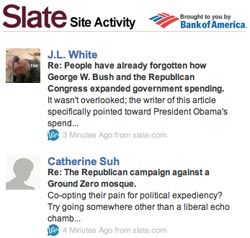
Last month, Echo introduced a "Recent Comments" widget, which brought the newest responses to the front of the site. This new real-time widget updates live, not requiring refresh. It plays a key role in this morning's update, as the comments widget runs alongside River-enabled sites, which also display real-time comment counts for new entries, and nests the reactions (be they from comments on the site, Twitter, Digg or other sources) below the entry.


Echo, which has a wide array of large media customers in its roster, highlighted its River offering with staged demos on Slate.com, TechCrunch and Mashable. The River function even managed to pull comments from disparate technology sources, such as WordPress (on TechCrunch) and Disqus (from Mashable). This move further separates Echo from its assumed competition, and puts them more into the real-time space, rather than vanilla comments.

"Displaying conversations on the home page in this way changes the way people see the front page of a typical news site," said Chris Saad, VP of Strategy for Echo in a press release. "Readers get to see a summary of what people like them are saying right from the front page, getting a new perspective on the headlines of the day... This new product continues our mission to turn static web pages into vibrant real-time experiences, driving Facebook style engagement on our publisher sites."


While the old way of comments might be dead, by their positioning, what this new product does do, for its premium members, is practically give sites' community equal prominence to that of the original writer, who sees their work do battle with often opinionated readers. And if a conversation flareup does ignite, Echo will show each update in real time. It's enough of a push that the service's executives used lofty phrases about changing the world of publishing "one product at a time", fighting against a world of static media.

For premium subscribers to Echo, adding the new River functionality is simple, just requiring a little Javascript code. The company says the River can be customized as to its content and appearance.

Disclosure: Chris Saad of Echo and I occsionally co-host the Edge Theory Conversations podcast.

May 24, 2010

Google Reader Enables Public Comments on Shared Items

Google Reader Enables Public Comments on Shared Items

One of the best benefits of sifting through hundreds of new RSS items each day in Google Reader and selecting the best ones to share has been the ensuing conversations that have developed as a result. It used to be that these conversations were limited to networks like Socialmedian and FriendFeed, but they later took place within Google Reader itself, for all friends I had hand approved, and later, in Google Buzz, assuming I had given people permission. Now, the Reader team has removed the hassle of picking who was enabled to comment or not - making shares have the option to be public to the world for conversation. This highly anticipated move is a big reason I have continued to be so bullish about sharing Reader items and participating where they land on Buzz.

If you have not already seen the prompt, the next time you enter Google Reader, you will see the option to "Keep my shared items public" or to "Make my shared items protected". Hit "Save" to keep comments public, or choose to keep the shares open to only contacts in your friend list.

You Can Now Make Your Shared Items Public to All

This move is incredibly simple, when contrasted to the labyrinth of privacy settings required at Facebook to determine where your content is being displayed, and it protects those who have previously opted to make their Reader shares private, as explained in the company's blog post announcing the changes this afternoon.

My Shared Reader Items Are Visible to All

The ability for the world to comment on Google Reader shares should be a big boost to Buzz, as even more places are open for discussion. As mentioned in April, statistics show Reader shares as the 2nd-highest source for conversations on the network. This should bring that percentage up a great deal.

Want to see my shared items? You can find them here, or we can get connected on Buzz.

May 12, 2010

Echo's Reactions Platform Hits It Big With Old Media

Echo's Reactions Platform Hits It Big With Old Media

When JS-Kit first announced their Echo platform, declaring the death of comments, many thought it to be hyperbole. But as we have seen with a metamorphosis of the way people react to content around the Web, sharing it downstream with followers on Facebook, Twitter, Google Buzz and many other outposts, blog comments no longer hold the lofty role they once did, and it has become increasingly important to discover reactions - wherever they are. Since that announcement almost a year ago, JS-Kit rebranded as Echo, and has been promoting their premium reaction platform to more than just blogs - but old media titans. Today, the company announced a wide array of publishers who have chosen Echo to capture their real-time reaction stream.

Included in the morning's announcement were names such as The Washington Post, Newsweek, Time, Forbes, and Sports Illustrated. In a quick e-mail announcement the company said they were "extremely excited and gratified to be working with these high profile and influential brands, helping each of them create real-time conversations on their sites."

In parallel, the company also relaunched its Web site, now at http://aboutecho.com/.

Unlike its Web 2.0 cousin, Disqus, Echo is not focused on offering a free comment platform for bloggers, and has been creating a robust system that starts at $99 a year. For its part, Disqus announced the acquisition of Harvard Business Review as a customer today. Also, recently, Intense Debate, the quietest of the three offerings, was selected by TechCrunch as the tech blog's comments engine.

Echo's announcement can also be found on their Web site: Echo partners with Washington Post, Time, Forbes and others

March 29, 2010

Cliqset, Status.net Support Salmon for Comments Migration

Cliqset, Status.net Support Salmon for Comments Migration


As Marshall Kirkpatrick noted in a post on ReadWriteWeb this morning, the Salmon Protocol project we first introduced back in October of 2009 looks like it is progressing beyond the planning stages, as it has been integrated in two small, but influential, social networking sites, Status.net and Cliqset - both of whom are strong open standards advocates laboring away in the shadows of larger communities.

The Salmon Protocol, which aims to define a standard protocol for comments and gestures (such as likes) to swim upstream to the originating blog, hopes to unify conversations across diverse locations. It's planned for adoption by Google Buzz (See: Designing Buzz for a Google-Free World) and solves the problem that first blew up back in 2008 around fractured conversations.

While many people, including myself, have adapted to a new world whereby conversations take place in a wide array of communities, it would be nice for the content originator to have one centralized location to see all downstream activity.

Evan Prodromou of StatusNet mentions integration of Salmon's digital signatures in a blog post from Sunday, where he also notes support for Activity Streams encoded in RSS 2.0 and Atom. The move, paralleled by deployment at Cliqset, should be what I hope is the start of a lot more announcements, from small and big companies alike, to make Salmon a reality. The next big target, which I am biased in favor of, obviously, would be for Disqus to integrate with Salmon and pull comments upstream to this blog.

I managed to find time to talk with Darren Bounds of Cliqset at SXSW earlier this month. In our quick discussion, recorded on CinchCast, you can find his comments on their support of open standards, and that network's direction - which could hint at why they're an early adopter of Salmon.

March 8, 2010

BackType Launches Labs, BackType Me, for Social News

BackType Launches Labs, BackType Me, for Social News

BackType, the best comments search engine on the Web, which launched in 2008 and has since morphed to act as a "real-time, conversational" search engine, today announced the introduction of BackType Labs, an "in progress" look at some of their newer projects. The first to debut is a service called BackType Me, which aims to find out what content is being shared by people you follow on Twitter.

Funded by Y! Combinator, BackType has grown from its two cofounders to a team of three, and is actively looking to hire two more engineers, focused on software and search. In the last few months, the threesome has evolved the site to display news by category, such as "Technology", "Politics" or "Entertainment", and has grown closer to Twitter, displaying topics that are "Hot Right Now", much like Twitter's trending topics.


Shares from Within My Social Circle on BackType Me

Now, searching BackType displays shared items from friends as well, which feeds the BackType Me product. Search BackType for a specific term (for example, the Oscars) and if logged in, you can see which of your connections shared a specific article on Twitter. The core BackType Me service displays all content shared in your social circle, and highlights the individuals who have shared it.

BackType Me could be a quick way to scan important items shared on social sites from friends in your network, and I assume we can expect more to come from BackType Labs. The team is already hinting at something called "BT.IO", which could be yet another URL shortener or something else entirely. We'll be watching them at work in the Labs when it debuts.

February 25, 2010

How To Enable Comments on Google Reader Shares In Buzz

How To Enable Comments on Google Reader Shares In Buzz


With the recent launch of Google Buzz, shared items from Google Reader's RSS platform have become more visible and more important than ever. (TechCrunch said growth increased 35%) Those Buzz users with existing shared Reader feeds had these streams automatically connected to Buzz, enabling Buzz viewers to see your shares, and if enabled, to leave comments, once obscured in your own private network, in a public place. But those following you on Buzz don't automatically have the option to comment on your Reader items, and for some, this can be frustrating. Here's how you can help them join the conversation.

Google Reader enabled conversations back in March of 2009. As somebody who has adapted to a distributed multi-locational world of conversations, I have optimized my activity to embrace the conversations in this platform. In the last year, I have been enabling connections to comment on my Reader shares, and as a result, the conversations grew dramatically.

An Active Google Reader Item in Buzz, With Comments

But the integration, to date anyway, has required some effort on my part. As new followers added my feed to their reading list, I have had to give permissions to these followers to comment on my items, by adding them to a folder, which I called "Friends". This work, a few followers a day, has paid off in a big way, as I have enjoyed fantastic conversations in my Reader, and now, this group can participate with me in Buzz.

Many of you are probably seeing more followers from Buzz into your Google Reader world than you ever had before. Now, it is more critical than ever to move these folks into a folder who can comment on your items, or they will be met with errors, locking them out of your conversation.

So here's how you fix it:

1. Log into Google Reader at http://www.google.com/reader

2. On the left side, click "Sharing settings". (Shortcut here)

3. Where it says "Who can see your shared items?", there is an item which says "Who can comment on your shared items?". Those items that have checkboxes are enabled.

My Sharing Settings and Connected "Friends" to Comment on My Items


4. Click "people are following you", and from there, you can add individuals to folders.

Adding a New Individual To a Group for Commenting

5. Repeat until you're done.

Note How All My Contacts Are In Groups for Commenting

As new followers come in, even if you choose not to follow them back, you should add them to a folder that can comment on your items. With Buzz drawing ever more attention to your Reader shares, and Reader shares being a big part of the content there, it makes sense to extend the conversation there. If this seems complicated, note it is due to a policy of having "private" conversations in Reader from the last year, and adapting this policy to a new public place. Until Google Reader enables fully public conversations on all shared feeds, this will be how you can make your feed an active place.

You can find my Reader shares here: http://www.google.com/reader/shared/louisgray. We can get connected on Buzz here: http://www.google.com/profiles/louisgray.

February 7, 2010

Blippy Surfacing Popular Purchases to Increase Engagement

Blippy Surfacing Popular Purchases to Increase Engagement

A few weeks ago, when I first started using Blippy, the site that tracks my purchases offline and online, I said it simply proved how boring I am. Aiming to not itself become boring, as exciting as reading old receipts as popular funnyman Stephen Colbert recently called it, the site recently introduced two new features that will highlight user activity and popular purchased items, bringing discussions to the top.

For fellow FriendFeed veterans, Blippy's move is much like increasing the visibility of active discussions on the site through "best of day". It also mirrors the recent move by Facebook to highlight popular entries from you and your friends in the newsfeed.

Lively Chatter in My Blippy Stream Surfaces Active Purchases

While previously, activity on your Blippy stream would move chronologically out of the main view as you made more purchases, active threads can now be found in a section Blippy calls "Lively Chatter". Also, you can check "Popular Purchases" from everyone on the site, leveraging the increasingly popular standard of "likes" and comments.

One Active Discussion on Blippy

The more people you follow on Blippy, the more likely it is that you will see comments and likes in your stream. These are highlighted in "Recent Activities". Clicking on "Lively Chatter" shows items that have gained comments (including comments from yourself), letting you see conversations about the movies and music and apps that you are buying.

Another Active Discussion on Blippy about Siri

For now, Philip Kaplan (aka Pud), creator of the site, is the most frequent commentor in my feed, which comes as no surprise, but this may change as people grow more accustomed to making the site more of a two-way platform, instead of just simply importing.

While some look at Blippy as a perfect example of oversharing or our own willingness to put personal data on the Web, I see it as a logical extension to our recommending and telling people what we "like". Pud, curious about the series "Breaking Bad", which popped up in Mike Arrington's stream, even had the show gifted to him due to his curiousity. I expect to see many more similar actions driven directly from activity on the site.

December 25, 2009

How I Aimed to Do Better On the Web in 2009

How I Aimed to Do Better On the Web in 2009

As 2009 loomed, near the end of 2008, I took a look back at how I was utilizing the Web and set for myself some direct goals, not necessarily number-oriented, but measurable nonetheless. As I illustrated in 10 Things I Wish I Would Do Better On the Web Come 2009, I wanted to make a concerted effort to interact with readers on the site (and on other blogs), and be more active away from home, participating in events, panels, podcasts, and the like. (Note Steven Hodson's reaction to this list as well)

With the goal of keeping myself accountable, here's the year's goals revisited, and summarily rated with a success or failure.

1) Make More Comments on Original Blog Posts

Success: Although a great number of comments continue to remain on FriendFeed and Facebook, or Google Reader, I made a concerted effort to leave comments in reaction to posts for blogs big and small this year, be it the individual Posterous or Tumblr account, or a large blog network, such as TechCrunch or GigaOM. I don't think I will ever fully do as good a job here as I would like, but I was certainly aware of my activity in 2009.

2) Respond to More Comments on louisgray.com

Success: Disqus makes this process extremely easy, letting me respond to comments that come to the blog via e-mail, or in rapid fire with their simple user interface. On "hot" blog topics, I made sure to respond to a good number of thought-provoking readers, and "walk down the line" to add my views. As with the above, this too could be improved, but I believe I was better at this in 2009 than in 2008.

3) Be More Interactive On Twitter

Success: I am still not as huge a Twitter fan as many people. I continue to use Twitter more for links than conversation. But I also wanted to use the service to help promote the #BlameDrewsCancer phenomenon, and have been very active in responding to @Replies. I try not to use the site as a status update service all too often, but this became more than just a repository for "New Blog Post" in 2009.

4) Spend Less Time on a Few Sites, and More Time on Many Sites

Failure: I believe I merely exchanged some sites for others here. I continue to spend a lot of time on Google Reader and FriendFeed (no surprise to most of you). While in 2008 I spent a bit of time on Socialmedian and Strands, I removed myself from those sites for the most part in 2009, and replaced them with more use of Facebook, plus the addition of Ecademy and Simler. (which have some FriendFeed-like elements)

The leverage of RSS continues to keep me on Reader more than in visiting many different downstream sites, and I still am visiting non-tech at a bare minimum.

5) Have More Time for In-Depth Reviews

Success: In addition to a great number of in depth reviews of new iPhone applications, I also started using YouTube to help describe some services, including Lazyfeed and my6sense. In terms of other Web services, I have tried to make sure when covering a site that I have walked through it and included a good number of screenshots or explanatory items to provide more background, even if it means I am not first to publish.

6) Follow Up On Sites and Services After Their Launch

Partial Success: Following up on all sites and giving equal time is practically impossible. But for every site I discussed only once, there were many more, such as Brizzly, Lazyfeed, Simler and others that saw multiple pieces of coverage that included updates on the product and company.

7) Attend More Industry Conferences and Panels

Success: 2009 saw me attend BlogWorld Expo for the second straight year. In addition, I attended SXSW in Austin, LeWeb, multiple TechCrunch CrunchUps, and had other speaking opportunities.

8) Participate More Visiblity on Conferences and Panels

Success: Adding on to the above, I gained the opportunity in 2009 to branch out a bit, leading a panel on Twitter applications at LeWeb, speaking on content aggregation at SXSW, speaking on realtime at BlogWorld, on information overload at the Inbound Marketing Summit, the death of advertising with the SFAMA, and other opportunities. I aimed to say yes to as many as I could, travel and expenses willing. 2010 should continue the trend.

9) Be More Active on Podcasts, Videoconferencing

Partial Success: 2009 did not feature the regular podcasts that were attempted in 2008 with the ReadBurner Weekly and Elite Tech News podcasts being shuttered. I did participate in FFundercats a few times, joined Leo Laporte for a holiday This Week In Tech, and Steven Hodson for another, but this was less than I had anticipated.

However, in addition to the group podcasts, I started using Cinch a lot, letting me send off single person podcasts from the iPhone, or 1-1 interviews, as were done at LeWeb.

10) Highlight More Bloggers and Entrepreneurs

Failure: As in 2008, I continued the highlighting of five new bloggers and ten new Friendfeeders each month through the first half of the year. But the purchasing of FriendFeed by Facebook in August pushed this plan askew, making me openly wonder if it made sense to continue that practice. I continue to seek out new content and highlight it through Google Reader shared items and other places, but could improve.

By setting these goals at the end of last year, they were somewhat in the back of my head as I made plans and actions through 2009. I tried not to set an arbitrary number-based goal that would make things seem like a chore, but did want to do the right thing. As you can see, many of these goals, especially in regards to events, were much stronger in 2009 than 2008. I just thought it made sense to report back to you.

November 25, 2009

BackType Feeds Partners Faster, Thanks to PubSubHubbub

BackType Feeds Partners Faster, Thanks to PubSubHubbub

BackType, the most robust and feature-rich comments tracker on the Web, has expanded its services over the last few months to include a number of new items, including the launch of BackTweets, to find shared links on the microblogging service, a TweetCount plugin to highlight the number of times items have been retweeted, and a BackType Connect plugin for WordPress to show related conversations around the Web attached to your blog. The company's API is also used by popular services including Bit.ly and Disqus, who leverage the service to find external links and related tweets. Today, these downstream partners can expect updates to happen in near real-time, thanks to BackType's jumping on the PubSubHubbub bandwagon, in a partnership with Superfeedr, providing practically instantaneous updates downstream.

Superfeedr, one of the more aggressive services promoting PubSubHubbub, is providing the legwork for BackType, acting as a hub, pushing updates automatically as they are discovered. In today's post, BackType says the move reduces load on publishers by sending feed updates to all potential subscribers, without requiring multiple polls, and avoiding the arbitrary nature of clients' periodic requests.

If you subscribe to BackType to follow individuals' comments, or if you simply use Disqus or BackType connect on your blog, the move will ensure updates reach your content faster than they ever have before. In a Web world that is getting increasingly real-time, the name PubSubHubbub keeps popping up, and BackType is staying on the leading edge of innovation.

October 17, 2009

Proposed Salmon Protocol Aims To Unify Conversations on the Web

Proposed Salmon Protocol Aims To Unify Conversations on the Web


As comments on the Web become fragmented, conversations that occur on downstream aggregation sites often are taking place in a silo, disjointed from parallel discussions on the originating Web site. Over the last two years, many people have found this evolution controversial, hoping to unify the conversations in a central location - and some services, including JS-Kit's Echo and Disqus, have taken the first step by pulling external discussions to the source. But a brand new proposal, authored by John Panzer of Blogger, called the Salmon Protocol, is looking to take advantage of Pubsubhubbub to unify the conversations in all places, both upstream and downstream. And yes... the name of Salmon comes because those fish manage to swim upstream, just like the comments.


An Initial Presentation on the Salmon Protocol

As discussed in Friday's panel at Blog World Expo on technology and the real-time Web, Pubsubhubbub essentially works as a middle-man conduit, taking information from a data's source passing along changed data to downstream destination sites. The proposed Salmon Protocol would similarly watch both source and destination sites for comments, and upon discovering new comments, it would send the new comments to the site which is lacking the full conversation. If multiple downstream destinations are designated, the Salmon Protocol will also populate these multiple sites.

In conjunction with Pubsubhubbub, the Salmon Protocol leverages the newest iteration of webfinger, enabling publishers to receive comments and verify subscribers - as a form of true identity recognition, similar to how both Disqus and JS-Kit have you register for individual accounts with either service. An additional side benefit to leveraging Webfinger would be to dramatically reduce the potential for spam, assuming each individual has a unique ID.

The debate over fractured conversations has risen and fallen over the last two years. In September, I essentially said I was done listening to people complain about the issue after hearing complaints regarding Google SideWiki - as I believe people will want to have conversations where they are comfortable, and that they shouldn't be forced to come back to a single source. This is a point I have been hammering since the first major flareup back in April of 2008. (See: Should Fractured Feed Reader Comments Raise Blog Owners' Ire?)

Many people believe that transporting comments from one site to another and making the conversations one could cause confusion, or even make potential commenters uncomfortable. With this in mind, John has suggested that users "be made aware of the publishing scope of the comments they leave," adding "For some aggregators, this may be implied (all data is public), for others a warning or a checkbox may be necessary." (See: Salmon Protocol (Draft) Protocol Summary)


A Test Comment from the Aggregator Via Salmon


The Resulting Comment Back On the Blog Via Salmon

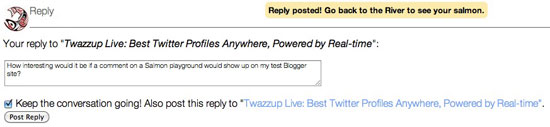
There is a test playground for the Salmon Protocol, and I can verify that it already works. If you want to test it, one option is to take a testbed Blogger account and point the Salmon Protocol your way. It occurs automatically, and comments that happen on the downstream aggregator will make it back to the blog immediately, thanks to Pubsubhubbub. Now, the quest becomes to turn this brand-new protocol into a new standard - one that could pose a serious challenge to services like JS-Kit Echo and Disqus, even including threaded replies. If done well, the long debate over unified conversations could soon be over.

Learn more at: http://www.salmon-protocol.org/.