Silicon Valley Technology Commentary & Archives · Est. 2006 3,045 Posts · 2006–2026
Showing posts with label Realtime (38 posts). Show all posts

December 19, 2011

December 19, 2011 · 3 MIN READ · BY LOUIS GRAY

Time Shifting In a World of Realtime

Time Shifting In a World of Realtime


Nearly three short years ago, the buzz word du jour in tech was “realtime”. Real time discovery. Real time search. Real time serendipity. The explosion of interest in social sharing tools like Twitter, Facebook and FriendFeed (remember this was early 2009) had people (myself included) saying that “Delayed news will no longer be acceptable for early adopters, who will gravitate to the quickest sources of news, wherever they may be.” In practice, while this has occasionally been true, I’ve found a completely divergent innovation to play as big a role in the way I (and others) consume news content and entertainment - that of time shifting, which has remained valuable at a time when most real-time search engines have pivoted or vanished.

Best exemplified by TiVo and other DVRs, preceded by the creaky VCR, the act of consuming media at a time much after its initial airing is so commonplace that live viewings are so uncommon that friends often tiptoe around current storylines for top shows. In some social circles, only the most breaking drama series get the “day it actually aired” treatment - like Breaking Bad, Dexter or Homeland, while everything else goes to TiVo, to be consumed later. (Obviously, I saw the season finales for Dexter and Homeland last night)

News, with some exceptions, can be similarly stored away for later viewing, be it through RSS readers or on your social network of choice. One must not be glued to the real time stream to make sure you don’t miss anything. Instead, the RSS reader traps your own hand-picked links, ready for viewing when you get the opportunity, not necessarily tied to their time of posting.

On the big screen, movies may bank on a massive opening weekend, but with consumers having so many options for entertainment sources, it’s common to see people mention they’ll “wait for Netflix”, which could be months or years away, content to save a few dollars while also getting the comfort of watching in their own home. And if you do find yourself suddenly interested in a show your friends have been seeing which has been out a few seasons, don’t fret, as you can, in almost all cases, catch up - tapping into many options, be they Netflix, Hulu, Xfinity, iTunes or Android Market.

This fall, I made it a personal mission to watch all of Mad Men, after hearing people go on and on about its quality. I powered through it with many late-night Netflix marathons. After finally ordering Showtime, I caught up on this season’s Dexter on Xfinity, and then did the same for Homeland. If my wife misses her favorite shows, she can do the same, tapping into the various video repositories on the web, including the big three networks, typically slower to adapt to the innovation of the web.

I watch my evening talk shows 3 to 5 in a row, from Jon Stewart to Conan, fast forwarding through commercials and skipping uninteresting guests - efficiently getting the best and skipping the rest. It’s almost the same approach I take to my RSS reader or activity on the social networks, skimming, reading, clicking and leaving no prisoners. Even if I’m not constantly connected, and I do a good job of getting close, I don’t feel this sense of missing something.

Realtime reactions to breaking news events, kicked off by an initial discovery, and then rattling around search engines and social media, can’t be duplicated by time shifted content, but for most buckets of content, be they text, audio or video, the drive to be first and in the mix of the story as it is interpreted and curated, is not essential. Advents in information and content sharing over the last few years have instead made “on demand” a reality, getting me what I want when I want it, not when someone else decides for me.

July 25, 2011

July 25, 2011 · 2 MIN READ · BY LOUIS GRAY

Twitter Search Gets Modern Facelift, Index Still Limited

Twitter Search Gets Modern Facelift, Index Still Limited

Since Twitter acquired Summize way back in 2008, the company's search engine has been one of the biggest question marks - for while use of the network has risen dramatically, the company has been unable to keep historical data beyond a few days. Recent enhancements, which Twitter termed personalization, help to separate quality updates from junk, but for the most part, the situation with the search engine remains the same. Today, the search engine saw flickers of life with a design revamp that brings the front-end of the engine in line with Twitter's newish Web interface. It also brings forth the "Promoted" search queries which the company is relying on for revenue.

Over two years ago, I talked about how Twitter's search engine became increasingly less useful over time thanks to a shrinking index and oddities, like being unable to find any tweets from specific users, or missing data, even when search operators were used. At the time, I asked if this would be a "temporary blip" which I hoped would "come back soon", but the company has prioritized other features. In the meantime, a deal with Google to provide realtime updates in their search results lapsed. So we're still stuck with the few days of results, just in a prettier format.

The new Twitter Search Front End, Including Top Trends by Your Geo

In addition to the cleaner look of Twitter search, the service also has a new example pop-up for search operators. While the practically ancient "flight :(" example held over from Summize remains, new are example searches including "from:alexiskold", "to:techcrunch" and "@mashable", nods to the GetGlue founder and top blogs who give Twitter a lot of press.

Also included? The optimistic operator: "superhero since:2010-12-27" which says it will return results "containing "superhero" and sent since date "2010-12-27" (year-month-day)". If you do run that query, you'll get responses dating back all the way to July 23, 2011. Where the rest of the 7 months' results are is anybody's guess.

Search Operator Options on the New Twitter Search

Despite one's social networking preferences, the data inside Twitter is extremely valuable. The company really could have a lead on being the realtime pulse of the planet. This makes prioritizing new tweets the most important, but I'd bet the world could benefit from more than a week's worth of content.

April 28, 2011

April 28, 2011 · 3 MIN READ · BY LOUIS GRAY

LiveShare Preps Real-Time Visual Communication Platform

LiveShare Preps Real-Time Visual Communication Platform

Forget everything you think you know about the humdrummery of the competitive but me-too echo chamber of the social photo sharing space. While most of the world has gone gaga over faux artistry around filters that make amateur photographers feel like experts, CoolIris' LiveShare team has been creating one of the most intriguing visual platforms I've seen - taking what I already liked about their platform, including a fun way to share photos around events and groups and vaulting into a new world of real-time, with video, shared links, and text updates.

The result looks almost magical, even to the cynical observer who thinks he's seen everything.

Sitting in on a preview of their new platform, which is expected to become available in the next month or two, LiveShare looks like they've finally delivered on their name, as I saw the company's three cofounders create and share photos, video and URLs instantly between devices, and this content was available for immediate playback and interaction from the receiving party.

For all the hype about "real time" and "near real time" and instant, maybe the terms have gotten fuzzy, but if there was any kind of delay, to me it was imperceptible. When one person would hit publish, the item would immediately display on the other device. Multiple photos would cleanly lay themselves out in a sharp grid, and video never even considered buffering. The result is a new platform for real-time visual communications that I haven't seen anyone else attempt, and one that should be available on any modern platform, thanks to adherence to cutting-edge Web standards.

"By the time you move your finger from the button, it should show up," said Soujanya Bhumkar, explaining his interpretation of real-time.

In an internal note to the LiveShare development team, he wrote: "For the first time, you can capture moments and share them with friends and family with absolutely no delay at all - the instant your finger taps the camera icon your photo or video instantly appears in your personal stream on your phone, iPad and the Web even before the content is fully uploaded. No waiting, no uploading - there is nothing out there in this space that delivers such instant gratification."

LiveShare's origins are in the photo sharing space, and the company may be known for its media consumption, but as they said Wednesday, the natural evolution, based on user feedback, is to discover media highly relevant to the individual, and to assign social velocity to relevant people, so that instead of broadcasting to everyone or narrowcasting to a select few, you and your content is discoverable by those interested.

"If this is possible, my expectation for what live sharing is has completely changed," said Austin Shoemaker, cofounder and CTO of CoolIris. "No more progress bars and hourglasses. Reality and speed are matched to consumer expectations."

The new platform is engineered using WebGL on HTML 5, meaning that on day one, it works in Safari, Chrome, FireFox and Opera. Not only can you passively view content in the browser, but you can drag and drop content from your host PC onto any LiveShare stream and make it an active participant in any ongoing stream. "Consumption on the Web is not a second-class experience," Shoemaker added.

One doesn't have to think too hard about the dramatic use case of curating events around topics and locations with the new LiveShare platform, going beyond siloed areas for photos and other siloed areas for texts. As the company promises, they aren't trying to create yet another walled garden, but instead, to fill the gaps that remain in email and social networking. And I'll tell you, even for this Android-leaning geek, the demo of sharing content on the new LiveShare between two iPad 2s was so sleek, it was tempting to jump back on the bandwagon. Make sure you check out their demo video. It'll have you lusting after their new platform - coming soon.


November 11, 2010

November 11, 2010 · 1 MIN READ · BY LOUIS GRAY

Lazyscope RSS and Twitter Client Slims Down, Speeds Up

Lazyscope RSS and Twitter Client Slims Down, Speeds Up

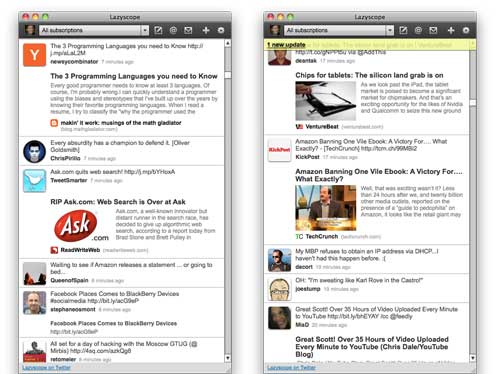
Last week's launch of Lazyscope brought an intriguing new Twitter and RSS client into the world which allowed for full story viewing in a right pane that supported rich media, effectively replicating Twitter's iPad experience on the desktop in a versatile Adobe AIR application. Just over a week later, the application has already seen significant updates that show its potential to become an option for Twitter power users - with the adoption of real-time user streams, a new "mini" single column size and keyboard shortcuts.

Like fellow desktop Twitter client TweetDeck, Lazyscope's support for real-time user streams eliminates the need for a refresh button, as updates flow into the application practically as they are posted to the microblogging network. The more active the users, the more frequent the updates, of course, as they cascade from the top down, simulating the stream in real time.

Lazyscope in Single Column View With User Streams Enabled

The option for a single column view that does not monopolize the screen is also important - as the content viewer (right pane) only opens when an article is selected, and closes when you are click the back arrow to return to the stream. In fact, the single column view is now the default view, giving you your screen real estate back.

Lazyscope in Full Expanded View

In addition to these two updates, Lazyscope, from the makers of Lazyfeed, has turned on keyboard shortcuts, letting you navigate the stream with arrow keys, reposting with the enter key, and my personal favorite, scrolling to the top of the screen with the space bar. As someone who uses keyboard short cuts all day long in Google Reader to go from story to story, doing the same in Lazyscope can make me even more efficient, and as they put it... more lazy.

If you haven't yet tried it, check out Lazyscope at http://www.lazyscope.com.

October 3, 2010

October 3, 2010 · 3 MIN READ · BY LOUIS GRAY

Tweetbeat Captures World's Events In Realtime, Spam Free

Tweetbeat Captures World's Events In Realtime, Spam Free

One of the most valuable and pervasive user-generated features of Twitter has been the evolution of hashtags. Whether used to signal discussion of a specific topic, or to participate in a shared event, searching for mentions of popular hashtags has become a frequent occurrence, aimed to capture the pulse of the world in real time. But, like most good things, they too can be used for ill will, as spammers and other jokers latch on to popular events and topics to push their nefarious agenda. Also, search results from Twitter, especially as the service grows in popularity, are not categorized or grouped. Tweetbeat, the latest introduction from search company Kosmix, delivered a solution last week that brings the world's events to the fore, with Twitter as the filter, spam free.

Just like the company's previous (and ongoing) efforts with the Tweetbeat Firsthand extension, which surfaces relevant Twitter accounts through the entire Web, Kosmix is again trying to make the pervasive noise from Twitter useful, bringing the best of the service forward, and pushing the dreck to the back.

Tweetbeat tracks the opening of The Social Network

Tweetbeat, launched last week at the TechCrunch Disrupt event, features what the company calls LiveFollow event streams to see real-time reactions from experts and others, Replay functionality to show tweets that took place during past events, and recommendations to find people who are engaging in events of shared interest.

The Disrupt event was not only a good launch conference for the product, but also a good test case, as Tweetbeat chronicled people's reactions to startup introductions, panels and yes, the AOL/TechCrunch news. Companies and people mentioned in the event were featured in a leaderboard, showing who was getting the most digital ink.

Tweetbeat tracks the Giants and Padres as they fight

But Tweetbeat is more than just tech conferences. Tweetbeat fires up for weather hotspots, movie releases, and all manner of sporting events. (See: http://tweetbeat.com/events. For me, one of the most compelling and fun uses of Tweetbeat is the service's dedicated NFL section, which shows real-time reactions to games across the league, with breakdowns by contest. You can even play back each game to ride fans' highs and lows. Even the baseball pennant race got a look in (See: Giants vs. Padres - Game 162 on Tweetbeat).

Tweetbeat NFL in Action for the Lions & Packers

Kosmix was among the earliest partners to have access to Twitter's full firehose feed, and they are leveraging that access to its fullest with Tweetbeat, pulling in about 3,000 tweets per second, filtering them for relevance and hiding those with low influence - a rank they have developed for every single active Twitter user, utilizing multiple factors, such as retweets and the influence level of those who have retweeted them. The result? An incredibly fast, no nonsense view of the world's reactions to real-time events.

Twitter's trending topics are well known to often be led by frivolous or off-color hastags, and you won't find that on Tweetbeat. While Twitter search may be a quick click away within the service to see what people are saying that very second, Tweetbeat is capturing it all and ranking it for usefulness. You just might find the event you are searching for is not just on Tweetbeat, but organized with style. So check it out at http://www.tweetbeat.com. With the NFL season under way, and fall TV shows hitting the air, you know I'll be sneaking over to see what the world is saying.

Disclosure: Kosmix, the parent company of Tweetbeat, is a client of Paladin Advisors Group.

August 24, 2010

August 24, 2010 · 4 MIN READ · BY LOUIS GRAY

Why My6sense: Right Time, Right Place, Right Context

Why My6sense: Right Time, Right Place, Right Context

After a post talking about the "Me Me Me" portion of social media, it seems only right to follow up and talk about news with me. If you caught Marshall Kirkpatrick's story on ReadWriteWeb (See: My6Sense & The Geek Who Rode His Blog to the Edge of the World) or caught the CinchCast interview I did with Robert Scoble, you know that I have joined digital intuition pioneer my6sense as the company's vice president of Marketing, after working with the company for a year as an advisor as part of my work with Paladin Advisors Group. By joining my6sense, I am the company's first employee in the United States, as the bulk of the company is at their Israeli headquarters, and I get the opportunity, once again, to take a major participatory role in a tech startup which has the very real potential to change the way we consume information, of all kinds, in all places.

As you may know from my previous coverage of my6sense, the company has an iPhone application today that prioritizes content from your subscriptions and social streams, based on your own behavior, automatically. Even more importantly, the company has an "Attention API", which can plug into any content provider, stream client or social network, breaking us out of the box of editorially-divined content prioritization, or best guess social circle recommendations, or the most-common, simple chronological sorting.

Truth is, even for the most focused of us information consumers, we are missing interesting content. More people are sharing more information more easily in more places, and it is impossible to read every Tweet, every Facebook share, every RSS entry or every Google Buzz post. Our intuition tells us quickly what are the most important items, and we find ourselves skipping the rest, or getting annoyed at what we find less valuable, considered "noise". I fear it is only going to get worse.

Solving for this information overload dilemma has seen new companies debut interesting filters, or rely on popularity or community to push items that may interest you to the top, but this is not true human ranking function, or it expects you to explicitly list your interests by keyword or subject. From all the companies I've talked to, interviewed, tested, and written about, my6sense has the best underlying technology, which works implicitly, leveraging your own behavior and not only already works very well, giving me a great mobile feed reading experience, but also sets up the opportunity to make this the official prioritization and personalization engine for the Web.

Even if we wholly adopt the belief that there is value in real-time reactions and recency, there is much to be said for the right content to find its way to you at the right time, in the right context. Factors that make you decide whether to read one article or update over another can be dependent on many different things - the source, the author, the headline, the subject, or even the time of day or location, and my6sense's Phds are working on divining the best stuff just for you - not anybody else. And in the year-plus that I have used the iPhone app, I practically never use its alternate time-based view, as the content is unfiltered and usually off-topic.

What makes me excited enough about my6sense to put Paladin on the backburner, despite the firm's doing very well, and having just hired a new partner, is that this is the right time to start plugging in prioritization and personalization for the entire Web. If the entire story were "just" an iPhone application, it wouldn't be interesting. But consider the benefits of personally curated content sites from major media outlets, social networks and clients. Consider how valuable it would be for those sites if users found content more relevant and stayed just percentage points longer per site, read more stories, and clicked on more relevant ads. Consider the real value of not contributing to the world of information overload, but cutting through the noise like a warm knife through butter, find the best and ignoring the rest.

My6sense already has the best technology, from all I have seen and heard, to make this happen. Now comes the opportunity to help do my part, an active role, to transform the company from technology leader to market leader.

And if you are curious what this means for the future of louisgray.com, I will of course be changing my About page and will offer disclosure if there is ever a time that warrants it, just as I always have. I have tried to bring solid content and ideas and smart technology here since 2006, when I worked for a hardware company, and in the last year, as a new media Partner at Paladin. The perspective changes, but the goals remain the same. Please do continue to keep me honest, and always let me know if you think I have crossed the line.

If you haven't yet had a chance to catch the call I did with Robert Scoble from Monday night, it is embedded below.


August 19, 2010

August 19, 2010 · 4 MIN READ · BY LOUIS GRAY

Real-Time News Needs to Reward Authenticity, Curation

Real-Time News Needs to Reward Authenticity, Curation

At the Search Engine Strategies San Francisco event Wednesday, Echo's Khris Loux sat down with me and representatives from UltraKnowledge, CBS Interactive (formerly CNET) and CNN.com to discuss the rise of citizen journalism and social media, intertwined with traditional journalism, and how mainstream media outlets can adapt their practices to include curation as part of their offerings. Our panel's determination could be summarized as saying the ability for the public to launch stories and extend storylines related to realtime has removed the ability for mainstream media to be gatekeepers, furthering the need to accurately determine authenticity and truth. And where mainstream media cannot have exceptional access, be it to geography, sources or timing, part of their new role is to discover and highlight high quality content, regardless of its source, in effect, adopting the role of curator.

Best exemplified by CNN.com's iReport, citizen journalists are being given a chance to report on equal footing with the mainstream media. While iReport gives these would-be reporters a place to piggyback on a major brand, many others have taken to their own blogs, social networks or Twitter to report live, and unlike the traditional approach where media authors would issue a story and call it a day, the life of a story now often starts when it hits the Web, spawning comments, shares and retweets. But as citizen journalists and bloggers are given the same capability to gain visibility, mainstream media's much-celebrated structure to put articles and stories through the vetting process sometimes falls astray in the race to get the story out quickly.

CNN's iReport Has "Vetted" about 5% of all Submissions Today

All time, about 7% of all Submissions are "Vetted".

A little over two years ago, I highlighted how quickly incorrect news can spread in the age of microblogging. (See: Smart People, Stupid Tweets. Fake News Spreads Fast on Twitter.) While many of us know not to believe everything on the Web, even if it is in Wikipedia, there remains a need to separate fact from fiction. With so many publications out there reporting on the same information at the same time, without having additional insight, the task of curating the very best of the analysis and repeaters can become a very serious task.

In January, I broached this issue, asking, "Can You Filter for Quality News Amidst Instant Analysis?" and earlier still, in December, highlighting how some news organizations are in fact incentivized for behavior which may lead away from taking the extra effort sometimes required to get the story right. (See: Growing Grumblings on Tech News Don't Address Incentives)

As excited and promotional as I am about the ability for anyone to create and share content, I am equally worried that incentives to promote the discovery of accuracy are not clearly defined, and it is often very difficult to find a real authority on a given topic in a world of instant analysis. When a story breaks in a real-time platform, like Twitter, the person who first reported the earthquake, or was present on the scene of an event, is only an expert for a short time, and when that topic has faded, new influencers for new stories are needed. This leads to a need for trusted sources to harness the truth from the originator of news, wherever it may be, mass media or citizen journalism, and rapidly verify accuracy.

But the sheer volume of feedback can overwhelm even the most well-intended. CNN.com reported one recent popular article achieved more than 30,000 comments - a practical impossibility to moderate by humans, leading to the desire to somehow separate the wheat from the chaff and surface the most accurate and supported insight. As one knows, trusting the community is possible, but usually results in an across the board maligning of those who share opposing views. See any political blog or sports blog for this particular variety of trench warfare. See any comment stream on Yahoo! News or on YouTube to see the quality of the masses at work.

The answer lies in finding a way to reward the truth-seekers in the real-time Web, and to reward media, be they an established brand or an emerging one, for discovering accurate insights, or simply harnessing them. The world of real-time storytelling is evolving before our eyes, and in some cases, its sheer ephemeral nature promises to introduce as many issues as it solves. We, as readers, creators and sharers, should be working diligently to keep our streams clean and provide value to all those who come in contact with our content.

For more thoughts, see Echo's essay: Real-time Storytelling

August 13, 2010

August 13, 2010 · 2 MIN READ · BY LOUIS GRAY

48ers.com Offers Realtime Social Search Across Networks

48ers.com Offers Realtime Social Search Across Networks

For the most part, realtime search engines, including OneRiot, Topsy and Twazzup, have focused on indexing the world of Twitter. That makes some sense, given the significant number of updates flowing through the microblogging network, but it covers only part of the worlds real-time sharing spectrum. A relatively new site, called 48ers, is looking to return results not just from Twitter, but also Facebook, Google Buzz, Digg and Delicious, and more interestingly, it lets you show results from each network on its own, should you choose. While Twitter may still win in terms of the total number of discovered results, they are intertwined with people who have chosen to post in other places.

Much like practically every search engine that has debuted after Google's spartan interface displayed the UI of the future, 48ers.com's home page is relatively light, showing only a search field, and in the age of Twitter, Trending topics. Click on a Trending Topic, such as "Hannah Montana Forever" and you see results that match the query.

A 48ers.com Search for VC Funds Shows Results from Buzz, Twitter

No big deal, right? True. But if you look at the top left of the search result page, you see you can now filter the search by any of five networks. Click on Facebook for the same query, and you will see shares on Facebook with the same match. Similarly, clicking on Google Buzz, Digg or Delicious will further segment the results by their source.

Searching 48ers for Oakland A's Updates from Buzz

Clicking on the results of any query takes you to the status update, if on Twitter or Facebook, the Digg submission, the Delicious bookmark, or the Google Buzz entry. (For example, this special Google Buzz entry on Hannah Montana)

Breaking News updates via 48ers from Facebook and Twitter

Like Twitter's vanilla search engine, 48ers offers useful searches, including "breaking news" and the more social ""totally recommend", which gets used surprisingly often.

Where 48ers comes up short is in continuing the realtime flow. Twitter's search engine, despite its failings, prompts to refresh as new entries are posted. FriendFeed's has them flow from the top. 48ers does not do that, so while the initial query may be made on realtime sources, the results themselves are static.

You can find 48ers on the Web at http://www.48ers.com or on Twitter at @48ersdotcom.

July 25, 2010

July 25, 2010 · 2 MIN READ · BY LOUIS GRAY

Supertrackr Tracks "Anything" on the Web, Instantly

Supertrackr Tracks "Anything" on the Web, Instantly

Thanks to advances in the Web's real-time infrastructure over the last few years, our acceptance of latency or delay in discovery has practically been eliminated. We don't want to wait minutes or hours or days for news and information, and the freshness of content is essential. Often, when people want a near-instant reaction to world events, they're not looking to a filtered editorially driven source, such as CNN or Yahoo! News, but instead, they are looking to social networks like Twitter and Facebook, and often blogs, to get the very latest.

This drive to be completely up to date has led to the development of tools that drive instant notification of "matches" to saved queries. Early in Twitter's infancy, one had the option to "track" a word and get instant notification of its being tweeted. But due to Twitter's rapid growth and some infrastructure holes, the feature has long since been dead. In its place has risen third-party tools and products that tap into Pubsubhubbub, a real-time notification protocol powering most of the world's blogs today, and many different content sites.

Among the most aggressive promoters of Pubsubhubbub and real-time notifications has been Julien Genestoux of Superfeedr, an infrastructure for real-time parsing of feeds in the cloud. Superfeedr recently launched a "Track" tool to instantly find Atom-based entries that match keywords pushed to a developer's application.

Chatting With Supertrackr and Tracking Results for Android

One of the simpler and more interesting applications of this tool that I have seen is called Supertrackr. Developed by @Harper, Supertrackr operates within any Jabber-based IM client (or Google Talk), and lets you follow or remove keywords, via something of a command line, and get updates instantly. The app taps into Google's App Engine and Superfeedr to drive results into your chat window as new entries.

Removing Android, and Seeing Updates on Other Keywords

For practical purposes, you probably don't want to "track" popular terms like "twitter" or "android" or "e-mail" because your chat window from Supertrackr would get flooded and you would have new entries before you even acknowledged the last ones. I tried, and it works, as advertised. Operating Supertracker is as easy typing "/track word" to follow a term and "/remove word" to stop. So if you are in a Jabber-based IM client or use Google Talk often, you could be leveraging Supertracker to find all URLs discussing hot topics, or following your company or brand.

Twitter may not have brought Track back, despite Steve Gillmor's insistence they do, but other developers are filling the gap to get us closer to that monitoring utopia of instant notifications on anything from any source anywhere. Check out Supertrackr at http://www.supertrackr.com/ or Superfeedr at http://superfeedr.com.

May 17, 2010

May 17, 2010 · 2 MIN READ · BY LOUIS GRAY

Lazyfeed Gets Social, Interactive, With Real-time Remix

Lazyfeed Gets Social, Interactive, With Real-time Remix

Lazyfeed's July 2009 debut was arguably one of the most interesting new services to hit the information consumption market in the last few years. Built upon the belief the people wanted to follow topics, rather than feeds, and get updates in real time, the product offers a unique, and lazy, way to see streams of info on topics you like flow into your field of view, while prompting you to find more related sources and topics. Today, after months of incubation, Lazyfeed launched a new interface that brings the product out of the world of solitary RSS feed reading, and into the world of social.

True to the product's origins, Lazyfeed still lets you discover new articles, in real time, based on keywords you select. But you can now group those keywords into something called a "Channel", and you can make those channel mixes public. Connect with other friends using the service, and now you have a community building around those terms which you follow - sharing you interests with other connections in your social graph.

The New Lazyfeed With Channels, Followers, Posts and More

For example, I created new channels on Google, Apple and techno music. In time, I could build out my Lazyfeed to include updates for traditional media, sports, blogging and social media, or practically any topic. If it gets blogged, Lazyfeed will find it.


Creating the Google Channel With Keywords

Two of My Channels and Updates By Keyword 

With the added social elements of Lazyfeed, I can now see what topics my friends are following, and what specific posts have caught their eye - and now, every user has a public profile page. For example, mine is http://www.lazyfeed.com/user/louisgray. Is this yet another place to follow the same people? Maybe. But it's a new category of content sharing that hasn't been made possible before - with the possible exception of Google Reader sharing.

Posting from Lazyfeed to Facebook Is Simple

From within any Channel, I can now make new "posts" in response to articles that I have found particularly interesting. These posts, with my comments, will be shared with my new Lazyfeed network. This way, we can discuss topics we both find of note, and can make the once passive approach of real-time feed consumption one that you are now doing with your peers. Additionally, you can send these posts to Twitter or Facebook to alert others to your activity on Lazyfeed.

Lazyfeed has come a long way since its initial debut nearly a year ago. Now that you don't feel you're doing this in a solo environment, it's likely the community elements will spur major interaction and traffic. Find me here: http://www.lazyfeed.com/user/louisgray

April 8, 2010

April 8, 2010 · 2 MIN READ · BY LOUIS GRAY

Google Buzz Team Tweaks Tweet Imports, Hints at Filtering

Google Buzz Team Tweaks Tweet Imports, Hints at Filtering

As Google Buzz users discover their own approach to using the service, and being selective as to which programs they pull into the site, many have been dissatisfied with the way Buzz has handled Twitter. Unlike other aggregation services, including Cliqset and FriendFeed, Buzz's imported tweets are not imported in real-time, and can seem very disjointed - made worse by their being imported in clumps. Today, one Googler explained they were going to solve the clumping issue in what was termed a public experiment, making things "less awful" in the interim before more capabilities are released, including filtering of imports by source - a popular option seen on sites like FriendFeed and Facebook.

Why Buzz does not pull in tweets in real time is extremely curious, given Google's much-publicized relationship with Twitter, their focus of late on recency in search, and of course, Buzz's centering around standards, such as PubSubHubbub, a big player in the real-time world. That Twitter does not support PubSubHubbub is obviously one contributor, but other services have managed to find a way to get Twitter updates with practically zero delay, through leveraging Twitter's APIs. The result is a truly unsatisfactory experience, contributing to many people removing Twitter as a service feeding Buzz.

The way Buzz polls Twitter for updates now can mean older updates get pulled in as new along with more recent items. To date all "new" updates were added concurrently, but now they will be redistributed using the timestamp of the tweet from Twitter, in effect shuffling those updates throughout the network. This will make Buzz's mysterious "unread" counts even less relevant, and should be seen as a band-aid.

Updates from Twitter Now Shuffle In By Their Official Timestamp


Josh Wills, an engineer on the Buzz team, explained:
"Personally, I really like Twitter, and I want better integration between Twitter and Buzz. My hope is that this is a temporary change until we work out a way to play nicely together that is beneficial to everyone."
Josh went on to say that the changes were intended to "make things less awful" while things get "worked out" to make the tweets appear in real-time. Whether that's a business development decision or an engineering one, to make things "play nicely together" was not explained, but he added that he believed "real-time twitter updates don't make sense w/o the highly-anticipated source filtering."

The ability to hide sources, such as Twitter, from one's feed in Buzz will be as important as it has become to hide services in FriendFeed, or to stop seeing Farmville updates in Facebook, should you not be interested. While Buzz has been fairly close-lipped in terms of talking about future features, Josh's comment referring to the filtering shows it's on their radar, and no doubt coming, rather than being speculated about endlessly by hopeful users.

Older Tweets that do enter Buzz can of course be made more prominent if they gain conversation, and therefore, get bumped to the top of your feed - but from what I've seen, most engagement comes on native items on the network.

April 6, 2010

April 6, 2010 · 1 MIN READ · BY LOUIS GRAY

Ping.fm Taps Superfeedr to Broadcast Realtime RSS Feeds

Ping.fm Taps Superfeedr to Broadcast Realtime RSS Feeds

While the mass broadcast of status updates across multiple networks is something done best in moderation, the opportunity to distribute one's RSS feeds, from a blog or any other source, to potential viewers, no matter where they are, is core to the nature of the technology itself. Today, Ping.fm, the Seesmic-owned utility that allows for multi-network pollination, announced a new feature that gives RSS feeds the same flexibility as traditional status updates.

The solution is powered by Superfeedr, the real-time cloud based feed parser and publisher who I have long been bullish on thanks to their support and promotion of Pubsubhubbub, a protocol behind real-time data transmission from network to network.

With Superfeedr having already proven capable of acting as the back-end for real-time RSS distribution across the Web, Ping.fm's turning to Julien Genestoux and team makes logical sense, rather than trying to reinvent the process. Now Ping.fm is much more than a massive broadcaster of status updates, but a vehicle for RSS too.

See the official announcement here: Ping.fm Provides RSS Support