![Preserving thirty years of digital journalism history [Graphic via Gemini]](https://blog.louisgray.com/images/uploads/1794860104648_digital-history-fades.jpg)
Preserving thirty years of digital journalism history [Graphic via Gemini]
![Preserving thirty years of digital journalism history [Graphic via Gemini]](https://blog.louisgray.com/images/uploads/1794860104648_digital-history-fades.jpg)
![License laundering and the origin of machine code [Graphic via Gemini]](https://blog.louisgray.com/images/uploads/1794787800677_ai-code-open-source.jpg)
If AI is doing all the writing and the reading, and has made the creation of software relatively trivial, quite possibly even putting us on the path to bug free code, then that process has value. But, interestingly, Jakub Jankiewicz, Creator of jQuery Terminal, suggested that all code generated with help from AI should be Open Source or released under Creative Commons to the world. Why? As he outlines, foundation models were trained on decades of GPL and repositories scraped from the open web. His suggestion: when you ingest millions of developer hours and spit out proprietary binaries, you are essentially turning collective public knowledge into private value.
This seems like the perfect ragebait for a back and forth discussion on Hacker News on a weekend, and that's precisely what has happened, as we've seen nearly six hundred comments debating copyrightability and the U.S. Copyright Office guidelines. Predictably, this explicit use case has already been addressed that using AI tools to assist does not impact the copyright protection for the results, and that copyright doesn't extend to purely AI material, if humans were not involved.
Try getting this group to agree. Won't happen. I remember the initial debates around open source vs closed source -- as companies felt open source alternatives would erode their profit margins or produce low quality software rife with security issues. Meanwhile, practically the entire Web has been built on the back of open source software and interoperable standards, and things haven't yet completely ground to a halt.
Depending on one's hot take on AI, the sheer mention of AI involvement can basically make you feel like taking a side. If you think AI is the best thing since the invention of CGI unicorns, you think this is no big deal. If instead you think AI is going to eradicate humanity, based on the blood, sweat and tears of creatives, you want to make sure it never sees a penny. But tying open source mandates directly to machine assistance feels like fighting the last war.
Long before automated coding, developers studied Stack Overflow snippets and public repositories to build their products. Those of us masquerading as HTML jockeys searched for code examples or hit View Source to see how sites embedded tables or built nifty JavaScript crawls. The real tension is not about whether an algorithm read your GitHub commits, but about who takes responsibility when things break in production or who cashes the checks that result from your effort. Writing code is simply no longer the bottleneck. The ability to orchestrate systems and define the actual problem matters far more than generating raw boilerplate functions -- and that's before you even get to marketing and sales.
If pure machine code spawned by agents cannot be copyrighted because those bots don't hold legal rights, companies relying entirely on unedited prompts might find themselves in an indefensible position. But yeeting ones self to the other side and treating every AI-impacted function as a public utility ignores the human architectural choices required to stitch those elements into a working application. My hot take is that AI use is going to be as commonplace as a word processor, a calculator or a spreadsheet. It's just a tool, and using the latest tools doesn't make your output less valuable or owned.
Ultimately, the open source community will adapt to this flood of machine text just as it adapted to copy-pasting from forums. The winners won't be the people guarding yesterday's tools, but those who focus on what we build next, and who adapt to a fast-changing world.
Disclosures per always: I am not a lawyer and have never been confused for an engineer. I am also not an AI, and I barely know how to use GitHub. Wow. Glad I got that off my chest.
![Routing blue links past unplugged TVs [Image via Gemini]](https://blog.louisgray.com/images/uploads/1794263163489_television-no-blue-links.jpg)
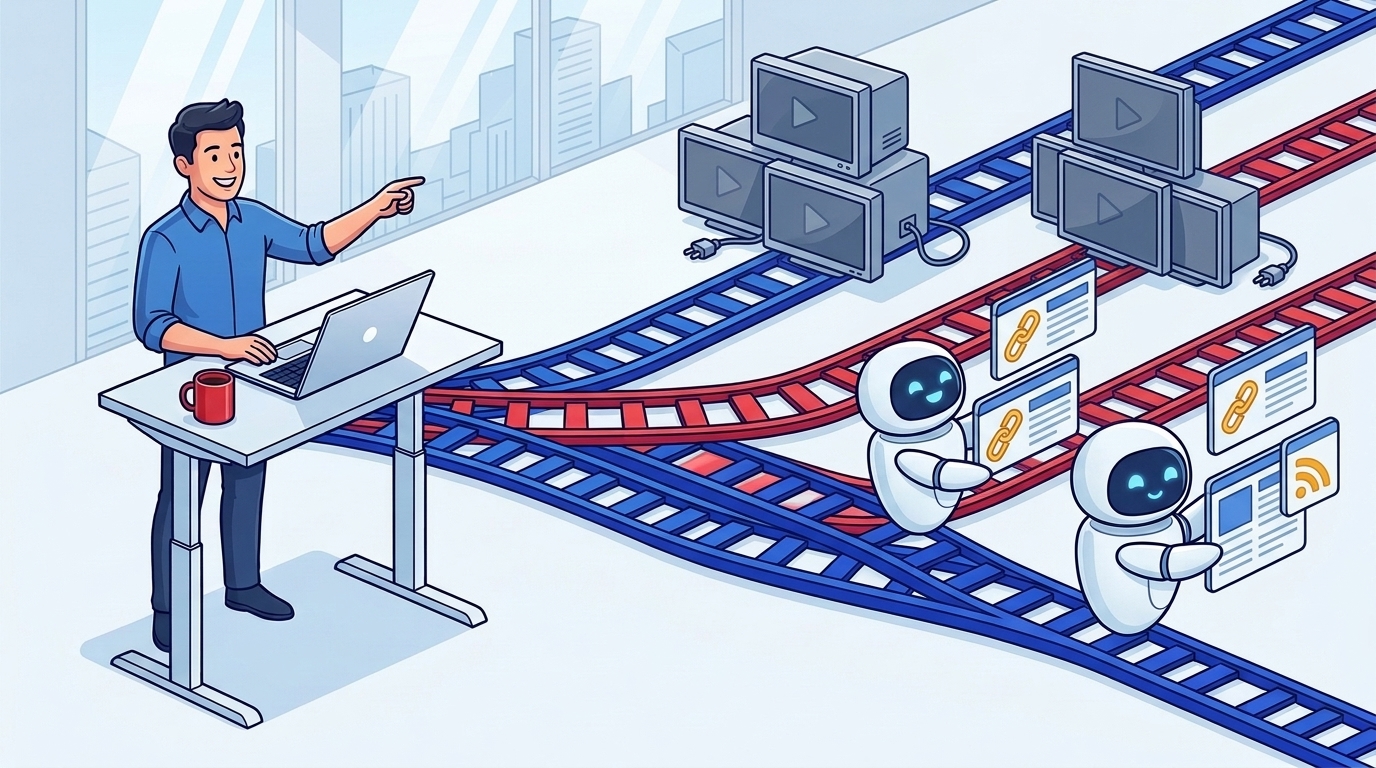
One of my favorite web authors, Ryan Broderick, who I read religiously, dropped another one of his truth bombs today in Garbage Day, decrying the continued decimation of text-based content that once defined the web, only to see it morph into something that is video first, or as he says "officially TV now". As we've observed over the last two-plus decades, Web behavior has rotated from newsgroups and reading full text articles, following links across the web, to short-form video consumption and Netflix-style episodic bingeing, with powerful algorithms suggesting you keep watching -- with sleep as the natural enemy.
Like I've said recently, you can't force old habits on new people who have been raised in a world of infinite bandwidth and infinite choice any more than you can ask kids to turn off the cartoons or put down the YouTube and pick up a newspaper. In today's post, Ryan calls time on the old "internet of libraries, replaced by an "internet of televisions", where, as he puts it, no one is famous, everyone is a celebrity on rented terms, and getting real traction with written words gets harder by the month -- made even more real as the hub and spoke model of RSS readers and centralized discovery lost momentum each year in favor of chasing ephemeral likes and practically non-monetizable "views", whose definition changes regularly to suit the platform.
Just a few weeks ago, I highlighted Garbage Day when saying how filtertainment eviscerated our informed monoculture. Every leap in bandwidth eventually fills the container you give it. We marched from static text sites passed around via links and email, to real-time social streams, to pocket screens pumping high-definition video straight into our earbuds. Not that this really comes as a surprise. In 2010, I warned about accelerating information streams on connected devices with "no off button, ever." When you give a tired population a choice between demanding prose and effortless video dopamine, the couch wins almost every night.
Video winning the mass-market feed isn't a mystery, if that's the market you want.
What breaks the open web for writers is a simpler mechanical truth: television has no blue links. When someone leans back into an algorithmic Reel, a video podcast on YouTube, or a zero-click chatbot answer, there is no natural exit ramp carrying a curious mind three hops deeper to an unfamiliar blog. I traced the roots of this choke point back in 2018, examining how a decade of silos throttled open content distribution and left the web linking less and talking more.
Publishing has always rested on creation, discovery, and distribution. Once Google Reader, FriendFeed, Digg, and Technorati disappeared, dominant platforms stopped acting as filtered pass-throughs. They actively throttled outbound URLs to hoard watch time, training creators to perform natively inside the silo for instant feedback while an essay on your own domain sat waiting for visitors who never arrived.
Waiting around for algorithmic cable boxes to hand text writers organic reach is a losing game. If the giant social apps want to be television, those of us who still think, build, and connect through reading have to wire up our own switchboard again. That conviction is why I built Webnerd.ai, which I introduced last month as a personal project that has no expectations of millions of users, but rejuvenates that feeling of discovery and sharing.
Do your part by cutting out the broadcast middleman: subscribe directly to blogs, personal newsletter inboxes, feeds and publications in folders you control, backed by practical AI summaries and stream audio that save time while still sending clicks straight to the original author.
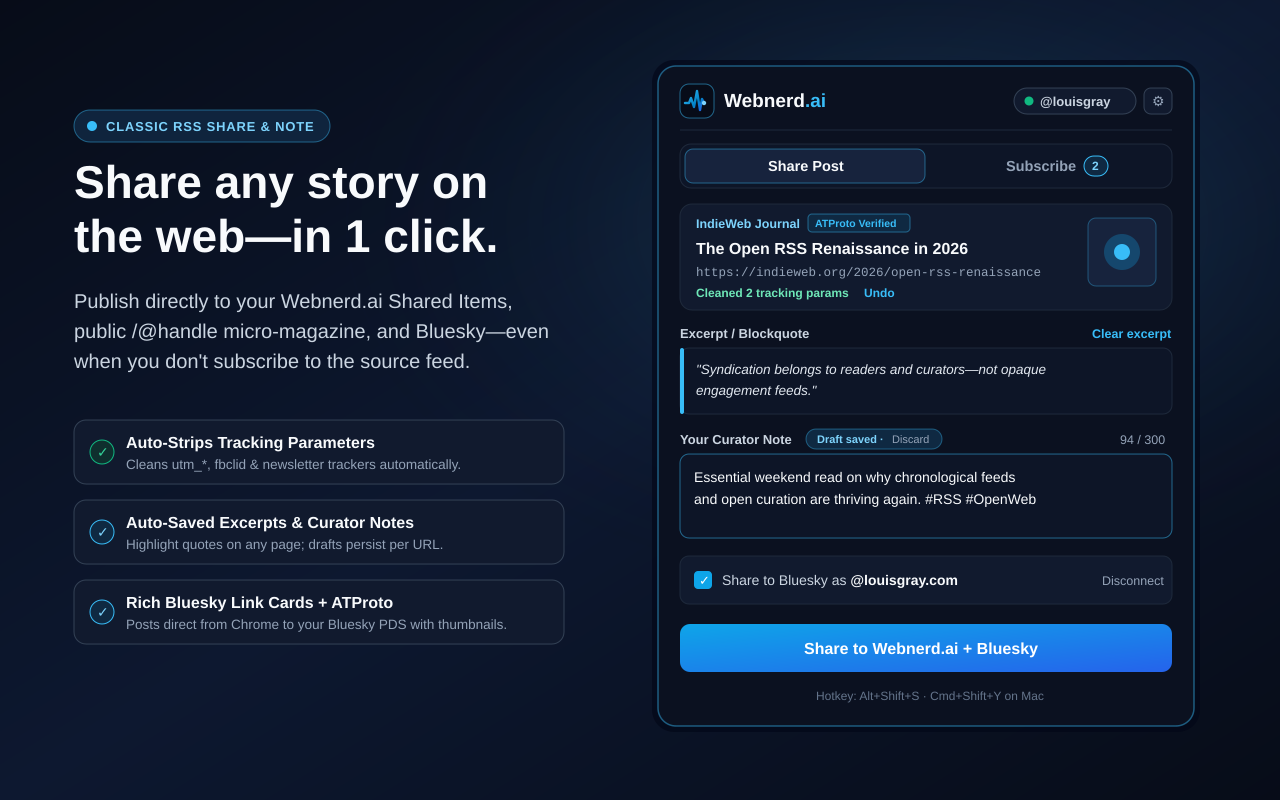
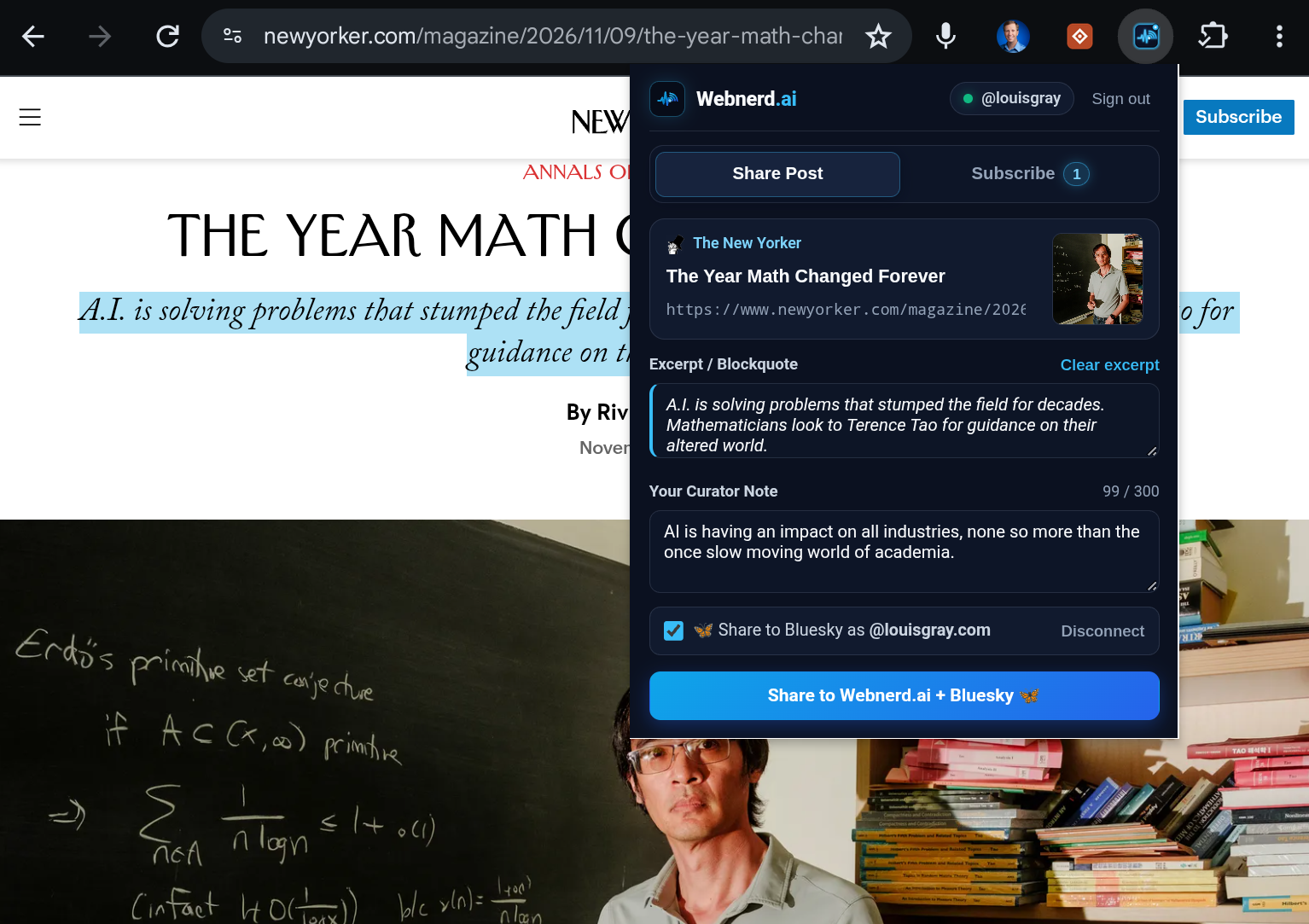
Even more important is solving the traction gap where open-web discovery always worked best -- from person to person. Algorithms optimize for passive session length, while human readers vouch for voices worth keeping. Curated starter bundles help newcomers find active blogs on day one, while one-click sharing inside the app or right from the browser toolbar with the Webnerd.ai Chrome Extension turns every reader into a distribution node. When I flag a great piece, it lands on my public shared stream, cross-posts to Bluesky, and feeds its own subscribable RSS stream, keeping those blue underlines traveling across the open web.
Broadcast TV never killed books or independent magazines, and Instagram's binge button won't kill sharp writing either. Let the big platforms fight over the living room. The library is still open -- we just have to pass the good reads around ourselves.
Disclosures, per always: I work at Google and use Gemini and Antigravity tools a lot. I built Webnerd.ai, its Chrome Extension, and this blog's CMS with Antigravity's help. Nobody at Google reviews my posts, ever.

The Web content model consists of three major parts: creation, discovery and distribution. The last decade-plus has seen tremendous turbulence as one-time hubs came and went, and content creators lost a grip on how their content could be consumed and shared easily from both dedicated fans and casual visitors. Couple that with shorter attention spans and all matter of marketing hacks that have distracted core audiences, and it's a tough slog out there for journalists and bloggers.
One of the motions I've missed in our consumption and flow has been the fast option to share and subscribe as I encounter the best content on the web. So I've built a Chrome extension for Webnerd.ai that has three major functions:
1. Subscribe to new sources and add them to your folders as you browse.
2. Add individual items to your shares in Webnerd.ai, even without subscribing.
3. Share directly to Bluesky, with optional caption.
Starting today, Webnerd.ai Share & Subscribe is officially public on the Chrome Web Store, working across Chrome and other modern browsers, such as Brave, Arc, Vivaldi, and Edge.

Back in our Web 2.0 peak, I had bookmarklets for Google Reader and FriendFeed as mainstays in my browser and I could see top stories spread from person to person. The act of sharing content helps expose great new sources to my network, and in turn, I learn from them.
Here are some benefits of the Webnerd.ai extension:
One click publishes the story directly to your Webnerd.ai Shared Items, your personal curated stream (like mine at @louis-gray), and its accompanying RSS feed.
The extension is tuned for fast link-blogging while you read, including:
utm_*, fbclid, gclid, and newsletter tracking tokens get scrubbed automatically before you share.site.standard.graph.recommend endorsements via AT Protocol OAuth 2.1.

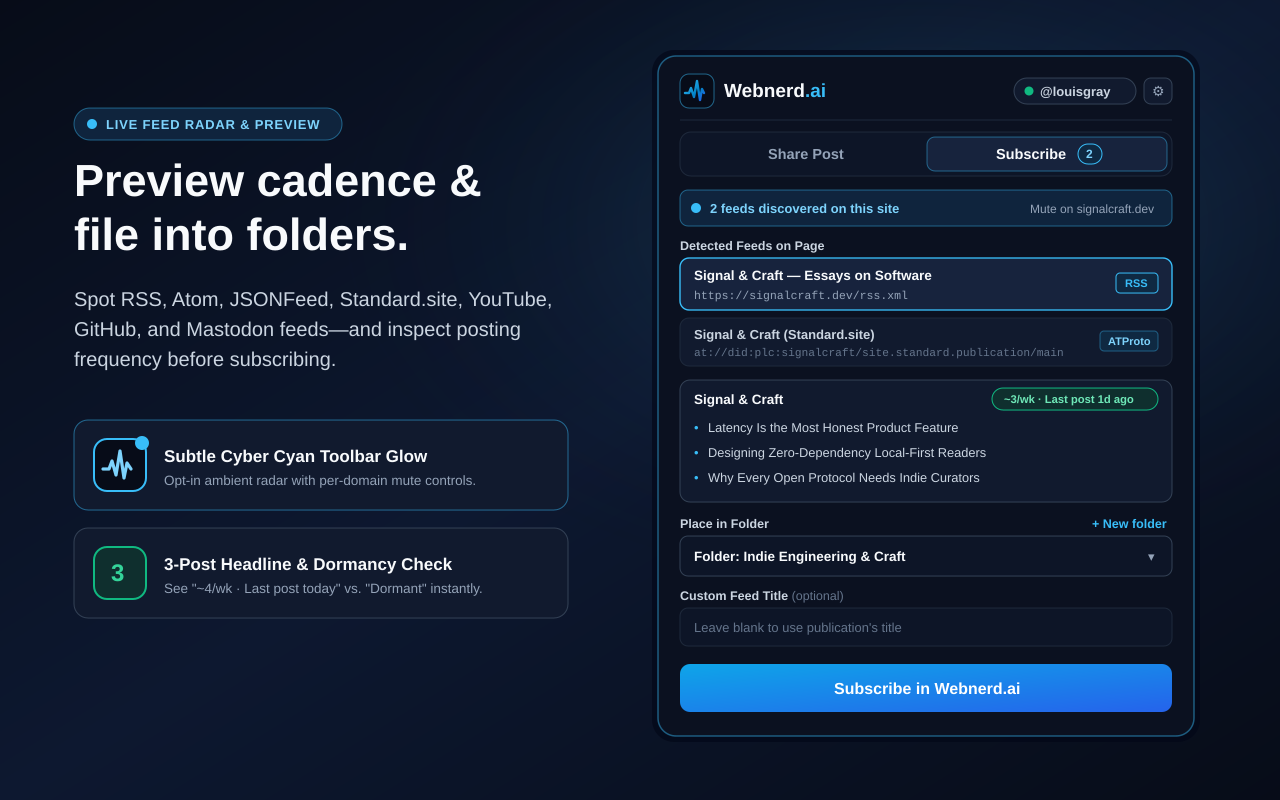
Spot hidden feeds with an optional glow, check the posting cadence, and add as you go.
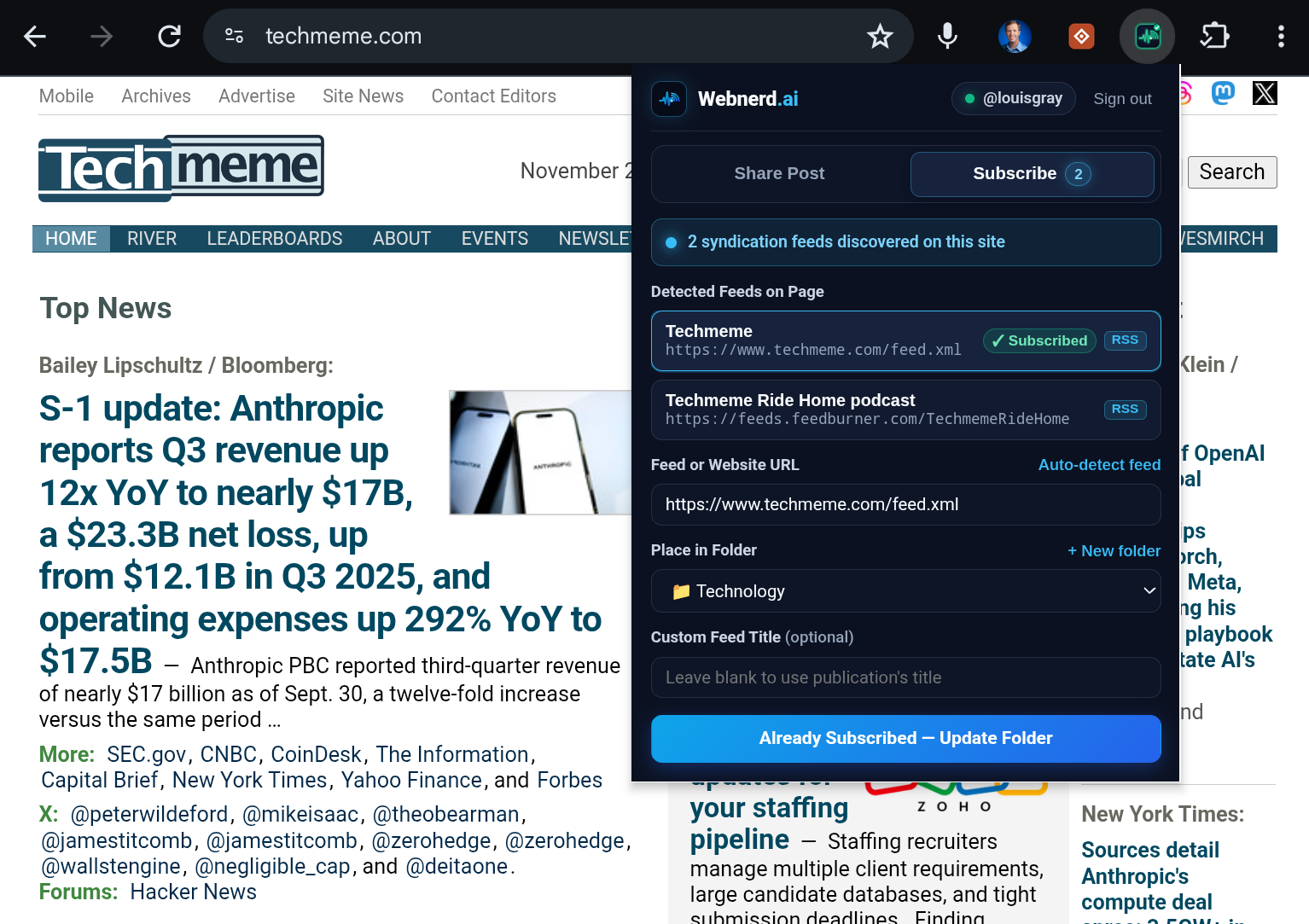
Modern browsers stripped the orange RSS icon out of the address bar years ago, indicating millions of readers that feeds died when they were actually hiding in plain sight. Turn on the extension's opt-in Toolbar Glow and the toolbar icon gently illuminates whenever a page publishes RSS, Atom, JSONFeed, or AT Protocol Standard.site publications -- including subscribable channels and profiles across Substack, Medium, YouTube, GitHub, Mastodon, Bluesky, and Reddit.
And if you are worried you're going to subscribe to a site that posts way too often, you can previews a feed's latest three headlines alongside an instant cadence check, so you know right away if a blog is active. From there, file the writer directly into any of your existing Webnerd.ai folders or spin up a new folder inline.

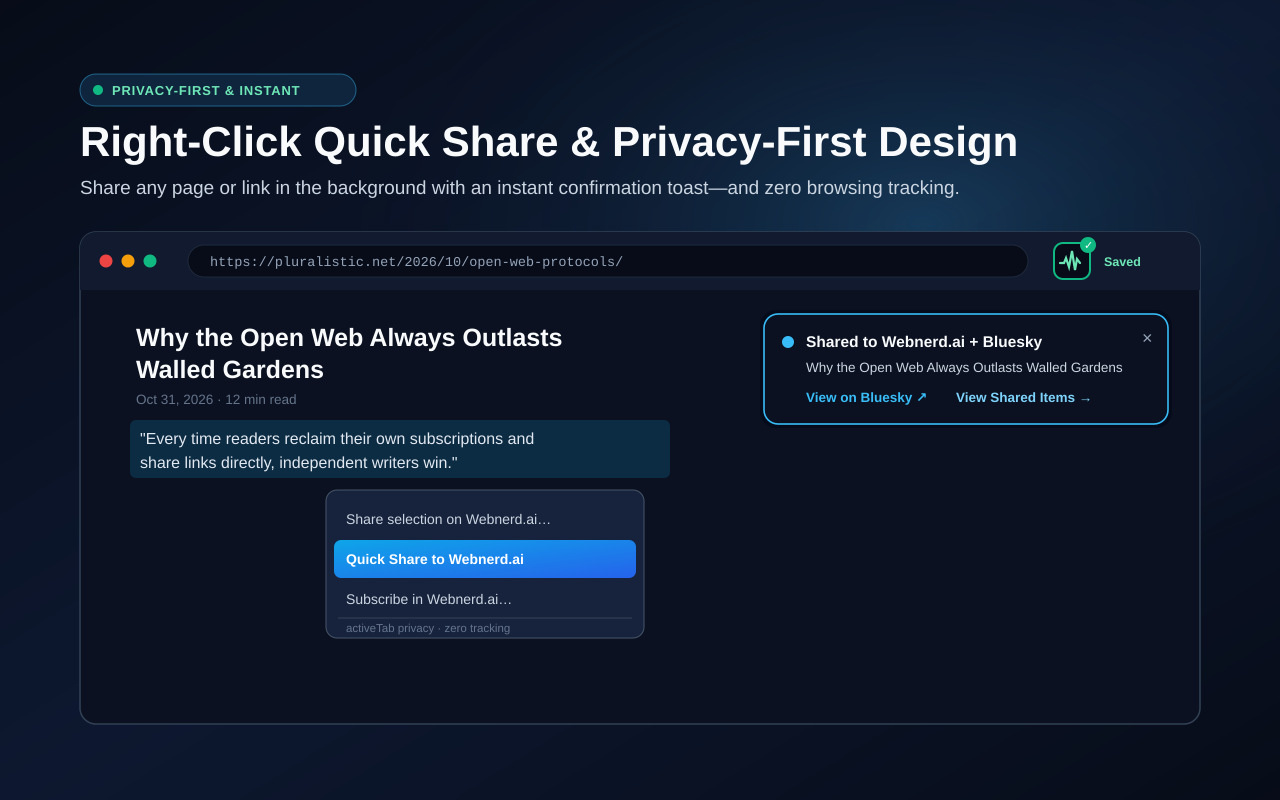
Right-click any page, quote, or link to Quick Share in the background with zero browsing tracking.
When you're moving fast, right-click any page, highlighted quote, or outbound link and hit Quick Share to Webnerd.ai. It publishes in the background and pops a clean confirmation toast in the corner of the page with direct links to view your post on Bluesky or in Shared Items.
Just as important is what the extension refuses to do. Too many browser add-ons demand blanket access to read every page you visit around the clock. I couldn't care less about your browsing history. Out of the box, Webnerd.ai runs on minimal activeTab permissions -- zero background tracking of your browsing activity -- only inspecting the current tab when you click the icon, tap the hotkey, or trigger the context menu (unless you explicitly opt into the ambient Feed Radar glow).
install Webnerd.ai Share & Subscribe from the Chrome Web Store, pin the pulse icon to your toolbar, and tap 1-Click Pair over at webnerd.ai/extension to connect your existing Webnerd.ai session. Give it a spin on your open tabs today and ping me on Bluesky with what you want to see next -- the native Android app is up next.
Every few years, Silicon Valley decides traditional reporters just don't get it and builds a friendlier stage of its own. The latest flashpoint is Andrew Fedorov's look in The San Francisco Standard at Colossus, the latest venture-backed pub featuring adoring profiles of Mark Zuckerberg and other tech leaders. Kara Swisher compared the magazine to "Vaseline mirrors" for fragile executives, while Nilay Patel of The Verge quipped that the tech bubble is welcome to its own "in-flight magazine." First of all, I've never heard of it. Sometimes it's good to be in my focused bubble. But it's all going to be okay.
Back in 2009, I wrote that bloggers and PR aren't automatic enemies when everyone understands the transaction, and during the 2011 spat around over investor-backed tech blogs, I said being genuine is the best disclosure of them all. Insiders who fund companies will typically understand how those businesses operate better than outsiders do, and content marketing can be valuable if it gets a story that couldn't have gotten out otherwise, so long as it owns its perspective. It's the final stage of access journalism, for better or worse.
Readers aren't fooled by what they see. Just like our debates around AI-generated content or if ads have value, they know what promotional content smells like. Where this fluffery actually causes damage is inside the corner office itself - reinforcing these execs' hot takes that they lack any issues. Last month, I wrote about how filtertainment eviscerated our informed monoculture, letting every slice of society retreat into comfortable spaces populated entirely by people who agree with them. Founders and billionaires are just as vulnerable to that comfort loop as anyone scrolling apps on their couch.
The best Silicon Valley products get better because they survive contact with skeptics and users. Tough questions from beat reporters, teardowns on independent blogs, and grumpy user threads expose blind spots that boardroom peers don't dare to say - lose the fast track to shares or other privileges. When leaders trade that messy friction for curated profiles that treat every strategic pivot like destiny, they quietly dull their own product instincts. Even my own new Webnerd.ai app has already benefitted from user feedback or bugs that got through my queue.
Print a shiny mag if you want to leave it on the coffee table in the lobby or frame it on your wall. Enjoy the friendly banter that comes from knowing no gotcha questions are coming your way. But don't forget the purpose of an in-flight magazine: keep the passengers relaxed at thirty thousand feet while somebody else checks the instruments. The trouble starts the moment the pilot starts using it as a navigation chart.
Disclosures per always: I have always appreciated Kara. What. You wanted more disclosures?