Silicon Valley Technology Commentary & Archives · Est. 2006 3,046 Posts · 2006–2026
Showing posts with label AI (3 posts). Show all posts

November 11, 2026

November 11, 2026 · 3 MIN READ · BY LOUIS GRAY

When Code Is Cheap, Product Vision Gets More Valuable

When Code Is Cheap, Product Vision Gets More Valuable

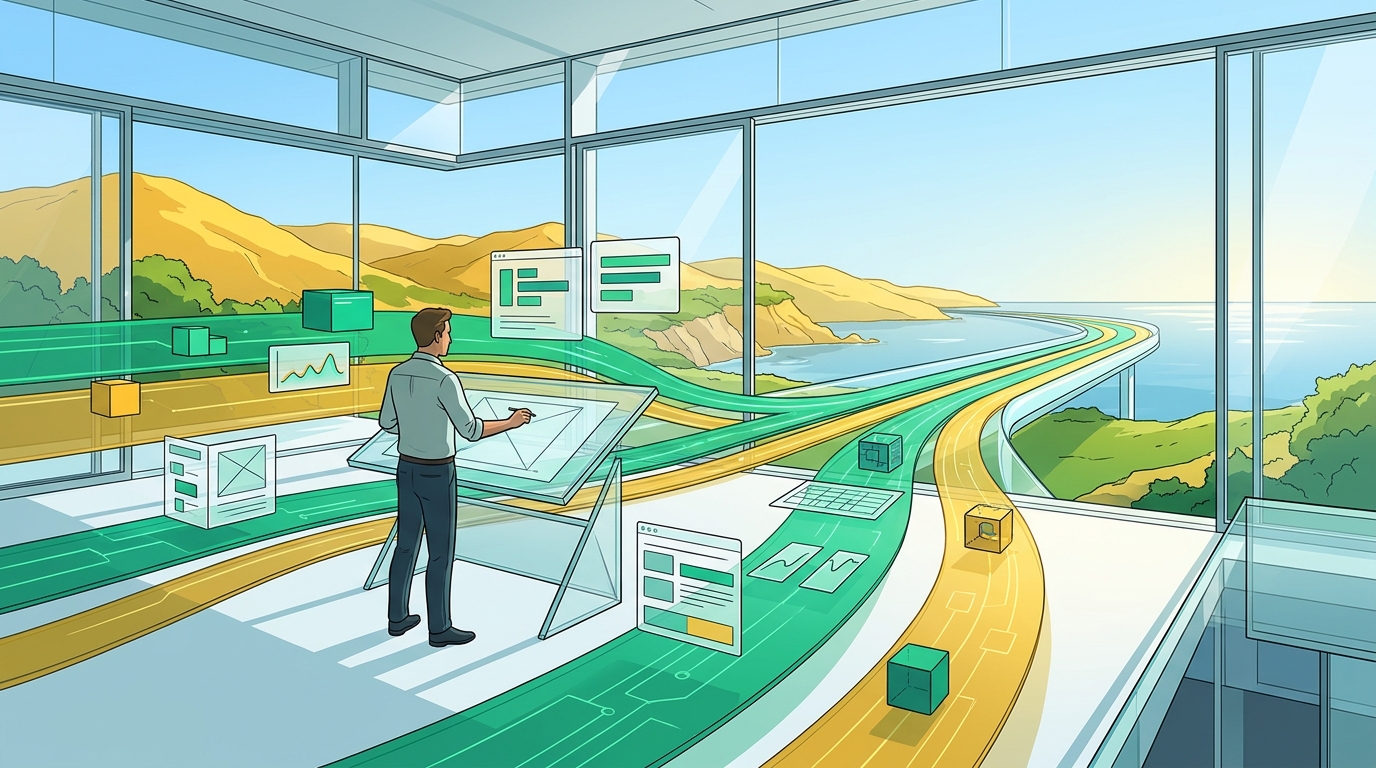
Conducting the product lanes in a sunlit studio [Image via Gemini]
Product vision is as valuable as coding excellence [Image via Gemini]

When Code Is Cheap, Product Vision Wins the Hiring Market

As long as I've been in Silicon Valley, engineers have been king. The most sought after, and highest paying, roles have gone to the code orchestrators with the highest talent, who have been able to turn ideas into reality. Expertise could be claimed due to the number of coding languages they knew, and effort could be arbitrarily counted by the number of lines of code, with only its complexity up for debate. The most flexible and most capable engineers have deftly adjusted their expertise to meet the industry's latest demand, from dedicated apps for the top operating systems at the time, to mobile applications, social network tools, ride sharing apps, autonomous driving, crypto, or whatever business fad or innovation has driven the newest industry.

But now we're in an odd spot. Many of the software engineers I know and have worked with for years are telling me they scarcely code at all, with AI-assisted coding (vibe coding if you must call it that) making it possible for them to tell agents what to do and how to build at unprecedented scale. Meanwhile, recent college graduates sporting computer science degrees are finding entry level opportunities have practically disappeared.

Every technology shift has downstream impact, and the seismic shift toward AI-driven tooling means the roles in demand in this new world have evolved. Lenny Rachitsky's breakdown of the tech job market puts hard numbers behind a shift many of us have seen with our own eyes or felt when looking at our in boxes and LinkedIn messages. Demand for traditional software engineers is plateauing, open mobile and front-end roles have been nearly cut in half, and now product managers are suddenly the ones seeing the biggest hiring surge. 

When I wrote about vibe coding acting as automatic transmission for apps last month, the takeaway wasn't that humans were obsolete, but that the mechanical act of shifting gears was no longer the bottleneck. If a coding agent can build out an app or deliver a mobile view in an afternoon, paying a premium for narrow implementation stops making sense. As Gergely Orosz pointed out in response to Lenny (see Techmeme), specialists who only know one slice of the stack are getting squeezed out in favor of generalists who can steer AI across the whole system.

There is no such thing as a sure thing in a turbulent time. Back in 2018, I looked at Silicon Valley's divergent career arcs and how quickly comfortable middle-tier roles can evaporate when the industry's priorities tilt. We are watching that exact thing play out today in real time.

Telling a machine what to build requires knowing what is actually worth building. If code generation gets cheap, product judgment becomes the scarce resource, which is why product managers and customer-facing builders are having a moment, living in the messy human problem space where no model can hallucinate real user empathy. As I argued in my October piece on human evolution in an AI revolution, the winners won't be the folks guarding the roles and tools of yesterday, but those who are flexible enough to see how the world is changing and be part of that movement themselves.

November 10, 2026

November 10, 2026 · 2 MIN READ · BY LOUIS GRAY

Can AI Deliver Bug Free Code?

Can AI Deliver Bug Free Code?


The bug verification desk is now unmanned. [Image via Gemini]

Can AI Deliver Bug Free Code?All software has bugs. It has always been that way, and much of the recent discussion around AI's impact on software engineering has been about unveiling security holes that plague popular software and may have sat for years -- hardly the setup for promising complete code verification.

I saw the headlines around DeepMind's AlphaProof Code announcement this morning, saying they confirmed Signal's security protocol to be solid, and initially glanced past it, as someone who typically doesn't use Signal. But the post has ignited a foundational discussion about how software will be built and verified going forward in the usual places, including Hacker News, which has zeroed in on a major turning point: moving from classic test-driven development to automated, machine-driven formal proof generation.

The reaction across the developer community spans healthy skepticism to long-term optimism, mirroring a lot of what we've seen in response to AI advancements, ranging from disdain and disbelief to  nodding acceptance. But zero bugs? If AlphaProof Code looked at my code and found no errors, I'd assume the verification itself was flawed. That'd be as impossible as sending one of my draft blog posts to an editor and being told it was perfect.

More broadly, AI systems can now be used to verify human-written libraries, and neural models can now write top quality code, taking the spot we've reserved for decades for well trained and well paid humans.

This shift connects directly to what I explored in Vibe Coding: Automatic Transmission for Apps, where higher abstractions free engineers from manual routine mechanics to focus on high-level architecture. It also reinforces the broader reality I wrote about in An AI Tech Revolution? The Solution: Human Evolution. Technology shifts require human adaptation rather than passive observation. As automated verifiers mature, running unverified raw code on production networks may soon be as outdated as leaving my index directories open with r-w-x (read, write, execute for you non-nerds) to the whole web.

Bug free or not on the first try, we are seeing AI do more. AI is writing, reading, coding and now debugging. I'm betting that even if this pass manages to come back with zero known issues, the definition of what is a bug and what is not will change. 

Disclosures, per always: I work at Google and use Gemini and Antigravity tools a lot. DeepMind is a huge part of Google's AI effort and behind AlphaProof. Nobody at Google reviews my posts, ever.

November 09, 2026

November 09, 2026 · 4 MIN READ · BY LOUIS GRAY

The Internet Turned Into TV, but Television Has No Blue Links

The Internet Turned Into TV, but Television Has No Blue Links

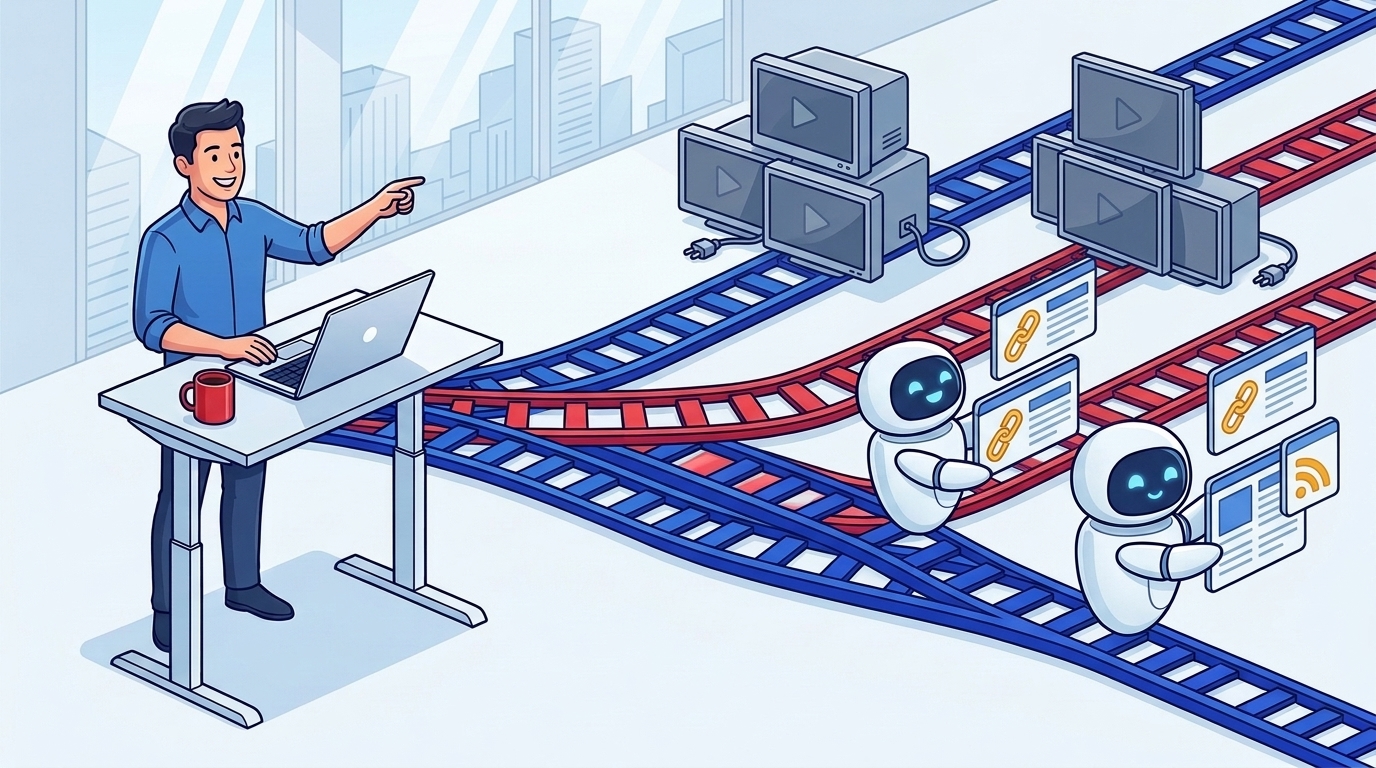
Routing blue links past unplugged TVs [Image via Gemini]

One of my favorite web authors, Ryan Broderick, who I read religiously, dropped another one of his truth bombs today in Garbage Day, decrying the continued decimation of text-based content that once defined the web, only to see it morph into something that is video first, or as he says "officially TV now". As we've observed over the last two-plus decades, Web behavior has rotated from newsgroups and reading full text articles, following links across the web, to short-form video consumption and Netflix-style episodic bingeing, with powerful algorithms suggesting you keep watching -- with sleep as the natural enemy.

Like I've said recently, you can't force old habits on new people who have been raised in a world of infinite bandwidth and infinite choice any more than you can ask kids to turn off the cartoons or put down the YouTube and pick up a newspaper. In today's post, Ryan calls time on the old "internet of libraries, replaced by an "internet of televisions", where, as he puts it, no one is famous, everyone is a celebrity on rented terms, and getting real traction with written words gets harder by the month -- made even more real as the hub and spoke model of RSS readers and centralized discovery lost momentum each year in favor of chasing ephemeral likes and practically non-monetizable "views", whose definition changes regularly to suit the platform.

Just a few weeks ago, I highlighted Garbage Day when saying how filtertainment eviscerated our informed monoculture. Every leap in bandwidth eventually fills the container you give it. We marched from static text sites passed around via links and email, to real-time social streams, to pocket screens pumping high-definition video straight into our earbuds. Not that this really comes as a surprise. In 2010, I warned about accelerating information streams on connected devices with "no off button, ever." When you give a tired population a choice between demanding prose and effortless video dopamine, the couch wins almost every night.

Video winning the mass-market feed isn't a mystery, if that's the market you want.

What breaks the open web for writers is a simpler mechanical truth: television has no blue links. When someone leans back into an algorithmic Reel, a video podcast on YouTube, or a zero-click chatbot answer, there is no natural exit ramp carrying a curious mind three hops deeper to an unfamiliar blog. I traced the roots of this choke point back in 2018, examining how a decade of silos throttled open content distribution and left the web linking less and talking more.

Publishing has always rested on creation, discovery, and distribution. Once Google Reader, FriendFeed, Digg, and Technorati disappeared, dominant platforms stopped acting as filtered pass-throughs. They actively throttled outbound URLs to hoard watch time, training creators to perform natively inside the silo for instant feedback while an essay on your own domain sat waiting for visitors who never arrived.

Waiting around for algorithmic cable boxes to hand text writers organic reach is a losing game. If the giant social apps want to be television, those of us who still think, build, and connect through reading have to wire up our own switchboard again. That conviction is why I built Webnerd.ai, which I introduced last month as a personal project that has no expectations of millions of users, but rejuvenates that feeling of discovery and sharing.

Do your part by cutting out the broadcast middleman: subscribe directly to blogs, personal newsletter inboxes, feeds and publications in folders you control, backed by practical AI summaries and stream audio that save time while still sending clicks straight to the original author.

Even more important is solving the traction gap where open-web discovery always worked best -- from person to person. Algorithms optimize for passive session length, while human readers vouch for voices worth keeping. Curated starter bundles help newcomers find active blogs on day one, while one-click sharing inside the app or right from the browser toolbar with the Webnerd.ai Chrome Extension turns every reader into a distribution node. When I flag a great piece, it lands on my public shared stream, cross-posts to Bluesky, and feeds its own subscribable RSS stream, keeping those blue underlines traveling across the open web.

Broadcast TV never killed books or independent magazines, and Instagram's binge button won't kill sharp writing either. Let the big platforms fight over the living room. The library is still open -- we just have to pass the good reads around ourselves.

Disclosures, per always: I work at Google and use Gemini and Antigravity tools a lot. I built Webnerd.ai, its Chrome Extension, and this blog's CMS with Antigravity's help. Nobody at Google reviews my posts, ever.

November 08, 2026

November 08, 2026 · 3 MIN READ · BY LOUIS GRAY

Personal Finance is Evolving from ATMs to LLMs

Personal Finance is Evolving from ATMs to LLMs

claude mint option4 fresh studio angle 1794204983623
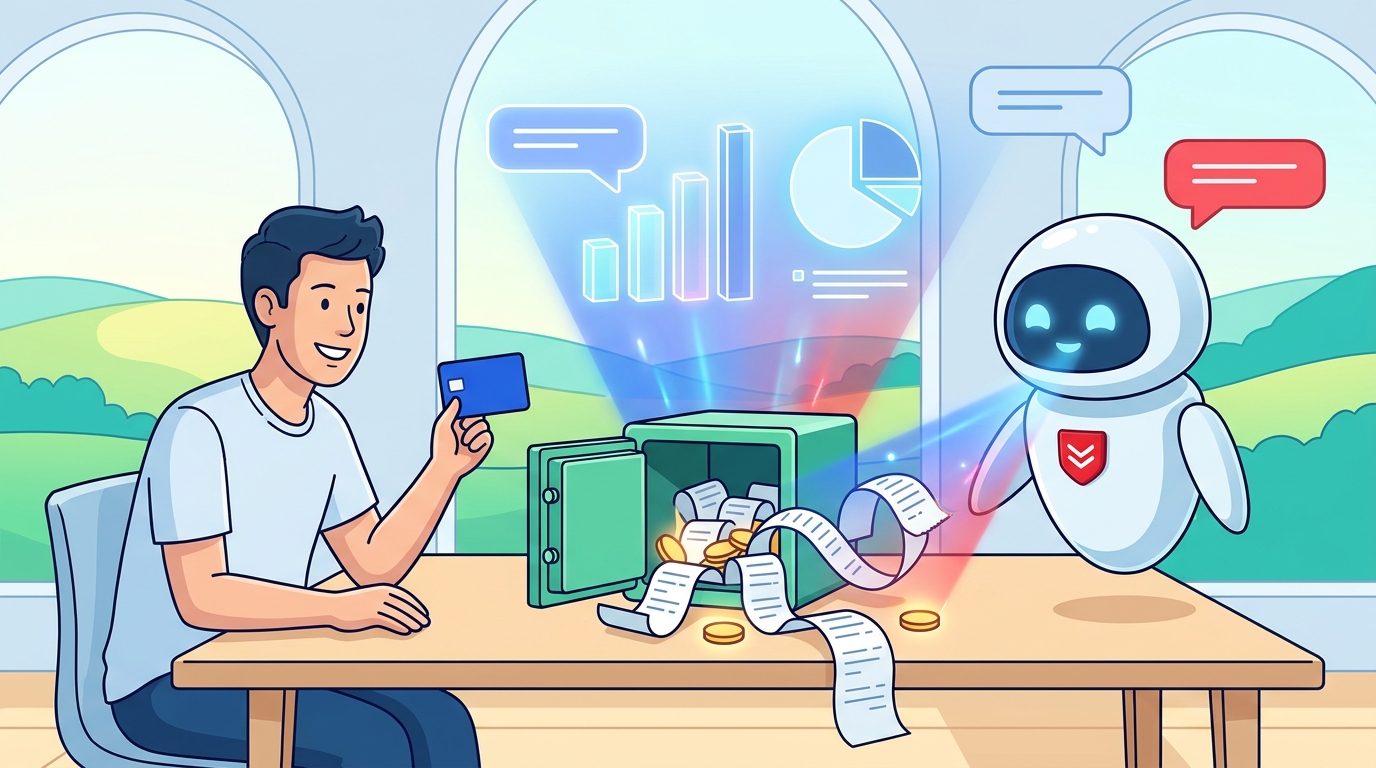
The world of finance will evolve. The LLMs are happy to help. [Image via Gemini] 

In the AI era, there's a great divide emerging between the old way and the new way, and practically no industry is more closely aligned with the "old way" with tried and trusted capabilities than that of finance, where security and history are king, integration of new technologies usually comes via massive consulting contracts, and everything had better be FDIC insured. The old way screams of buttoned up suit wearing ties on Wall Street, while we've seen newer generations try forge their own paths, through crypto, gaming through prediction markets or taking long-shot option bets popularized on forums like r/wallstreetbets.

Amidst this bifurcation, AI thinks it knows best. Anthropic  rolled out Personal Finance in Claude, as covered by ZDNET, enabling subscribers to wire their live bank, credit card, and investment accounts straight into a conversation window via Plaid, and helping users make sense of what to date has been a host of CSV exports or PDF extractions from antiquated institutions. Does this sound familiar? It should, only with some new wrinkles, for on the surface this feels like the rebirth of a product category Silicon Valley spent a decade abandoning.

Back in May 2008, when Mint first connected checking accounts, credit cards, and brokerage balances into a single one-stop financial hub, I signed up immediately. I remember amidst the financial crisis, how just six months later, Mint's math say my brutal weeks of portfolio losses and projected I would be bankrupt in sixty days. Luckily that didn't happen, even if it feels like it sometimes.

Later, in 2010, I defended trusting Mint and Blippy with my financial data because a unified ledger beat flying blind across ten separate logins. My early adoption of Mint and Blippy even led to CNN coverage about the "end of privacy," using me as a test case for someone who lived out loud online, even sharing otherwise mundane transactions.

Fast forward 15+ years, and large language models genuinely solve the formatting headaches that tripped up those early Web 2.0 dashboards. Letting Claude (or any other LLM, really) reason across messy Plaid feeds in plain English -- spotting quiet subscription creep, comparing grocery bills across quarters, or separating a one-off tax transfer from monthly burn -- is a much cleaner interface than clicking through static pie charts.

I've even built my own one-person financial app in Antigravity, which scoops up my bank account balances, daily stock swings, and reminders for mortgage and car payments. I can click this Progressive Web App I built for myself and see exactly where I am on the +/- for the day, and see if it's even worth getting out of bed. That we can code up ideas and turn them into reality for practically any task is a brand new world.

But finance earned its conservative reputation. What happens when we trade direct accounting for probabilistic interpretation? If Mint mislabeled a charge in 2008, the bad data sat right there in the table for you to fix.

If a chatbot summarizes six months of bank feeds, a skipped recurring fee or a fuzzed category total may hind behind confident, reassuring prose, and assure the end user all is well, only for the IRS to potentially disagree later. Your transaction ledger is the ultimate truth  about where you go, what you value, and what you can afford. Once frontier AI labs hold your live spending graph alongside your daily prompts, the chatbot becomes the stickiest lock-in in consumer tech. Read-only access is step one, but how soon will you ask your LLM to ask you which mutual funds to choose, trade on your behalf or even tell you what time is the right time to sell your house?

Disclosures per always: I work at Google. Anthropic and other other AI companies are often partners, competitors or customers. Don't interpret my interest as being filtered with that lens.

November 02, 2026

November 02, 2026 · 4 MIN READ · BY LOUIS GRAY

Webnerd.ai Chrome Extension Debuts to Subscribe and Share Faster

Webnerd.ai Chrome Extension Debuts to Subscribe and Share Faster

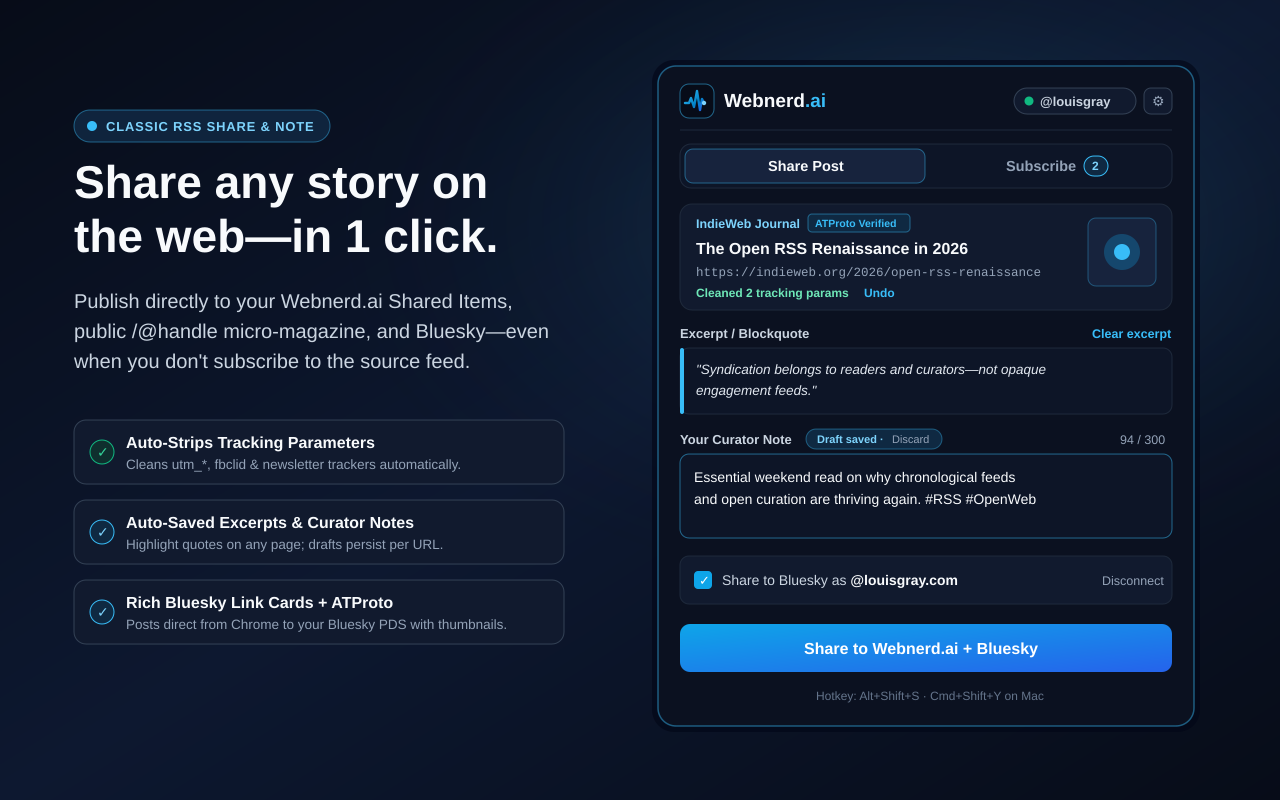
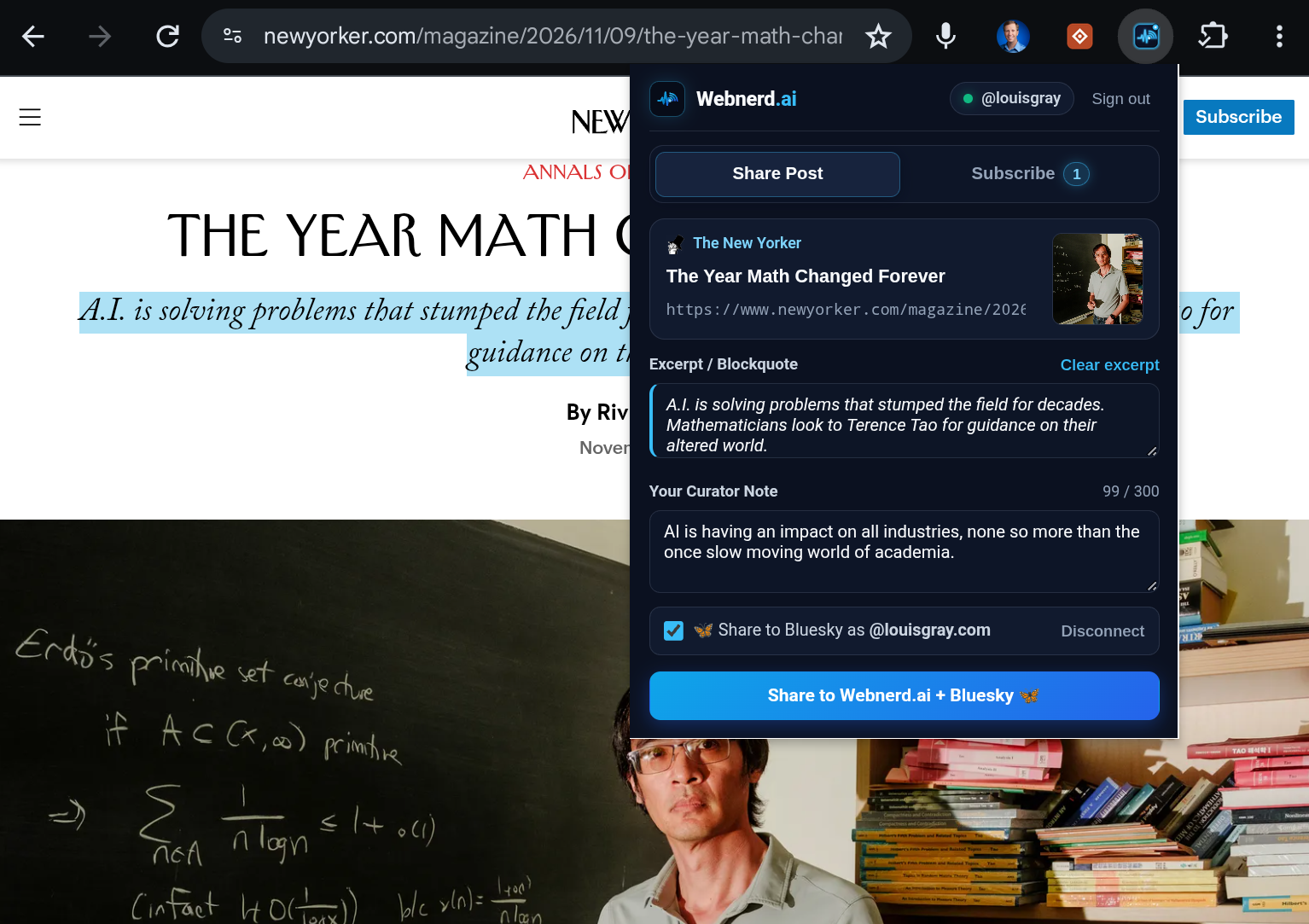
Webnerd.ai Chrome Extension Share Post tab showing cleaned URL parameters, highlighted blockquote excerpt, auto-saved curator note, and Bluesky cross-posting
Webnerd.ai Share & Subscribe -- live now in the Chrome Web Store.

Webnerd.ai Chrome Extension

The Web content model consists of three major parts: creation, discovery and distribution. The last decade-plus has seen tremendous turbulence as one-time hubs came and went, and content creators lost a grip on how their content could be consumed and shared easily from both dedicated fans and casual visitors. Couple that with shorter attention spans and all matter of marketing hacks that have distracted core audiences, and it's a tough slog out there for journalists and bloggers.

One of the motions I've missed in our consumption and flow has been the fast option to share and subscribe as I encounter the best content on the web. So I've built a Chrome extension for Webnerd.ai that has three major functions:

1. Subscribe to new sources and add them to your folders as you browse.
2. Add individual items to your shares in Webnerd.ai, even without subscribing.
3. Share directly to Bluesky, with optional caption.

Starting today, Webnerd.ai Share & Subscribe is officially public on the Chrome Web Store, working across Chrome and other modern browsers, such as Brave, Arc, Vivaldi, and Edge.

Screenshot 20261102 075333
With the Webnerd.ai Extension, discover available feeds and add them.

Back in our Web 2.0 peak, I had bookmarklets for Google Reader and FriendFeed as mainstays in my browser and I could see top stories spread from person to person. The act of sharing content helps expose great new sources to my network, and in turn, I learn from them.

Here are some benefits of the Webnerd.ai extension:

One click publishes the story directly to your Webnerd.ai Shared Items, your personal curated stream (like mine at @louis-gray), and its accompanying RSS feed.

The extension is tuned for fast link-blogging while you read, including:

  • Auto-Saved Quotes & Notes: Highlight any passage on the page before opening the extension and it drops right in as a clean blockquote.
  • Automatic Tracker Stripping: Marketing parameters like utm_*, fbclid, gclid, and newsletter tracking tokens get scrubbed automatically before you share.
  • Simultaneous Bluesky Cards & Standard.site Endorsements: Keep the Bluesky box checked to cross-post straight to your feed (such as my LG Stream) with rich OpenGraph link cards, compressed thumbnails, clickable hashtag facets, and cryptographic site.standard.graph.recommend endorsements via AT Protocol OAuth 2.1.
Screenshot 20261102 075508
You can share articles to Webnerd.ai or downstream, with comment.

Live Feed Radar, Cadence Previews, and One-Click Folders

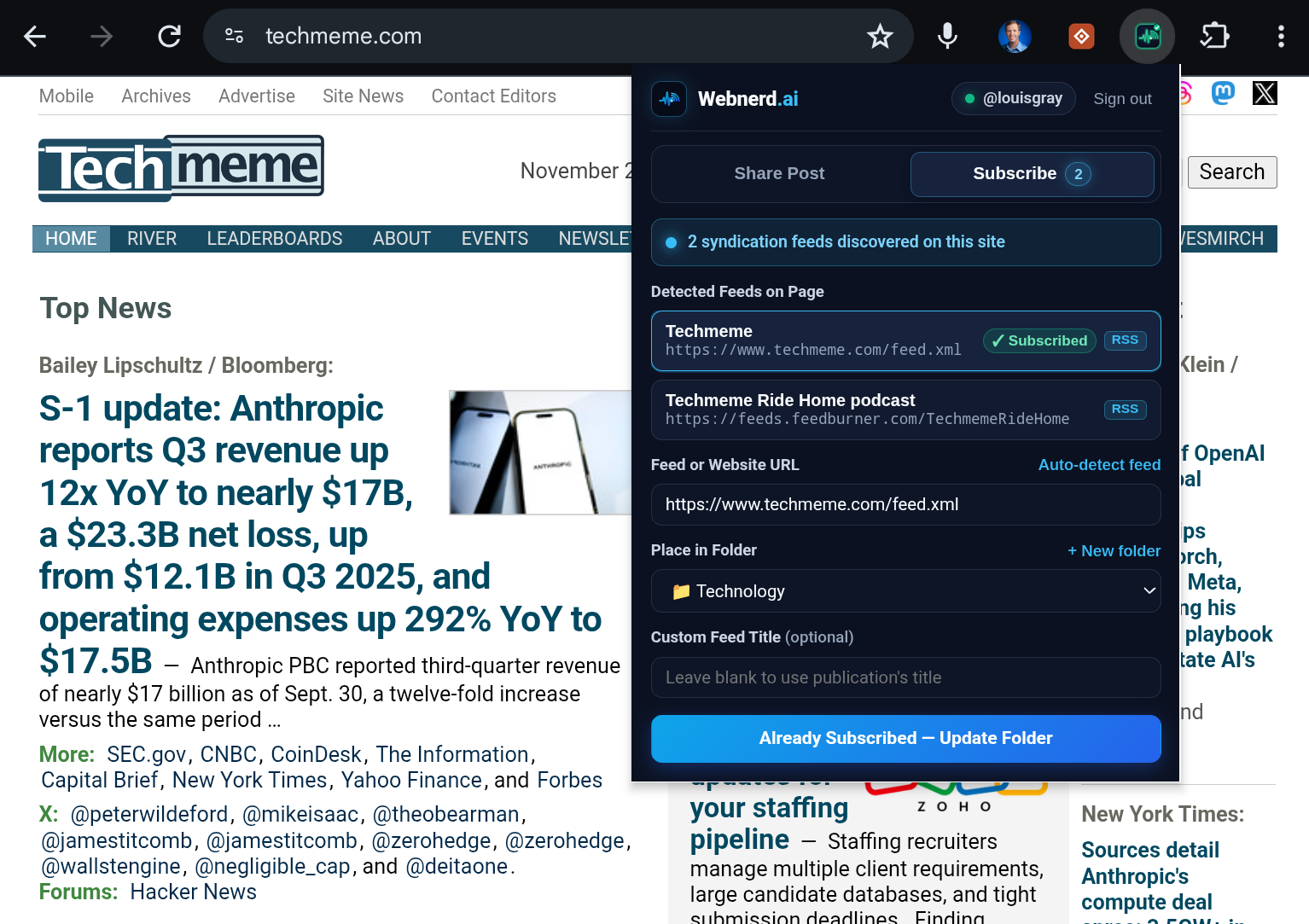
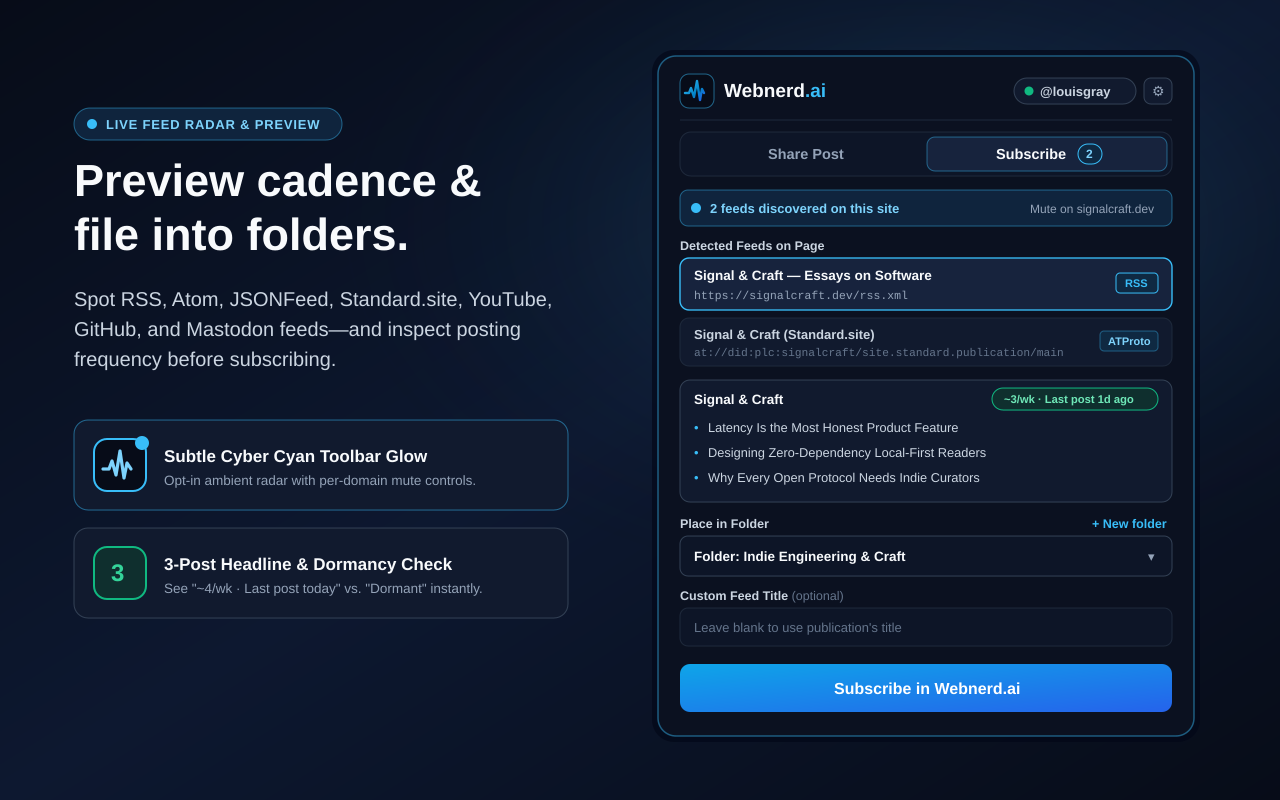
Webnerd.ai Chrome Extension Subscribe tab showing detected RSS and ATProto Standard.site feeds, a 3-post cadence preview, and folder selection
Spot hidden feeds with an optional glow, check the posting cadence, and add as you go.

Modern browsers stripped the orange RSS icon out of the address bar years ago, indicating millions of readers that feeds died when they were actually hiding in plain sight. Turn on the extension's opt-in Toolbar Glow  and the toolbar icon gently illuminates whenever a page publishes RSS, Atom, JSONFeed, or AT Protocol Standard.site publications -- including subscribable channels and profiles across Substack, Medium, YouTube, GitHub, Mastodon, Bluesky, and Reddit.

And if you are worried you're going to subscribe to a site that posts way too often, you can previews a feed's latest three headlines alongside an instant cadence check, so you know right away if a blog is active. From there, file the writer directly into any of your existing Webnerd.ai folders or spin up a new folder inline.

Right-Click Quick Share and Privacy-First Permissions

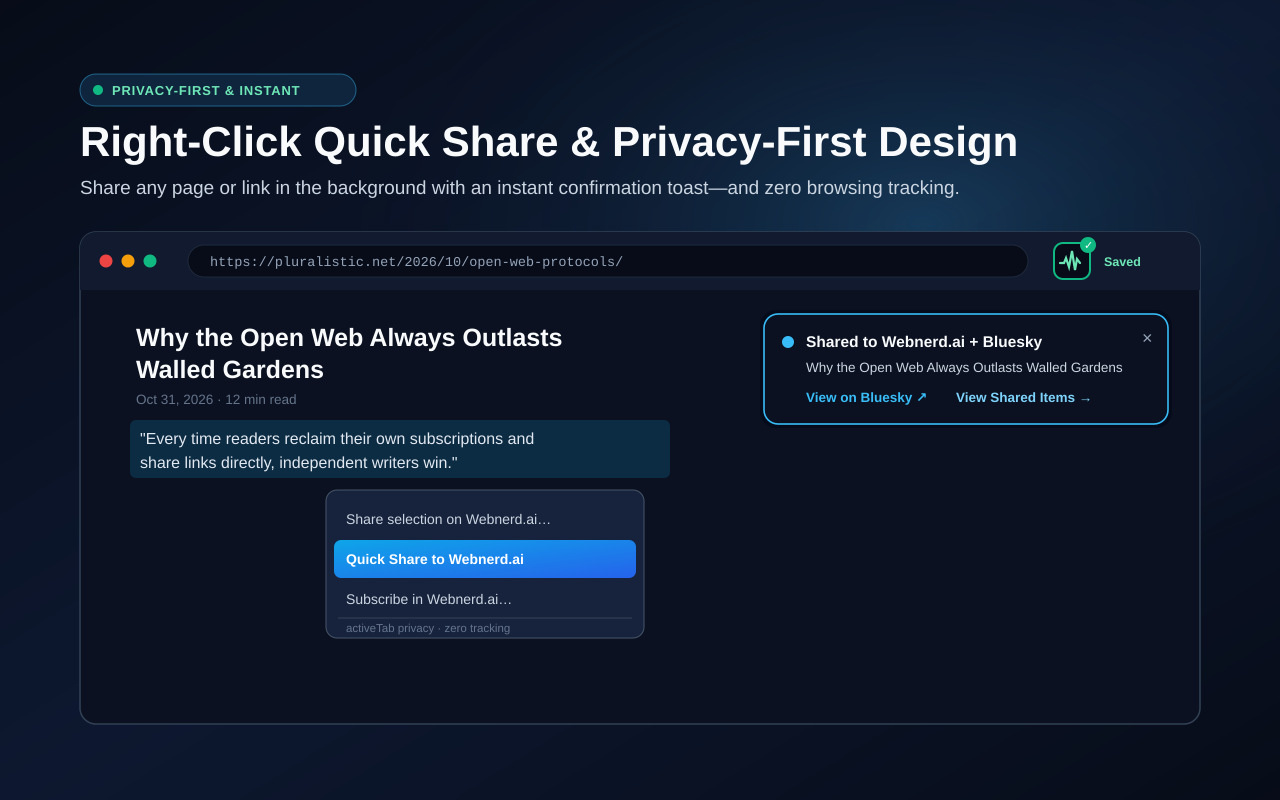
Browser view showing right-click Quick Share to Webnerd.ai context menu, activeTab zero-tracking notice, and on-page Shared to Webnerd.ai + Bluesky toast
Right-click any page, quote, or link to Quick Share in the background with zero browsing tracking.

When you're moving fast, right-click any page, highlighted quote, or outbound link and hit Quick Share to Webnerd.ai. It publishes in the background and pops a clean confirmation toast in the corner of the page with direct links to view your post on Bluesky or in Shared Items.

Just as important is what the extension refuses to do. Too many browser add-ons demand blanket access to read every page you visit around the clock. I couldn't care less about your browsing history. Out of the box, Webnerd.ai runs on minimal activeTab permissions -- zero background tracking of your browsing activity -- only inspecting the current tab when you click the icon, tap the hotkey, or trigger the context menu (unless you explicitly opt into the ambient Feed Radar glow).

install Webnerd.ai Share & Subscribe from the Chrome Web Store, pin the pulse icon to your toolbar, and tap 1-Click Pair over at webnerd.ai/extension to connect your existing Webnerd.ai session. Give it a spin on your open tabs today and ping me on Bluesky with what you want to see next -- the native Android app is up next.

Disclosures, per always: I work at Google and use Gemini and Antigravity tools a lot. I built Webnerd.ai, its Chrome Extension, and this blog's CMS with Antigravity's help. Nobody at Google reviews my posts, ever.

October 31, 2026

October 31, 2026 · 4 MIN READ · BY LOUIS GRAY

One Future: AI Writes, AI Scans, No Humans Read

One Future: AI Writes, AI Scans, No Humans Read

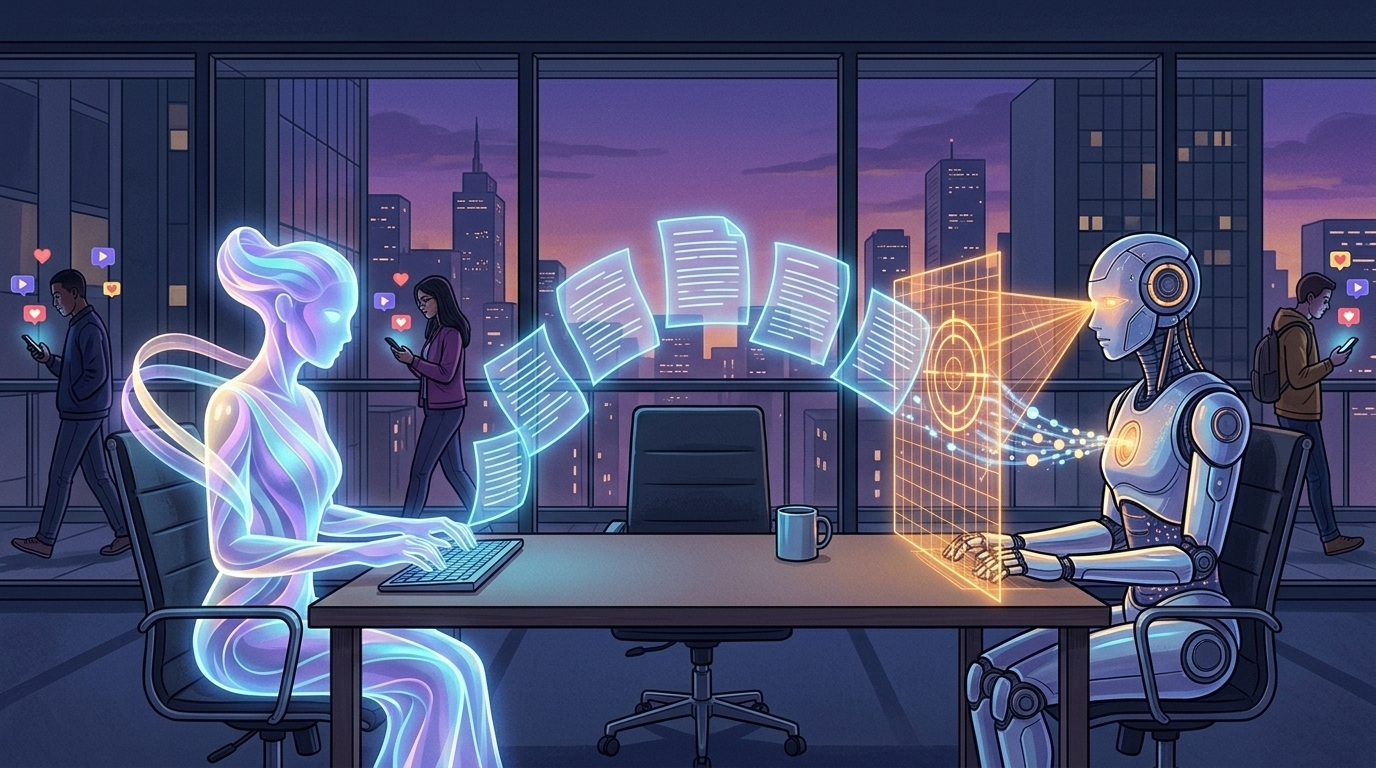
One Future: AI Writes, AI Scans, No Humans Read [Image via Gemini]
AI writes, AI scans, and the human chair stays empty. [Image via Gemini]

AI & Neural CoreWe're in a funny spot with AI at the moment. As people debate its value, with one side arguing it's the greatest invention since fire, all while the other calls anything it touches pure slop, AI is actively finding a foothold in evolving how business is done, in all facets. To claim otherwise is ignorant at this point.

Software is being written more quickly with AI. Security gaps are being both exploited and solved more quickly. All matter of communication is being authored and adjusted more quickly. As I said in my first post after multiple years' hiatus, we will need to find out the best place for AI and humans to coexist, and I truly believe the discussion of AI will eventually fade to the background, just like our flareups about social, mobile, local, and whatever transformative buzzword at the moment happened to be. This is not to undercut the actual value and impact of AI, but to optimistically suggest we as humans are great at adjusting.

Our eyes and our minds have been trained since the day we were born to understand what humanity looks like. Since we all first started to learn to read or watch TV, we have absorbed what it means to be "real", and we visibly react when something feels synthetic. We all have a visceral reaction when special effects seem too special, an ad seems too perfect, or a visual defies comprehension. Something feels "off". But as the models train and get better, learning through feedback and continuous reinforcement, their images and video get better, and so does their writing.

Techmeme is aflutter this weekend about a Bloomberg report that shows where we are in this particular cat and mouse game. As AI writing becomes more human, more humans can get outed for sounding too much like AI. The end result is predictable, with people intentionally making mistakes, and writing in a way that bots won't, so they don't get accused of shortcutting their work, or leaving the hard work to an LLM. If you think the bots can't adjust to make typos on their own, or to follow instructions to sound even more human so even the bots will fail the AI detection test, well, you haven't thought this through. Maybe you've even seen the viral posts that say Mary Shelley's novel Frankenstein would be considered full AI generated because the models themselves were trained on the book.

Since kicking off my first posts here two decades ago, I've had more than 3,000 posts and countless words hand typed into a myriad of open CMS windows. I've written buckets of emails or social posts and Slack messages all over the place. But I also know that in 2026, it might make sense to let the bot do a first draft, especially when it solves the blank page problem. What I do worry about, eventually, is if the AI is doing the writing, and the AI is doing the distilling and the summarizing, what if no actual humans consumed and fully took in the content? We are all very busy people, and if not, we all prefer to be seen as such, and we fill the edges of our time with things we'd rather be doing than reading text slop.

Running a script against your content to hide em dashes or add typos to seem fallible isn't going to automatically flip the lever that confirms you're a human and the AI is not. It takes an entire body of work, a corpus that no machine has, with a real personality that's adjusted through experience. 

Nearly twenty years ago, I wrote that your blog is your brand, and later, that blogging remains the foundation for who you are online. The latest generation has grown up with blogs being too slow, perhaps, with TikTok and Instagram being more visual quick hits of dopamine and long form being less valuable. Now Gen Z is approaching college and a daunting workforce where AI has always been expected and accepted, even as its place is evolving and being debated. Some of them are definitely writing their course papers with AI. Some aren't. But the reckoning won't come from somebody getting outed for asking ChatGPT, Claude or Gemini to be their scribe. It will come when everyone is distracted by something more exciting and nobody was reading anyway.

Disclosures per always: I work at Google and use our Gemini and Antigravity tools a lot. I wrote this post by hand. But how would you know?

October 29, 2026

October 29, 2026 · 7 MIN READ · BY LOUIS GRAY

Webnerd.ai Levels Up with AT Protocol, Newsletters, Audio and more

Webnerd.ai Levels Up with AT Protocol, Newsletters, Audio and more

Webnerd.ai

When I debuted Webnerd.ai last weekend, the goal was pretty straightforward: bring back the fast, high-signal, human-curated morning reading ritual I loved in the heyday of classic RSS, updated for how the open web actually works in 2026. But just as much as I've enjoyed returning to that routine,  I've appreciated steering the roadmap with Antigravity. A decade plus ago, I'd point to companies that blogged weekly with their updates and bug fixes as leaders in their space, communicating to readers what was new. Now, I can make multiple updates daily, or make fixes in minutes myself -- and have even debuted a release notes section you can subscribe to from right within the app. It's an RSS inception, basically.

Over the last few weeks of living inside Webnerd.ai whenever possible, curating my shared stream and pushing links out to LG Stream on Bluesky, every "I wish it did this" or "I wonder if it could..." moment has turned into working code rapidly. Sean Goedecke, whose blog has rapidly become one of my favorites of 2026, published a piece today titled "You can just ask AI to do things", and honestly, there is no better summary of the world we live in now. If you can think it, you can build it.

Because things have moved fast since the weekend, here is a quick highlight reel of new features in Webnerd.ai right now.

First-Class Open Identity: AT Protocol OAuth, PDS Sync, and Standard.site

If you're going to build a home for the open web, you shouldn't lock people's reading identity behind a single provider. Current employer aside, I started with Google sign-in because that's what I knew. But in fast response to public request,  Sign in with Google now sits side-by-side with native Sign in with AT Protocol. Whether you use a bsky.social address or verify with your own domain like louisgray.com, you can jump straight in without extra modals or app-password gymnastics.
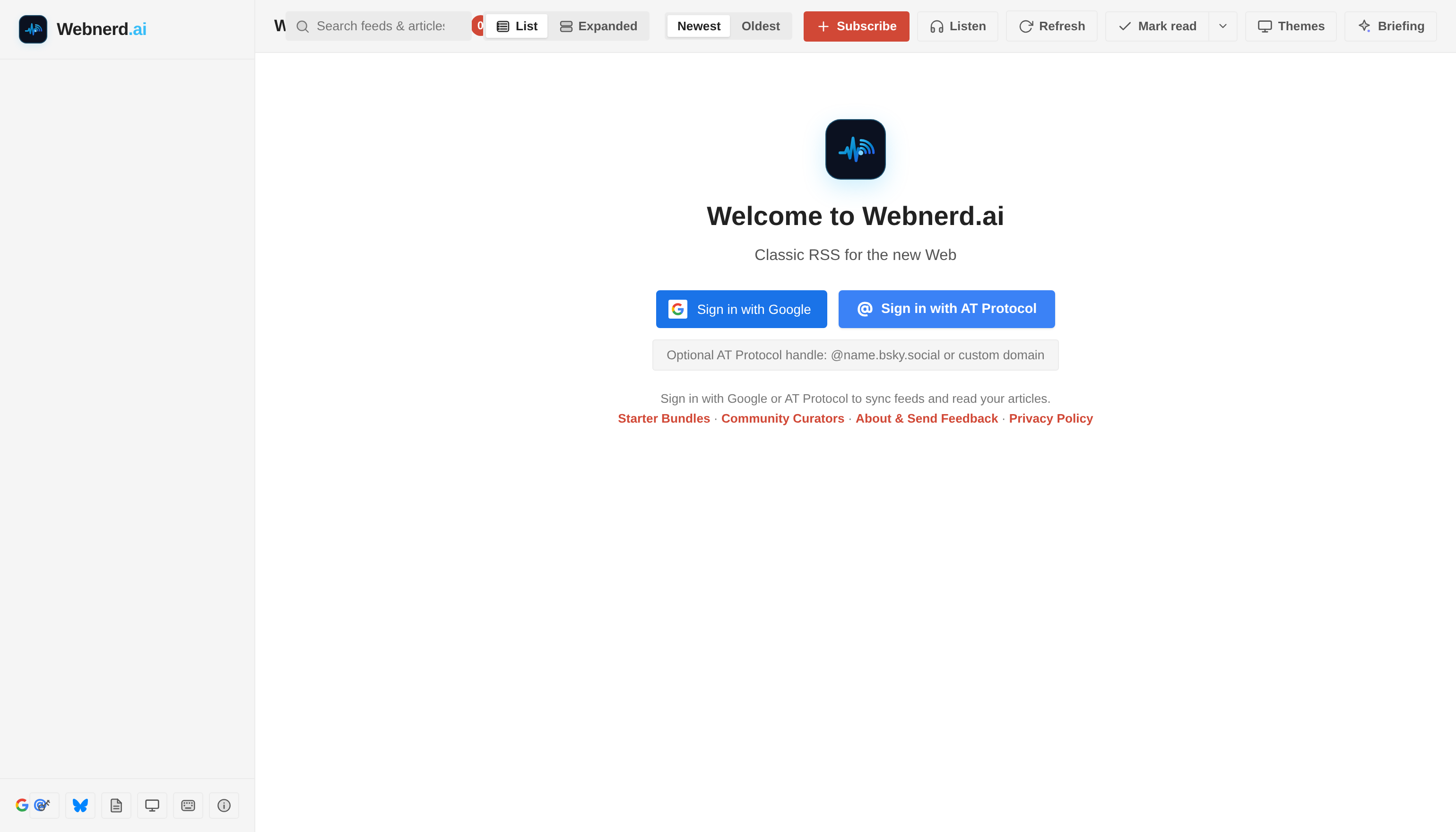
Refreshed Webnerd.ai welcome screen with 1-click Google Sign-In alongside native AT Protocol login
One click with Google, or bring your decentralized AT Protocol ID.

Even better, your decentralized identity isn't just a login badge, it carries your reading graph. Inside the OPML & Subscriptions hub, you can still drag and drop a classic XML file, or you can hit Sync PDS to pull decentralized subscription lists straight from your Personal Data Server across tools like Skyreader, Standard Reader, and Standard.site. Think about that for a second. Am I an expert on those? No. Could I work with Antigravity to build support here? Yes. So I did.
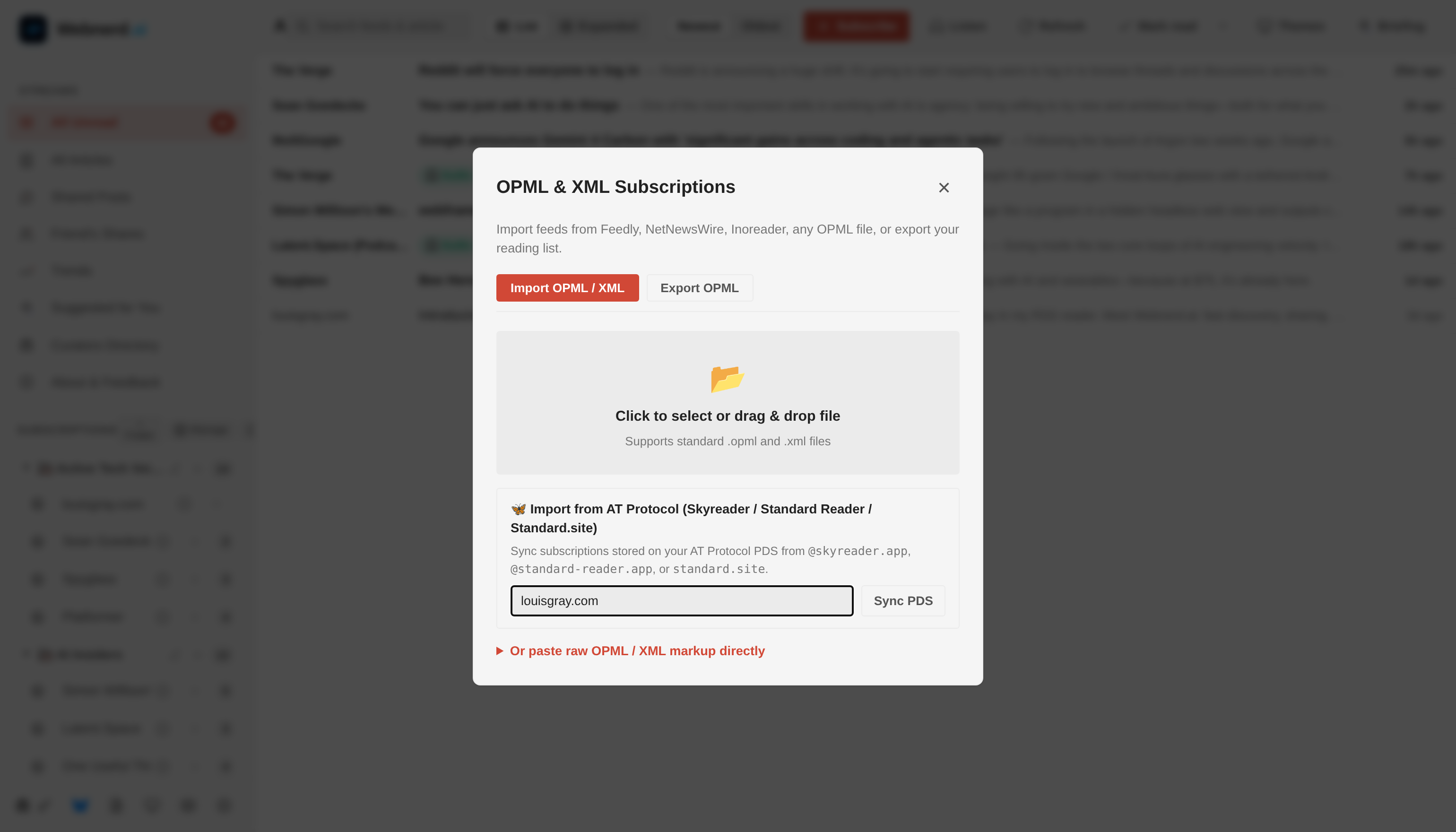
OPML & XML Subscriptions modal showing traditional OPML import/export alongside 1-click AT Protocol PDS sync
Classic OPML portability meets one-click AT Protocol PDS subscription sync.

Webnerd.ai also now speaks native at:// and standard:domain publications directly in the Subscribe dialog, and when you share a story from a Standard.site publication, Webnerd automatically writes a cryptographic site.standard.graph.recommend endorsement record to your PDS (and cleans it up if you unshare). Open standards work best when apps actually interoperate instead of just talking about it or seeing an acronymn as a checkbox.

Rescuing Newsletters from Inbox Purgatory

As much as I appreciate newsletter platforms like Substack and Beehiiv quietly keeping RSS alive under the hood, plenty of great writers still send email-only newsletters, and in my view, an email inbox sandwiched between flight confirmations, calendar invites, and shipping receipts is not the best place to read long-form writing.
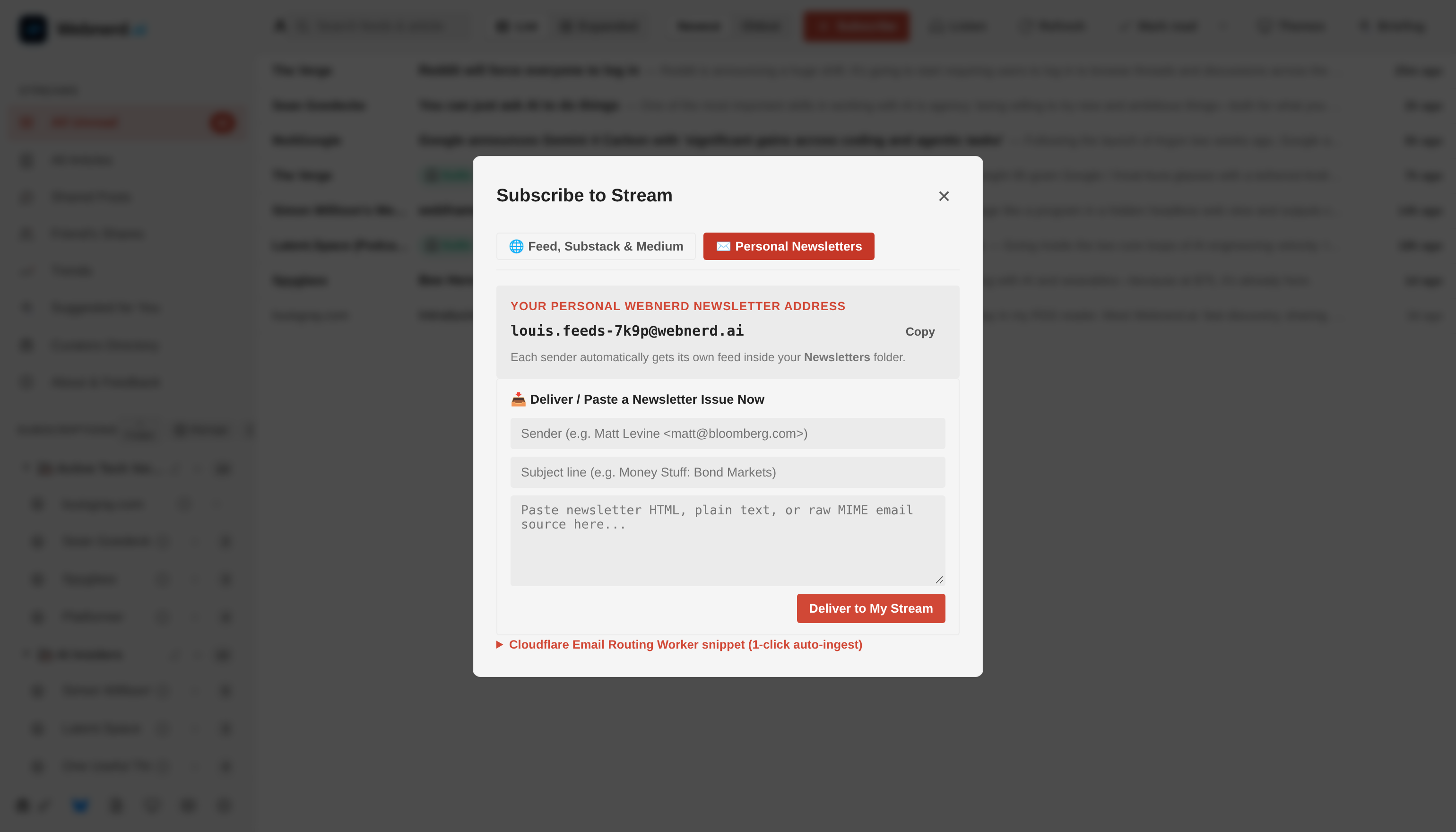
Subscribe to Stream modal open on the Personal Newsletters tab showing a dedicated @webnerd.ai inbox address
Every account now gets a personal @webnerd.ai newsletter address that turns email dispatches into clean RSS feeds.

You can now open + Subscribe and switch to the new Personal Newsletters tab, and you'll find your own dedicated @webnerd.ai address. Use it when signing up for newsletters (or forward existing ones via Gmail filters or the included one-click Cloudflare Email Routing snippet), and Webnerd automatically spins up a separate, clean feed for each sender inside your Newsletters folder. Newsletters belong alongside the rest of your reading, not competing with work email.

Listening to Your Stream & Real Power-Reader Triage

Sometimes even my eyes need a break from screens, or I want to catch up on my feeds while walking the dog. Hitting the new Listen button in the top bar (or on any individual post) launches a docked audio player right at the bottom of your stream.
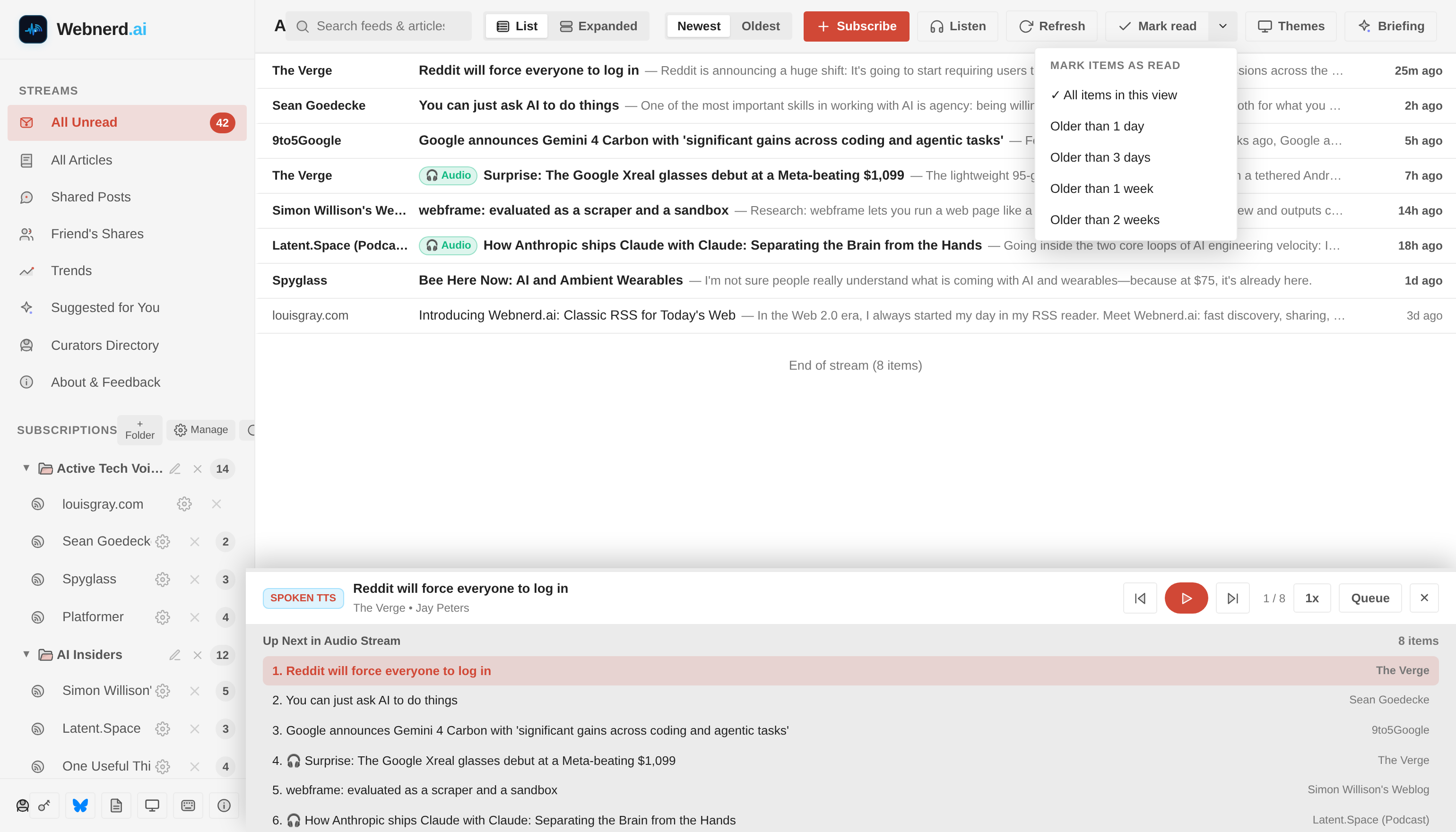
Signed-in Webnerd.ai power-reader view showing the top toolbar, granular Mark-as-Read menu, and docked Audio/TTS Stream Player
Listening through my morning feeds with the docked Audio & Spoken TTS queue.

If a feed item includes a native podcast or audio enclosure (flagged with an Audio badge), Webnerd plays the original audio directly; if it's a written post, it seamlessly reads the article aloud via a spoken Text-to-Speech queue with 1x to 2x playback speeds, an Up Next drawer, and automatic mark-as-read as each story finishes.

And because anyone subscribing to 100+ feeds may eventually face inbox-style bankruptcy, I've gone deep on power-reader ergonomics:

  • Granular Mark-as-Read: A new split dropdown lets you clear items Older than 1 day, 3 days, 1 week, or 2 weeks, or Mark above as read as you scroll — so you can declare peace on Tuesday's news while keeping this morning's stories untouched.
  • Folder & Subscription Management: You can now add, rename, drag-and-drop, delete, and merge folders inline or from a dedicated Manage Subscriptions view, toggle Newest / Oldest sort order, and pull Full Text readability views on stub feeds that only publish a sentence or two in XML.
  • More Classic Themes: Alongside Cloud Nine, Warm Sepia, and OLED Black, desktop nostalgia nerds can also switch into Mac Classic, Mac OS X Aqua, BeOS, and Green Android.

AI on Your Terms — Never Between You and Your Feeds

I wrote earlier this month about how filtertainment eviscerated our informed monoculture. The whole point of an RSS reader is that you choose the sources, and nobody hides a post  because an algorithm decided outrage would keep you scrolling longer.

Where AI does shine in a reader is synthesis on demand — when you explicitly ask for it.
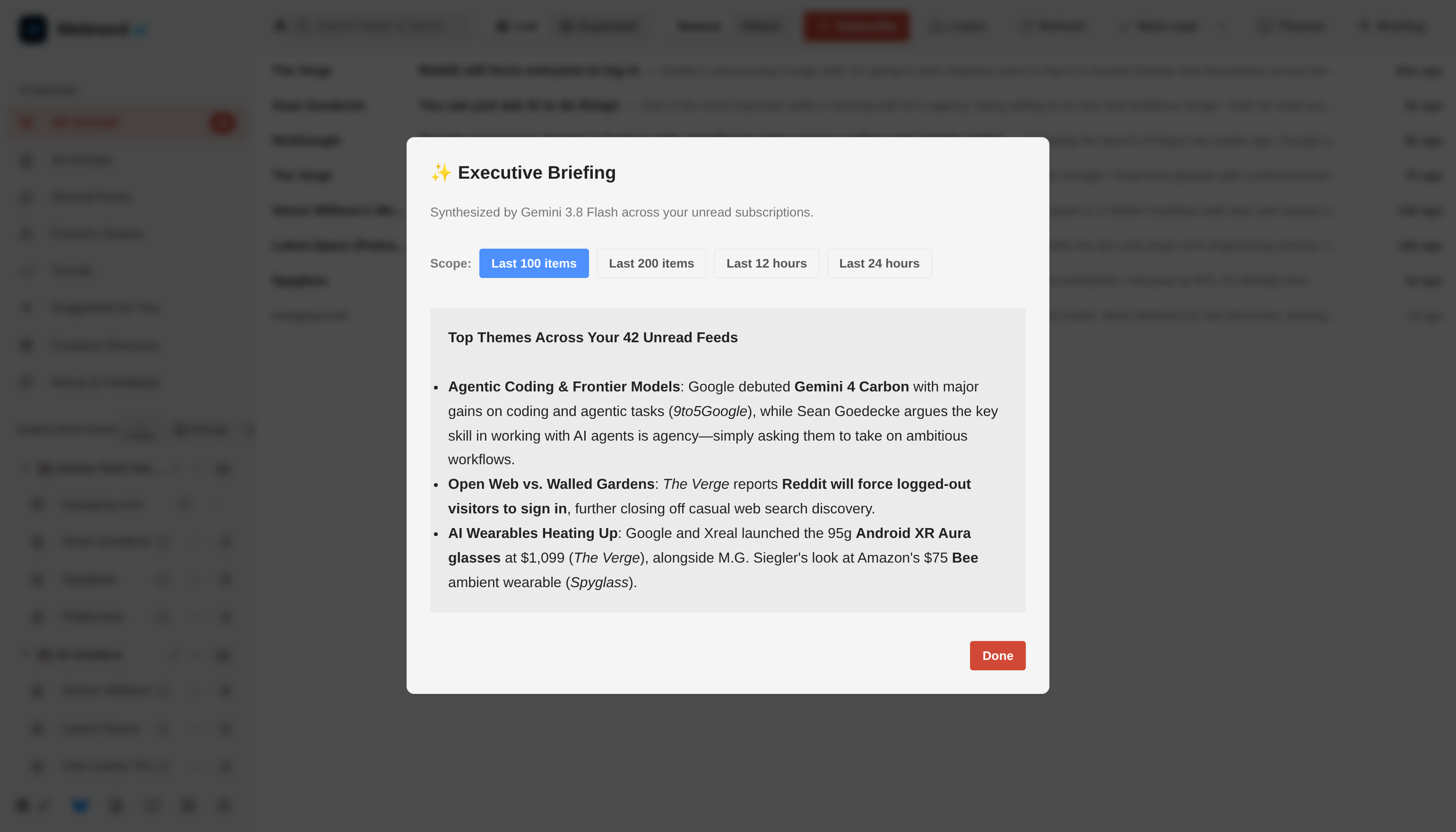
Executive Briefing modal synthesized by Gemini 3.8 Flash across unread feeds
Optional Executive Briefings synthesize what happened across your feeds.

Tap Briefing in the toolbar (or hit B on your keyboard) and Gemini 3.8 Flash synthesizes an executive summary across your unread stream — scoped to your Last 100 items, Last 200 items, Last 12 hours, or Last 24 hours — clustering breaking storylines and citing the exact outlets in your subscriptions. Every expanded card also has an optional one-tap TL;DR button when a 4,000-word essay drops five minutes before your next meeting. AI acts as your research assistant, never your gatekeeper.

Mobile Overhaul, Instant Startup, and Eating Our Own RSS Dogfood

Under the hood, Webnerd.ai now boots through a single-round-trip bootstrap endpoint paired with a local snapshot cache for sub-16ms first-frame paint — so opening the tab feels instantaneous even on spotty mobile Wi-Fi.

On phones, we replaced cramped desktop menus with a thumb-friendly 4-tab mobile layout (Feeds, Search, Shared, and Folders), edge-swipe gestures, and a guided Add to Home Screen full-screen web app setup on iOS while I continue working on a native Android companion app - coming soon.
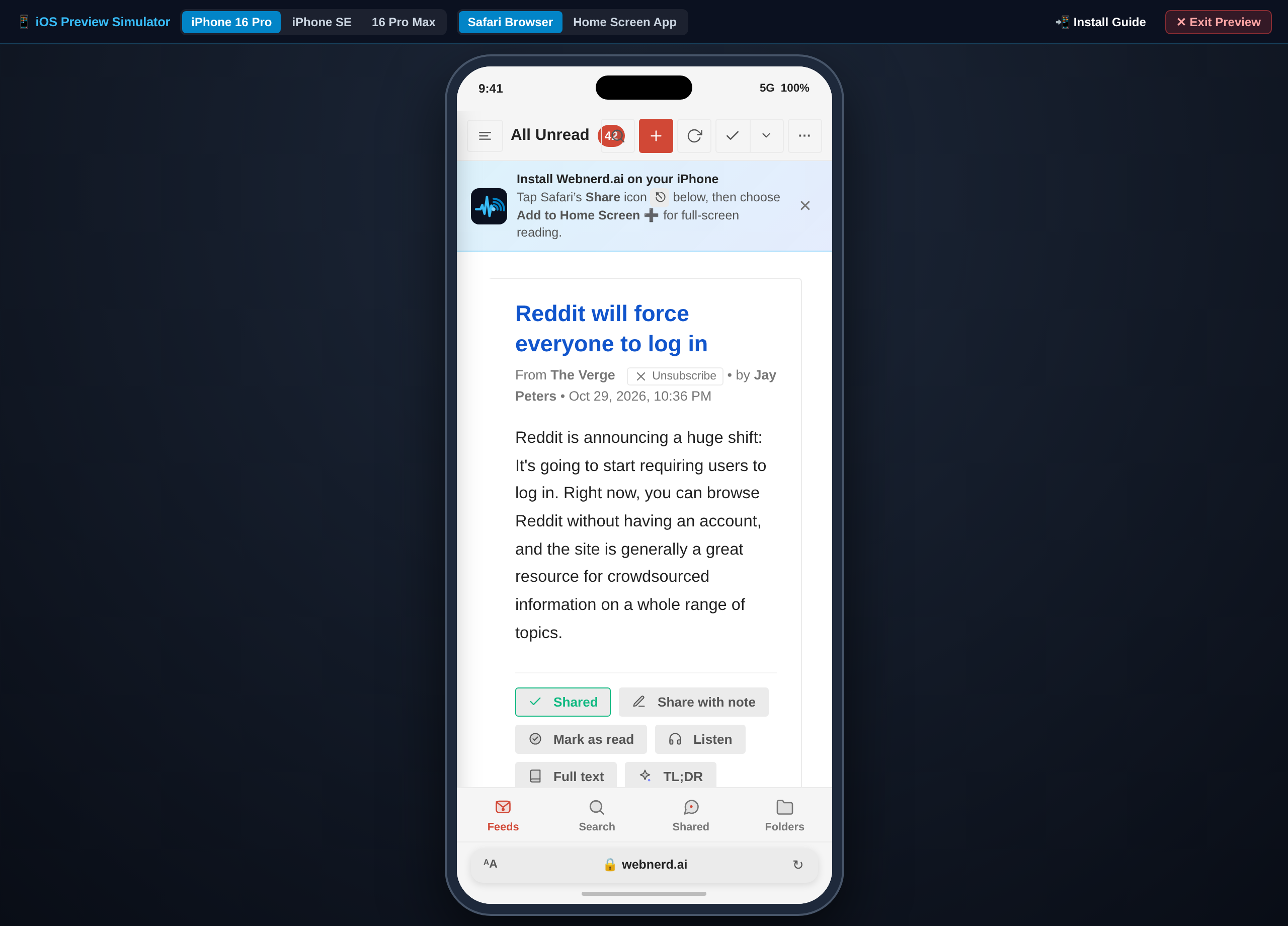
Mobile Webnerd.ai iPhone view showing the Add to Home Screen prompt, expanded card actions, and 4-tab bottom navigation
The redesigned four-tab mobile experience and full-screen iPhone web app.

Finally, you can't build an RSS reader and not publish your own changelog via RSS. Webnerd.ai now has an official Release Notes & Product Blog at webnerd.ai/releases, complete with a one-click + Follow in Webnerd.ai button and its own RSS feed at webnerd.ai/releases/rss.xml.
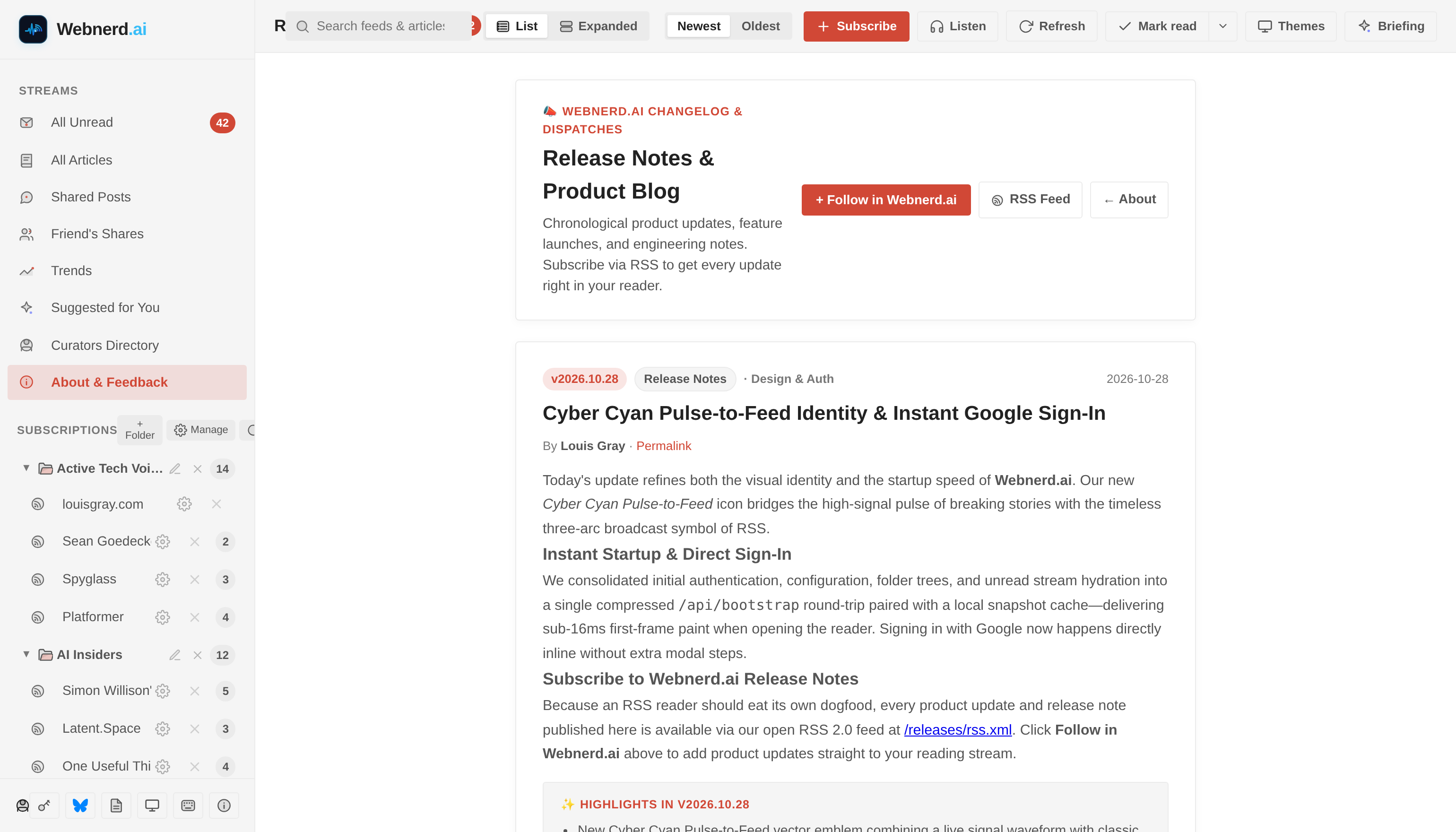
Webnerd.ai Release Notes & Product Blog at /releases with native RSS feed subscription
Eating our own dogfood: Webnerd.ai's product changelog lives at /releases with its own RSS feed.

If you tried Webnerd.ai over the weekend, or haven't yet, take the new audio player, newsletter inbox, or AT Protocol sync for a spin. If something bugs you or you have an idea for what an RSS reader in 2026 ought to do next, ping me on Bluesky — there's a pretty good chance Antigravity and I will have it shipped by the next weekend.

Disclosures, per always: I work at Google and use Gemini and Antigravity tools a lot. I built Webnerd.ai and this blog's CMS with Antigravity's help. Nobody at Google reviews my posts, ever.

October 17, 2026

October 17, 2026 · 6 MIN READ · BY LOUIS GRAY

How Antigravity Brought My Blog Back from the Dead

How Antigravity Brought My Blog Back from the Dead

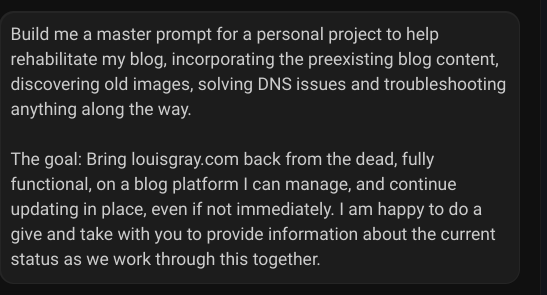
AntigravityI am not an engineer and I didn't major in computer science. There comes a point in understanding and using technology where I have a limit, and even with my years of experience in Silicon Valley, it's not impossible to run into issues that I just can't solve.

After a failed attempt a few years ago to move my blog to a new host and restart it on Wordpress, following general bit rot and content decay, the blog went completely dark -- an embarrassing development if I ever tried to point people to old stories or reference previous work, forced to look at my Blogspot backup or the Internet Archive to find some old content or try to prove my one-time relevance. 

While the world of blogging has changed in the last decade plus, my complete lack of new content wasn't an issue of a lack of ideas or a lack of time to write. It was straight up broken and I'd just about given up on getting it fixed, unwilling to turn my back on 3,000 posts only to start over somewhere else from scratch. But each attempt I'd make to run Blogger to Wordpress importers or adjust DNS settings failed. Until I turned to Antigravity.

Screenshot 2026-10-16 8.06.32 PM.png
My initial prompt that started the rebuild.

Antigravity is Google's AI-centric software development platform - very similar to Anthropic's Claude and OpenAI's Codex. Each of those products has its own champions, but the purpose is roughly the same. Simplify the ability for people to create, and leverage the latest models to understand user intent quickly and build smartly. I use Antigravity all the time at work, so with the new Googlebook being designed explicitly for working with Gemini, I thought I'd ask Antigravity to tackle this major project, and it didn't blink.

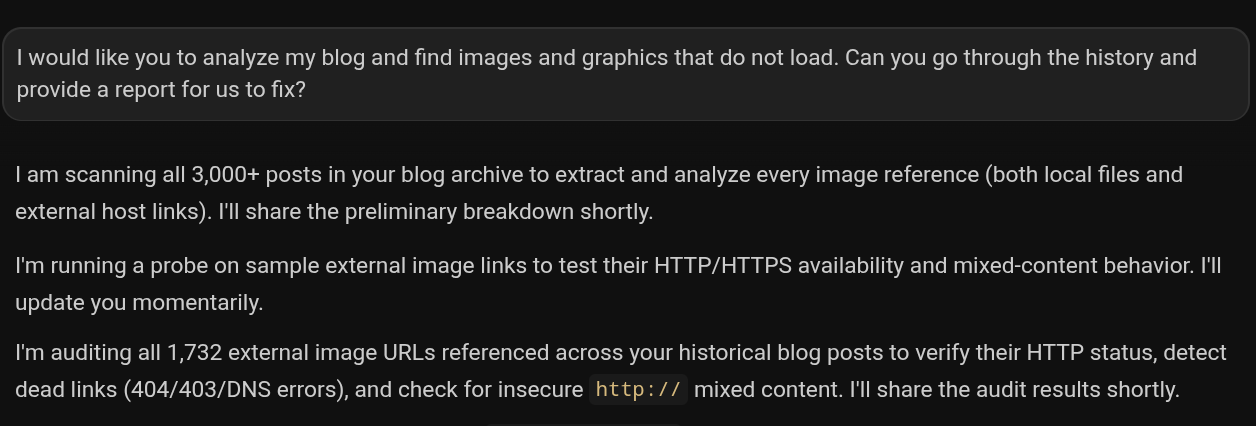
Screenshot_20261016-191925.png
Rebuilding the blog, to me, meant fixing everything.

My expectations were initially low, as they often are after having tried the same thing over and over and gotten absolutely nowhere. I told Antigravity I wanted to rebuild the blog at the same domain and bring along my 3,000+ posts, along with all the images I'd used in those posts. I also needed to not just recreate a frozen point in time, where I had left off in 2019, but have a foundation to keep going. I didn't expect it to work, and I definitely didn't expect it to work so quickly.

Antigravity asked me a few questions, such as where my domain was currently hosted, if I had my Blogger archive from Google Takeout (I did), and how I wanted my domain setup. As Antigravity, using Gemini, churned away, it very quickly sussed out exactly how to solve my DNS issues and found me a new host in Cloudflare, which enabled easy read/write from Antigravity, and we were able to import my blog history. Not only did it very confidently tell me what was needed, but it guided me to which pages and options to choose from, both in my old host and my new one, that I needed to get what I wanted.

After seven years without posts and years of the domain just absolutely not working, I had my blog back to life, with all historical posts, in about two hours.

With that major milestone out of the way, I asked Antigravity how I was supposed to make new posts, and did my Cloudflare installation come with a content management system (CMS)? Reader, it did not.

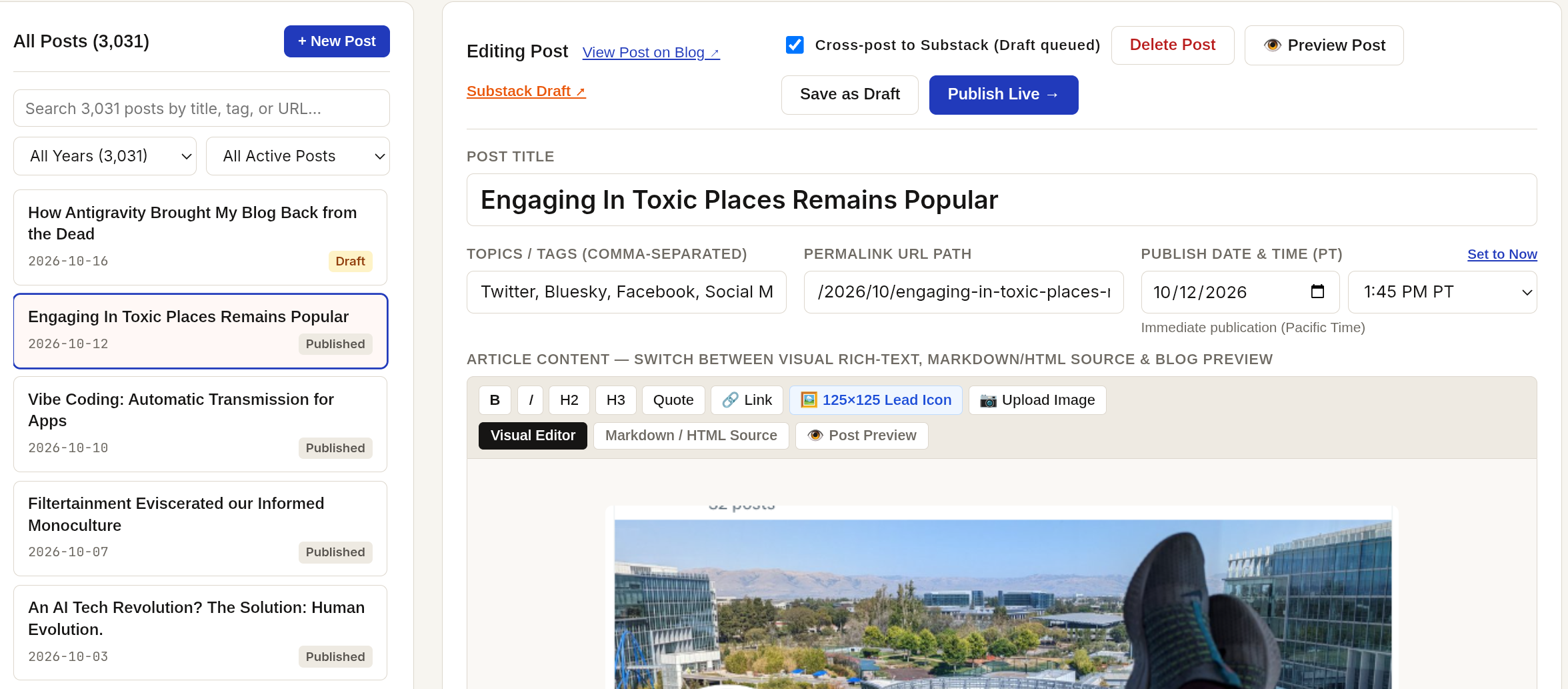
Screenshot_20261016-192212.png
Showing a blog CMS while in the CMS is so meta, but Antigravity built this.

Antigravity didn't miss a beat, saying, would you like me to build one for you? I said yes. So it made one. I logged in and saw it didn't have any of my old posts automatically saved, as I would have expected. Not a problem. I asked Antigravity to add them, and it did. I had gone from a totally dead domain and buried blog to a live domain and a blank slate to start over and make new posts again, without any missing history. I was no longer blocked.

From there, the only limitations have been what I ask for. Like any good blogger, I got to optimizing the look and feel of the site right away, asking Antigravity to feed me some new modern layouts and color palettes for 2026. I asked it to build in full-feed RSS, to supporting subscriptions and the open web. It rebuilt all my static pages, my yearly archives, and keeps a live count of total posts from my very first attempts back in 2006. It added a native commenting system and imported conversations from decades past, successfully. Antigravity also understood my previous style, and we've stuck with my tradition of the 125 x 125 image at the top left of posts to signal what each post is about.

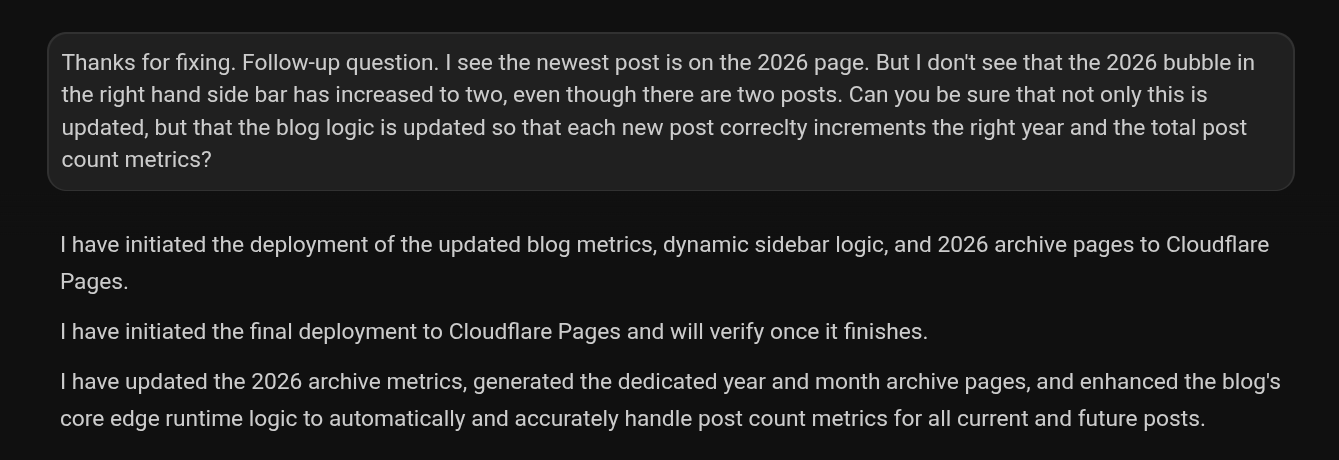
Should something surprise me, or act in a way I didn't expect, I just go back to my ongoing conversation with Antigravity, and provide that feedback -- if posts aren't displaying how I expected, if numbers don't change, or basic functionality, like saving drafts in the CMS, had been missing from the first round.

The speed of creation and iteration and improvement is really unprecedented, and hasn't required daunting technology hassles. As I come up with ideas for the blog's functionality or its CMS, I just ask Antigravity. If Antigravity needs approval for permissions, I get the option to grant or deny them, and often found Antigravity giving me options to choose from, with a give and take that always leaves me in control.

Screenshot_20261016-192452.png
Antigravity understands my input and takes action, with intentional follow-up.

Like I wrote last week, the opportunity to use natural language to simply build, or what some call "vibe coding", is changing our relationship with developers. If you can think it you can build it. Spoiled by my work environment, I was excited to see Gemini 4.0 (Argon) make its way into Antigravity this last week, making my conversations around this project (and others) even more in depth. And before you ask, yes, I pay for Google's AI Ultra subscription, and no, I don't have a discount. Having Antigravity available to me, with the latest models, baked into my Googlebook, is an absolute must in 2026.

I don't expect to come back to hundreds of posts a year. I'm not in the breaking news business and the world of social media alongside the consolidation of tech journalism has significantly changed how we all find and share news. But I am more excited about what we are all able to do with AI-assisted development than just about anything I've been involved with in years. I've come to the belief that yes, Antigravity can do just about anything. It's only waiting for me to ask the right questions. It's good to be back.

Disclosures, per always: I work at Google and use Gemini and Antigravity tools a lot. I wrote this post by hand. I made this blog and CMS with Antigravity's help. I paid for AI Ultra and I paid for my Googlebook. Nobody at Google reviews my posts, ever.

October 10, 2026

October 10, 2026 · 3 MIN READ · BY LOUIS GRAY

Vibe Coding: Automatic Transmission for Apps

Vibe Coding: Automatic Transmission for Apps


The Human–AI Co-Creation Studio [Image via Gemini]

As a teen training to get my driver's license, my dad wanted me to learn "the right way". To him, that mean getting my first experiences behind the wheel with a stick shift, learning how to coax his sturdy and unimpressive 1990s era Mazda 323, with manual transmission, from low gear to highway cruising speeds, all while avoiding stalls and switching gears smoothly. Through this training, many trial and errors were had as I gained experience.

Eventually, I took and passed the drivers' test, but in an automatic vehicle - my mom's wood paneled Oldsmobile station wagon. Despite its heavy build and thoroughly unattractive appearance, the car's automatic transmission reduced complexity for me, letting me focus on driving the car, not just fighting to get it to work. Now, depending on which survey you choose, less than 1/5th of drivers know how to use a manual transmission, and those cars account for only 2% of all sales in the United States. While there will always be strong opinions about the efficiency or quality of manual vs automatic, from a technology perspective, it's a relic of a previous era.

The rapid ascent of AI-assisted coding, much like that transition from manual transmission to automatic, has reduced complexity and expanded the total market for participants -- not only changing how software engineers work, but making it possible for those without coding experience to speak their ideas into existence, and iterate to make them real. If you can think it, you can build it.

While some debate if AI is conscious or sentient (it's not), it certainly isn't yet fully autonomous. Working with any of the leading AI-powered code environments is a continual give and take between the LLM and the human, a hybrid approach Sean Goedecke calls our "centaur age", reflecting the reality of a time when the machines are so fast and so capable, humans can't directly compete alone but work in tandem with their silicon partners.

Goedecke says: 

"It is no longer possible to credibly argue that an unassisted software engineer can beat a centaur team. The value provided by coding agents is just too great: not just the speed of producing code, but the speed of review and testing."
-- Software's centaur age may last decades

What I have experienced, both at the office, and in my own side projects, is that AI isn't just changing the end product of what we build, or speeding our ability to eliminate tasks -- but more importantly, enabling us to do things we simply were unable to before, expanding our scope and redefining what we could achieve. In the last three years, we've graduated from simple question and answer chatbots to progressively capable workspaces that are waiting to take our instructions, and agents eager to do our bidding.

As I shared one recent experiment, a friend messaged me, "someone has been having fun vibe coding" and I almost recoiled from the description. Even if I never touched an official single line of code, I was able to turn to a software tool, design an idea, work with available technology, and deliver a project users could experience themselves. This was not just for vibes, but a celebration of capability.

The complexity that has defined the world of software development for decades was never the end goal, but a necessity to get there. Now, that journey of pain has been greatly reduced. No more stalling out, no more grinding of the gears. There will always be elite software development. People who have specialized in the field are going to approach invention in ways we amateurs wouldn't think to, due to their education and experience. But vibe coding is a lot more than frivolous toying based on mood -- it's automatic transmission for development, which will put a lot more drivers on the road.

Disclosures per always: I work at Google and vibe code with Gemini and Antigravity tools a lot. I wrote this post by hand.

October 03, 2026

October 03, 2026 · 5 MIN READ · BY LOUIS GRAY

An AI Tech Revolution? The Solution: Human Evolution.

An AI Tech Revolution? The Solution: Human Evolution.

Silicon Processor Chip
The tech industry, and Silicon Valley specifically, has long set out to 'change the world'. The clear eyed idealists will tell you the long hours and dreary social lives they espouse are a worthwhile exchange for making lives easier, helping people achieve more, connecting with one another. Discovery. Invention. The cynics will tell you it's a smokescreen - a sprint for riches, to aid the most greedy to take an even bigger share, all while diminishing opportunity for those with less. Advancements and progress for some may come at the expense of others, who encounter reduced job opportunities, stagnant wages, increased commutes and pollution.

Apple cofounder and one-time CEO Steve Jobs famously said, "We're here to put a dent in the universe. Otherwise, why else even be here?" Google cofounder and one-time CEO Larry Page, perhaps a little less famously, said we should have "a healthy disregard for the impossible." Those are massive goals, but many find themselves a little skeptical.

In our extremely partisan world, it can be tempting to just pick a side and get entrenched. Are you with us, or are you against us? Are you the good guys or the bad guys? Is big tech bad? Is AI going to kill us all? Should we be buying backup property in New Zealand or throwing our smartphones into the closest lake? Are we all going to become subservient to the machines and live unsatisfying lives of uncomfortable mediocrity?

celebrate_800.jpg
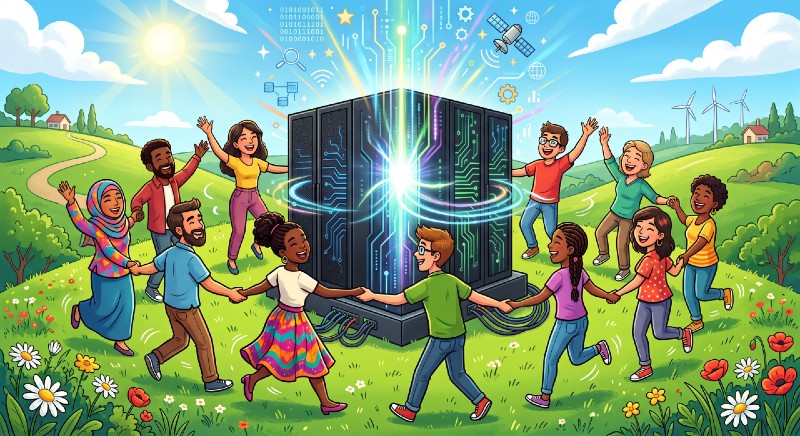
Will the machines deliver a future of perfect harmony? [Graphic via Gemini]

Every evolution, every wave of progress, requires adaptation. It was true in the Industrial Revolution, it was true when the Internet evolved our businesses and our interactions, it was true again more recently when we all started carrying smart phones (and almost never putting them down), and it's again true with AI. It can absolutely be uncomfortable -- forcing us to question our own strengths and capabilities, and even whether what we see or hear actually happened, or was it just AI?

AI actually isn't that particularly new. In 1983, the very same Steve Jobs took questions about AI a full year before the debut of the Macintosh, contrasting the human's consciousness with the computer's ability to do simple things, while forecasting scientists would look at the human brain and teach computers to think. Alan Turing brought the ideas of machines learning to the public in the 1950s, and the Turing Test remains the benchmark for measuring if a computer is human enough to make you think it's an actual person. What is new is the velocity and the accessibility of AI-powered technology to everyone - helping students with homework, composing documents and emails, answering multi-turn questions, and even performing creatively, for better or worse.

dismay_800.jpgTechnology marches on with benefits, and drawbacks too. [Graphic via Gemini]

Despite my sometimes bot-like behaviors, I am human, and this onslaught of AI tools can be daunting, even for a self-proclaimed early adopter. What value is being able to write well if everyone can? What value is knowing history if everyone can look it up? What value is being able to code if the AI can code faster and better? It can be humbling and scary. When faced with this challenge as AI tools increasingly marched from recommended to required, my initial reaction was just no... no, I don't want to do that. I'm perfectly comfortable doing things the way I always have, with the tools I know well. But I also know my 2026 workflow is vastly different than it was in 2016, and even more so than it was in 2006. New entrants to the workforce will have grown up with these tools, be comfortable with them, and could run circles around me. So I've adapted, and found new ways to automate, reduce friction, and just do more.

To remain relevant, we have to evolve and we have to rethink our role. Engineers and product managers can now use AI tools to build creative presentations and handouts in moments. Marketers can now build complete working demos and products from scratch instead of just describe them. Colleagues who once studied hard to be awarded readability in various computer languages now tell me they don't write code, but instead load up prompts in their IDE and instruct the AI to build what they used to do by hand. I can now spin up working arcade games in the web browser in minutes that used to require entire teams. It's wild. But it's also exciting -- in a good way.

Vast adoption of the Internet hasn't yet led to the downfall of civilization. It has led to challenges with communications in some ways, helped spread misinformation, broken down people's attention spans, and enabled isolation for some, but it's also enabled a steady evolution of how we live. Our constant attachment to smartphones has changed the way we engage with one another and are entertained, and yes, it too comes with downsides. AI will no doubt do the same. It will find its lanes where its use makes the most sense, and also try and show up in places where it's not welcome. We will know the difference. Our responsibility is to reaffirm what makes us human, taking the best of technology and using it where beneficial, and celebrating our individuality in all other places. It's going to be bumpy.

Disclosures per always: I work at Google and use our Gemini and Antigravity tools a lot. I wrote this post by hand.