Silicon Valley Technology Commentary & Archives · Est. 2006 3,045 Posts · 2006–2026
Showing posts with label Wikipedia (5 posts). Show all posts

December 31, 2010

December 31, 2010 · 4 MIN READ · BY LOUIS GRAY

The Quora Phenomenon - Peaking on Value & Authenticity

The Quora Phenomenon - Peaking on Value & Authenticity

Unless you've been completely logged out of all social networks, taking the post-Christmas week off as part of a tech detox, you have no doubt bumped into discussion of Quora, the red-hot question and answer site that has taken Silicon Valley by storm. Already an intriguing site that has seen well-respected people who do not typically participate on Q&A sites answer probing and provocative questions about their current or former businesses, the site has seen an explosion of new users, spawning an ever-growing array of discussions on practically any topic. And unlike the more mainstream Q&A sites, which have decayed into primary sources for jokes exposing the vacuousness of the below-average American, quality so far has remained strong on Quora, spawning hopes that this time, the formula is done right.

The mission of Quora is a simple one, theoretically, stated as a continually improving collection of questions and answers created, edited and organized by its users. This makes it share some commonalities with Wikipedia, with the community self-policing what answers are correct or incorrect, through voting them up or down, be it due to the users' identity or the value of the answer itself. The more accurate and transparent the answer, the more likely to be accepted by the community, of course.

Some of the Answers I Voted up on Quora

The site has been especially interesting for Silicon Valley insiders, who have used it as a forum to ask advice on fundraising, how to operate in a startup, or ask investigative questions about companies' origins. The seeming exclusivity of the site, where top bloggers, entrepreneurs, VCs and business people are interacting with the same people who enjoy their products has been extremely attractive - especially when they truthfully answer burning questions we've all had.

More than a year ago, I said that any successful social site needed to nail three points, namely: Technology, Community and Relevancy. Quora has delivered on all three, rapidly tying people to relevant topics, connecting them with people from other networks or just within the site, and providing an intelligent platform that helps surface quality.

One of my Answers on Quora

The attention to quality is especially critical for Quora. The community's ability to edit questions or answers manages to keep discussion accurate, while logs are kept for each edit, so one can see if responses are being redirected. Answers can be voted up by the community, and it's clear who is doing the voting, providing another layer of authenticity to the service.

Another big value for Quora is the return to long-form discussions. In a world of Twitter and Facebook, where discussions are measured in character counts, Quora's rich question and answers, complete with nested replies, seem much more fulfilling. Robert Scoble called this an ingredient of major blogging innovation, which helped kick off the spike in users, but even if it's not revolutionary, it's great to see more in depth discussion than abbreviations, hashtags and @replies.

Where I have heard people express concern about Quora is what could happen if it breaks into the mainstream and becomes diluted as sites like Yahoo! Answers have, suffering from the chatroom phenomenon that doomed other sites targeted toward casual discussions. Safeguarding Quora from this is the use of one's real identity, connected through Facebook or Twitter, and the community's ability to downvote or mark as "Not Helpful" responses that don't pass muster.

(See also: Skeptic Geek: Is Quora Becoming What Google Buzz Should Have Been?)

What I think is more risky than more people jumping into the fray is people simply declining to participate. The site is gaining huge value today from people candidly and transparently providing good answers to sometimes tough questions. If they choose to stop, putting a rein on the openness, the value can be lost, meandering into a world where users simply discuss products or trends. It may also simply be at the peak of its Hype Cycle, before falling into Gartner's famed Trough of Disillusionment. But this feels a lot more sticky than a fly-by-night idea. The site is becoming a valuable repository for insight into people and services, and each discussion smartly leads you to new people and new related topics, helping keep your interest level high.

Without falling into the real-time sieve that can drown casual users of sites like Twitter and FriendFeed, Quora does maintain the feeling of newness. The site's front page shows notifications for activity on your network or previous history, and shows trending people and topics. If there's something going on in the site relevant to you, it has a good shot at finding your attention - without seeing items fall from the top in a never-ending waterfall.

The Quora Front Page, With Recent Activity

I've recently used Quora to discuss the popularity of Google Reader, why people still use FriendFeed, and why my6sense utilized implicit behavior to rank content. Many others are dropping interesting questions and receiving interesting answers.

I am hoping the site does not become yet another place to count followers and connections, but the numbers are going up. You can find me on the site here: http://www.quora.com/Louis-Gray.

March 10, 2010

March 10, 2010 · 2 MIN READ · BY LOUIS GRAY

Brizzly Acquires Birdfeed, WikiRank, Adds iPhone App

Brizzly Acquires Birdfeed, WikiRank, Adds iPhone App

Thing Labs, the parent company of Brizzly, one of the more innovative Twitter Web clients out there, unveiled a slew of announcements this morning, with the acquisition of popular iPhone application Birdfeed and WikiRank, a visualization Web app based on Wikipedia data. The acquisitions will help fuel the launch of Brizzly's first branded iPhone application, and a new Brizzly Guide, which extends the trend explanations core to Brizzly since the product debuted with permanent definitions, accessible even after a topic stops trending.

The Brizzly Guide, as you can assume, looks much like Wikipedia, integrating a trending topics definition with related links, and a Twitter search. For example, Chuck Norris is trending because he turns 70 years old today, and SXSW is trending because of its debut on March 12th. This furthers the company's focus on the Let's Be Trends API launched last fall.

Why Is Chuck Norris Trending? Because Chuck Norris Trends When He Wants.

"I would love to see the Guide fill the gap in 'why are people talking about this' and 'what is it' that I don't see on Wikipedia or other search/news sources. Wikipedia is definitely of great value and we use it for context on some Guide pages," said Thing Labs CEO Jason Shellen. "We are turning on new ways to contribute and can't wait to see how our users continue to help explain the world around them."

Brizzly's new iPhone application, released today, has been much awaited, and a clear hole in their lineup. But the company took a different approach. Rather than building their own app from scratch, they acquired Birdfeed, and worked with the developer, Buzz Andersen (@buzz), who recently joined Jack Dorsey's Square, to add new features and release it as a branded app.


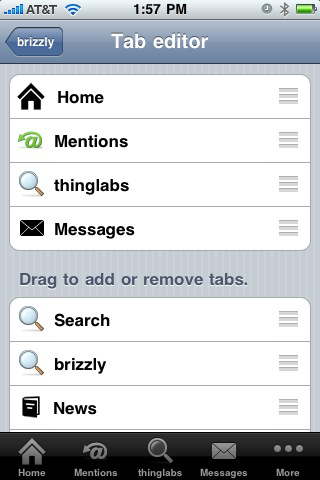
Brizzly's New iPhone App With Custom Tabs and Photos

The new iPhone app features many Brizzly-only features, including Brizzly Guide support, uploading of photos to Brizzly Pics, and muting from Brizzly.com. It also features multiple account support, lists, saved searches, classic retweets, custom tabs and infinite scrolling, according to a microsite on the new product, found at http://brizzly.com/iphone/.

September 26, 2009

September 26, 2009 · 2 MIN READ · BY LOUIS GRAY

Should Real-Time Trends Get Real-Time Definitions?

Should Real-Time Trends Get Real-Time Definitions?

On Tuesday, we talked about Brizzly releasing a new API called "Let's Be Trends", which enables third party developers and services to tap into the company's definitions database for currently trending topics on Twitter. While not every definition requires multiple paragraphs to explain, I have been thinking about the real value of these definitions, and how they could be utilized as an ongoing news feed, similar to a real-time Wikipedia. After all, as trends age, the reason for their trending changes ever so slightly.


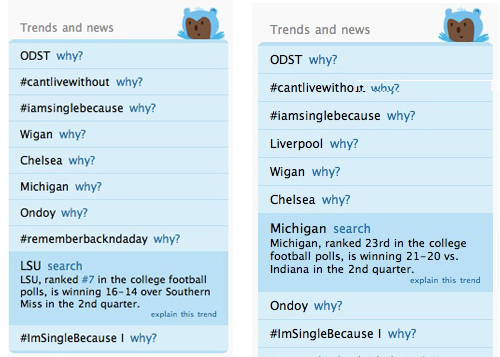
Note the real-time definitions for the real-time events.

Typically, Twitter's trending topics fall into four major categories:
  • Memes: Often hashtags for time-wasting games. (#iamsinglebecause)
  • Celebrity names: Either due to a death or other event with a person in the news. (Jay-Z)
  • Live events: Could include conferences or sporting events. (#sxsw09 or LSU)
  • Technology Tools: You can often see the words "iPhone" or "TweetDeck" trending.
Memes are the least likely to need updating. #iamsinglebecause and #cantlivewithout are fairly self-apparent. Complete the sentence and see what your friends think. Celebrity names, depending on the situation, could need updating. If Patrick Swayze passes away and becomes a trending topic, that's fairly clear. But if you have Barack Obama trending, it could be for a meeting with a world leader, or simply because he called Kanye a jack-ass. You can also see the need to make an update, as in the case of Conan O'Brien, who trended last night not because of his show, but because he had fallen and hit his head during a taping of that show.

Technology Tools like TweetDeck may trend ever higher because of a point release, or AT&T will trend because of the release of MMS, but often they trend just because people are talking about them often. (Like with the iPhone)

Live events to me seem like the biggest opportunity to have continuous definition updates. If you wanted to know why Michigan or LSU were trending this morning, the answer was yes, because there was a college football game. But what about the score? Why would LSU get more attention than Notre Dame? Maybe because of the team's ranking, or the excitement of the game? At this point, defining a trending topic (in Brizzly for example) becomes a lot like reporting on the news - so it would make sense to update the definition based on the score or the position of the game - is it the second quarter? Are we in overtime?

This may seem trivial today. We're talking about features on an API for a single service. But if we are to believe that microblogging is growing and that user contributions to the global service are going to play an expanding role, maybe this would be the time to start thinking about how we can utilize the opportunity to drive information back to those looking for it and inch our way further toward the future of media. And maybe, just maybe, Brizzly or somebody else can hire somebody whose job it is to consistently update live events.

May 6, 2009

May 6, 2009 · 3 MIN READ · BY LOUIS GRAY

Microsoft Live Search Employee Says Search Engine Analysis Flawed

Microsoft Live Search Employee Says Search Engine Analysis Flawed

On Tuesday evening, I attended a get-together with some of the minds behind Powerset, the $100 million natural language search engine acquisition slowly being integrated into Microsoft's Live Search engine. The goal? To keep the San Francisco startup natives feeling still connected to their roots, and not detached as part of the Redmond software monolith, while also giving interested tech reporters and bloggers an opportunity to see why Microsoft has any chance in the search market against its primary foe, Google. While I'll talk later about some of the statistics they offered, there was a conveyed perception that traditional reviews of search engines are flawed in their simplicity, in their context, and are not in depth enough to gain a clear knowledge of what's complex subject matter.

Discussed in detail on Senior Program Manager Mark Johnson's blog, Deliberate Ambiguity (See: "How *not* to rate a search engine"), the feeling is that reviewers commonly perform three queries before rating an engine "good" or "bad" - their own name, a hot topic of the day, and then something completely random. If the engine being tested doesn't match expectations, then it's off to the woodshed. (See: Cuil, Searchme, and other engines that have not been embraced for such examples)


Is Live Search Feeling Lucky? They Say Try It for a Week.

Instead of a simple Live Search vs. Google three query test, Mark recommended users try out Live Search for a full week, arguing that their own experiences would trump any simple demo. And as we discussed yesterday, one person's experience could be wildly different from another's, people primarily focus on the first search result, ignoring the bulk of the iceberg, and that it can be extremely difficult to infer intent and importance of results.

For example, as we discussed yesterday, assuming the working set of a search engine is Wikipedia, as Powerset's search engine prototype was, the web crawler will incorrectly determine that years associated with entries are of incredible importance, given how often they are referenced. As a result, rather than World War Two events rising to the top in importance, computers are more likely to trust results labeled '1944' or '1942' - so how do you teach computers to think like humans and correctly rate influence and importance? He adds, concluding his post, "this is rocket science."

At the quick meetup, questions around Microsoft's potential to dethrone Google were plentiful. We talked about how the once-mighty Alta Vista had once had a significant lead, and even after Google's debut, it held a corner in image search and language translation, before those too were eroded. Could Microsoft find a position that Google just doesn't do well? Could Microsoft start to be good enough such that if people tried to use Live Search for a full week, that Google would seem 'less good'? I even overheard a comment at the event that said in user groups, those surveyed preferred results that displayed a Google logo, even if the results shown were from Live Search.

The Google brand just means trusted search for many people, and even the Microsoft monolith is finding competition to be incredibly difficult. Google managed to find a market space that didn't need Microsoft, and could compete on its own revenue terms, without being frozen out by a competitor who could offer a parallel offer for free, a la Netscape. Even if Microsoft has built a better mousetrap, it is going to need to find a way to communicate that to users and deliver them a compelling reason to make a switch - and if Mark's words are to be believed, users and press aren't doing the needed research to help communicate their progress.

January 10, 2009

January 10, 2009 · 2 MIN READ · BY LOUIS GRAY

Disgruntled NFL Fans Take Out Frustrations On Wikipedia

Disgruntled NFL Fans Take Out Frustrations On Wikipedia

Like any good sports fan, tonight, I've been watching the NFC divisional playoff game between the Arizona Cardinals and the Carolina Panthers. The Panthers, despite a regular season record of 8-0 at home on their way to the playoffs, saw their season end, as the Cardinals put on a drubbing, winning 33-13. Making the problem worse was the Panthers' quarterback, Jake Delhomme, who turned the ball over an amazing six times, including a fumble and five interceptions. And while Arizona led by doing the damage on the field, angry Panthers fans have done even more damage, defacing Delhomme's Wikipedia page.
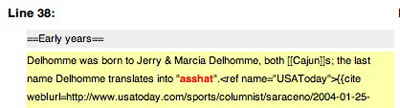


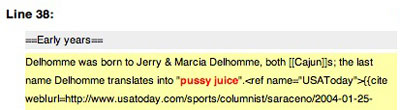
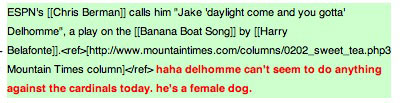
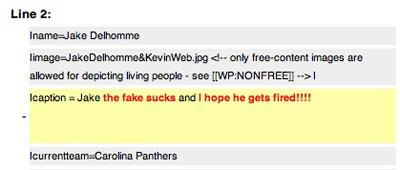
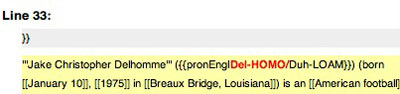
Delhomme's Wikipedia page has lain relatively dormant going into the playoffs, seeing only the occasional update for career statistics, and additions for the recently completed season. But as the game started to slip away, with the Cardinals going into halftime with a 20 point lead, his page started to be vandalized, with changes taking place practically every ten minutes over the last two hours. The changes, which you can see in the page's history, range from false definitions of his last name, including "pussy juice" and "asshat", to pure complaints about tonight's game.


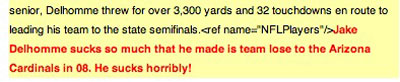
One comment, since deleted, says, "Jake Delhomme sucks so much that he made is team lose to the Arizona Cardinals in 08. He sucks horribly!" (sic). Another adds, "Jake the fake sucks and I hope he gets fired!!!!", while a third refers to him as "the worst Q.B. in the league!" This of course, is not true, given his 15 TDs and 3,288 yards in the regular season, according to the still-intact NFL.com.


Wikipedia's live editing feature can no doubt be tantalizing to people who want to muck with a famous person's reputation. Stephen Colbert has had lots of fun encouraging watchers of the Colbert Report set up new pages on Wikipedia, or alter existing ones.


As noble as Wikipedia's initial goals were, to replace the encyclopedia online with a group-edited repository, its open rules have left it open for any nutjob to write that Delhomme "can't seem to do anything against the cardinals today. he's a female dog.", or change the pronunciation of his name to "Del-HOMO". It's no secret why many teachers, including my wife, tell their students to stay far away from using the site as a reputable source.

And if you're a professional athlete, be sure you never have a bad game, just to save face online.