Silicon Valley Technology Commentary & Archives · Est. 2006 3,045 Posts · 2006–2026

July 7, 2011

July 7, 2011 · 2 MIN READ · BY LOUIS GRAY

Spotify In the US: Of Course It'll be Great and Affordable

Spotify In the US: Of Course It'll be Great and Affordable

Spotify's long drawn-out arrival in the United States has been rumored and rerumored over the last two years, drawing fatigue from those both eager to get their hands on the service and those covering the space, some of whom have compared the nascent cloud-based music service to the much-delayed Duke Nukem Forever. In the meantime, US-based services like Rdio have emerged as real competition, alongside music lockers from Amazon and Google, and Apple's iCloud, which dropped last month with a feature set that was somewhat underwhelming to those who had epxected Spotify-like features from Cupertino.

In recent months, more news has trickled out from Spotify in terms of their expanding their US office in New York, and capturing deals with the dinosaur US labels, who haven't shown their innovation or eagerness to adopt their sales strategies in recent years, both cozying up to Apple and then cowering in response to their every move. Yesterday, Spotify in a fairly understated way said yes, their launch in the US was imminent, though no date was given, and now you see people speculating on pricing.

After initially having free access to Spotify starting in late 2009, I converted to a true paid for premium plan early this year, at $9.99 a month, bringing Spotify's huge music library to my desktop and all my mobile devices - made even better with solid integration to my Sonos S5 wireless speakers throughout the house. I do not expect that when Spotify officially launches that I'm going to see any kind of price hike, and I am adamant that this is the best deal going. Theoretically speaking, although I prefer lower prices of course, I would probably pay upwards of $30 a month to get Spotify access, just for the feature set they have today.

Due to the delays around Spotify and much ongoing hype, some from here, those who have been on the outside looking in might be tired of the promise and continue their skepticism until they can download the app and gain access to the service - but what was once a pipe dream looks like its coming very soon and at a great price. So if you're tired of hearing about it, you don't look like you have to wait much longer. It's the #1 reason I almost completely stopped using iTunes.

July 6, 2011

July 6, 2011 · 4 MIN READ · BY LOUIS GRAY

Billions of Awesome Pieces of Content Served Daily?

Billions of Awesome Pieces of Content Served Daily?

Mark Zuckerberg, Facebook CEO, and Barack Obama, USA's interim CEO, dueled for attention this morning in what turned out to be an intriguing one-two punch on the state of social globally and then then the state of the nation broadly. Zuckerberg promised us something "Awesome", while Obama dueled with opposing party leaders claiming he didn't keep his own promises. Not bad considering both were completed before noon Pacific.

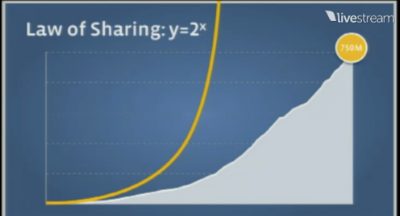
Zuckerberg, possibly feeling a little defensive after a week-plus of early adopters fawning over Google+, possibly the biggest and most direct alternative to Facebook since the network started, focused primarily on the introduction of group chat, anticipated since the Beluga acquisition earlier this year, and the integration of video calling, powered by Skype, also expected. While that particular awesomeness could be debated, more important was the company's shift away from measuring raw user counts - which is mind-boggling at 750 million active accounts, far and away the leader, but pushing more attention on the amount of content shared on the network. Zuckerberg said that number, growing exponentially, ahead of user growth, is now at 4 billion unique items per day.

4 billion. Per day. Just on Facebook.

We know people don't share equally, with a nice 5 or so shares per registered user per day, but as Zuckerberg highlighted, there are more and more ways to update your Facebook stream. It may have started simple, with your interests, but now all manner of application and service can post to your feed, whether you're there or not. You can check in, or tweet in, or upload your photos, or have your blog posted there, and yes, still add status updates, comments, likes and so on. No wonder more updates are happening per person and this number is growing.

Exponential Content Growth on Facebook (Image via TechCrunch stream)

Selfishly speaking, this is why I've highlighted my6sense and teamed up with them for the past year. Zuckerberg highlighted the growth in mobile and the growth in content being shared per person leading to this incredible tsunami of data that shows no sign of decreasing. What this presents to us is, unsurprisingly, a question of quality. Facebook is for many a necessary utility to connect people and act as an online Rolodex. It's a service our parents understand and our little sisters too. Maybe our grandparents and assorted relatives are there too. I know mine are, and I've had to hide a lot of their stuff, trust me.

When Google+ launched, I gave the team kudos for not immediately jumping on the aggregation bandwagon. It is this aggregation and the introduction of so many different ways to update Facebook that has helped power the content numbers, and theoretically decreased your ability to find the best stuff. Google+ is addicting for many of the first users who know that the content was created and shared with them in mind. For Facebook, while they want more than anything to keep you on their site and to keep you engaged, which is working very well, there's a question, especially among the bleeding-edge geeks, as to whether they are spending real time on the network and contributing directly.

Think about two other things Zuckerberg said today. One was that many (he almost said most) people do not make friend requests, but react to them in a passive way. That's been my case as well. Second, he said that groups work when everybody knows who is in the group, typically started by one person who is the ringleader of sorts. This tells me that people, counted in those 750 million users helping post 4 billion items a day, are possibly sleepwalking through the network. They're not working to expand their contact list or to create groups, but reacting to others. This is happening because they're tapped out. They're tapped out on time and on interest. They probably don't want more friends, more connections, more groups because they're already at the point where they're full, and they're often full on the junk food equivalent of content.

Creating new features for 750 million people at once and making it simple enough for your grandparents to use is incredibly difficult, and Facebook made it look pretty simple today in their demos. While not the most advanced, as early comparisons to Google Talk and Google+ pointed out, the goal was simple and successful. Group chat, if it's anything like Beluga, should be a sure win as well. But I continue to worry about the site's ability (and others like it) to accurately discern what the most interesting and relevant updates are for me. They know, just like I've said for a long time, that the amount of content being created and shared is increasing, and is at all time highs. Now, they've delivered to us a number - a new metric to watch, because it's only going to get a lot busier from here.

Billions and billions and billions of pieces of content. Every day. And that's just on one network - a huge one yes, but just one. Impressive.

Disclosure: I am vice president of marketing at my6sense, a Paladin client. Our service supports Facebook streams for relevance.

July 5, 2011

July 5, 2011 · 2 MIN READ · BY LOUIS GRAY

BackType Buy Latest Boost for Twitter Search, Analytics

BackType Buy Latest Boost for Twitter Search, Analytics

This morning, news broke that Backtype, the SF-based, YCombinator founded startup that emerged in 2008 as a blog comments tracker and later pivoted a few times into a professional Twitter analytics company had "gone blue" and joined the mother ship, acquired by Twitter itself. The acquisition is another divider in the haves and have nots for Twitter developers - some who find themselves competing with the realtime short updates giant, and others who find themselves now sporting Twitter badges - TweetDeck included.

The addition brings some a small team of sharp engineers to the growing offices, and expands the company's focus on two pieces that need a lot of help - both search and analytics, though it's most likely the BackType team will be focused on the latter.

Twitter Follower Activity on BackTweets Pro Including Ups and Downs

The company's initial phase, as a comment tracker which let you follow people's engagement on blogs around the Web, was well chronicled here. They were actually listed as the #3 overall new Web service of 2008, and I aggressively predicted they were going to be acquired by the second half of 2009. I even listed Twitter as one of the potential buyers, although my prediction ended up being two years off.

Search Results for "Caylee" Spiking Earlier Today With Influencers, Other Data

After that initial move didn't get the company the traction and/or revenue they hoped, they drafted on the sails of fast-growing Twitter and rebooted with their BackTweets product. In May of this year, they upped the ante with BackTweets Pro, offering detailed analytics for search and user statistics. This appears to have finally been the product offering that gained Twitter's attention. While Twitter has gained a lot in the last few years in stability and UX, the core offerings of the service have been fairly static. Users have had to go to other services to watch individual statistics and see trends on keywords for anything more than a few days. It's surely not a matter of not having the resources or the interest, but it seems to have played a lower priority - something which may change following today's news.

Longtime Twitter watchers also remember 2008 was the time of another acquisition, when they acquired Summize, the basis for today's Twitter search engine, much maligned, but often used. What Twitter has done is learned what pieces of the developer community they can take out like a sniper, and which ones they'd rather not do themselves. Search has never seemed their strength, and we haven't seen many words on making it more fully-featured in a very long time - outside of a lapsed agreement with Google and ongoing relationship with Bing. Considering users aren't making too much noise about it, they've either accepted these shortcomings as long-term realities, or they just don't care. The BackType guys know that companies care about the way their brands are being mentioned or followed, and they just may get their fix from Twitter itself when the products resurface.

July 3, 2011

July 3, 2011 · 1 MIN READ · BY LOUIS GRAY

Google+ Referral Traffic Possible to Track, Unlike Buzz

Google+ Referral Traffic Possible to Track, Unlike Buzz

What is this string? And what could it mean?

Last year's launch of Google Buzz was followed by some blogger navel gazing around how referral traffic from the social network within Gmail was sending negligible traffic. The rub, of course, was that Gmail is served under SSL, and would not be sending back session headers to downstream sites, regardless of click-through volume. So guessing whether Buzz was driving a high or low percentage of traffic relative to other sites was pretty much a guess. In contrast, it is possible to divine traffic from Google+, launched last week, but it's not directly designated, falling under the general Google.com domain.

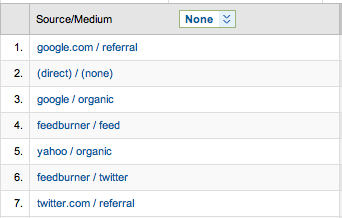
For Google Analytics users, Google+ is not called out as a dedicated site, making its use practically invisible, adding onto the "Google/Referral" statistic, as opposed to "Google/Organic", separating the company's Web apps from native search.

For those viewing raw logs, or using third party tools (like Sitemeter, which I use in addition to Google Analytics, Quantcast and Icerocket, just to overload myself with data), you can see Google+ referrals having the following string:

http://www.google.com/url?sa=z

If you can track how many times visitors come your way with that particular string in their referral, then you can know just how much an impact Google+ is giving you downstream. For me, despite reports from others, I've never gotten much traffic at all from Facebook, and Twitter tends to like a specific type of story, inconsistently. FriendFeed, once my 2nd highest referrer, is practically gone. You get what you give in the social networking space, so no doubt if you participate in G+ (as the cool kids are calling it these days) or you make it part of your flow, you can see it bringing visitors your way.

So watch for that string if you care about this stuff. There's no Gmail excuse this time to obscure transparency.