Silicon Valley Technology Commentary & Archives · Est. 2006 3,045 Posts · 2006–2026

March 19, 2011

March 19, 2011 · 4 MIN READ · BY LOUIS GRAY

For Digg and Other Web Services, 5 Years Can Be a Lifetime

For Digg and Other Web Services, 5 Years Can Be a Lifetime

TechCrunch's Sarah Lacy practically writes an epitaph today for Digg following news that the company's cofounder Kevin Rose, the face of the company since its inception, had resigned to pursue a new and unannounced startup. The backdrop of her story is a detailed article she wrote on Rose and the Digg phenomenon back in 2006, when she, then writing for BusinessWeek, placed Kevin on the cover with a youthful grin and headline blaring how he was worth $60 million.

Almost five years later, Digg is an also ran in the Web news influence space, outpaced by real-time social media tools, and traffic was noted to be trending downward for years. The story, whether it has a happy ending or a crash, epitomizes the short-term paths to success or failure for many Web startups, who expect to launch loud, grow fast, and make it big - often in less time than a single presidential term.

That Kevin had shifted priorities away from Digg some time ago was no secret to those who watched. His investments in a wide array of leading Web companies, from Foursquare and Gowalla to Dailybooth, SimpleGeo, Square, Facebook, Twitter and more must have other angels salivating. His Twitter profile was recently reprioritized to read, "Tech angel investor. Founder of digg.com, wefollow.com." And one can't fault him. As any startup veteran can tell you, years of pushing at a breakneck pace with an insatiable audience can be draining. That he diversified is a smart personal business strategy.

So what of the five years between the $60 million cover and the similarly bold headline of "RIP Digg"? Same people. Same Web site. (Give or take) But a much different story.

Of note, this blog has been running for more than five years, so I can go back to my own reaction to the original story when it broke in August of 2006. At the time, in an article titled, "Digg The Man a Pit To Hide His $60 Million", I picked apart BusinessWeek's assumptions of Digg's valuation, Rose's liquidity and how Rose had become the posterboy for the Web 2.0 movement. I added, "Digg, scarcely known a year ago, in the shadows of Web giants like Slashdot and CNet, has developed organically to be a real kingmaker for all media... But Kevin's not worth $60 million yet. He has a lot of work to do yet to achieve what is a tremendous potential."

What happened after 2006? Twitter launched and Facebook opened up beyond colleges. With Digg seemingly run by an elite group of early adopters who could reach the front page with ease, the common Web user found faster venues to reach many at once, while stories reaching the front page of Digg would take hours. The site seemingly became as hyped for its ability to drive traffic downstream as to provide real value to Web visitors. By 2008, in an article titled "On the Web, If You're Not Growing, You're Dying", I showed how Digg was in a rut after hitting a peak in 2007, placing the site's traffic alongside other floaters, like Technorati and MySpace.

Reaction to the initial BusinessWeek piece was varied, of course. Jason Calacanis complained that the users of Digg would not share from the financial windfall. Om Malik called the headline "Vapor". Meanwhile Steve Rubel compared the cover story to one of Marc Andreesen in Web 1.0 days. Of note, it's interesting that Om, Steve and Jason also are continuing to be visible five years later.

So what else were we talking about back in August 2006? Issues with Microsoft Zune -- check. Topix -- practically invisible these days. The battle for Web privacy. Apple and Google shooting down rumors. Microsoft's Web strategy stumbling. Google launching Apps for your domain. The entrenched retailers trying to stop Apple from adding movies to iTunes. Much of that era sounds familiar, but also quaint.

Five years after the article, Slashdot scarcely comes up any more (though they can still push downstream traffic). Reddit and Hacker News are the hip news submission sites for geeks. Twitter and Facebook are dominant, worth billions. Topix and Technorati are floaters. The time for Digg to make it big seems to have passed, and the only great reason Kevin would have had to stay would be sheer loyalty or inertia. But the Web moves too fast to stay still, and it's obvious the future held more promise than the past, and it was time for him to move.

Five years down the road, I expect this blog to still be publishing. It's probable that Om and Jason and Steve will still be prominent commentators as well. But how we perceive Kevin could be dramatically changed - be it through the value of his next idea or wherever he may pivot next. But think about the other startups out there that have seen well more than their 5th birthday. Are they fading to black or are they ready to lead? Time takes its toll.
March 18, 2011

March 18, 2011 · 2 MIN READ · BY LOUIS GRAY

Finicky iOS Users Rebelling Over Rovio's Angry Birds "Ads"

Finicky iOS Users Rebelling Over Rovio's Angry Birds "Ads"

Mobile app downloaders have come to expect a lot from their apps. iOS reviewers on Apple's iPhone, iPod Touch and iPad platform are notorious for being among the harshest raters across the app store landscape - as likely to drop a single star rating as a glowing five start mark, and practically demanding that advertising be limited to free apps.
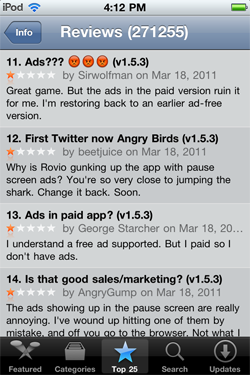
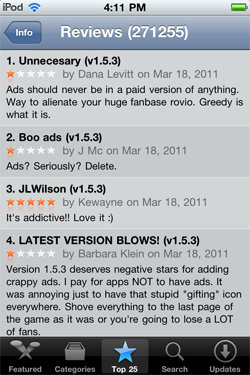
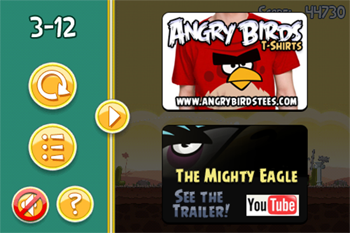
A point upgrade today to the seemingly invincible Angry Birds franchise from Rovio has iOS reviewers up in arms, thanks to in-game house ads that tout other extensions of the brand, from stuffed toys to begging for Facebook likes and YouTube views. The result, the practically permanent high flier has crashed down in a fluff of feathers with a deluge of one-star rants.

As Angry Birds all too excitedly notes in the latest revision of the game, the average rating on the iTunes Store for the app was 4.78 stars out of 5. Users love flicking birds at pigs. It's a given. But with version 1.5.3, the 99 cent app brought ads that appear when the game is paused - just as on the Android platform - and this alone has dropped the franchise into hater territory. The current version is bumping along at an average of 3 stars, rising with each upvote and dropping with each slam, and the stream of comments is mercilessly opposed to this new tactic.

   
A sea of 1 star ads for the latest Angry Birds Update

"Ads should never be in a paid version of anything. Way to alienate your huge fanbase rovio. Greedy is what it is", writes Dana Levitt in her one-star review. 
"Version 1.5.3 deserves negative stars for adding grappy adds. I pay for apps NOT to have ads." piles on Barbara Klein in her one-star missive. 
"... I (like others) am incensed at the barrage of ads when you pause the game," says MadDownpour.
There are many more just like this (as you can see on the iTunes page hosted by Apple).
The Hated Ads Show When the Game is Paused


The one-star ratings for the previously beloved game are plentiful, and the reasoning seems pretty straight forward. Users believe that if they have paid good money, even if it's 99 cents, they deserve to go ad-free, no matter what type of ads those are. Given Rovio is soaring right now, with talk of an IPO, the movie tie-in with Rio, and months in the spotlight, it'll be surprising to see if they are tarnished by ticking off this excitable user base.

As for us on Android? The banner ads are a pain, but you're not charging, so I think we can deal with it.

March 16, 2011

March 16, 2011 · 3 MIN READ · BY LOUIS GRAY

SXSW 2011 "Winners": Foursquare and Hashable

SXSW 2011 "Winners": Foursquare and Hashable


The crowds at the South by Southwest (SXSW) Interactive event in Austin this week were said to be 20-30 percent higher than the previous year, which led to longer lines, more crowded venues, less parking, and far-flung panels and events at hotels well beyond walking distance. Even bigger than the larger crowds were the expectations many people had for startups targeting the show for major visibility and possibly, stardom on the level much glorified with Twitter's rise to public awareness in 2007 and Foursquare's launch in 2009. But the reality of it was that of all the noise one heard before the show and during the show, the old brands seemed to hold serve, and most of the challengers made minor impact.

Two years removed from their buzzy debut, Foursquare doubled down ahead of the SXSW event with version 3.0 of their location app on both Android and iPhone, making the application much more fun than before, and introducing an "Explore" function which promoted trending venues, highlighted a running 7-day leaderboard for friend connections, and smartly added historical data to every checkin, letting you know the last time you were in a space, and marking the first time(s) you had checked in with other friends.

This, combined with a rollout of many challenging to obtain SXSW specific badges, and a large presence with shirts galore and a real foursquare court surrounded by easily approachable Foursquare employees, put the app in front of everyone. For all the talk of group chat, it was Foursquare I saw picked up time and again from venue to venue, leading people to the next destination, to watch as party attendance rose and fell, or to see what was swarming. I look forward to the post-SXSW update from Foursquare that gives the full rundown of statistics, but despite a big push from Google for Google Places and Hotpot, and some work by Gowalla, the LBS world was extremely one sided.

When people were group texting, the usage seemed pretty split, but from what I could tell, there were few converts. Those using GroupMe before the show kept using GroupMe, and those who liked Beluga kept using Beluga. Meanwhile, TextPlus' much larger audience, which I was told is pushing upwards of thirty five million messages a day to eight million accounts, is not the typical SXSW attendee. Yobongo got a fair amount of press for its unique iOS app as well, but lies tangential to the group text space.

The one new application I left SXSW using that I wasn't before, was Hashable. Though skeptical at first about its utility, I sat down with the company's CEO, Mike Yavonditte, and learned more about how the company's service has you checking into people instead of places, and how it could serve not just as your new business contacts database, but as a potential replacement for LinkedIn, acting not just as a repository for former business connections, but one for new links and intros from within your network. As I checked in from place to place with Foursquare, I was also tapping Hashable to say who I was with, who they were and what we were doing. Meanwhile, those in my "inner circle" were doing the same.

Now back home from SXSW, I expect the frenetic pace of checkins and connections to decrease. It's also possible that many of my most important meetings will be noted privately in Hashable, rather than broadcast to the world. Similarly, those confidential introductions I'll do between people might take place outside of the app and in email, until I get a full grasp on what's public and what's private with the world. But this said, Hashable has a place now that is not filled by any competitor, and they're now in my social repertoire.

No one service "blew up" at SXSW and captured the imagination. Beluga sold before the show. Fast Society tried to be visible and you couldn't go too far without tripping over a Chevy, Pepsi Max or some other corporate gimmick. But Hashable is in the vernacular now and may prove very useful, while Foursquare surprised many of us and smartly cemented its position as a major tech leader. They're still young, but they're the kings of their space and should keep it. For what it's worth, I didn't hear a single mention of Facebook Places. Could be the crowd, but I assume if you take something fun, take the personality out of it and flatten it out for the masses, nobody talks about it any more.

March 15, 2011

March 15, 2011 · 2 MIN READ · BY LOUIS GRAY

Your App Is Not Complete Until You Can Tweet from It

Your App Is Not Complete Until You Can Tweet from It

One of the famous mantras around Web services and communication apps is that no service or application is truly complete until it offers private messaging or email. Users practically expect they need to connect one to one or one to many if they are given unique IDs, part of why you can find, outside of your traditional mail systems, ways to email one another on places like LinkedIn, Quora, Twitter, Facebook, FriendFeed and countless other networks, creating a practically endless supply of in boxes that need to be checked.

In that vein, I'd venture that there's some truth to a new extension of that phrase for 2011 and beyond - that no application is complete until you can tweet from it.

Two years ago, as Twitter's ecosystem was finding its legs, the fact that a game would offer users the option to tweet a high score was in itself news. Unsurprisingly, one of the first comments on that post was simply, "Looks like a great way to get people to stop following you..." But since that time, it seems most iPhone and Android games offer the chance to share scores via Twitter. eReaders let you tweet what page you are in for the book you are reading, and music streaming services give you the option to tweet out tracks or artist pages.

With Twitter's update to the official Mac desktop app, a contextual menu option which comes up with every right-click or Control Click is "Tweet". Tweet the words you have highlighted on the screen. Tweet the Web page you are viewing. Tweet tweet tweet. Tweet the YouTube video you just watched. Tweet the Flickr photo you viewed. Tweet the blog post you just wrote. Tweet tweet tweet.

So how much is too much? So far, it doesn't seem like there's really a limit to what is tweetable and what's not. I told the developer of a business card indexing app that he should let users tweet when their jobs start and complete, for example saying, "I just indexed 200 business cards at businessURL.net!". After all, if customers want to share your message, you should make it easier.

Now we have inanimate objects tweeting. Scales tweet your weight. Shoes tweet how far you ran or how many calories you burned at the gym. Location apps tweet everything under the sun, including who you're with and where you are. If an application exists, it can tweet. Unsurprisingly, even this post will automatically get tweeted, and you can tweet it.

Fight the 140 character limit or not, but Twitter is an ecosystem for people, services and bots. If Twitter is to be a channel of your lifestream that shares what you're doing in your life, than all the services you interact with will get a piece of your profile and your stream. If you're developing an app, before you hit publish or ship, think... does it tweet? If it doesn't tweet, maybe you're not done.