I've been watching the buildup around location and check-ins with some level of interest over the last year or so, mixed with some thinly veiled skepticism. While my tendency at times has been to mock the entire practice of reporting one's location from stop to stop, gaining real-time updates on friends' locations, and competing for virtual badges intended to improve one's self-worth, I've for the most part kept quiet about the whole thing - lest I find myself forced to eat my words as I doubled back and used something I might have sworn I would never do.
For the most part, the excitement around
Foursquare,
Gowalla and other similar applications has centered on two elements - the fun, social side that spikes when a group of mostly single friends participates in something like an informal barcrawl in an urban center, such as San Francisco, or the potential for businesses to gain information about their most-frequent customers, returning with favors such as coupons or specials for loyal guests. The expectation is that with time, Foursquare and Gowalla (and their competitors) will gain so many users battling for badges and other privileges that this mass data will become actionable and useful. And for whatever reason, users will continue broadcasting their location, manually or automatically, largely due to game theory and sheer competitiveness.
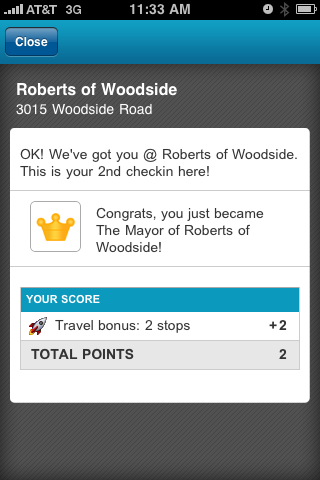

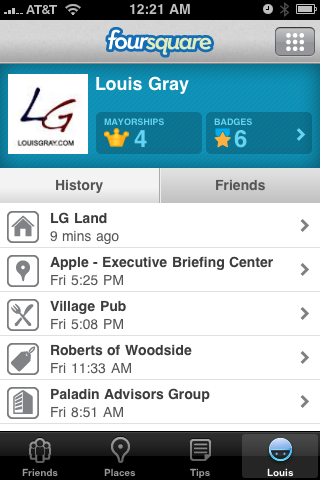 My Scintillating Foursquare History and a New Mayorship!
For me, as I've watched this phenomenon, expecting to be dragged into it kicking and screaming, fingernails digging a rut in the ground, I've always wondered if this is the front of a battle that doesn't have a place for otherwise socially active people like me who happen to be married, don't drink, have kids, and generally don't do much exciting enough to check in at constantly.
In February of 2009, speaking about Brightkite, I said I wasn't using these apps because I was simply too boring, not because of any privacy risk. At the time I joked about checking in to home, church or lunch, or even at a micro-level, checking in from the couch, the fridge, or the kids' room. And after some testing of Foursquare in the last month, that's not too far off from the truth.
As
I've used Foursquare exclusively in the last few weeks, the discussion will largely be framed by my experience there, and your own experience with other apps may differ.
How pervasive is Foursquare?If you read some headlines, you would think it was a phenomenon sweeping the nation, starting with the urban centers, and flowing outward. The company reported it was rapidly advancing toward a million unique users, having grown six figures alone at the recent South by Southwest conference, which I attended in Austin, Texas. But even here in the San Francisco Bay Area, I've routinely found businesses that are unlisted in the service, or have had close to zero activity, a year into the app's existence. I've added restaurants, department stores and office buildings. I even found myself named mayor of a grocery store in upscale Woodside, California after only two visits there in a three-day period.
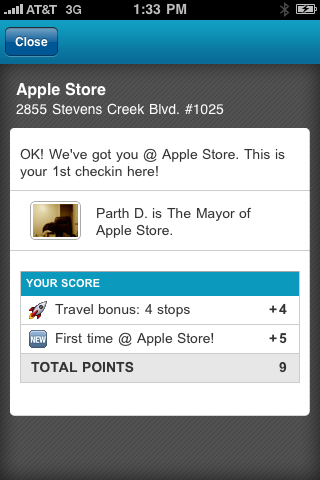
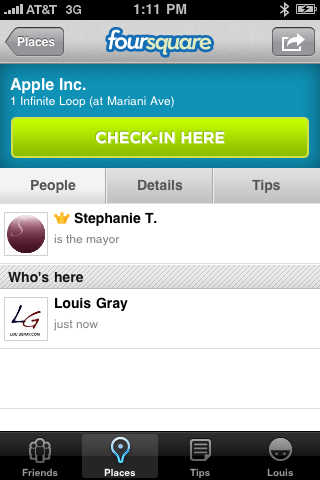 Other Foursquare Users Run the Apple Store and Apple Campus
If the assumption is that Foursquare is growing and being used all over the place, it seemingly hasn't gotten all the way down the peninsula. If San Francisco venues are hard to claim and become Mayor for, it's pretty much a breeze around Woodside, Sunnyvale, Milpitas and Cupertino. And in practically every case where I checked in, I was the only person at that venue, with the exception being the Valley Fair Apple Store Saturday afternoon on iPad launch day.
I can only imagine that as you move further inland toward less populated areas, you could easily be the only person using the app, effectively doing battle with yourself alone.
How accurate is Foursquare?I have read a lot of notes talking about how easy it is to cheat on Foursquare - as people used Web tools to check in across the country, or even scripts to make themselves atop the charts for notable venues worldwide. And if Foursquare were to accurately show where people were, you would see a lot more mundane or even seedy updates. It's a wonder people never check in at strip clubs, laundromats, or adult bookstores. The truth is that many people no doubt sanitize their checkins to present a good face of who they are to their contemporaries.
Meanwhile, checking in to places where you actually haven't set foot is very simple. Foursquare does a very good job guessing your location, and if there are venues in the area, you can pull down and select from the list where you want to check in. This works even if you're driving (so long as the CHP doesn't see you). So, for kicks, I've checked in at places like Hitachi Data Systems or Palm Computing without even slowing down at an intersection. And if you have a frequent route to and from the office, it's possible you can check in enough times at a place on the way to get Mayorship. I've already checked in at the Executive Briefing Center at Apple headquarters in Cupertino twice. I wonder if I keep turning on De Anza from South 280 if I can gain Mayorship without even being invited...
 Only 7 Check-ins From 5 People Made Me The Mayor After 2.
Similarly, my home location, called "LG Land", where I am mayor (Duh), shows one other guy has checked in, who I know has never set foot in my home. It could be he was going quickly and thought it read "Golf Land", for the miniature golf course down the street, but there's no way for me to log into Foursquare and negate his checkin, just like Apple can't kick me out of the records of their EBC.
Also, there are many places where it makes sense not to check in at all - such as friends' residences. We took our kids Easter Egg hunting this afternoon at a couple's home. Rather than add them as a new venue, it made more sense to check in at the park next door to give an idea of where we were, without being 100 percent accurate. Better than nothing?
How Interesting Is Foursquare?Taking into account the above notes on accuracy and the opportunity for cheating, my experience with Foursquare has been much as I had anticipated. I am unsurprisingly mayor not only of my home, but also of Paladin Advisors Group (a new venue) and client offices in the South Bay. I secured mayorship of Robert's in Woodside after two visits, and have checked in multiple times at church, Safeway, gas stations and some parks in the area.
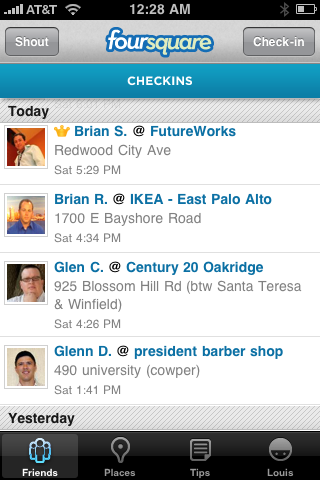
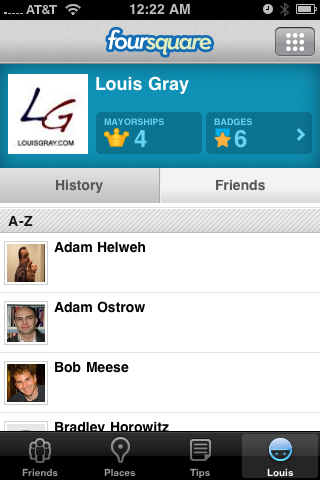 My Foursquare Buds Are Just As Boring As Me
My feed, just like my actual travel history, is therefore pretty uninspiring. That's a major reason I set up a parallel Twitter account (
@lgloco) for Foursquare, rather than muddy my regular feed with those updates. I've tried to avoid self-mockery with the mundane nature of my updates, but instead to give it a fair shake, checking in where I really am, no matter the critical need to broadcast it.
But I'm not the only one. To be honest, the vast majority of your updates aren't that brilliant either - with stops at Ikea, Best Buy and the barber shop being among those I've seen friends update in the last day or so. So where then is the appeal of instant knowledge? I can get why you might want to know if a business is "trending" in an area, or if you guys are at a hot club and I'm not, but may want to join you. But if you're getting your hair cut, I'm not suddenly going to show up and ask for a trim and I'm not going to try and get a bulk rate on make-it-yourself bunk beds at Ikea.
Trust me, there are times where I've thought of Foursquare having real utility. When delayed at the Denver airport on the way to SXSW last month, I wondered if others I knew were in the same airport stuck with me. And I scanned the list of seven folks at the Apple Store Saturday to see if there was anybody I knew. Of course, there wasn't. But these are rare exceptions.
If you want to announce you're at a party with three friends, you can just as easily put a note on Twitter with the user names of your three buds as checking in simultaneously. And keep in mind as a boring married guy with kids, I'd be more likely to check in with my twin toddlers at home than any place else.
So Is It Me Or Is It The App?Despite the above, I'm not resentful of Foursquare and have found some of the mechanisms fairly entertaining. If I don't take myself too seriously, checking in at a Shell station or a Taco Bell or a client site isn't too much trouble and you know I'm always smirking when I do it. And being a numbers and charts guy, I do like scrolling through my stats on Foursquare to see the day I check in the most and averages. Any time you can take activity and turn it into stats or trends, you've got my attention.
 Note More than Half My Checkins Are At New Places
But I am not gaining a ton from the real social aspects of the app. I watch Brian Remmel and Brian Solis go to and from FutureWorks. I watch Denton Gentry and his family check in off the grid presumably around the East Bay. I see random Googlers frequent their favorite restaurants. For the most part, they're as boring as me.
I'm not putting on a curmudgeon's crown and dismissing the app or the trend. It seems to be taking hold, at least for the digerati, and I've wholly embraced similar publicly revealing sites, including Blippy and all the various social networks. I am enjoying being as boring as humanly possible and telling you all about it - because it's more accurate than any facade I could give you. After all, we couldn't be nearly as productive online if we were away from the computer all the time. If I really were out there checking in to bar after bar overnight, it'd be a different story, and a different person outright.
Now, if you don't mind, I need to check in at home. If you think that's interesting, you can find me on Foursquare at
http://foursquare.com/user/lgloco. The "loco" is intentional.
 On Saturday many of my friends and peers stood in line for hours to be among the first to get Apple's newest digital device - the iPad. Some even stayed overnight in the rain. I didn't. I waited all the way until the afternoon to pick up not just one - but two - iPads, one for me, and one ostensibly for my wife and the twins to share. The entire process took about 20 minutes and I didn't have to pull an all-nighter on the sidewalk.
 One of the small aggregation startups that debuted in 2008, but failed to catch on with users, despite a feature-rich and clean interface, was Mergelab, forged by a host of former Jobster executives, including the company's former CTO, Phillip Bogle, and Alan Steele, the company's vice president of engineering. The story of Mergelab was incredibly brief,
  In the company's continued efforts to reduce the impact rising from the initial confusion around